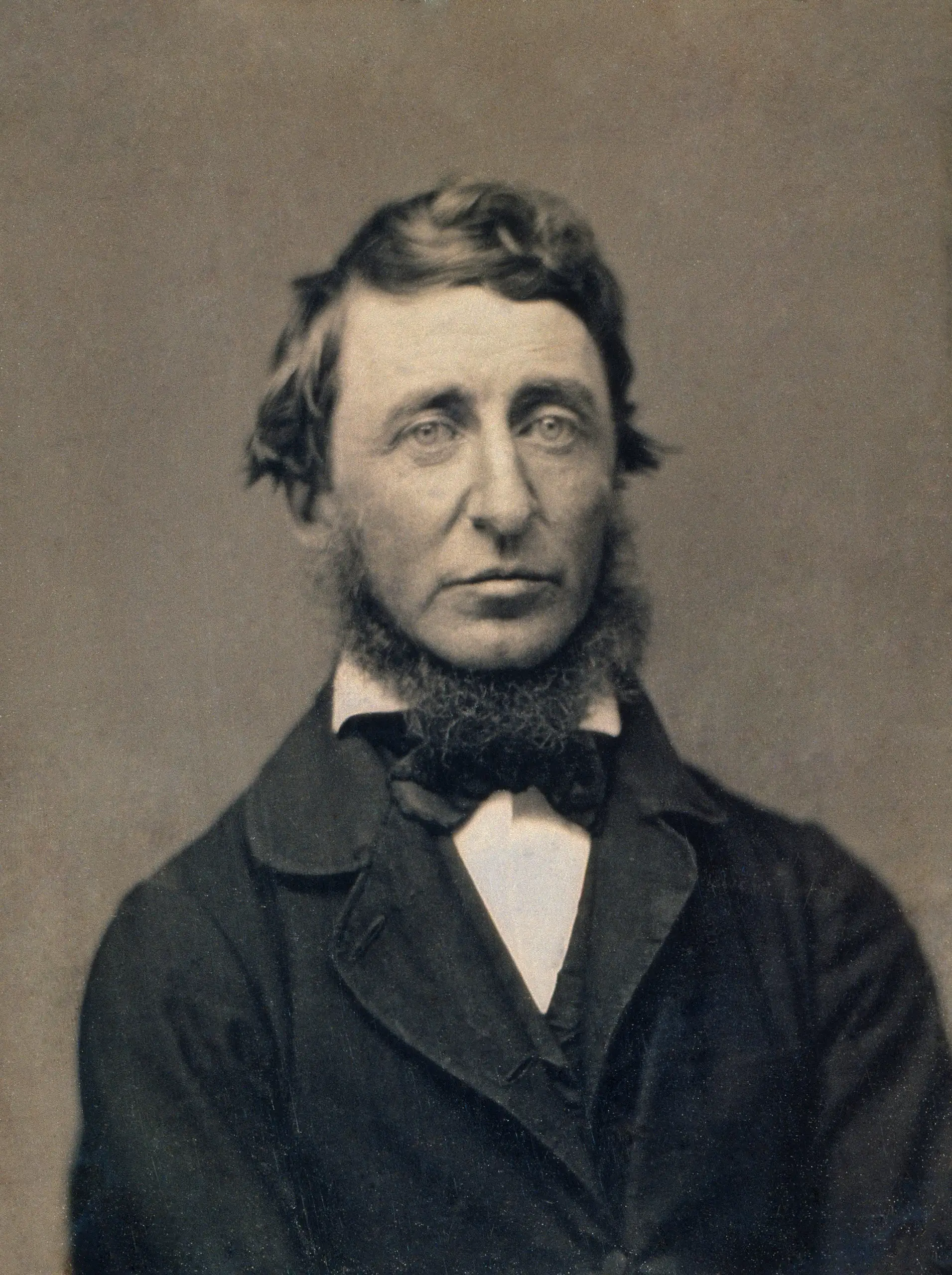
Henry David Thoreau
poet•philosopher•essayist•naturalist
Also known as: David Henry Thoreau, H.D. Thoreau, The Sage of Concord
Birthday
July 12, 1817
Birth Sign
Cancer
Birthplace
Wheeler-Minot Farmhouse, Concord, Massachusetts
Age
Died at 44
Height
5 ft 8 in (173 cm)
About
David Henry Thoreau was an American essayist, poet, philosopher, and naturalist who lived from 1817 to 1862. Born in Concord, Massachusetts, he became a central figure in the Transcendentalist movement alongside Ralph Waldo Emerson. His work combined rigorous observation of the natural world with profound questions about society, government, and individual conscience.
Thoreau is best remembered for Walden, a reflection on simple living published in 1854, and the essay Civil Disobedience, originally titled "Resistance to Civil Government." These works argued that individuals should not allow governments to overrule their consciences and have a duty to avoid allowing such acquiescence to enable the government to make them agents of injustice. His ideas on nonviolent resistance profoundly influenced later leaders like Mahatma Gandhi and Martin Luther King Jr.
Throughout his life, Thoreau worked as a teacher, surveyor, and pencil maker before dedicating himself fully to writing. He spent two years living in a cabin he built near Walden Pond, conducting experiments in self-reliance and recording detailed observations of nature. He died of tuberculosis at age 44, leaving behind a vast collection of journals and manuscripts that continue to shape environmental and political thought today.
Early Life & Background
David Henry Thoreau entered the world on July 12, 1817, at the Wheeler-Minot Farmhouse in Concord, Massachusetts. His father owned a local pencil factory, and his mother managed the household while raising four children. The family moved frequently within Concord during his childhood before settling permanently in a home that would become the backdrop for much of his later life. From an early age, Thoreau displayed a precocious fascination with the natural world, spending hours exploring the woods and ponds surrounding his hometown.
He attended Concord Academy where he excelled in Latin and Greek, developing a classical foundation that would serve him well in his future studies. In 1833, he enrolled at Harvard College, graduating in 1837 with a Bachelor of Arts degree. Although he found the formal curriculum limiting, he was deeply influenced by the emerging Romantic and Transcendentalist ideas circulating in Boston at the time. After graduation, he briefly taught at the Concord Academy but resigned after one year because he refused to administer corporal punishment to students.
Following his departure from teaching, Thoreau worked various jobs including tutoring and manual labor. In 1841, he moved into the home of Ralph Waldo Emerson, serving as a tutor, editor, and handyman. This period marked his deep immersion in the Transcendentalist circle, where he developed close friendships with other intellectuals. During these years, he began experimenting with writing and philosophy, laying the groundwork for his most famous works.
Career Growth
Thoreau's professional trajectory shifted dramatically in 1845 when he moved to a small cabin he built himself near Walden Pond. For two years, two months, and two days, he conducted an experiment in simple living, observing the local ecology and documenting his experiences. This period produced the material that would become his most famous book, Walden; or, Life in the Woods, published in 1854. The book offered a detailed account of his time in the woods and served as a critique of modern society's obsession with material wealth.
In 1849, he published "Resistance to Civil Government" in Aesthetic Papers, an essay arguing for individual moral authority over unjust state laws. The piece gained widespread recognition under its later title, Civil Disobedience, and became a foundational text for nonviolent resistance movements worldwide. Throughout the 1850s, Thoreau engaged in extensive lecturing tours across New England, often discussing his experiences at Walden and his views on slavery and abolition.
His commitment to social justice led him to defend John Brown following the raid on Harpers Ferry in 1859. Thoreau delivered lectures supporting Brown, which contributed to his arrest and brief imprisonment. In 1861, he published A Week on the Concord and Merrimack Rivers, a memoir of a boat trip he took with his brother John in 1839. He continued writing and lecturing until his death from tuberculosis on May 6, 1862, in Concord.
Career Timeline
Public Image & Style
Thoreau is portrayed as the quintessential sage of simplicity and integrity. His aesthetic is associated with rustic clothing, wooden cabins, and a deep connection to the natural world. Media portrayals emphasize his role as a proto-environmentalist and a champion of individual conscience. His tone is consistently serious, reflective, and challenging, urging readers to question societal norms.
Modern interpretations often highlight his relevance to contemporary issues like climate change and minimalist living. While popular culture sometimes portrays him as a hermit who hated people, historical records show he was deeply engaged with his community. His image has evolved from a solitary thinker to a symbol of resistance against unjust systems and a guide for sustainable living.
Fame & Fandom (iFAMOUS Rankings)
Henry David Thoreau remains a towering figure whose influence stretches far beyond the quiet cabin he built near Walden Pond, anchoring modern conversations on simplicity and conscience. The iFANN Global Fame Rankings have not yet collected data for this person, so his precise standing is unranked in the latest August 2026 data collection. Despite this absence from numerical lists, his cultural footprint is anything but negligible, sustained by a community that treats his writings as living doctrine rather than mere historical artifacts. There is no formal fandom name for this devoted group, as the concept of a celebrity fanbase does not fit a man who died in 1862 and famously shunned the spotlight. Instead, his adherents are scholars, environmentalists, and philosophical seekers who organize through institutions like The Thoreau Society and the Walden Woods Project rather than social media campaigns or interactive fan clubs. These followers engage in rituals of personal reflection, often visiting Walden Pond to measure snow depth or practicing civil disobedience, actions that serve as their version of collective worship. The resonance of his work has surged recently, with reports indicating deep engagement among Chinese youth and new interpretations in contemporary documentaries, proving his ideas adapt effortlessly to changing times. His legacy is defined not by viral moments or crowd-surfing adoration, but by the enduring power of two specific chapters: his experiment in self-sufficiency at Walden and his night in jail for refusing to pay a poll tax. These verified events have evolved into global folklore, inspiring movements led by figures like Mahatma Gandhi and Martin Luther King Jr., ensuring that his voice continues to challenge societal norms long after his final words about good sailing were spoken. While he lacks the celebrity mythology of modern stars, the intensity of his intellectual impact creates a unique form of fame where the audience is measured in generations influenced rather than votes cast.
Interesting Facts and Legends
The most defining chapter of Thoreau's life was his two-year experiment in simple living at Walden Pond, where he resided to document self-sufficiency and nature. This period produced his seminal book, Walden; or, Life in the Woods, which symbolizes the rejection of materialism. Another pivotal moment occurred when he spent a night in jail for refusing to pay a poll tax, an act of protest against the Mexican-American War and slavery that inspired his famous essay "Civil Disobedience." This text later became a cornerstone for non-violent resistance movements led by figures like Mahatma Gandhi and Martin Luther King Jr.
Thoreau also possessed a reputation for rigorous scientific observation, famously venturing out into blizzards to measure snow depth, a habit that reinforced his image as a dedicated naturalist willing to face extreme conditions for truth. In August 1851, he witnessed a fire near Walden Pond that destroyed much of the forest, an event he recorded to illustrate the resilience of nature and the destructive power of humanity. Though he died of tuberculosis, folklore often attributes his final words as "Now comes good sailing," a phrase that captures his calm acceptance of death and adds to the mythos of the man who lived too fully for his time.
Notable Quotes
“I went to the woods because I wished to live deliberately, to front only the essential facts of life, and see if I could not learn what it had to teach, and not, when I came to die, discover that I had not lived.”
“Under a government which imprisons any unjustly, the true place for a just man is also a prison.”
“The mass of men lead lives of quiet desperation.”
“It is not enough to be busy... The question is: What are we busy about?”
“If you have built castles in the air, your work need not be lost; that is where they should be. Now put the foundations under them.”
Family & Personal Life
Henry David Thoreau was born into a working-class family in Concord, Massachusetts. His father, John Thoreau, owned a pencil factory, while his mother, Cynthia Dunbar Thoreau, managed the household. He had two siblings: a brother named John Thoreau, who died in 1842, and a sister named Sophia Thoreau. Sophia played a crucial role in managing his estate after his death and promoting his work to the public.
The family moved frequently within Concord before settling permanently. Thoreau maintained a close bond with his sister throughout his life, and she remained a significant presence in his daily activities. His relationship with his brother John was particularly close, and John's death in 1842 deeply affected him. Thoreau never married and had no children, dedicating his life entirely to his intellectual pursuits and his family.
Notable Connections
Relationships & Dating History
Henry David Thoreau never married and had no documented romantic relationships or children. Throughout his life, he remained single, dedicating himself entirely to his intellectual pursuits, his family, and his close friendships with the Transcendentalist community. While he maintained a close bond with his sister Sophia Thoreau, who managed his estate after his death, there is no historical evidence of a wife, fiancée, or long-term partner.
His diaries contain references to fleeting attractions and observations of women, but these were never acted upon in the form of committed relationships. Consequently, his status at the time of his death was single, and he left no heirs. Thoreau's personal life was characterized by his commitment to solitude and intellectual freedom, which he prioritized over conventional domestic arrangements.
Death & Aftermath
Died
May 6, 1862 (aged 44)
Death Place
Concord, Massachusetts, USA
Cause of Death
Tuberculosis (consumption)
Henry David Thoreau died on May 6, 1862, at the family home on Main Street in Concord, Massachusetts. He had battled a long-term respiratory illness known as consumption for several years, with his condition likely worsened by pneumonia or bronchitis shortly before his passing. His final days were spent confined to bed under the care of his sister Sophia and his parents, marking the end of a life dedicated to rigorous observation and simple living. Public reaction centered on deep mourning within the Transcendentalist community rather than public spectacle. Ralph Waldo Emerson delivered a eulogy at the funeral service held three days later at the Old Burying Ground, now Sleepy Hollow Cemetery. Emerson's words acknowledged Thoreau's unique character, while contemporaries like William Ellery Channing Jr. offered tributes praising his integrity.
The aftermath focused on preserving his literary voice through posthumous publications managed by his family. Sophia Thoreau oversaw the release of significant works including Excursions in 1863 and The Maine Woods in 1864. These releases, alongside his journals and letters, sparked renewed interest in his writings and ensured his ideas on civil disobedience and nature reached a wider audience. The estate was handled quietly without controversy, eventually dissolving as his works entered the public domain. His legacy has since been amplified by modern documentaries and foundations bearing his name, though the immediate post-death era was defined by personal grief and the careful curation of his unpublished manuscripts. The Thoreau Edition continues to publish his correspondence today, keeping his intellectual contributions alive for future generations.
Net Worth (Estate Value)
$0
iFANN Editorial Team estimate
As a deceased historical figure from the 19th century, Thoreau does not have a traditional net worth in the sense of liquid assets. His estate value is represented by the ongoing revenue generated by his intellectual property and legacy. The Henry David Thoreau Society and various publishers hold rights to his works, generating income through royalties from publications of his journals, letters, and books.
While many of his texts are now in the public domain in various jurisdictions, the brand of Thoreau continues to generate significant revenue through educational materials, documentaries, and tourism to Walden Pond. The final volume of his correspondence was published in February 2026 by the University of California Press, indicating continued scholarly and commercial interest. His estate has earned millions over the last century through continuous publication and licensing deals for adaptations.
The iFANN Editorial Team's analysis of Thoreau's enduring legacy and posthumous earnings points to an estimated estate value that reflects the ongoing cultural and economic impact of his work. His writings remain standard reading in schools globally, ensuring steady demand for his publications and related merchandise.
Awards & Accolades
View 12 records, honours and achievementsKnown For
Walden
1854 · Author
Civil Disobedience
1849 · Essayist
A Week on the Concord and Merrimack Rivers
1861 · Author
Keywords
Sources
Quick Facts
- Profession
- poet, philosopher, essayist, naturalist
- Born
- July 12, 1817
- Birthplace
- Wheeler-Minot Farmhouse, Concord, Massachusetts
- Died
- May 6, 1862
- Death Place
- Concord, Massachusetts
- Gender
- Male
- Birth Sign
- Cancer
- Height
- 5 ft 8 in (173 cm)
Personal Details
- Full Name
- David Henry Thoreau
- Height
- 5 ft 8 in (173 cm)
- Children
- Education
- Harvard College (B.A., 1837), Concord Academy
Frequently Asked Questions
What is Henry David Thoreau best known for?
Did Henry David Thoreau ever get married?
How did Henry David Thoreau die?
Who was Henry David Thoreau's mentor?
Is Henry David Thoreau still relevant today?
Similar People
Join the community
fans discussing