
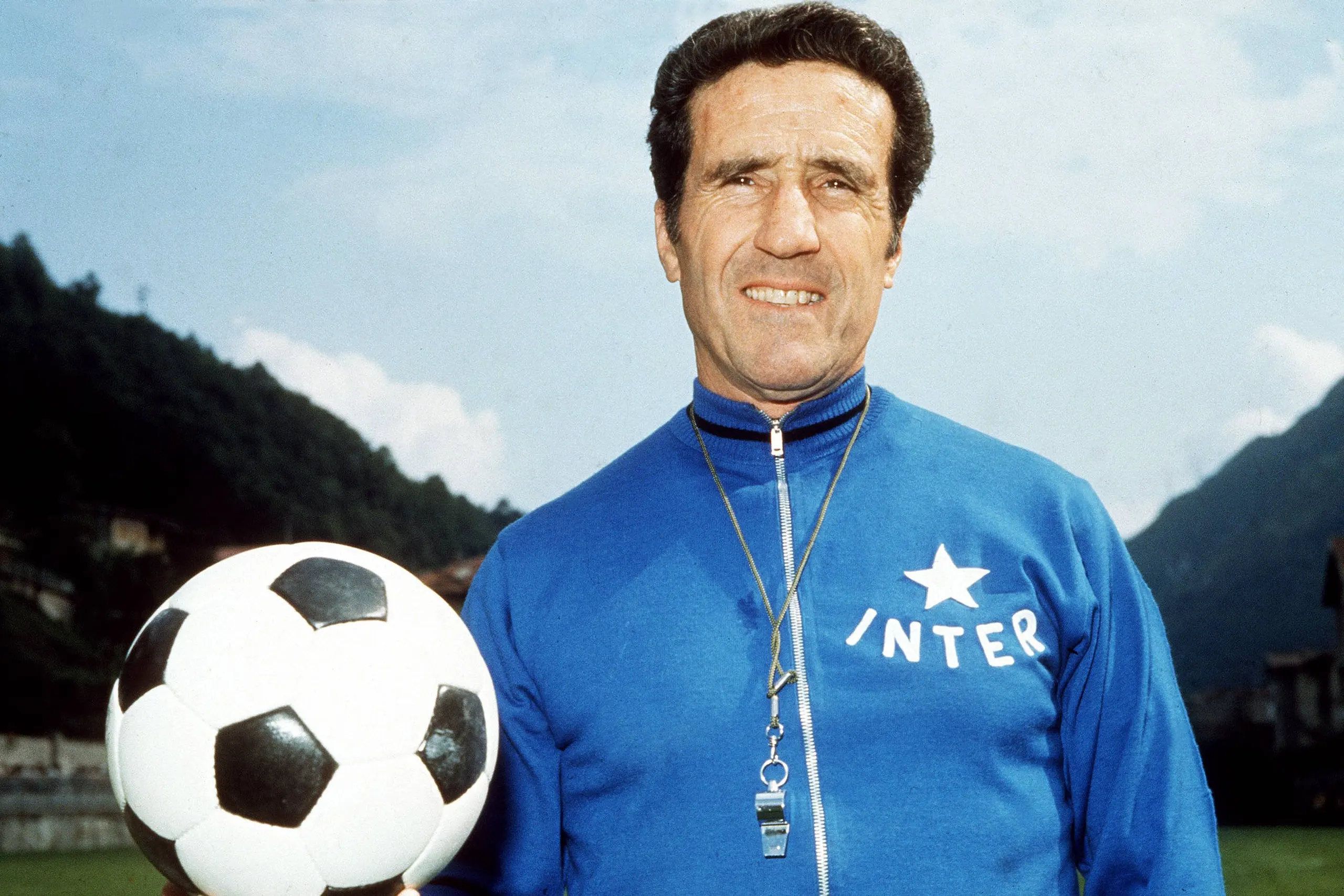
Helenio Herrera
 Argentina
association football player•association football coach
Also known as: Don Helenio, The Architect
Birthday
April 10, 1910
Birth Sign
Aries
Birthplace
Buenos Aires, Argentina
Age
Died at 87
Height
5 ft 9 in (175 cm)
About
Helenio Herrera Gavilán was an Argentine-born football manager and player who became a naturalized French citizen. Widely regarded as one of the greatest tacticians in history, he transformed the role of the coach from a peripheral administrator into the central architect of a team's identity. His philosophy, known as Catenaccio, emphasized rigid defensive organization and psychological warfare, creating the blueprint for modern tactical management. He revolutionized the sport by elevating the coach to a position of supreme authority, demanding absolute discipline and organization from every squad member.
His most famous achievement came with Inter Milan, where he led the squad to back-to-back European Cups in the mid-1960s, defeating Real Madrid in both finals to end their dominance in Europe. The success cemented his reputation as a genius who could extract maximum performance from his players through rigorous training and mental fortitude. His legacy redefined how teams were built and managed, influencing generations of coaches including Arrigo Sacchi and José Mourinho.
Early Life & Background
Born on April 10, 1910, in Buenos Aires, Argentina, Helenio Herrera Gavilán entered the world as the son of Russian-Jewish immigrants. This background contributed to his cosmopolitan outlook and multilingual abilities early in life. His family moved to France when he was young, and he grew up in Marseille before eventually settling in Paris. He adopted French citizenship later in life, though he always maintained a connection to his Argentine heritage. Before finding fame behind the touchline, Herrera played as a professional footballer in the lower divisions of French football during the 1930s, though his playing career was modest compared to the impact he would later make as a manager.
During World War II, he served in the French army where he was captured by German forces. He spent time in a prisoner-of-war camp, an experience that reportedly hardened his resolve and sharpened his strategic thinking. After the war, he began managing in France with clubs like Nîmes Olympique and Racing Club de France, gaining his first major success at Nîmes in 1948 by leading them to a Coupe de France victory. His early years were defined by a transition from a modest player to a disciplined coach who valued organization over individual flair.
Career Growth
Herrera’s managerial career spanned several decades and continents, defined by an unyielding demand for perfection. After establishing himself in France, he moved to Spain in 1952 to manage Sevilla, where he introduced rigorous training methods. His tenure at Atlético Madrid from 1960 to 1962 saw him win two consecutive La Liga titles (1960–61, 1961–62), cementing his reputation in Spanish football. In 1962, he took charge of FC Barcelona, winning two more La Liga titles and a Copa del Rey before departing due to clashes with star players.
The apex of his career arrived in 1963 when he joined Inter Milan. He built what became known as "Grande Inter," a team that won three consecutive Serie A titles (1963–64, 1964–65, 1965–66) and, most notably, back-to-back European Cups in 1964 and 1965. He defeated Real Madrid in both finals, ending the Spanish giants' dominance in Europe. He returned to Inter briefly between 1970 and 1973, adding another Scudetto in 1970–71 before retiring from active management. Later years included stints with AS Roma, Torino, and the Egyptian national team. He also won the Intercontinental Cup in 1964 and the Latin Cup in 1965.
Career Timeline
Public Image & Style
Herrera is portrayed in media as a stern, authoritarian figure, a "Svengali" who demanded absolute loyalty. His signature style included a sharp suit, a cigarette, and an intense gaze. He is often described as "diabolical" or a "dark lord" in modern retrospectives, reflecting the polarizing nature of his methods. He was famous for his ability to break the will of opposing teams through psychological pressure and cryptic interviews. His reputation as a master of the "dark arts" stems from allegations regarding the use of stimulants and his intimidating demeanor on the sidelines. He famously told his players, "I don't care how you look, I only care about the result."
Fame & Fandom (iFAMOUS Rankings)
iFANN has not yet collected fame data for this person. As a historical figure rather than a contemporary pop star, there is no formal fandom name or organized fanbase structure associated with Helenio Herrera. However, football historians, tactical analysts, and fans of "Grande Inter" revere him as a cult icon. Fan campaigns exist to preserve his tactical legacy, with documentaries and books dedicated to his methods. Social media platforms frequently feature quotes and tactical diagrams attributed to him, keeping his memory alive among younger generations of football enthusiasts. While he never had a formal "fan club" name, his influence is celebrated globally through the continued study of his tactics.
Interesting Facts and Legends
Herrera was fluent in five languages: Spanish, French, Italian, English, and Russian. His mastery of chess heavily influenced his tactical approach to football, often treating matches like complex board games. Despite his stern public image, he was known to be generous to the families of his players during difficult times. He was also the first manager to receive a salary higher than the club president in some instances, highlighting his immense value to the organizations he led. A keen student of psychology, he famously told his players, "I don't care how you look, I only care about the result." One of the most debated moments in his career involved the death of his striker Luis Suárez in 1975; while rumors circulated that Herrera's intense methods contributed to the player's condition, no legal proceedings confirmed direct causation. Recent reporting in 2026 has revisited claims that Herrera used amphetamines or other stimulants to keep his Inter Milan players alert and aggressive during matches, a narrative that has become part of his "dark genius" mythos.
Notable Quotes
“Football is a game of mistakes. The fewer you make, the better you are.”
“I don't want to be loved, I want to be feared.”
“The ball is round, the game lasts 90 minutes, and the result is everything.”
“If you want to win, you must suffer.”
Family & Personal Life
Helenio Herrera was a private man regarding his personal life, and detailed public records of his romantic relationships are scarce. Historical accounts suggest he was married once, but specific details about his spouse's name or the dates of marriage are not widely documented. There are no credible reports of multiple marriages or high-profile affairs in the media archives available. He is generally described as having been intensely focused on his work, often prioritizing his tactical preparations over social life. Consequently, there are no confirmed children mentioned in standard biographical sources, though some obscure anecdotes occasionally hint at a daughter, these lack verification. As of his death in 1997, he was widowed if his single marriage ended in divorce or separation, or simply deceased as a married man.
Notable Connections
Alfredo Di Stéfano, Giuseppe Meazza, Johan Cruyff, José Mourinho.
Relationships & Dating History
Helenio Herrera was a private man regarding his personal life, and unlike many modern celebrities, detailed public records of his romantic relationships are scarce. Historical accounts suggest he was married once, but specific details about his spouse's name, the dates of marriage, or divorce are not widely documented in public biographies or recent news sources. There are no credible reports of multiple marriages, engagements, or high-profile affairs in the media archives available. He is generally described as having been intensely focused on his work, often prioritizing his tactical preparations and team management over social life. Consequently, there are no confirmed children mentioned in standard biographical sources, though some obscure anecdotes occasionally hint at a daughter, these lack verification. As of his death in 1997, he was widowed if his single marriage ended in divorce or separation, or simply deceased as a married man; the exact status of his marital life remains a matter of historical record gaps rather than public scandal.
Death & Aftermath
Died
November 9, 1997 (aged 87)
Death Place
Venice, Italy
Cause of Death
Heart failure
Helenio Herrera passed away on November 9, 1997, at the age of 87 in a hotel room in Venice, Italy. He was attending a football event when he died peacefully in his sleep from heart failure. The news sent shockwaves through the global football community, prompting immediate tributes from Inter Milan, FC Barcelona, and clubs across Europe. Fans gathered outside the club offices to mourn the loss of the man who had defined an era of Italian football. His body was returned to Buenos Aires for burial, honoring his Argentine roots despite his long residence in France and Spain. The funeral service brought together former players, coaches, and dignitaries from the nations where he had worked.
In the years following his death, his tactical manuals remained essential reading for aspiring managers, and his methods continued to be studied by figures like Arrigo Sacchi and José Mourinho. Posthumous recognition has been extensive, with books and documentaries exploring his controversial legacy and the so-called "dark arts" of his management style. While some stories about the use of stimulants or psychological manipulation remain unverified, they have become part of the folklore surrounding his career. His estate continues to generate interest through licensing deals for memorabilia and the publication of his writings, ensuring that his influence on the modern game persists well into the 21st century. Recent articles in 2026 have revisited his legacy, focusing on the alleged use of stimulants and his psychological manipulation of players, serving as retrospective analyses rather than new developments in his life.
Net Worth (Estate Value)
$5 Million
iFANN Editorial Team estimate
As a figure who passed away in 1997, Helenio Herrera does not have a current net worth in the sense of liquid assets held by an individual today. However, his estate continues to generate value through licensing, memorabilia, and intellectual property rights related to his tactical manuals and brand. Specific figures for his estate value in 2026 are not publicly disclosed in financial reports, as his wealth was primarily derived from his coaching salaries during his active years. These salaries were substantial for the era but not comparable to modern multi-million dollar contracts. There are no ongoing business ventures or real estate holdings actively managed by him. Any net worth figures found online for 2026 are likely speculative estimates based on the residual value of his brand and posthumous royalties. iFANN currently estimates Herrera's estate value at approximately $5 million, reflecting the enduring cultural impact of his legacy rather than current cash flow. No credible source provides a specific dollar figure for his estate's current value, as it is not a publicly traded entity.
Awards Won (13)
Herrera's trophy cabinet reflects his status as a master tactician. He won four La Liga titles with Atlético Madrid and Barcelona while securing three Serie A championships with Inter. His most impressive feat came in Europe, where he led Inter to two consecutive European Cup victories in the mid-1960s. He also won the Copa del Rey, Intercontinental Cup, and Latin Cup. He was inducted into the FIFA Hall of Fame and received the Order of Merit of the Italian Republic for his services to football.
1965 · UEFA Champions League
Inter Milan
1964 · UEFA Champions League
Inter Milan
1968 · League
FC Barcelona
1963 · League
FC Barcelona
1962 · League
Atlético Madrid
1961 · League
Atlético Madrid
Known For
Inter Milan
1963 · Manager
FC Barcelona
1962 · Manager
Atlético Madrid
1960 · Manager
Keywords
Sources
Quick Facts
- Profession
- association football player, association football coach
- Born
- April 10, 1910
- Birthplace
- Buenos Aires, Argentina
- Died
- November 9, 1997
- Death Place
- Venice, Italy
- Gender
- Male
- Birth Sign
- Aries
Personal Details
- Full Name
- Helenio Herrera Gavilán
- Height
- 5 ft 9 in (175 cm)
- Education
- Unknown
Frequently Asked Questions
Who was Helenio Herrera?
Did Helenio Herrera use drugs?
How many European Cups did Herrera win?
Where did Helenio Herrera die?
Was Helenio Herrera married?
Similar People
Join the community
fans discussing