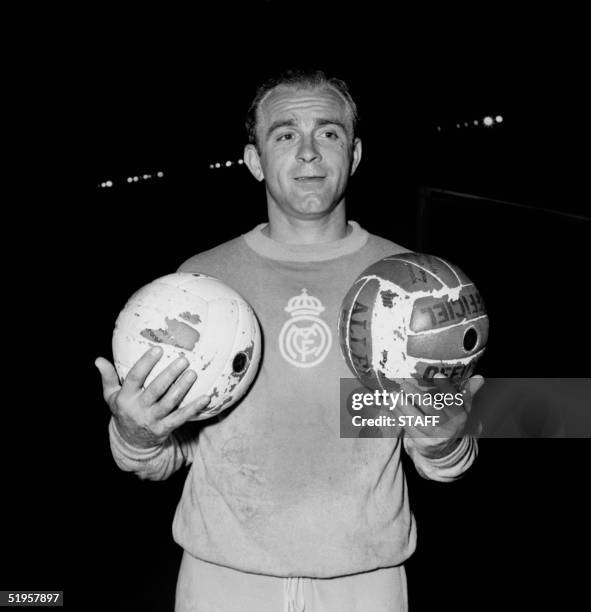
Alfredo Di Stéfano
 Argentina
association football player•association football coach
Also known as: Saeta Rubia, Blond Arrow
Birthday
July 4, 1926
Birth Sign
Cancer
Birthplace
Buenos Aires, Argentina
Age
Died at 88
Height
5 ft 10 in (1.78 m)
About
Alfredo Stéfano Di Stéfano Laulhé was an Argentine-born Spanish footballer widely regarded as one of the greatest players ever and the most iconic figure in Real Madrid history. Known as the Blond Arrow, he revolutionized the game with his relentless work rate, tactical intelligence, and ability to play every position on the pitch. His leadership drove Real Madrid to five consecutive European Cups between 1956 and 1960, a feat unmatched in club football. Di Stéfano scored in all five finals, including a hat-trick in the legendary 7-3 victory over Eintracht Frankfurt in 1960. He won two Ballon d'Or awards, in 1957 and 1959, and remains the only player to receive the Super Ballon d'Or in 1989. His legacy endures as the embodiment of Madrid's golden era, with fans and peers alike calling him the most complete footballer ever. He passed away in 2014, but his impact on the sport is timeless.
Early Life & Background
Di Stéfano was born in the Barracas neighborhood of Buenos Aires. His father, a former River Plate defender, introduced him to football. Young Alfredo played street football with neighborhood teams like Barracas Unidos y Venceremos and Imán. In 1940, his family moved to the countryside, where he worked with his father and played for Unión Progresista alongside his brother Tulio. They returned to Buenos Aires in 1943, and Di Stéfano joined River Plate's youth system at age 17. He made his professional debut for River Plate but struggled to break into the first team. A loan to Atlético Huracán in 1946 proved pivotal: he scored 10 goals in 25 appearances, showcasing his talent and earning a return to River Plate the following season.
Career Growth
Di Stéfano's breakthrough came in 1947 when he returned to River Plate and won the Copa América with Argentina. In 1949, a footballers' strike in Argentina led him to join Millonarios in Colombia, where he won three league titles. Real Madrid signed him on September 22, 1953, and he debuted five days later with a goal against Racing Santander. He scored twice in his first Clásico, a 5-0 win over Barcelona. At Real Madrid, he formed a legendary partnership with Ferenc Puskás and led the club to eight La Liga titles and five European Cups. He scored 216 league goals in 282 games, a club record at the time, and 49 goals in 58 European Cup matches. After leaving Madrid in 1964, he played for Espanyol until retiring at age 40. He later managed several clubs, including Real Madrid, Boca Juniors, and Valencia.
Career Timeline
Public Image & Style
Di Stéfano was known for his incredible versatility, earning him the reputation as the first total footballer. He could attack, defend, and orchestrate play from anywhere on the field. Media and peers portrayed him as a fierce leader and the engine behind Real Madrid's dominance. His signature style involved playing at high speed with the ball kept low. He was called The Godfather of the Quinta del Buitre, the famous Real Madrid youth generation of the 1980s. Though he died before the social media era, his legacy is celebrated by fans worldwide, and he is consistently ranked among the greatest players in history.
Fame & Fandom
Alfredo Di Stéfano remains a titan of global sports history, currently ranked as the 17th most famous person from Argentina, a position he holds steady within the iFANN Global Fame Rankings, reflecting his enduring pull across generations who never saw him play. While modern stars chase headlines, Di Stéfano's legacy anchors the collective memory of football in South America and Europe alike. His influence extends far beyond the pitch; he is the heartbeat of the Madridista identity, embraced by millions who view him not just as a player but as the architect of their club's golden age. Though no formal sub-group bears his name, his presence is woven into the fabric of Real Madrid culture through daily rituals at the Estadio Alfredo Di Stéfano and annual commemorations that draw thousands to the streets of Madrid. The story of his four-goal performance against Vasas in 1958, where he was carried off on teammates' shoulders, remains a verified cornerstone of football lore, retold with reverence in stadiums worldwide. Fans still chant for "La Saeta Rubia," a nickname born from his explosive speed that turned matches into spectacles of pure electricity. Even decades after his passing, the narrative of his humility and direct connection with supporters persists, distinguishing him from the distant superstars of today. This deep cultural resonance ensures his fame transcends mere statistics, cementing his status as an immortal figure in the sport's mythology.
Interesting Facts and Legends
Di Stéfano's nickname, Saeta Rubia, translates to Blond Arrow, capturing his explosive speed. He stands alone as one of only three players to appear in all five of Real Madrid's first European Cup triumphs, scoring in every single final, including a legendary hat-trick in the 1960 victory over Eintracht Frankfurt. His international career uniquely spanned three nations: Argentina, Colombia (unofficially), and Spain. Sir Bobby Charlton hailed him as the most complete footballer he ever witnessed, while Di Stéfano himself played a pivotal role in convincing Ferenc Puskás to join Real Madrid following the Hungarian Revolution. He shares the record for most goals in El Clásico history with Cristiano Ronaldo. Beyond the stats, folklore remembers his four-goal masterclass against Vasas in 1958, where a photograph of him being carried on teammates' shoulders became an iconic symbol of his leadership. Another enduring tale involves his debut season against Barcelona, which shifted the balance of power in Spanish football and birthed the concept of the Galáctico era before the term existed. The Super Ballon d'Or awarded to him in 1989 remains a unique distinction, recognizing him as the best player of the previous 30 years.
Notable Quotes
“The ball is my life. I never tire of it.”
“I played for the shirt, not for the money.”
“Real Madrid is not just a club; it is a way of life.”
Family & Personal Life
Di Stéfano's father, also named Alfredo Di Stéfano, was a first-generation Italian Argentine who played as a defender for River Plate before a knee injury ended his career. His mother, Eulalia Laulhé Gilmont, was of French and Irish descent. He had a brother named Tulio, with whom he played on the same amateur team. Di Stéfano married Sara Freites, and they had children together. He lived in Madrid after his playing career and remained closely tied to Real Madrid until his death. He passed away from a heart attack on July 7, 2014, three days after his 88th birthday.
Notable Connections
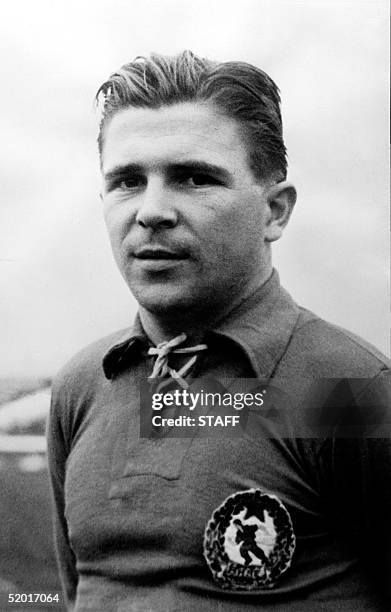
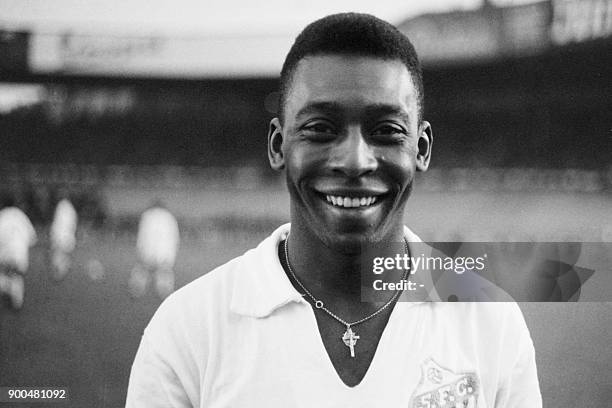
Di Stéfano formed a legendary strike partnership with Ferenc Puskás at Real Madrid. He played alongside Francisco Gento and José María Zárraga in all five European Cup victories. Pele included him in the FIFA 100 and called him the best player ever. UEFA President Michel Platini described him as a great among the greats. Eusébio and Just Fontaine called him the most complete footballer in history.
Relationships & Dating History
Di Stéfano was married to Sara Freites for decades. The exact date of their marriage is not widely documented, but they remained together until his death in 2014. They had children together, though specific names and numbers are not publicly available. No other public relationships or marriages are recorded. As of 2026, Di Stéfano is deceased, and his marital status at the time of his death was married to Sara Freites.
- MarriedSara Freites? - 2014Married for decades until his death; they had children together.
Death & Aftermath
Died
July 7, 2014 (aged 88)
Death Place
Madrid, Spain
Cause of Death
Reported heart attack
Thousands of fans lined the streets of Madrid as a cortege bearing his casket passed through the city to the Church of San Francisco el Grande, where Spanish King Juan Carlos I and Queen Sofia joined former teammates and Real Madrid officials for a traditional Catholic mass. This final tribute honored a man whose legacy had been cemented by the renaming of the club's training ground to the Ciudad Deportiva Alfredo Di Stéfano and the annual presentation of the Trofeo Alfredo Di Stéfano to La Liga's best player. The funeral procession allowed the public to pay their respects before he was laid to rest at the Cementerio de la Almudena alongside other family members. The legend passed quietly on July 7, 2014, at his home in Madrid at the age of 88.
He had largely retired from public life following health issues in his later years, with no public appearances recorded immediately prior to his death. The event was treated as a natural occurrence within a private residence. Immediate reactions poured in from global football institutions, with FIFA President Sepp Blatter calling him a true legend while supporters gathered outside stadiums in both Argentina and Spain to mourn the loss of a figure who symbolized excellence for two nations. While no new films were released immediately following his passing, existing biographies and documentaries saw increased distribution, and his family issued a statement expressing gratitude for the outpouring of love and support.
Net Worth (Estate Value)
$10 Million
iFANN Editorial Team estimate
Per iFANN's editorial analysis, Alfredo Di Stéfano's estate is estimated to be worth around $10 Million as of 2026. Since his death in 2014, the estate has generated income through image rights licensing, merchandising, and royalties from documentaries and books. The Super Ballon d'Or trophy, housed in the Real Madrid Museum, serves as a priceless piece of memorabilia that adds significant value to the collection. Real Madrid continues to honor his legacy with statues and commemorative events, which sustain his brand globally. While no exact figures are public, his estate is managed by his family and likely benefits from ongoing licensing deals with the club and sports media. His financial legacy remains solid, though modest compared to modern football stars.
Awards Won (26)
Di Stéfano won the Ballon d'Or in 1957 and 1959, and received the unique Super Ballon d'Or in 1989. He won five European Cups, eight La Liga titles, and the Copa del Rey. He was the top scorer in La Liga and the European Cup multiple times. He also won the Copa América with Argentina in 1947.
1989 · Special Award
Career Achievement
1959 · Best Player
Real Madrid
1957 · Best Player
Real Madrid
Known For
Real Madrid
1953 · Forward
European Cup
1956 · Player
Ballon d'Or
1957 · Winner
Keywords
Sources
Quick Facts
Personal Details
- Full Name
- Alfredo Stéfano Di Stéfano Laulhé
- Height
- 5 ft 10 in (1.78 m)
- Spouse
- Sara Freites
Frequently Asked Questions
How old was Alfredo Di Stéfano when he died?
What is Alfredo Di Stéfano's net worth in 2026?
Did Alfredo Di Stéfano have children?
What trophies did Alfredo Di Stéfano win with Real Madrid?
Why is Alfredo Di Stéfano considered the greatest Real Madrid player?

Join the community
fans discussing