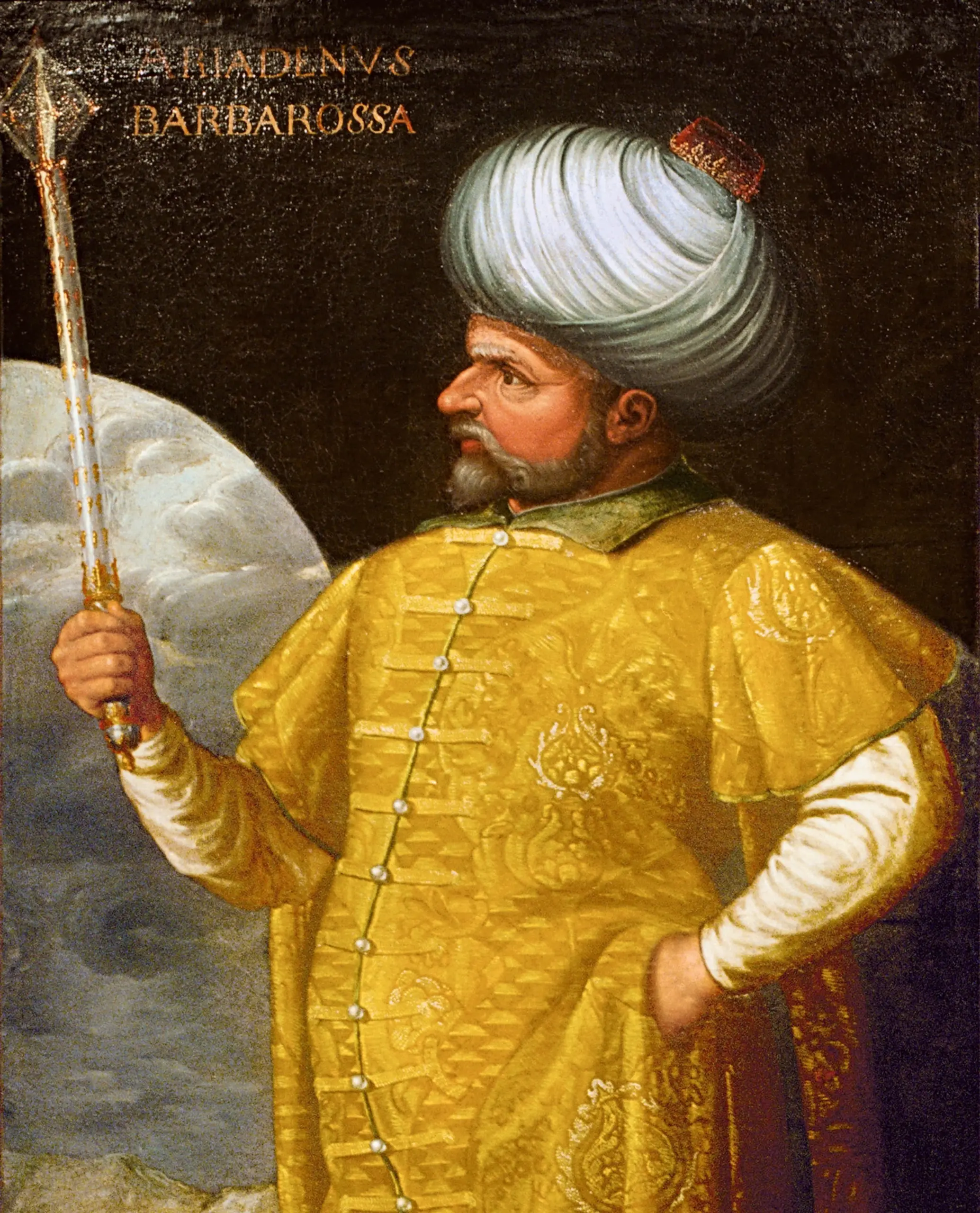
Hayreddin Barbarossa
Ottoman admiral•corsair•Beylerbeyi of Algiers•Kapudan Pasha
Also known as: Hızır Reis, Khizr, Barbaros Hayreddin Paşa, Redbeard
Birthday
1478
Birth Sign
Capricorn
Birthplace
Bonova, Lesbos (Mytilene), Ottoman Empire (modern Gera, Greece)
Age
Died at 68
About
Hayreddin Barbarossa was an Ottoman corsair and admiral who became Kapudan Pasha, grand admiral of the Ottoman Navy, and the man most responsible for turning the Mediterranean into an Ottoman sea in the sixteenth century. Born on the island of Lesbos as Khizr, he inherited the nickname Barbarossa, Italian for redbeard, from his elder brother Oruç, along with the fleet and the base at Algiers. His given name was later joined by the honorific Hayreddin, meaning goodness of the faith, bestowed by Sultan Suleiman.
He is best known for the Battle of Preveza on 28 September 1538, where his fleet defeated the Holy League under Andrea Doria and effectively broke the naval power of the Habsburg-led coalition for decades. That victory, along with his earlier capture of Algiers in 1516 and Tunis in 1534, made him the central figure in Ottoman naval expansion. He also ran joint campaigns with France in the 1540s against their common Habsburg enemy. He died in Constantinople on 4 July 1546, still in office, at roughly sixty-eight.
Fans of Ottoman and Mediterranean history know him as the corsair who turned freelance raiding into an instrument of empire, and his name still marks Turkish naval tradition. His chief rival at sea was Andrea Doria, and his patron was Suleiman the Magnificent, who gave him the fleet and the rank that let a Barbary raider become a grand admiral. He is not to be confused with Frederick I Barbarossa, the Holy Roman Emperor, a separate figure entirely.
Early Life & Background
Khizr was born on Lesbos, then Ottoman territory, in the village of Bonova, the modern Gera municipal unit. His birth date is disputed: sources give 1466, 1478 or 1483, and the honest answer is that we do not know. His father, Yakub Ağa, was a Turkish sipahi or potter, though some sources call him Albanian, who settled on the island after the Ottoman conquest of 1462. His mother, Katerina, was a Greek Orthodox Christian widow from Mytilene, sometimes described as a priest's daughter. The four surviving sons, Oruç, Ishak, Khizr and Ilyas, all went to sea. Greek sources sometimes claim the family was of Greek origin and converted, while Turkish tradition insists on Turkish paternal descent. This is the single most-disputed point in his biography and should be presented as contested rather than settled.
Before fame, Khizr worked as a sailor and trader, then joined his brother Oruç in the corsair trade. The pivotal moment came around 1502 to 1510, when Oruç's ship was wrecked off Euboea and Ilyas was killed. Oruç was captured by the Knights of St John and held as a galley slave for roughly three years before Khizr helped ransom him. From then on the brothers operated as a single raiding enterprise, moving their base westward to the Barbary Coast. By 1512 to 1515 they had established themselves at Djidjelli and then Jijel and La Goulette, raiding Spanish and Genoese shipping and ferrying Muslim refugees from Spain to North Africa. These were the years that taught him the western Mediterranean, its currents, its harbors and its shipping lanes, and they built the reputation on which everything later rested. The stage was set for the capture of Algiers in 1516, which would change everything.
Career Growth
The breakthrough came in 1516, when the brothers captured Algiers from Spain and Oruç declared himself Sultan of Algiers. Two years later, in 1518, Oruç was killed in battle against Spanish forces at Tlemcen. Khizr inherited the fleet, the nickname Barbarossa, and the Algiers base. He formally offered Algiers to Sultan Selim I and was made Beylerbeyi of Algiers. In 1529 he drove the Spanish out of the Peñón of Algiers, the fortress commanding the harbor, a key step in securing the city.
Suleiman the Magnificent summoned him to Constantinople in 1533 and appointed him Kapudan Pasha, grand admiral of the Ottoman fleet. That same year he was sent on a diplomatic mission to France. In 1534 he captured Tunis, though it was lost again to Charles V's 1535 expedition. In 1537 he campaigned in the Adriatic and Ionian with the French against the Habsburgs, raiding Venetian possessions. Then came 28 September 1538 and the Battle of Preveza, where he defeated the Holy League fleet under Andrea Doria. It was a decisive Ottoman naval victory and his signature achievement. Through the 1540s he ran joint Franco-Ottoman campaigns, including the relief of Nice in 1543 and operations along the Italian and Spanish coasts. In 1545 he retired to Constantinople with a palace on the Bosphorus.
Preveza effectively broke the Holy League's naval power and gave the Ottomans the upper hand at sea for decades. Barbarossa is credited with converting freelance corsair raiding into a state instrument of empire and with building the Ottoman navy into a Mediterranean power. He also trained and sponsored the generation of admirals who followed him, among them Turgut Reis and Piri Reis, who carried his methods forward.
Career Timeline
Public Image & Style
In Turkish tradition, Barbarossa is the pious warrior-admiral, the founder of naval power, a figure invoked by presidents and commemorated in television serials. In older European sources he is the terror of the Mediterranean, the king of pirates, a red-bearded scourge. Both images have stuck. His signature aesthetic in art is the turban, the red beard, and the Ottoman admiral's galley with its distinctive striped sail and crescent flags. The Barbarossa flag, red with a crescent and a sword, circulates widely online, often without context.
Modern depictions tend to emphasize his strategic genius and his role in state-building rather than his corsair past, though the debate over glorifying Ottoman pirates continues. In Greece, his name carries a different charge, and Erdoğan's 2026 Preveza message was read there as provocative. An Art Institute of Chicago woodcut, Sinan Reis and Hayreddin Barbarossa, keeps circulating as a cultural artifact and shapes how later audiences picture him. He remains a contested figure, which is part of why he still matters.
Fame & Fandom (iFAMOUS Rankings)
iFANN has not yet collected fame data for Hayreddin Barbarossa, so no ranking is available. He is a figure from the sixteenth century, and the modern fame engine does not measure him. He is also not on the September 2026 iFAMOUS Rankings flagship list. His fame is historical and cultural rather than contemporary, carried by navies, television serials and political rhetoric rather than by search traffic or social media followings.
There is no organized fandom in the modern sense, no fandom name, no fan campaigns or birthday projects. The nearest equivalent is the audience around the Turkish TV serials Barbaroslar: Akdeniz'in Kılıcı (2021) and Barbaros Hayreddin: Sultanın Fermanı (2022 to 2023), which generated press interest, including an Ertuğrul actress publicly awaiting the release and an Indian-perspective review in Daily Sabah. History enthusiasts and naval buffs discuss him on forums and in documentaries, but there is no formal fanbase. His name lives on in Turkish naval tradition, in the seismic vessel Barbaros Hayreddin Paşa, and in the occasional coffee shop or bar, which is a different kind of afterlife than a fandom.
Interesting Facts and Legends
His flagship was the galley Baştarda, and the name Barbaros lives on in Turkish naval tradition. He spoke Turkish, Greek, Italian, Spanish and Arabic, a polyglot corsair by any measure. The name Barbarossa was his brother's first: Oruç was the original Redbeard, and Khizr inherited it after Oruç's death in 1518. The red beard itself became the defining physical attribute in European depictions, though no contemporary portrait confirms its exact shade, and his height is unrecorded entirely.
No verbatim quotation survives from Barbarossa himself in the standard sources, so direct speech attributed to him should be treated with suspicion. The most-cited line about him is modern: Erdoğan's 2026 characterization that he turned the Mediterranean into a Turkish sea. His honours were all contemporaneous, the title Hayreddin, the office of Kapudan Pasha and the Beylerbeyi rank, and he predates awards ceremonies, magazine covers and rankings by four centuries. Modern Turkish naval vessels and even a seismic research ship carry his name, a legacy that has outlasted every empire in the region.
Family & Personal Life
His father, Yakub Ağa, was a Turkish sipahi or potter, though some sources say Albanian, who settled on Lesbos after the Ottoman conquest of 1462. His mother, Katerina, was a Greek Orthodox Christian widow from Mytilene, sometimes described as a priest's daughter. The four surviving sons were Oruç, Ishak, Khizr and Ilyas. Ilyas was killed around 1510 when Oruç's ship was wrecked off Euboea, Oruç was killed in battle at Tlemcen in 1518, and Ishak died in battle in Anatolia. Khizr, the future Barbarossa, outlived all his brothers.
His own household is poorly documented. No wife's name is reliably recorded in the standard reference sources, though some later Turkish popular accounts name one without corroboration. He is generally described as having had a son, Hasan Pasha, who succeeded him as governor of Algiers and later served as Kapudan Pasha, and a daughter. The family lived between Algiers and Constantinople, with Barbarossa's later years spent in a palace on the Bosphorus. Oruç was both brother and mentor, the elder who took Khizr to sea and whose nickname and enterprise passed to him in 1518.
Notable Connections
His brother Oruç Reis was his mentor and partner; Suleiman the Magnificent was his patron; Andrea Doria was his chief rival at Preveza; Charles V was his Habsburg adversary; his son Hasan Pasha succeeded him as governor of Algiers and later Kapudan Pasha. Turgut Reis and Piri Reis carried on his naval tradition, and Francis I of France was his ally in the 1540s.
Relationships & Dating History
Documented romantic relationships for Hayreddin Barbarossa are essentially absent from the historical record. No wife's name is reliably recorded in the standard reference sources, and there is no record of a marriage date, a divorce, or a widowhood. Some later Turkish popular accounts name a wife, but these are not corroborated by encyclopedic sources and should be treated as unverified. There is no documented romantic history in the modern celebrity sense, no named mistresses, no recorded marriage dates. Stating that clearly is more accurate than inventing partners. The question of his wife's name is among the most-searched about him, which is precisely why the silence of the sources needs saying plainly. As of 2026 he has been deceased for nearly five centuries, and his status at death was married, though to whom is unknown.
Death & Aftermath
Died
July 4, 1546 (aged 68)
Death Place
Constantinople (Istanbul), Ottoman Empire
Cause of Death
Unknown
What is known about the death of Hayreddin Barbarossa is thin, and the sources say so plainly. He died on 4 July 1546 while still holding the office of Kapudan Pasha, grand admiral of the Ottoman fleet. His final years were spent in Constantinople, where he had a palace on the Bosphorus, and it is there that his death is placed. No cause of death is reported in any of the standard accounts. Nothing survives describing his last days, his final public appearance, or the circumstances of his passing. Because his birth year is variously given as 1466, 1478 or 1483, his age at death can only be stated as somewhere in his sixties or seventies.
No account of the funeral survives either. The record does not give its date, its location, whether it was public or private, who attended, or where he was buried. Ottoman practice and his rank make burial in Istanbul plausible, but that is inference rather than documentation, and it should be treated as such. Contemporary tributes and memorials tied specifically to his death are likewise unrecorded.
What followed was a commemorative and political afterlife rather than a funerary one. On 28 September 2026, President Recep Tayyip Erdoğan marked the anniversary of the Battle of Preveza with a post declaring that Barbarossa had turned the Mediterranean into a Turkish sea, a message Greek outlets covered as provocative. Turkey's first seismic research vessel carries the name Barbaros Hayreddin Paşa and continues on missions. A coffee chain in the Houston area opened a second shop in 2020, a San Francisco bar borrowed the name in 2015, and a 2022 Middle East Forum piece debated Turkish glorification of Ottoman pirates, a reminder that his image remains contested.
Net Worth (Estate Value)
$0
iFANN Editorial Team estimate
Hayreddin Barbarossa died in 1546, four centuries before modern celebrity net worth was a concept. No estate, royalties, licensing revenue or intellectual property income exists for him in any meaningful sense. The modern commercial and media use of his name, from the seismic vessel Barbaros Hayreddin Paşa to a Houston coffee chain and Turkish television serials, is not an estate and does not generate income for descendants. Any figure for his net worth in 2026 would be fabricated. iFANN's editorial research places his financial relevance at zero in modern terms, and the honest answer is that his wealth was contemporary: a fleet, a palace on the Bosphorus, and the revenues of the Kapudan Pasha office, none of which survive as measurable assets. His true legacy is strategic and cultural, not financial.
Awards & Accolades
View 6 records, honours and achievementsKnown For
Battle of Preveza
1538 · Ottoman commander
Capture of Algiers
1516 · Corsair commander with Oruç Reis
Kapudan Pasha of the Ottoman Navy
1533-1546 · Grand admiral
Capture of Tunis
1534 · Ottoman commander
Keywords
Sources
Quick Facts
- Profession
- Ottoman admiral, corsair
- Born
- c. 1478 (disputed: 1466 or 1483)
- Birthplace
- Bonova, Lesbos
- Died
- July 4, 1546
- Death Place
- Constantinople (Istanbul)
- Gender
- Male
- Children
- Hasan Pasha (son), one daughter
Personal Details
- Full Name
- Khizr bin Yakub
- Children
- Hasan Pasha (son), one daughter
Frequently Asked Questions
What was Hayreddin Barbarossa known for?
What was Hayreddin Barbarossa's ethnicity?
Why was Hayreddin called Barbarossa?
Was Redbeard a real pirate?
What was Hayreddin Barbarossa's wife's name?
Similar People
Join the community
fans discussing