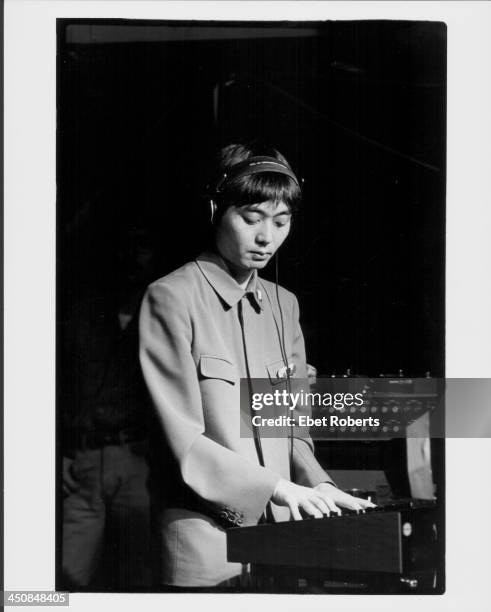
Haruomi Hosono
 Japan
JapanMember of Yellow Magic Orchestra
musician•singer-songwriter•record producer
Also known as: Harry Hosono
Birthday
July 9, 1947
Birth Sign
Cancer
Birthplace
Minato, Tokyo, Japan
Age
79 years old
About
Haruomi Hosono is a Japanese musician, singer-songwriter and record producer whose restless creativity has reshaped Japanese pop music across five decades. He is famous for founding Happy End, a band that proved Japanese-language rock could be artistically and commercially viable, and Yellow Magic Orchestra, a trio that fused synthesizers, drum machines and sly humor into a sound that anticipated synth-pop, techno and countless electronic genres. YMO became global stars, and Hosono emerged as the group's conceptual anchor. Hosono has scored films for Studio Ghibli, composed in-store music for Muji, and produced albums for artists ranging from Miharu Koshi to Seiko Matsuda. In the 2010s and 2020s, a new generation discovered his work: Harry Styles named his 2022 album Harry's House after Hosono's 1973 solo debut Hosono House. Still active and ever-curious, Hosono remains a quiet giant whose influence reaches from Tokyo's underground to the pop charts of the West.
Early Life & Background
Haruomi Hosono, born on July 9, 1947, in Minato, Tokyo, Japan, experienced a childhood deeply influenced by Western culture. His home environment was notably shaped by American sensibilities, particularly through his mother's profound love for Hollywood films and music. Young Hosono himself spent countless hours captivated by the sounds emanating from FEN (Far East Network), the US military radio station, which exposed him to a vast and diverse world of Western popular music. As he progressed into his teenage years, his musical interests solidified around the vibrant, psychedelic rock sounds pioneered by American bands such as Moby Grape and Buffalo Springfield. He not only listened intently but also actively covered their songs, performing them in English. This pervasive early immersion in American culture led Hosono to later reflect that he felt thoroughly Americanized, even expressing a poignant regret about not having been born an American himself.
Hosono's professional foray into the music world began in the late 1960s as a bassist for Apryl Fool, a psychedelic rock band that garnered a following during its active period. After the eventual dissolution of Apryl Fool, Hosono quickly became a central figure in the formation of Happy End. This groundbreaking new group set out with an ambitious and somewhat controversial goal: to unequivocally prove that rock music could be performed in the Japanese language, not just as a novelty, but as an art form that was both artistically profound and commercially successful. This bold gamble paid off handsomely; Happy End's albums are now universally recognized as foundational documents that dramatically shaped the landscape of Japanese rock music. Crucially, it was during this highly experimental and formative period with Happy End that Hosono also began his pioneering work with the Ace Tone rhythm machine, an early drum machine whose distinctive sound would soon become a recognizable hallmark of his innovative and evolving musical style.
Career Growth
In 1978 Hosono released his solo album Paraiso with the Yellow Magic Band, a group that included session musicians Yukihiro Takahashi and Ryuichi Sakamoto. The project was meant to be a one-off, but the chemistry was undeniable. Hosono named the group Yellow Magic Orchestra as a sarcastic dig at Western exoticism, and their self-titled debut became an international sensation. YMO pioneered the use of the Roland MC-8 Microcomposer, samplers, and the Vocoder VP-330, and tracks like Behind the Mask caught the attention of Michael Jackson.
After YMO disbanded in 1983, Hosono plunged into ambient music. He launched the labels Yen, Monad, and Non-Standard, releasing Mercuric Dance in 1985 and a series of albums he called sightseeing music. He scored Nausicaä of the Valley of the Wind (1984) and composed Watering a Flower for Muji stores. In the 1990s he founded daisyworld discs, and in the 2000s he formed Sketch Show with Takahashi, later inviting Sakamoto to perform as Human Audio Sponge. His 2019 New York show at Gramercy Theatre was his first US performance in decades, and his influence on Harry Styles brought him a new wave of attention in 2022.
Career Timeline
Public Image & Style
Hosono is widely regarded as one of the most influential figures in Japanese pop music, a pioneer who helped shape city pop, Shibuya-kei, and electronic music. The media portrays him as an ever-curious artist who never repeats himself, shifting from psychedelic rock to folk to electronic to ambient without missing a beat. Fans admire his quiet, cerebral approach and his willingness to let the music speak for itself. His Instagram and Twitter accounts, run by his team, share archival photos and updates, but Hosono himself maintains a low public profile. There is no official fandom name, but his work inspires deep devotion among crate diggers and electronic music enthusiasts worldwide.
Fame & Fandom (iFAMOUS Rankings)
Haruomi Hosono is the 46th most famous person in J-Pop / J-Rock, a standing that reflects his enduring status as a foundational architect of modern Japanese sound. This ranking, which tracks global attention across media coverage, search, and consumption signals worldwide, places him just ahead of many contemporaries who have faded from the mainstream conversation. His position in the iFANN Global Fame Rankings underscores a career that has seamlessly bridged decades, from the psychedelic rock of Happy End to the electronic futurism of Yellow Magic Orchestra and his recent resurgence with new studio work.
While Hosono maintains a quiet, cerebral public persona, his audience is a passionate, organic collective rather than a formalized club with a specific moniker. Fans are deeply invested in the revival of City Pop and Shibuya-kei, often tracing these genres directly back to Hosono's pioneering solo albums like Paraiso. The community acts as cultural ambassadors, actively preserving his legacy through digital archives and academic analysis, ensuring his influence on artists ranging from Daft Punk to Harry Styles remains visible. Recent announcements regarding his 2026 album Yours Sincerely and performances at venues like Radio City Music Hall have sparked renewed streaming campaigns, proving that his fanbase continues to drive interest in his catalog long after its initial release. There are no documented fan rituals or specific named campaigns unique to him, but the sheer dedication to keeping his music alive in a digital age speaks volumes about the respect he commands.
Interesting Facts and Legends
Haruomi Hosono's life is marked by fascinating historical connections and personal quirks. His paternal grandfather, Masabumi Hosono, holds the distinction of being the only Japanese passenger to survive the sinking of the Titanic in 1912. A near-fatal bout of food poisoning during a trip to India later inspired the creation of his acclaimed album Cochin Moon. In a moment of friendly rivalry, Hosono met Kraftwerk's Ralf Hütter in 2014; Hütter was reportedly annoyed to discover Hosono was born a year later, complaining about being the oldest. During his time with Yellow Magic Orchestra, Hosono was known for bringing a computer programmer onstage, an early innovation in live electronic performance. He remained the oldest member of YMO and among his friends from the Happy End days.
Legendary stories surround his role as the primary architect of Yellow Magic Orchestra, where he united Ryuichi Sakamoto and Yukihiro Takahashi to create a sound that predated the global synth-pop explosion. Fans often retell the narrative of his rediscovery in the 2010s, where vinyl hunters unearthed his work, turning him into a cult icon overnight. More recently, his announcement of the album Yours Sincerely at age 79 has cemented his legend as an eternal innovator who continues to create masterpieces well into his eighth decade.
Notable Quotes
“I was thoroughly Americanized, I even regretted that I wasn't American.”
“We were disconnected from our own roots. Traditional Japanese music, like Shamisen and Shakuhachi, I knew nothing about it.”
“Session work was all fusion... still a time when music couldn't be made without musicians.”
Family & Personal Life
Hosono's maternal grandfather was a piano tuner, and his mother was deeply into music and Hollywood films. His paternal grandfather, Masabumi Hosono, was a Japanese railway bureaucrat who survived the Titanic sinking. Hosono has kept his personal household life private; no information about a spouse, children, or current living situation is publicly documented.
Notable Connections
Hosono's closest collaborators include Yukihiro Takahashi and Ryuichi Sakamoto, his bandmates in Yellow Magic Orchestra and later in Sketch Show and Human Audio Sponge. He frequently worked with guitarist Shigeru Suzuki, keyboardist Hiroshi Satō, and drummer Tatsuo Hayashi on early solo albums. As a producer, he shaped the sound of Miharu Koshi, Sandii & the Sunsetz, Chisato Moritaka, and Seiko Matsuda. He also collaborated with Yōsui Inoue and Osamu Kitajima in the 1970s.
Relationships & Dating History
Salary, Net Worth In 2026
$20 Million
iFANN Editorial Team estimate
Per iFANN's editorial analysis, Haruomi Hosono's net worth in 2026 is estimated at $20 million. This substantial figure stems from a diverse portfolio accumulated over a fifty-year career. As a founding member of Yellow Magic Orchestra, he generates significant royalties from their extensive catalog, including classic releases like Yellow Magic Orchestra (1978) and Solid State Survivor (1979), alongside ongoing revenue from reissues and licensing deals for films, commercials, and video games. His solo discography, particularly the ambient and exotica records released via his daisyworld discs label, provides steady income through vinyl reissues and streaming platforms. Hosono has also secured substantial fees for his production work, crafting albums for major Japanese talents such as Seiko Matsuda, Chisato Moritaka, and Miharu Koshi. His composition Watering a Flower, commissioned by Muji for in-store playback, adds another layer to his earnings. Contributions to film scores, including Studio Ghibli's Nausicaä of the Valley of the Wind, further bolster his financial foundation. Renewed interest in his work during the 2010s and 2020s, driven by endorsements from contemporary artists like Harry Styles, has significantly boosted catalog sales and streaming numbers. Despite living modestly and avoiding the spotlight, his wealth rests on a library of music that consistently finds new listeners.
Awards & Accolades
View 2 records, honours and achievementsKnown For
Hosono House
1973 · Solo album
Paraiso
1978 · Solo album
Mercuric Dance
1985 · Ambient solo album
Nausicaä of the Valley of the Wind
1984 · Soundtrack contributor
Watering a Flower
1984 · Muji in-store composition
Keywords
Sources
Quick Facts
- Profession
- musician, singer-songwriter, record producer
- Born
- July 9, 1947
- Birthplace
- Minato, Tokyo, Japan
- Gender
- Male
- Birth Sign
- Cancer
Personal Details
- Full Name
- Haruomi Hosono
Frequently Asked Questions
How old is Haruomi Hosono?
What bands was Haruomi Hosono in?
What is Haruomi Hosono's net worth in 2026?
Is Haruomi Hosono married?
Does Haruomi Hosono have children?

Join the community
fans discussing