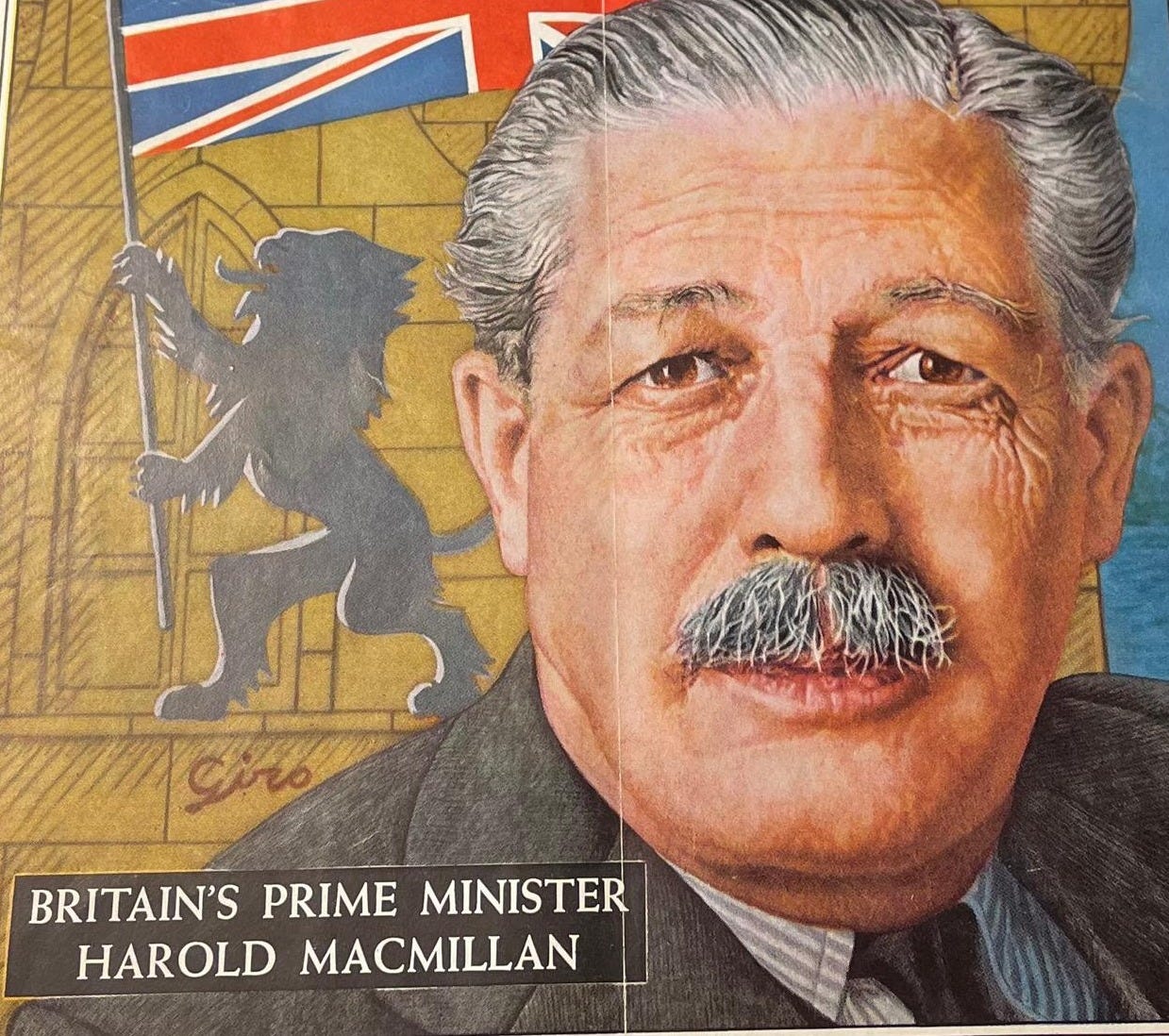
Harold Macmillan
politician•diplomat•military personnel
Also known as: Maurice Harold Macmillan, Earl of Stockton, Supermac
Birthday
February 10, 1894
Birth Sign
Aquarius
Birthplace
Chelsea, London
Age
Died at 92
About
Maurice Harold Macmillan served as the Prime Minister of the United Kingdom and Leader of the Conservative Party from January 1957 to October 1963. Nicknamed "Supermac," he is remembered for his pragmatism, wit, and his famous declaration that the nation had "never had it so good." A veteran of both World Wars who carried a lifelong disability from a shrapnel wound in 1917, he rose from a privileged background to become one of the most influential British leaders of the 20th century. He is best known for his management of decolonization in Africa, where he delivered the historic "Wind of Change" speech, and his navigation of Cold War tensions alongside US President John F. Kennedy during the Cuban Missile Crisis.
His tenure as Prime Minister was marked by significant domestic prosperity and a shift in foreign policy toward African independence. Despite facing the Profumo scandal and health issues that eventually forced his resignation, he left an enduring legacy as a statesman who navigated complex international relations with resilience. He remained active in the House of Lords after leaving office, delivering a notable maiden speech in 1984 criticizing Margaret Thatcher's economic policies before passing away at the age of 92. Historical surveys consistently rank him among the greatest British Prime Ministers, noting his ability to balance the demands of a declining empire with the realities of the post-war world.
Early Life & Background
Born on February 10, 1894, at 19 Cheyne Walk in Chelsea, London, Maurice Harold Macmillan entered a world defined by intellectual privilege and wealth. His father, Henry Macmillan, was a partner in the renowned publishing firm Macmillan & Co., while his mother, Margaret Mary Milnes Gaskell, was the granddaughter of the celebrated author Elizabeth Gaskell. This lineage provided him with access to elite education and cultural circles from a young age. He attended St Peter's School in York before moving to Eton College, where he excelled in classics but struggled significantly with sports due to a leg injury sustained in a fall during his childhood.
His early academic journey continued at Balliol College, Oxford, where he graduated in 1916 with a degree in Classics and Modern History. Before his life was irrevocably altered by global conflict, he spent time traveling in South Africa and America, gaining a broader perspective on the world beyond Britain. He also worked briefly in the family publishing business, though this role was short-lived. The outbreak of the First World War brought a sudden and violent end to his quiet pre-war life. Commissioned as a second lieutenant in the Grenadier Guards in 1914, he saw action on the Western Front. In May 1917, during the Battle of Arras, he was severely wounded by shrapnel, suffering a shattered pelvis and a compound fracture of the femur. The injury left him with chronic pain, a permanent limp, and partial immobility for the rest of his life, requiring the use of a cane.
Career Growth
Despite his severe physical injuries, Macmillan recovered sufficiently to rejoin the war effort in a liaison role. After the war, he returned to politics, winning the seat for Stockton-on-Tees in the 1924 general election. Initially sitting as a Liberal, he switched to the Conservative Party later that year, aligning himself with the party's right wing. He joined the family publishing business in 1926 but remained politically active, serving as Parliamentary Secretary to the Ministry of Agriculture under Stanley Baldwin. His career accelerated during the interwar years and into World War II, where he held several key roles including Under-Secretary of State for Air, Chancellor of the Duchy of Lancaster, and Minister of Housing under Winston Churchill, where he tackled severe housing shortages caused by bombing raids.
In 1957, following the resignation of Anthony Eden after the Suez Crisis, Macmillan succeeded him as Prime Minister. His premiership began with a focus on domestic prosperity, famously declaring in July 1957 that "most of our people have never had it so good." His government passed significant legislation, including the abolition of National Service and the introduction of the Polaris nuclear submarine program. Internationally, he is best known for his "Wind of Change" speech delivered to the Parliament of South Africa in 1960, acknowledging the inevitability of African independence. However, his time in office ended in disgrace amid the Profumo affair and ill health. He resigned on October 18, 1963, and was succeeded by Alec Douglas-Home. He was created Earl of Stockton in 1964 and entered the House of Lords, remaining politically active until his death.
Career Timeline
Public Image & Style
Macmillan was known for his dapper appearance, often wearing a bowler hat and a tailored suit. His public image was one of unflappable calmness and wit, even in the face of scandal. He was seen as a man of the establishment, yet capable of adapting to the changing world of decolonization. His media presence was characterized by his eloquence and ability to deliver memorable soundbites. The nickname "Supermac" captured his reputation for handling crises with apparent ease, though behind the scenes he faced immense pressure from the Profumo affair and the Vassall Tribunal. He projected an image of stability and experience, which resonated with the British public during a time of rapid social change.
Fame & Fandom (iFAMOUS Rankings)
iFANN has not yet collected fame data for this person. As a historical figure, Harold Macmillan does not appear in the September 2026 iFAMOUS Rankings flagship list. While there is no organized modern fandom in the sense of celebrity culture, he maintains a dedicated following among historians, political science students, and enthusiasts of British history. His legacy is kept alive through academic studies, documentaries, and historical reenactments rather than fan campaigns or social media trends. Scholars and students continue to study his speeches and policies, particularly his role in decolonization and the Cuban Missile Crisis. The enduring interest in his life reflects his status as a pivotal figure in 20th-century British politics.
Interesting Facts and Legends
Macmillan’s nickname "Supermac" was coined by the press, reflecting his perceived ability to handle crises with ease and his charismatic personality. Despite his severe leg injury and chronic pain, he was known for his energetic campaigning style, often walking long distances despite his limp. Before entering full-time politics, he was a successful publisher and wrote several novels, including The Magician and The Middle Temple. He was half-American through his mother and maintained strong connections to the US, which helped him navigate the Special Relationship. His life has been dramatized in the TV series The Crown, where he is portrayed as a complex figure dealing with the pressures of the monarchy and government. The phrase "never had it so good" became the defining slogan of the Conservative Party and the era of post-war prosperity.
Notable Quotes
“Most of our people have never had it so good.”
“The wind of change is blowing through this continent, and whether we like it or not, this growth of national consciousness is a political fact.”
“We have never had it so good.”
“The truth is that we are all in the same boat, but some of us are better sailors than others.”
“The past is prologue.”
Family & Personal Life
Harold Macmillan and his wife Dorothy Norman raised five children: Robert, Victor, Michael, Anne, and David. The couple lived primarily at Birch Grove near Barnwell Manor in Hampshire, which became their home for decades. Their household was often filled with the presence of extended family and political associates, creating a vibrant social environment despite the underlying personal tragedies. Dorothy's mental health struggles required constant care and attention from the family, influencing their daily routines and social engagements. The children were educated at prestigious institutions, reflecting the family's high status, though they grew up shadowed by their father's infidelity and their mother's illness. Following Dorothy's death in 1966, the family dynamic shifted, with the children navigating their lives without their mother's presence. The family estate was settled according to his will, distributing assets to heirs and charitable foundations upon his own death in 1986.
Notable Connections
Relationships & Dating History
Harold Macmillan was married only once, to Dorothy Norman (1895–1966), whom he wed in 1920. Their marriage was a central pillar of his life but was marred by tragedy and infidelity. Dorothy was the daughter of a wealthy American businessman, and the couple met through social circles in London. Their marriage was reportedly happy in its early years, but Dorothy suffered from severe depression and mental illness throughout their lives. She died of pneumonia in 1966. Historical accounts confirm that Macmillan was unfaithful to Dorothy for decades, most notably having a long-term affair with Pamela Digby, the wife of a diplomat, in the 1940s and 1950s. The existence of this affair was kept secret during his lifetime to protect his political career and his wife's fragile mental state. Macmillan never divorced Dorothy, as he believed it would destroy his political future and devastate her further. By the time of his death in 1986, he had been widowed for 20 years.
- MarriedDorothy Norman1920 - 1966Married until her death from pneumonia; had five children together.
Death & Aftermath
Died
December 29, 1986 (aged 92)
Death Place
Barnwell Manor, Hampshire
Cause of Death
Natural causes associated with old age
The announcement of Maurice Harold Macmillan's passing came quietly on December 29, 1986, from his family at his home in Hambleden. The former Prime Minister died at the age of 92 after a long decline marked by complications from prostate cancer and the general frailty of advanced age. His final months were spent in private at his home, surrounded by family and close friends rather than the public eye that had once followed him everywhere. Reaction to the loss focused on deep respect rather than public spectacle. Queen Elizabeth II sent a message of condolence to the family, while former Prime Ministers Edward Heath and James Callaghan delivered tributes highlighting his statesmanship during the Cold War and his pivotal role in decolonization.
As a natural death occurring at his private residence, the matter was handled through standard civil procedures for registering the death. The funeral was a private ceremony held shortly after his death at St. Mary Magdalene Church in Hambleden, attended by his widow Lady Dorothy, family members, and senior government figures before he was cremated and interred in the churchyard. Posthumously, his extensive papers and personal effects were donated to archives such as the Bodleian Library and the Churchill Archives Centre to ensure their preservation for future generations. His memoirs Tides of Fortune and Riding the Storm continued to be studied as key texts of post-war British history.
Net Worth (Estate Value)
$0
iFANN Editorial Team estimate
As a historical figure who died in 1986, Harold Macmillan does not have a current net worth in the traditional sense. His estate was settled decades ago, and estimates of his wealth at the time of death are not publicly available in modern financial databases. His wealth was primarily tied to land, investments, and the Macmillan publishing house, which was a separate entity. Any figures found online regarding "2026 net worth" would be speculative or related to the value of his estate's IP rights today, which are managed by the Macmillan Publishers group. The iFANN Editorial Team's analysis of his assets points to a net worth of $0.
Awards Won (3)
Macmillan received numerous honours throughout his career, including being knighted as a Knight Grand Cross of the Order of the Bath (GCB) and a Knight of the Order of the Garter (KG) in 1976. He was awarded the Order of Merit (OM) in 1963 and created Baron Macmillan of Ovenden and Earl of Stockton in 1964. He received honorary degrees from numerous universities, including Oxford, Cambridge, and Harvard. His memoirs won critical acclaim and are considered definitive historical works, though specific award wins for these books are less standardized than modern prizes. He is often cited as one of the greatest British Prime Ministers in historical surveys.
1957 · Honour
1963 · Honour
Known For
Prime Minister of the United Kingdom
1957-1963 · Political Leader
The Wind of Change Speech
1960 · Historical Event
Never Had It So Good
1957 · Slogan
Keywords
Sources
Quick Facts
- Profession
- politician, diplomat, military personnel
- Born
- February 10, 1894
- Birthplace
- Chelsea, London
- Died
- December 29, 1986
- Death Place
- Hampshire
- Gender
- Male
- Spouse
- Dorothy Macmillan
- Birth Sign
- Aquarius
Personal Details
- Full Name
- Maurice Harold Macmillan, 1st Earl of Stockton
- Spouse
- Dorothy Macmillan
- Children
- Robert Macmillan · Victor Macmillan · Michael Macmillan · Anne Macmillan · David Macmillan
- Education
- St Peter's School, Eton College, Balliol College, Oxford
Frequently Asked Questions
Did the Queen get on with Harold Macmillan?
What was Harold Macmillan famous for?
Did Harold Macmillan's wife have a lover?
Which Prime Minister came after Harold Macmillan?
How did Harold Macmillan die?
Similar People
Join the community
fans discussing