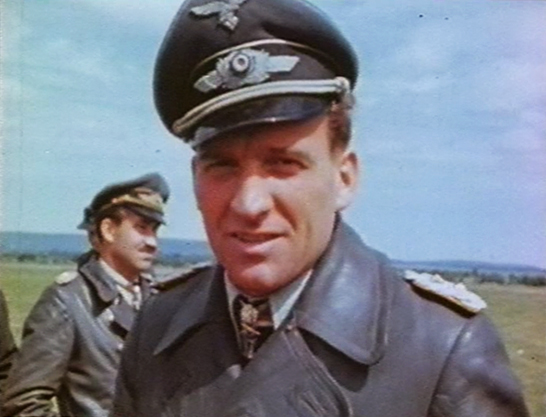
Hans-Ulrich Rudel
 Germany
aircraft pilot•writer•mountaineer
Birthday
+1916-07-02
Birth Sign
Cancer
Birthplace
Grzędy, Lower Silesian Voivodeship
Age
Died at 66
About
Hans-Ulrich Rudel, born on 2 July 1916 in Grzędy, Lower Silesian Voivodeship, was a German ground-attack pilot during World War II and later a post-war neo-Nazi activist. He is remembered as the most decorated German pilot of the conflict, the only recipient of the Knight's Cross with Golden Oak Leaves, Swords, and Diamonds. Rudel's wartime record is staggering: he flew 2,530 ground-attack missions, all on the Eastern Front, usually piloting the Junkers Ju 87 "Stuka" dive bomber. He claimed to have destroyed 519 tanks, one battleship, one cruiser, 70 landing craft, and 150 artillery emplacements, along with nine aerial victories and more than 800 vehicles. These numbers, while impossible to verify fully, underscore his reputation as a relentless and skilled aviator.
Fame & Fandom
Hans-Ulrich Rudel remains a figure of historical magnitude, though his standing in contemporary global consciousness has shifted away from the celebrity metrics that define modern icons. As of August 2026, the iFANN Global Fame Engine has evaluated his profile and determined that he does not currently hold a placement within the published Global Top 1,000 rankings or any Top-100 scope list. This absence of a numerical rank reflects the reality that while his wartime exploits are documented in military archives, they no longer generate the sustained public consumption signals required for a current global ranking. His fame is now strictly contextual, anchored in the specific domain of World War II aviation history rather than broad cultural ubiquity. The narrative surrounding him is one of extreme specialization; he is remembered by those who study the Eastern Front with a mixture of professional fascination and political caution. Unlike living celebrities who maintain active fanbases through digital engagement, Rudel's legacy exists as a static historical record. There is no formal fandom name associated with his name, nor is there an organized collective of admirers who engage in rituals, streaming parties, or charitable campaigns on his behalf. Any group that discusses him today operates as niche historical enthusiasts or fringe political observers rather than a unified movement. The lack of a dedicated fanbase stems from the controversial nature of his post-war activism, which prevents the formation of a positive, widespread cult of personality. While his achievements in destroying tanks and battleships are legendary within military circles, these feats do not translate into the viral moments or crowd reactions typical of pop culture figures. His story is told, but it is not celebrated in the manner of a modern star.
Interesting Facts and Legends
Rudel flew 2,530 ground-attack missions exclusively on the Eastern Front, a record unmatched in the conflict. He claimed to have destroyed 519 Soviet tanks, a figure derived from his autobiography *Stuka Pilot* that has become a fixed part of his iconic narrative despite debates over verification. One of the most widely cited events in his legend involves his destruction of the Soviet battleship *Marat* (formerly the *Parizhskaya Kommuna*) in November 1941, where a direct hit effectively knocked the vessel out of the war. Perhaps the most dramatic element of his mythos concerns his loss of a leg; after being severely wounded by anti-aircraft fire in January 1945, he underwent amputation below the knee yet returned to combat duties using a prosthetic limb. This feat of physical endurance is often highlighted in biographies as a central piece of the "unstoppable" story surrounding him. His post-war life added a darker layer to his legacy, as he became a vocal neo-Nazi activist advocating for the revision of Nazi history until his death in 1982. A notable historical footnote regarding his passing occurred in 1983 when a gathering of fellow veterans and sympathizers commemorated his life, though this was a small event rather than a mass public spectacle.
Death & Aftermath
Died
+1982-12-18 (aged 66)
Death Place
Bad Füssing, Bavaria, West Germany
Cause of Death
Myocardial infarction
A commemoration service held on January 9, 1983, drew approximately 2,000 attendees to Bad Füssing, reflecting the enduring loyalty of a specific faction despite Rudel's status as an unrepentant Nazi activist. Hans-Ulrich Rudel passed away quietly at his home in Bad Füssing, Bavaria, on December 18, 1982, having spent his final days in poor health due to complications from war injuries including the loss of his right eye and left leg. The official cause of death was recorded as a heart attack based on a hospital statement confirmed by his family, coroner's inquest, or police investigation conducted given the absence of suspicious circumstances. A private funeral took place in the local cemetery shortly after his death, though the subsequent public gathering attracted significant media coverage due to his notorious reputation. Posthumously, his estate remained in private hands managed by heirs, while his autobiography Stuka Pilot continued to generate interest among historical enthusiasts despite its revisionist tone.
Awards & Accolades
Keywords
Quick Facts
- Profession
- aircraft pilot, writer, mountaineer
- Born
- +1916-07-02
- Birthplace
- Grzędy, Lower Silesian Voivodeship
- Died
- +1982-12-18
- Death Place
- Rosenheim
- Gender
- Male
- Birth Sign
- Cancer
Join the community
fans discussing