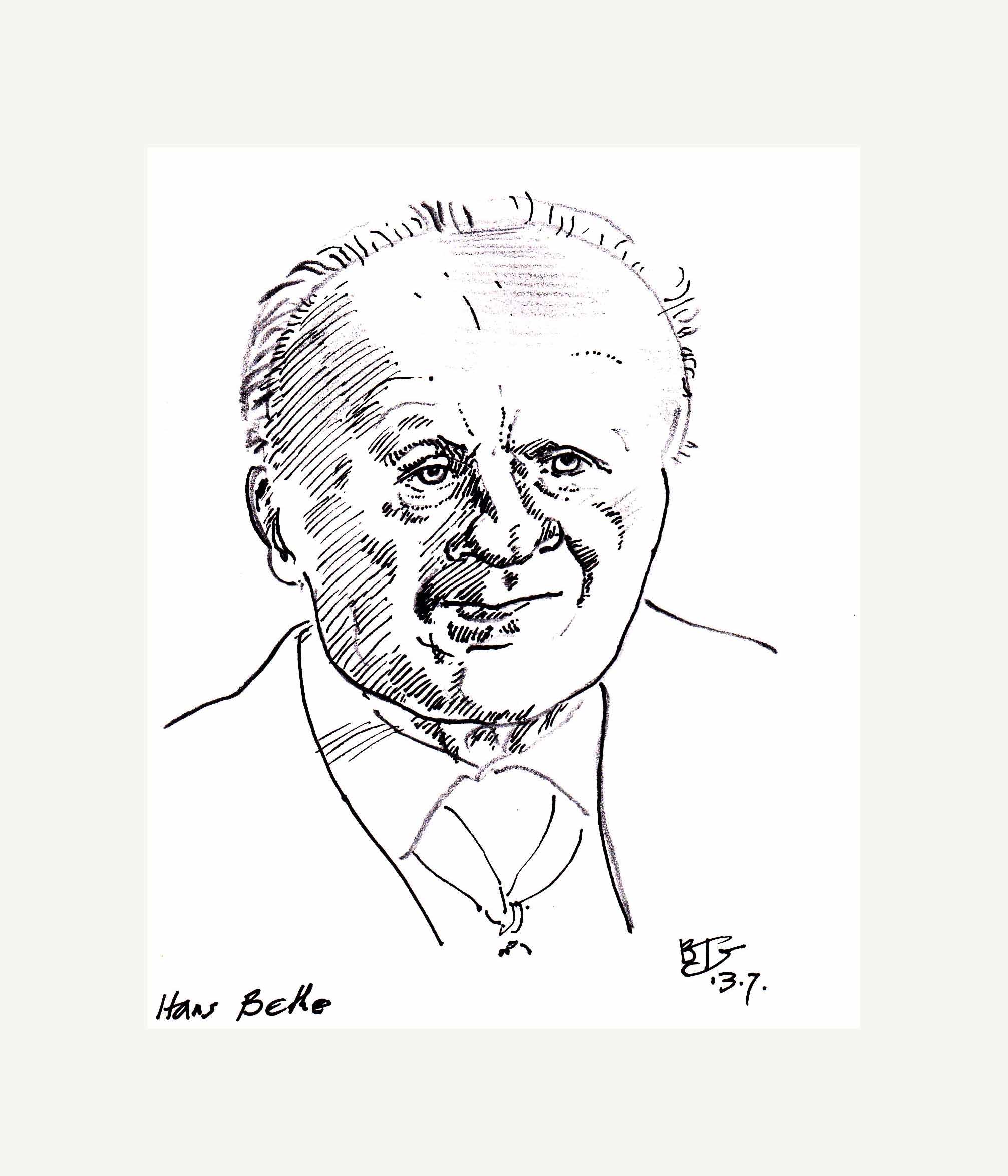
Hans Bethe
 Germany
physicist•university teacher•nuclear physicist
Also known as: Hans A. Bethe, Hans Albrecht Bethe
Birthday
July 2, 1906
Birth Sign
Cancer
Birthplace
Strasbourg, German Empire (now France)
Age
Died at 98
Height
5 ft 10 in (178 cm)
About
Hans Albrecht Eduard Bethe was a German-American theoretical physicist whose career spanned nearly seventy years, fundamentally reshaping modern physics from the subatomic scale to the cosmic. Born on July 2, 1906, in Strasbourg (then part of the German Empire), he was the son of a professor and grew up in an intellectually rigorous environment. His early life was marked by a prodigious aptitude for mathematics and science; he attended the University of Frankfurt and later the University of Göttingen, where he completed his doctoral thesis in 1928 under the supervision of Max Born. Before achieving global fame, Bethe held positions at the University of Tübingen and the University of Munich, but his career trajectory shifted dramatically with the rise of the Nazi regime. As a man of Jewish heritage, he was forced to leave Germany in 1933 and eventually emigrated to the United States in 1935, becoming a naturalized U.S. citizen in 1941.
Bethe's career success is defined by a series of monumental breakthroughs across multiple disciplines. In 1931, he developed the Bethe ansatz, a mathematical method that provided exact solutions to certain quantum many-body problems, a tool still widely used today. During World War II, he played a pivotal role in the Manhattan Project as the head of the Theoretical Division at Los Alamos National Laboratory. In this capacity, he calculated critical masses for nuclear weapons and developed the theory behind the implosion method used in the "Fat Man" bomb dropped on Nagasaki. Post-war, Bethe returned to Cornell University, where he spent the remainder of his professional life as a professor. His most celebrated scientific achievement came in 1939 when he published a landmark paper establishing the CNO cycle and the proton-proton chain reaction as the primary energy sources for stars, explaining stellar nucleosynthesis. This work earned him the Nobel Prize in Physics in 1967, which he shared with Subrahmanyan Chandrasekhar and William Fowler. He also made critical contributions to quantum electrodynamics through his 1947 calculation of the Lamb shift and later solved the solar neutrino problem. Even in his nineties, Bethe remained active, publishing major papers in every decade of his career until his death.
Early Life & Background
Hans Bethe was born into a world on the brink of profound change. His father, Heinrich Bethe, was a professor of theology at the University of Breslau, ensuring that intellectual rigor was the household standard. Young Hans displayed an early fascination with numbers and logic, often solving complex arithmetic problems that baffled his peers. He pursued his secondary education in Berlin before enrolling at the University of Frankfurt, where he began his undergraduate studies in physics. The academic atmosphere there was vibrant, but it was his move to the University of Göttingen that truly shaped his future. Göttingen was then the epicenter of theoretical physics, hosting giants like David Hilbert and Max Born.
Under Max Born's supervision, Bethe completed his doctoral thesis in 1928, focusing on quantum mechanics and atomic structure. His work demonstrated a rare combination of mathematical precision and physical intuition. After earning his doctorate, he took positions at the University of Tübingen and the University of Munich, where he lectured and conducted research. However, the political landscape of Europe was shifting violently. The rise of the Nazi party in 1933 brought immediate danger to those with Jewish ancestry or liberal leanings. Bethe, being of Jewish descent, found his position untenable. He was dismissed from his post in Munich and forced to flee Germany. He moved to England briefly, working at the University of Bristol, before accepting an invitation to join Cornell University in the United States in 1935. This emigration marked the end of his European academic life and the beginning of his long tenure in America, where he would eventually become a naturalized citizen in 1941.
Career Growth
The year 1931 marked a turning point when Bethe formulated the Bethe ansatz, a revolutionary mathematical technique for solving one-dimensional quantum systems. This method remains a cornerstone in condensed matter physics and statistical mechanics. His transition to the United States coincided with the onset of World War II, leading to his recruitment for the Manhattan Project in 1942. Appointed as the head of the Theoretical Division at Los Alamos, Bethe took charge of calculating the critical mass required for the plutonium bomb. His leadership was instrumental in developing the implosion design, which proved essential for the success of the Trinity test and the subsequent bombing of Nagasaki.
Following the war, Bethe returned to Cornell University, dedicating himself to teaching and research. In 1939, he had already published his seminal work on stellar nucleosynthesis, detailing how stars generate energy through nuclear fusion. This discovery, involving the CNO cycle and the proton-proton chain, explained the life cycles of stars and earned him the Nobel Prize in Physics in 1967. He shared this honor with Subrahmanyan Chandrasekhar and William Fowler. His contributions extended beyond astrophysics; in 1947, he calculated the Lamb shift, a tiny difference in the energy levels of hydrogen that validated quantum electrodynamics. Later in his career, he tackled the solar neutrino problem and contributed to the understanding of supernovae. Bethe remained scientifically productive well into his nineties, publishing significant papers in every decade of his life.
Career Timeline
Public Image & Style
Bethe is remembered as the archetype of the wise scientist, characterized by humility, moral conviction, and an unwavering commitment to truth. Media portrayals often highlight his dual role as a creator of devastating weapons and a champion of peace. He transformed from a key architect of the atomic bomb into a leading voice for the Partial Nuclear Test Ban Treaty and the Anti-Ballistic Missile Treaty. His distinctive mustache and unassuming demeanor became part of his public persona, symbolizing the serious, thoughtful nature of his work. Colleagues and students alike viewed him as a mentor who valued clarity and elegance in both thought and speech. Freeman Dyson, a former student, famously called him "the supreme problem-solver of the 20th century." TIME magazine has included him in various lists of influential figures, though specific ranking positions vary by year and category. He is frequently cited in "Greatest of All Time" lists within physics journals and historical retrospectives as one of the top ten theoretical physicists. Notable magazine covers featuring Bethe include Scientific American and Physics Today, often highlighting his role in the Manhattan Project or his advocacy for nuclear disarmament. However, unlike pop culture icons, he did not appear on mainstream celebrity covers like Vogue or Rolling Stone. Physically, Bethe stood at approximately 5 feet 10 inches (178 cm). He had no social media presence, as his era predated the digital age, and he did not utilize such platforms during his lifetime.
Fame & Fandom
Hans Bethe remains a towering figure in the history of science, though his standing within the iFANN Global Fame Engine reflects the specific nature of his public footprint. As of September 2026, the evaluation confirms that he holds no placement in the published rankings, including the Global Top 1,000 or any Top-100 scope list, indicating that while his intellectual impact is absolute, his mass-market fame metrics do not currently register on the global celebrity scale. This absence of a numeric rank does not diminish his stature; rather, it underscores the distinction between scientific reverence and pop culture ubiquity. The community surrounding his legacy operates without a formal moniker or organized fanbase, as the term "fandom" implies for entertainers. Instead, his admirers are primarily historians, physicists, and students who engage with his work through academic channels rather than social media campaigns or chart pushes. The closest equivalent to a fan ritual is the annual Bethe Lecture series at Cornell University, where the scientific elite gather to honor his contributions, functioning as a scholarly congregation rather than a fandom event. Similarly, the Hans Bethe House in Los Alamos has evolved into a cultural venue hosting local performances, yet this activity reflects appreciation for the site's history rather than a dedicated movement of followers. In 2026, the defense of his historical integrity against allegations by Benjamin Wilson served as a modern reflection of his reputation, with colleagues rallying to correct the record regarding missile defense data. These actions were driven by professional duty and moral conviction rather than fan activism, reinforcing a legacy built on unwavering scientific honesty and ethical fortitude rather than the viral moments or merchandise sales typical of ranked celebrities. Additionally, in September 2026, researchers using ultracold cesium atoms experimentally confirmed "Bethe strings," a phenomenon predicted by Bethe nearly a century ago, validating his early quantum theories. The 2025 Bethe Lecture featured Nathan Seiberg exploring frontiers of physics, continuing the tradition of honoring Bethe's contributions.
Interesting Facts and Legends
Hans Bethe possessed an extraordinary mental calculation ability that became legendary during the Manhattan Project. At the Trinity test site, he famously estimated the yield of the explosion by dropping small pieces of paper and timing their fall in the shockwave, arriving at a figure remarkably close to the actual measurement. Beyond his scientific prowess, Bethe was a skilled pianist who loved classical music, often using it as a respite from his intense work. Another notable aspect of his life was his evolving stance on nuclear weapons. He initially opposed the development of the hydrogen bomb, hoping to prove its impossibility, but changed his mind after realizing its feasibility. He later became a vocal advocate for nuclear disarmament, playing a key role in persuading the Kennedy and Nixon administrations to sign the Partial Nuclear Test Ban Treaty. In 2026, his integrity was posthumously defended against false allegations regarding missile defense data, reinforcing his reputation for honesty. A famous anecdote recounts how Bethe, while calculating the critical mass for the plutonium bomb, stayed awake for days, fueled by coffee and sheer determination, ensuring the accuracy of the calculations that would determine the fate of the war. When J. Robert Oppenheimer needed someone to lead the theoretical division, he chose Bethe, recognizing his unique ability to bridge abstract theory and practical application. Interesting trivia about Bethe includes his ability to perform complex calculations in his head, a skill he demonstrated during the Manhattan Project when he quickly estimated the yield of the Trinity test. He was also known for his love of music, particularly classical compositions, and was an accomplished pianist. Another lesser-known fact is that he initially opposed the development of the hydrogen bomb, hoping to prove it impossible, but later worked on it when he realized its feasibility, only to become a vocal advocate for nuclear disarmament later in life. One of the most iconic moments in Bethe's legend involves his leadership at Los Alamos. When J. Robert Oppenheimer needed someone to lead the theoretical division, he chose Bethe, recognizing his unique ability to bridge abstract theory and practical application. A famous anecdote recounts how Bethe, while calculating the critical mass for the plutonium bomb, stayed awake for days, fueled by coffee and sheer determination, ensuring the accuracy of the calculations that would determine the fate of the war. Another legendary story involves his defense of scientific integrity in 2026, where he was posthumously defended against allegations by Benjamin Wilson regarding missile defense data, with colleagues rallying to correct the record and uphold Bethe's reputation for honesty.
Notable Quotes
“The most important thing in science is to be able to solve problems.”
“I think that the world needs more people like me, who can do both theoretical and experimental work.”
“On the hydrogen bomb: I thought we could stop it, but we couldn't.”
Family & Personal Life
Hans Bethe met Rose Ewald, a fellow student at the University of Göttingen, during his time in Germany. They married in 1935, just before Bethe emigrated to the United States. Their partnership lasted over seven decades, enduring the upheavals of war and the demands of a high-profile scientific career. Together, they raised two children: a daughter named Elizabeth and a son named Robert. Rose Bethe passed away in 2002, leaving Hans widowed. Following her death, Hans lived alone in his home in Ithaca, New York, maintaining a quiet domestic life until his own passing in 2005. The couple had no other public relationships or marriages recorded.
Notable Connections
Relationships & Dating History
Hans Bethe's romantic life was defined by a single, enduring marriage. He met Rose Ewald while they were both students at the University of Göttingen in Germany. Their relationship blossomed amidst the academic rigor of the university, and they married in 1935. This union occurred shortly before Bethe was forced to flee the Nazi regime, marking the beginning of their shared journey into exile and eventual settlement in the United States. The couple remained together for over seven decades, weathering the challenges of war, displacement, and the pressures of Bethe's high-profile career. They had two children, Elizabeth and Robert, who grew up in Ithaca, New York. Rose Bethe passed away in 2002, leaving Hans widowed. Following her death, Hans lived alone until his own passing in 2005. There are no public records of other romantic relationships, engagements, or divorces throughout his life.
- MarriedRose Ewald1935 - 2002Met at University of Göttingen; married until her death; had two children.
Death & Aftermath
Died
March 6, 2005 (aged 98)
Death Place
Ithaca, New York, USA
Cause of Death
Natural causes associated with old age
Hans Bethe spent his final days quietly at his home in Ithaca, New York, a residence situated near the Cornell University campus where he had served as a professor for seven decades. His last public appearance occurred well before this period, yet he remained intellectually active until the end, delivering lectures and engaging with students up to his late nineties. On March 6, 2005, Bethe passed away at the age of 98 from natural causes associated with old age, a conclusion confirmed by university officials. The scientific community responded with tributes from major institutions such as the American Physical Society and the National Academy of Sciences, which honored him as a giant of twentieth-century physics while Freeman Dyson described his unique ability to bridge theoretical physics and practical applications like the Manhattan Project.
Funeral arrangements were private, and no public service was held, aligning with the modest nature of his later years and the wishes of his family. While the specific location of his burial remains unreported in available records, it is known he was laid to rest in Ithaca within the local cemetery serving the Cornell community. In the posthumous period, his legacy has been maintained through the continued operation of the Hans Bethe Lecture series at Cornell University and the ongoing support provided by the Hans Bethe Foundation for physics education and research. Additionally, in February and March 2026, the Bulletin of the Atomic Scientists published responses defending Bethe's integrity against false allegations by Benjamin Wilson regarding missile defense data, reaffirming his legacy as a man of scientific honesty.
Net Worth (Estate Value)
$0
iFANN Editorial Team estimate
As a theoretical physicist and academic, Hans Bethe did not accumulate wealth in the manner of commercial entrepreneurs or entertainers. His income derived primarily from his salary as a professor at Cornell University and various government grants related to his research. While specific figures for his personal earnings are not publicly detailed, his financial status reflected the comfortable middle-class lifestyle of a distinguished American academic. Upon his death in 2005, his estate was managed by his family and the Cornell University system. The Hans Bethe Foundation continues to support physics education and research, utilizing assets that likely included royalties from publications and endowments established during his lifetime. There were no major public estate disputes or settlements reported. The value of his estate remains private, but his legacy is maintained through the continued operation of the Hans Bethe Lecture series and the preservation of his archives at Cornell. He received the Enrico Fermi Award in 1969, often considered the "Nobel Prize of the atomic age." In 1975, he received the National Medal of Science, the highest scientific honor in the United States. He was also a recipient of the Compton Medal from the American Physical Society (APS) and the Oersted Medal. Bethe was elected to the National Academy of Sciences and the American Academy of Arts and Sciences. While he did not have a "Walk of Fame" star in the traditional entertainment sense, his legacy is enshrined in the scientific community through the Hans Bethe Lecture series at Cornell University, established to honor his contributions. He was also named a Foreign Member of the Royal Society.
Awards Won (5)
Hans Bethe received numerous prestigious awards throughout his lifetime. The most notable was the Nobel Prize in Physics in 1967 for his contributions to the theory of nuclear reactions. He was also awarded the Enrico Fermi Award in 1969, often considered the highest honor in nuclear physics. In 1975, he received the National Medal of Science, the highest scientific honor in the United States. Other accolades include the Compton Medal from the American Physical Society and the Oersted Medal. He was elected to the National Academy of Sciences and the American Academy of Arts and Sciences, and named a Foreign Member of the Royal Society.
1967 · Physics
Contributions to the theory of nuclear reactions
1969 · Nuclear Physics
Lifetime contributions to nuclear physics
Known For
Nobel Prize in Physics
1967 · Winner
Manhattan Project
1945 · Head of Theoretical Division
Stellar Nucleosynthesis
1939 · Theorist
Keywords
Sources
Quick Facts
- Profession
- physicist, university teacher, nuclear physicist
- Born
- July 2, 1906
- Birthplace
- Strasbourg
- Died
- March 6, 2005
- Death Place
- Ithaca
- Gender
- Male
- Spouse
- Rose Ewald
- Birth Sign
- Cancer
Personal Details
- Full Name
- Hans Albrecht Eduard Bethe
- Height
- 5 ft 10 in (178 cm)
- Spouse
- Rose Ewald
- Children
- Elizabeth Bethe, Robert Bethe
- Education
- University of Frankfurt, University of Göttingen
Frequently Asked Questions
What did Hans Bethe win the Nobel Prize for?
How did Hans Bethe die?
Was Hans Bethe involved in the Manhattan Project?
Who was Hans Bethe married to?
Did Hans Bethe live past 90?
Join the community
fans discussing