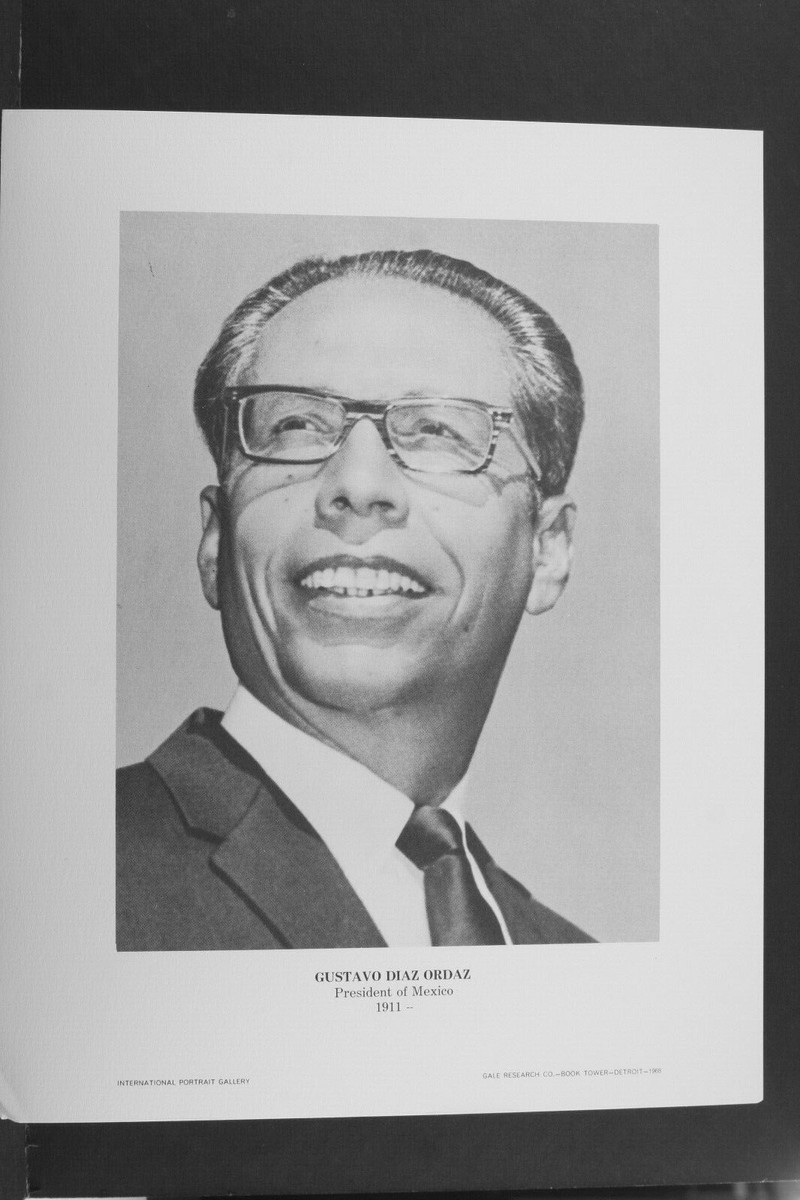
Gustavo Díaz Ordaz
 Mexico
Also known as: Gustavo Díaz Ordaz Bolaños
Birthday
March 12, 1911
Birth Sign
Pisces
Birthplace
Ciudad Serdán, Puebla, Mexico
Age
Died at 68
About
Gustavo Díaz Ordaz was a Mexican politician, lawyer, and diplomat who served as the President of Mexico from 1964 to 1970. A member of the Institutional Revolutionary Party (PRI), he is best remembered for his role in the Tlatelolco massacre of 1968, which has defined his legacy as a controversial and repressive figure in Mexican history.
During his presidency, Mexico experienced the economic growth of the Mexican Miracle and hosted the 1968 Summer Olympics and the 1970 FIFA World Cup. However, his administration's violent suppression of student protests on October 2, 1968, overshadowed these achievements, leaving an enduring mark on the nation's collective memory. His legacy remains deeply contested, with recent efforts to rename streets and remove his name from public spaces reflecting the ongoing reckoning with his actions.
Early Life & Background
Gustavo Díaz Ordaz Bolaños was born on March 12, 1911, in Ciudad Serdán, Puebla, a small city in central Mexico. He was a descendant of José María Díaz Ordaz, an associate of 19th-century Mexican political figures, which gave him early exposure to politics. He pursued a law degree at the University of Puebla, graduating in 1937, and later served as the institution's vice-rector. His political career began in 1943 when he was elected to the Chamber of Deputies for Puebla. He then moved to the Senate, representing Puebla from 1946 to 1952, where he forged a close relationship with fellow senator Adolfo López Mateos. This connection proved pivotal, as López Mateos would later become president and appoint Díaz Ordaz as Secretary of the Interior, a role that gave him significant influence over domestic affairs.
Career Growth
Díaz Ordaz's rise through the PRI culminated in his election as President of Mexico in 1964. His term coincided with the Mexican Miracle, a period of robust economic expansion. He oversaw Mexico's hosting of the 1968 Summer Olympics and the 1970 FIFA World Cup, making the country the first to stage both events within two years. In 1967, he addressed a joint session of the U.S. Congress, and in December 1968, he and President Lyndon B. Johnson participated in a ceremony shifting the Rio Grande into a concrete-lined channel, settling a century-old border dispute. However, his presidency is indelibly marked by the Tlatelolco massacre on October 2, 1968, when he ordered the violent suppression of student protests, resulting in hundreds of deaths. After leaving office in 1970, he served briefly as Ambassador to Spain in 1977 before retiring. He passed away on July 15, 1979, in Mexico City at the age of 68.
Career Timeline
Public Image & Style
Gustavo Díaz Ordaz's public image is overwhelmingly defined by the Tlatelolco massacre, which has overshadowed other aspects of his presidency. Modern media portray him as a repressive figure, and his name has become synonymous with state violence in Mexican historical memory. The 2016 VPRO documentary 'Speeches: Gustavo Díaz Ordaz' examined his 1968 warning speech to protesters. Recent municipal actions renaming streets and petitions to remove his name from monuments reflect his enduring controversial status in Mexican public life. In August 2024, Mexico City renamed streets bearing his name, with one Calle Gustavo Díaz Ordaz in the Álvaro Obregón borough becoming Calle Benita Galeana. In July 2020, a petition circulated in San Diego to remove a plaque bearing his name from a statue in Old Town.
Fame & Fandom
Gustavo Díaz Ordaz's public legacy is a study in absence: there is no organized fandom, no formal name for his supporters, and no community of admirers. The closest thing to a following exists among conservative circles of the PRI, yet even there he is not celebrated. Instead, the most visible engagement with his memory is a decommemoration movement, streets renamed, statues petitioned for removal, a campaign that says 'Goodbye, Gustavo' rather than preserving his honor. His iconic moments are not triumphs but a single night of violence and the decades of reckoning that followed.
In August 2026, the iFANN Global Fame Engine has evaluated Gustavo Díaz Ordaz but he does not currently hold a placement in the published rankings. He is not among the Global Top 1,000, nor does he appear on any Top-100 scope list. This absence is consistent with a reputation defined by infamy, not fame.
Interesting Facts and Legends
Díaz Ordaz was known for his stern public demeanor, often appearing in formal presidential attire. He was a heavy smoker, a habit that may have contributed to his health issues. He had a particular fondness for classical music and often attended concerts at the Palacio de Bellas Artes. He was also an avid reader of legal philosophy, which influenced his political decisions. In 1968, he reportedly received a personal letter from a student leader pleading for dialogue, but he ignored it. After his death, his personal library was donated to the University of Puebla, his alma mater. Additionally, the town of Gustavo Díaz Ordaz in Tamaulipas, Mexico, and multiple streets across Mexican cities still bear his name, including locations in Tijuana and Guadalajara.
A story still retold by historians is his 1968 warning speech to student protesters, delivered before the Tlatelolco massacre, a moment that has become a symbol of his authoritarian rule. The exact death toll remains disputed, but the massacre itself is a documented event that defines his legacy. Another layer of his legend is the modern campaign to erase his name from public spaces, culminating in the 2024 Mexico City street renaming under the slogan 'Adiós, Gustavo,' a civic act that has become part of his enduring controversy.
Family & Personal Life
Gustavo Díaz Ordaz was married to Guadalupe Borja, and their union was a stable partnership throughout his political career. The couple had children, though details about their names and lives are not widely documented. Díaz Ordaz's family life was largely private, with few public appearances together. His wife often accompanied him at official events, but she avoided the political spotlight. The family resided in Mexico City during his presidency, and after his term, they lived a quieter life away from public attention. His ancestor, José María Díaz Ordaz, was an associate of 19th-century Mexican political figures, connecting the family to a long political lineage.
Notable Connections
Gustavo Díaz Ordaz was closely associated with Adolfo López Mateos, his fellow senator and later president, under whom he served as Secretary of the Interior. He also worked with U.S. President Lyndon B. Johnson on the Rio Grande border settlement. His ancestor, José María Díaz Ordaz, was connected to 19th-century Mexican political circles.
Relationships & Dating History
Gustavo Díaz Ordaz was married to Guadalupe Borja, and their marriage lasted until his death. Public records indicate they were a devoted couple, though few details about their courtship or personal life have been documented. They had children together, but their names and lives remain largely private. Throughout his political career, his wife was a supportive presence at official functions. As of his death in 1979, he was still married to Borja.
- MarriedGuadalupe Borja1938 - 1979Married for over four decades until his death; she was a supportive presence during his political career.
Death & Aftermath
Died
July 15, 1979 (aged 68)
Death Place
Mexico City, Mexico
Cause of Death
Unknown
Gustavo Díaz Ordaz Bolaños, the 52nd President of Mexico who served from 1964 to 1970, died on July 15, 1979, in Mexico City at the age of sixty-eight. Contemporary reporting from The New York Times published on July 16, 1979, described him as an austere and tough-minded judge and noted his death occurred shortly after he had stepped down from public office following a long period of political influence. While historical records confirm the date and location of his death, specific medical details regarding the cause are not explicitly detailed in available search results.
Public reaction to his death was marked by significant historical reflection given his role in the 1968 Tlatelolco massacre, where his administration ordered the bloody suppression of student protests. The New York Times obituary highlights this legacy, noting that he was remembered as the leader who put down student riots. Modern context suggests a shift in how he is commemorated; recent news indicates that streets named after him in Mexico City were renamed in 2024, with one Calle Gustavo Díaz Ordaz in the Álvaro Obregón borough becoming Calle Benita Galeana, reflecting a contemporary move to distance public spaces from his controversial legacy. Similarly, a petition circulating in San Diego in 2020 sought to remove a plaque bearing his name from a statue in Old Town.
His legacy persists primarily through the naming of locations like Ciudad Gustavo Díaz Ordaz in Tamaulipas and various streets, though these are increasingly being re-evaluated or renamed as seen in the 2024 Mexico City street renaming initiative.
Net Worth (Estate Value)
$1 Million
iFANN Editorial Team estimate
As a deceased political figure from the mid-20th century, no credible contemporary net worth estimates exist for Gustavo Díaz Ordaz. His estate's current value is not publicly documented in available sources. During his lifetime, his income came from his government salary as a senator, cabinet secretary, and president. After his presidency, he received a pension typical of former Mexican presidents. His estate likely includes property and personal assets, but specifics are unknown. In 2026, any valuation would be speculative; iFANN currently estimates the figure at $1 million, a conservative estimate based on typical presidential pensions and property holdings, though actual worth may differ.
Awards & Accolades
View 1 records, honours and achievementsKnown For
President of Mexico
1964-1970 · President
Tlatelolco massacre
1968 · Ordered military crackdown
1968 Summer Olympics
1968 · Hosted in Mexico City
Keywords
Sources
Quick Facts
- Profession
- politician, lawyer, diplomat
- Born
- March 12, 1911
- Birthplace
- Ciudad Serdán, Puebla, Mexico
- Died
- July 15, 1979
- Death Place
- Mexico City, Mexico
- Gender
- Male
- Spouse
- Guadalupe Borja
- Birth Sign
- Pisces
Personal Details
- Full Name
- Gustavo Díaz Ordaz Bolaños
- Spouse
- Guadalupe Borja
- Education
- University of Puebla (law degree, 1937)
Frequently Asked Questions
What did Gustavo Díaz Ordaz do in 1968?
How did Gustavo Díaz Ordaz die?
Was Gustavo Díaz Ordaz married?
Why are streets named after Gustavo Díaz Ordaz being renamed?
How long was Gustavo Díaz Ordaz president of Mexico?
Similar People
Join the community
fans discussing