 Australia
About
The Bee Gees, an English-Australian musical ensemble, consisted primarily of the brothers Barry, Robin, and Maurice Gibb. Their career began in the late 1950s in Australia, developing into a professional act that achieved international recognition by the mid-1960s. The group's initial sound was characterized by intricate three-part harmonies and orchestral arrangements, producing a series of pop and rock hits. These early successes included tracks such as "New York Mining Disaster 1941" and "Massachusetts," establishing their presence on charts in both the United Kingdom and the United States. During this period, the group cultivated a reputation for crafting melodically rich and often melancholic compositions, distinguishing them within the pop landscape.
A significant stylistic evolution occurred in the mid-1970s when the Bee Gees incorporated R&B and disco elements into their music. This shift, influenced by their relocation to Miami, Florida, saw Barry Gibb's falsetto become a prominent vocal feature. The album Main Course, released in 1975, marked this transition with songs like "Jive Talkin'." The group's participation in the 1977 film soundtrack for Saturday Night Fever proved to be a pivotal moment. Their contributions, including "Stayin' Alive," "Night Fever," and "How Deep Is Your Love," propelled the soundtrack to become one of the best-selling albums globally, solidifying their status as leading figures of the disco era. This period of heightened visibility also brought unprecedented commercial success.
Following the disco era, the Bee Gees navigated a period of industry backlash, prompting another stylistic adjustment towards adult contemporary and pop-rock. While their commercial output as a group experienced fluctuations, the brothers maintained active careers as songwriters and producers for other artists, demonstrating their enduring musical versatility. They continued to release albums throughout the 1980s and 1990s, with Still Waters in 1997 achieving renewed chart success. The group's collective recording activities concluded with the album This Is Where I Came In in 2001. Maurice Gibb passed away in 2003, followed by Robin Gibb in 2012, effectively bringing the group's performing career to a close, with Barry Gibb continuing as a solo artist. The Bee Gees' body of work reflects a capacity for reinvention and a consistent output of popular music over five decades.
Formation Story
The foundation of the Bee Gees traces back to the Gibb family's emigration from Manchester, England, to Redcliffe, Queensland, Australia, in 1958. Barry, Robin, and Maurice Gibb began performing together as a vocal trio shortly after their arrival. Their early public appearances included singing between races at Redcliffe Speedway, where their harmonies captured local attention. Their first notable exposure came on a local Brisbane television show, leading to further opportunities within the Australian music scene. In 1962, the brothers secured a contract with Leedon Records, an Australian label, releasing their debut single, "The Battle of the Blue and the Grey," in 1963. This marked their formal entry into recorded music.
Over the next few years, the Bee Gees issued several singles and their debut album in Australia, developing their songwriting and performance skills. Despite moderate success in Australia, the brothers decided to return to England in early 1967, seeking broader international recognition. Before their departure, they had already written a substantial catalog of songs. Upon arriving in London, they sent a demo tape to producer Robert Stigwood, who was instrumental in signing them to Polydor Records in the UK and Atco Records in the US. Stigwood recognized their potential, structuring their career for a global audience. The release of their first international album, Bee Gees' 1st, in July 1967, and its lead single, "New York Mining Disaster 1941," quickly launched them onto the international charts, signaling the beginning of their worldwide career.
Members
Former Members
Vince Melouney (Vince Melouney)
Lead Guitarist · 1967-1968
Colin Petersen (Colin Petersen)
Drummer · 1967-1969
Geoff Bridgeford (Geoff Bridgeford)
Drummer · 1969-1970
Musical Style
The Bee Gees' musical style underwent several distinct phases across their career, initially rooted in a sophisticated pop sound. During the late 1960s, their music featured complex vocal harmonies, often layered with orchestral arrangements, drawing comparisons to contemporary British pop acts. Albums like Bee Gees' 1st and Horizontal showcased baroque pop elements, combining folk-rock influences with melancholic melodies and intricate vocal interplay. Their lyrical themes frequently explored introspection, romance, and social commentary, delivered with a certain earnestness.
The early 1970s saw the group experiment with more soulful and R&B-oriented sounds, though this period was marked by less consistent commercial success. A significant transformation occurred in the mid-1970s with the album Main Course, where they fully embraced funk and disco rhythms. This era introduced Barry Gibb's distinctive falsetto, which became a hallmark of their sound. Songs such as "Jive Talkin'" and "You Should Be Dancing" integrated prominent basslines, syncopated guitar riffs, and a driving beat, suitable for dance floors. The Saturday Night Fever soundtrack further refined this approach, with tracks like "Stayin' Alive" and "Night Fever" becoming emblematic of the disco genre. In later decades, the group returned to a more adult contemporary pop style, while retaining their characteristic harmonies, demonstrating an ongoing adaptability in their songwriting and production.
Discography
| Title | Year |
|---|---|
| Timeless: The All-Time Greatest Hits | 2017 |
| The Ultimate Bee Gees | 2009 |
| Number Ones | 2004 |
| This Is Where I Came In | 2001 |
| Their Greatest Hits: The Record | 2001 |
| Still Waters | 1997 |
| Alone | 1997 |
| Size Isn't Everything | 1993 |
| High Civilization | 1991 |
| Tales from the Brothers Gibb | 1990 |
| One | 1989 |
| You Win Again | 1987 |
| E.S.P. | 1987 |
| Living Eyes | 1981 |
| Love You Inside Out | 1979 |
| Tragedy | 1979 |
| Too Much Heaven | 1978 |
| Spirits Having Flown | 1979 |
| Bee Gees Greatest | 1979 |
| Sgt. Pepper's Lonely Hearts Club Band | 1978 |
| Night Fever | 1978 |
| Stayin' Alive | 1977 |
| How Deep Is Your Love | 1977 |
| Saturday Night Fever | 1977 |
| Children of the World | 1976 |
| You Should Be Dancing | 1976 |
| Bee Gees Gold | 1976 |
| Main Course | 1975 |
| Nights on Broadway | 1975 |
| Jive Talkin' | 1975 |
| Mr. Natural | 1974 |
| Life in a Tin Can | 1973 |
| Best of Bee Gees, Volume 2 | 1973 |
| To Whom It May Concern | 1972 |
| Trafalgar | 1971 |
| How Can You Mend a Broken Heart | 1971 |
| 2 Years On | 1970 |
| Cucumber Castle | 1970 |
| Lonely Days | 1970 |
| Odessa | 1969 |
| Best of Bee Gees | 1969 |
| I Started a Joke | 1968 |
| I've Gotta Get a Message to You | 1968 |
| Words | 1968 |
| Idea | 1968 |
| Horizontal | 1968 |
| Massachusetts | 1967 |
| To Love Somebody | 1967 |
| New York Mining Disaster 1941 | 1967 |
| Bee Gees' 1st | 1967 |
Tours
This Is Where I Came In Tour
2001 · 40 shows
One Night Only Tour
1997-1999 · 70 shows
High Civilization Tour
1991 · 50 shows
One for All Tour
1989 · 60 shows
Spirits Having Flown Tour
1979 · 55 shows
Children of the World Tour
1976 · 50 shows
Main Course Tour
1975 · 40 shows
1971 Tour
1971 · 30 shows
1st World Tour
1967-1968 · 50 shows
Bee Gees Australian Tour
1963-1966
Cultural Impact
The Bee Gees exerted considerable influence across popular music, particularly through their dual periods of significant commercial success. In the late 1960s, their blend of pop melodies and orchestral arrangements contributed to the evolving sound of pop and rock music, establishing a template for vocal harmony groups. Songs like "To Love Somebody" became standards, frequently covered by other artists and demonstrating the enduring quality of their songwriting. This early phase helped define a sophisticated, often melancholic, strain of pop music that resonated with a global audience.
Their most profound cultural impact arrived with the disco era of the late 1970s. The Saturday Night Fever soundtrack, released in 1977, was not merely a collection of songs but a cultural touchstone. It defined the aesthetics and sound of disco for millions, transforming the genre from a niche movement into a mainstream phenomenon. Tracks such as "Stayin' Alive" and "Night Fever" became anthems, influencing fashion, dance, and nightlife globally. The album's unprecedented sales figures and its pervasive presence in media reflected and shaped the prevailing cultural mood. While the group experienced a backlash in the anti-disco movement, their contributions to the genre remain foundational. Generations of artists across various genres have cited the Bee Gees as an influence, particularly regarding vocal arrangement and songwriting craft, solidifying their place in the broader history of popular music.
Fandom Culture
The Bee Gees cultivated a dedicated global fanbase throughout their extensive career. While they did not have a formally designated fandom name or specific fan color in the manner of contemporary pop groups, their supporters were known for their sustained loyalty across the group's different musical eras. Fans often connected through appreciation for the brothers' distinctive harmonies and their prolific songwriting, which resonated with diverse audiences. Concert tours, particularly the Spirits Having Flown Tour in 1979 and the later One Night Only Tour, provided significant opportunities for fans to gather and celebrate the group's live performances. Collectors sought out their numerous albums and singles, and their music frequently appeared in film and television, introducing their work to new generations of listeners. Discussions among fans often centered on the unique vocal contributions of each brother and the evolution of their sound from baroque pop to disco and beyond.
Awards Won (90)
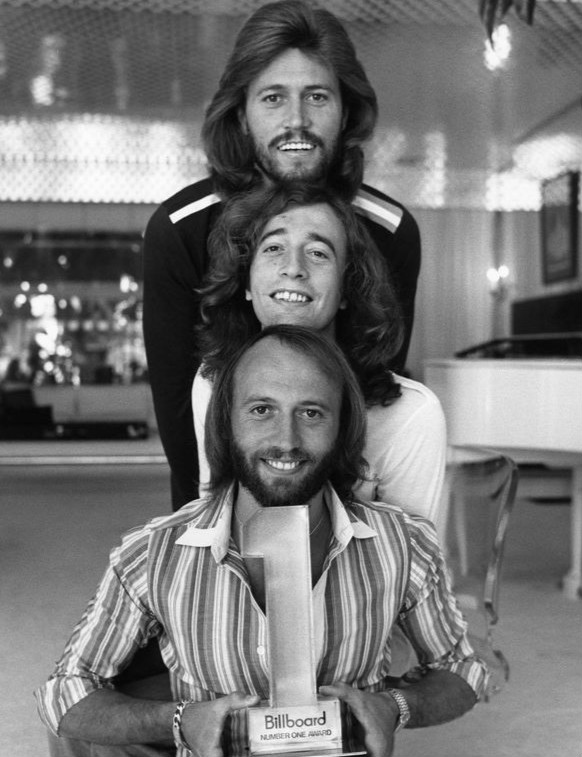
The Bee Gees received extensive recognition for their musical contributions, securing a total of 9 Grammy Awards, including Album of the Year for Saturday Night Fever. They also earned 9 American Music Awards, notably for Favorite Pop/Rock Album and Group. Further accolades include a BRIT Award for Outstanding Contribution to Music and induction into the Rock and Roll Hall of Fame in 1997, alongside their inclusion in the Songwriters Hall of Fame in 1994, acknowledging their prolific songwriting.
for: Stayin' Alive
Best Pop Vocal Performance by a Duo, Group or Chorus
for: Tragedy
Best Arrangement for Voices
for: Tragedy
Best Pop Vocal Performance by a Duo, Group or Chorus
for: Stayin' Alive
Album of the Year
for: Saturday Night Fever
Best Arrangement for Voices
for: Stayin' Alive
Best Pop Vocal Performance by a Duo, Group or Chorus
for: How Deep Is Your Love
Best Arrangement for Voices
for: Stayin' Alive
Producer of the Year
for: Saturday Night Fever
Favorite Pop/Rock Band, Duo or Group
Fame & Fandom
Trivia
Barry, Robin, and Maurice Gibb were born on the Isle of Man before their family moved to Chorlton-cum-Hardy, Manchester, England, and then emigrated to Australia in 1958.
Maurice and Robin Gibb were fraternal twins, born on December 22, 1949.
The group's name, "Bee Gees," is often thought to stand for "Brothers Gibb," but it was actually derived from the initials of Barry Gibb, promoter Bill Goode, and radio DJ Bill Gates, who helped them get their start in Australia.
Barry Gibb is the only surviving member of the original trio.
The brothers wrote most of their own songs, but also penned major hits for other artists, including Dolly Parton and Kenny Rogers' "Islands in the Stream" and Diana Ross' "Chain Reaction."
Group Info
- Formed
- 1958-00-00
- Debut
- 1963-00-00
- Debut Song
- The Battle of the Blue and the Grey
- Origin
- Redcliffe, Queensland, Australia
- Company
- Robert Stigwood Organisation
- Label
- Leedon RecordsSpin RecordsPolydor RecordsAtco RecordsRSO RecordsWarner Bros. RecordsMercury RecordsReprise Records
- Status
- Disbanded (2012-05-20)
Join the community
fans discussing