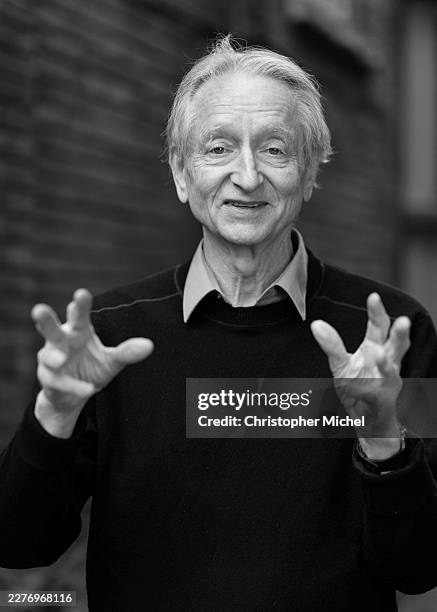
Geoffrey Hinton
 United Kingdom
computer scientist•artificial intelligence researcher•university teacher
Also known as: Godfather of AI
Birthday
December 6, 1947
Birth Sign
Sagittarius
Birthplace
Wimbledon, London, England
Age
78 years old
About
Geoffrey Hinton is a British-Canadian computer scientist and cognitive psychologist widely known as the Godfather of AI for his foundational role in the development of artificial neural networks and deep learning. Over decades of work, much of it pursued when the field was deeply unfashionable, he helped establish the core techniques that power the modern artificial-intelligence revolution. His persistence through long periods of skepticism toward neural networks proved decisive for the entire discipline. Hinton's contributions are central to how machines learn today. He was a key figure in popularizing the backpropagation algorithm used to train multilayer networks, and his work with his students on image recognition produced a breakthrough that is widely seen as the moment deep learning took off, triggering the wave of advances that followed in vision, speech, and language. For his achievements he was awarded a share of a Nobel Prize, a striking recognition of the field's impact. In a notable late turn, Hinton stepped away from his role at Google to speak freely about the dangers he believes advanced AI poses, warning about risks ranging from misinformation to existential threats, and becoming one of the most prominent voices urging caution about the very technology he helped create. Thoughtful and influential, Geoffrey Hinton is regarded as one of the principal architects of modern artificial intelligence.
Early Life & Background
Geoffrey Everest Hinton was born on December 6, 1947, in Wimbledon, London, England. He was educated at Clifton College in Bristol. In 1967, he entered King's College, Cambridge, where he switched between natural sciences, history of art, and philosophy before settling on experimental psychology, graduating with a BA in 1970. After Cambridge, he spent a year working as a carpenter. In 1972 he began a PhD in artificial intelligence at the University of Edinburgh, the only postgraduate program on the subject in the UK at the time. His supervisor, Christopher Longuet-Higgins, favored symbolic AI, but Hinton was already drawn to neural networks. He earned his doctorate in 1978. His fascination with the human brain drove his research; as an undergraduate, he realized scientists didn't truly understand how neurons learned or computed, and he spent his career trying to understand these processes. He then held postdoctoral positions at the University of Sussex and the University of California, San Diego, before spending five years as a faculty member in the Computer Science department at Carnegie Mellon University.
Career Growth
In the 1980s, while most AI researchers chased symbolic systems, Hinton pushed forward with neural networks. He co-authored a key 1986 paper that popularized backpropagation, the algorithm that trains multilayer networks. He also made key contributions to Boltzmann machines, distributed representations, and time-delay neural networks. In 1998 he founded the Gatsby Computational Neuroscience Unit at University College London. He returned to the University of Toronto in 2001 as a professor. The breakthrough came in 2012: Hinton and his students Alex Krizhevsky and Ilya Sutskever created AlexNet, a deep neural network that crushed the competition in the ImageNet image recognition challenge. That moment is often called the Big Bang of deep learning. In 2013 he joined Google as a Vice President and Engineering Fellow, leading the Brain Team Toronto. He stayed for a decade. In 2018 he shared the ACM Turing Award with Yoshua Bengio and Yann LeCun. In 2024 he and John Hopfield won the Nobel Prize in Physics for foundational discoveries enabling machine learning with artificial neural networks.
Career Timeline
Public Image & Style
Hinton is known as the Godfather of AI, a title he has mixed feelings about. The media often portrays him as a conflicted figure: a creator who helped build a technology he now warns about. His 2023 departure from Google and subsequent warnings about AI risks made headlines worldwide. He is typically seen in academic settings, wearing casual attire, and speaks with a thoughtful, measured tone. He does not maintain an active social media presence; he has no verified Instagram or Facebook accounts. Among researchers and tech enthusiasts, he commands deep respect. His former students include some of the most influential figures in AI, including Yann LeCun, Yoshua Bengio, and Ilya Sutskever. He has been featured in the TIME100 AI list in 2023 and covered by major outlets like The New York Times and TIME.
Fame & Fandom (iFAMOUS Rankings)
Geoffrey Hinton commands a rare form of global attention that transcends the typical metrics of celebrity, driven by his pivotal role in shaping modern artificial intelligence and his subsequent warnings about its existential risks. His influence is quantified by authoritative placement within the iFANN Global Fame Rankings, which track the scope of public engagement across media, search, and consumption signals worldwide. Current data confirms he is the 9th most famous person in AI, a standing he has held steady through recent cycles of intense industry scrutiny. This ranking reflects not merely academic recognition but a sustained cultural dialogue regarding the future of machine learning. While his professional stature places him among the elite figures of his field, the composition of his audience differs sharply from entertainment icons. There is no documented fandom name for Geoffrey Hinton, nor are there organized fanbases engaging in campaigns or rituals dedicated to his person. The group that follows his work consists primarily of students, researchers, and industry professionals who study his contributions to deep learning, engaging with his ideas rather than his persona. Unlike pop stars whose legacies are built on viral moments and fan-driven chart pushes, Hinton's legacy remains rooted in intellectual authority and the sober reality of the technology he helped create.
Interesting Facts and Legends
Before establishing himself as a leading figure in cognitive science, Geoffrey Hinton worked as a carpenter for a year following his graduation from Cambridge University. His middle name, Everest, honors his relative George Everest, the surveyor after whom the world's highest mountain is named. He is the great-great-grandson of George Boole, the logician whose algebraic systems form the bedrock of modern computing. His first cousin once removed, Joan Hinton, was one of only two women physicists to serve on the Manhattan Project. In February 2023, Hinton experienced what he described as a slow eureka moment, realizing that digital intelligence might already exceed human capabilities in specific domains. He has frequently warned that the cost to design a pathogen like COVID has dropped to approximately one hundred thousand dollars, highlighting the dangers of AI misuse. A defining moment in his recent career occurred in 2024 when he became the first computer scientist to receive the Nobel Prize in Physics for his work in machine learning. By August 2026, his reputation had evolved into that of a prophetic figure; during an appearance at the Ai4 conference, he delivered stark warnings about tech leaders Elon Musk and Mark Zuckerberg, earning the event's biggest applause. That same month, he engaged in high-profile debates with fellow pioneers Fei-Fei Li and Andrew Ng regarding regulation and job displacement, cementing his status as a central voice in the global conversation on AI safety.
Notable Quotes
“I have always been convinced that the only way to get artificial intelligence to work is to do the computation in a way similar to the human brain.”
“It now only costs about a hundred thousand dollars to design a pathogen like COVID, and so a cult with a million dollars could design ten of them and release them all at once.”
“The digital intelligence we've got now may be better than the brain already. It's just not scaled up quite as big.”
Family & Personal Life
Hinton comes from an extraordinary intellectual lineage. He is the great-great-grandson of mathematician Mary Everest Boole and logician George Boole, whose work forms a foundation of modern computer science. Another great-great-grandfather was surgeon and author James Hinton. His father, Howard Hinton, was an entomologist. His uncle was economist Colin Clark, and nuclear physicist Joan Hinton—one of only two female physicists on the Manhattan Project—was his first cousin once removed. Hinton has been married and divorced, but he keeps the details of his family life private. He has children, though their names are not publicly known. He currently lives in Canada.
Notable Connections
Hinton collaborated closely with John J. Hopfield, with whom he shared the 2024 Nobel Prize. He mentored Yoshua Bengio and Yann LeCun, who shared the 2018 Turing Award with him. His students include Ilya Sutskever, co-founder of OpenAI, and Alex Krizhevsky, co-developer of AlexNet. His PhD supervisor was Christopher Longuet-Higgins.
Relationships & Dating History
Hinton maintains a very private personal life, and public records of his romantic relationships are extremely limited. He has been married and divorced at least once, possibly twice, based on his own comments in interviews. He has not named his former spouses or provided details about those relationships. As of 2026, his relationship status is not publicly confirmed; he is believed to be single or in a private relationship. He has children, though their names and details are not publicly documented.
Salary, Net Worth In 2026
$10 Million
iFANN Editorial Team estimate
iFANN currently estimates Geoffrey Hinton's net worth at $10 Million. Unlike many of his contemporaries in the technology sector, Hinton spent the majority of his career within academia rather than founding commercial enterprises. His financial accumulation stems primarily from his salary as a professor at the University of Toronto and his compensation package as Vice President and Engineering Fellow at Google between 2013 and 2023. Additional income sources include research grants and prize money awarded for his scientific contributions. The Turing Award provided a share of $1 million, distributed among three recipients, while the Nobel Prize carried approximately 11 million Swedish kronor, shared jointly with John Hopfield. He does not hold major business ventures or lucrative endorsement deals. His wealth has grown modestly over recent years, driven largely by these prestigious awards and his tenure at Google. He also receives honoraria for speaking engagements and has been recognized with other accolades such as the David E. Rumelhart Prize and the Gerhard Herzberg Canada Gold Medal.
Awards Won (13)
Hinton has received some of the highest honors in science and computing. In 2024 he shared the Nobel Prize in Physics with John J. Hopfield. In 2018 he received the ACM Turing Award, often called the Nobel Prize of Computing, jointly with Yoshua Bengio and Yann LeCun. He was the first recipient of the David E. Rumelhart Prize in 2001. Other major awards include the Royal Society's Royal Medal, the Gerhard Herzberg Canada Gold Medal, and the Killam Prize for Engineering.
2024 · Physics
Foundational discoveries enabling machine learning with artificial neural networks
2022 · Science
Pioneering work on deep learning
Keywords
Sources
Quick Facts
- Full Name
- Geoffrey Everest Hinton
- Nationality
- British, Canadian
- Education
- BA in Experimental Psychology, Cambridge (1970); PhD in AI, Edinburgh (1978)
- Notable Awards
- Nobel Prize in Physics (2024), Turing Award (2018)
Personal Details
- Full Name
- Geoffrey Everest Hinton
- Education
- BA in Experimental Psychology from Cambridge University (1970); PhD in Artificial Intelligence from University of Edinburgh (1978)
Frequently Asked Questions
How old is Geoffrey Hinton?
What is Geoffrey Hinton's net worth?
Did Geoffrey Hinton leave Google?
Is Geoffrey Hinton married?
What is Geoffrey Hinton best known for?
Social Media
Similar People

Join the community
fans discussing