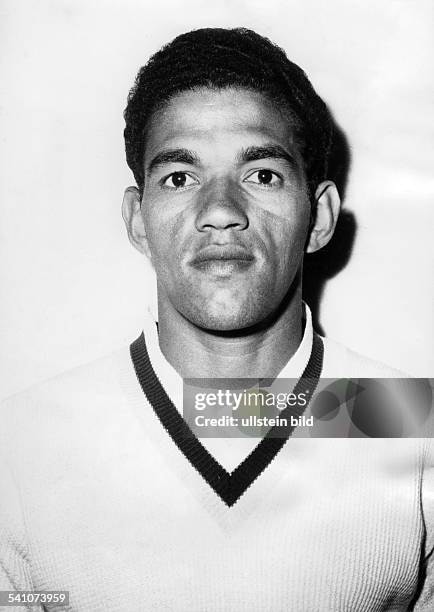
Garrincha
 Brazil
Also known as: Manuel Francisco dos Santos, Alegria do Povo, Mané Garrincha
Birthday
October 28, 1933
Birth Sign
Scorpio
Birthplace
Pau Grande, Magé, Rio de Janeiro, Brazil
Age
Died at 49
Height
5 ft 6 in (1.69 m)
About
Garrincha, born Manuel Francisco dos Santos, was a Brazilian winger remembered as one of the greatest dribblers football has ever seen. More than forty years after his death, he endures in Brazil as a folk hero, the player crowds nicknamed Alegria do Povo, the Joy of the People.
His genius grew out of an unlikely body. Born with legs bent in opposite directions, he turned what should have been a disability into an unreadable dribble, sending defenders the wrong way with a swerve no coaching could teach. He was central to the two proudest moments in Brazilian football, the World Cup wins of 1958 and 1962, and in 1962, with Pele injured early, he carried the team almost single-handedly and finished the tournament as both its best player and its joint top scorer. One statistic still circulates as proof of his importance: Brazil never lost a match in which Garrincha and Pele played together.
He spent the heart of his career at Botafogo, and his name now lives on in the fabric of the game, from the club's dressing room in Rio to the national stadium in Brasilia that carries his name. For Brazilians he represents football at its most joyful and instinctive, the street game raised to art, and his standing has only grown with the retelling.
Early Life & Background
Garrincha grew up in Pau Grande, a working-class district of Magé in Rio de Janeiro state. The son of Amaro Francisco dos Santos, a factory worker, and Maria Carolina de Jesus, he left school after the fourth grade to work in a textile mill. His body was shaped by hardship: polio and a twisted spine left his right leg bowed outward and his left leg six centimeters shorter and curved inward. Doctors performed six operations in his childhood, but the deformities gave him a waddling gait that later became his trademark on the pitch.
He played barefoot in the streets, developing a dribbling style that defenders found impossible to read. At 17 he joined the factory team, Serraria Futebol Clube, but professional clubs like Vasco da Gama, Fluminense, and Sao Cristovao all rejected him because of his legs. In 1953, Botafogo scout Carlos Alberto da Costa saw him play a local match and persuaded the club to sign him, reportedly telling the coach, "He's a deformed cripple, but he plays like a devil."
Career Growth
Garrincha made his Botafogo debut on July 19, 1953, and spent twelve seasons there, winning the Campeonato Carioca in 1957, 1961, and 1962. His international breakthrough came at the 1958 World Cup in Sweden, where he formed a devastating attacking partnership with Pele and provided the assist for the winning goal in the final.
The 1962 World Cup in Chile was his crowning moment. With Pele injured in the second match, Garrincha carried Brazil almost alone, scoring four goals and being named the tournament's best player. He finished as joint top scorer and earned the nickname Alegria do Povo. A famous statistic underlines his impact: Brazil never lost a match in which he and Pele played together.
He played his third World Cup in 1966, but Brazil was eliminated in the group stage. After leaving Botafogo in 1965, he had short, unremarkable spells with Corinthians, Atletico Junior in Colombia, Flamengo on loan, and smaller clubs in Brazil, France, and Venezuela. He retired in 1972, his career cut short by the alcoholism that would define his later years.
Career Timeline
Public Image & Style
Garrincha is remembered as the embodiment of futebol-arte, the joyful, improvisational style that Brazilians consider their footballing soul. He played with a smile on his face, often laughing as he beat defenders, and his dribbling was unpredictable, almost childlike in its creativity. The media has portrayed him as a tragic folk hero, a genius whose pure, instinctive talent was undone by his inability to handle fame and his personal demons. Botafogo fans consider him the greatest player in the club's history, and his number 7 shirt remains a symbol of flair and rebellion. There is no official fandom name, but he is universally known as Alegria do Povo, a nickname that contrasts with Pele's more regal O Rei.
Fame & Fandom
Garrincha never commanded a formal fan club with an official name, yet his legacy endures through a cultural identity known as 'The People's Joy' (*A Alegria do Povo*), a title that functions as the de facto designation for those who revere him as a symbol of Brazilian resilience. His supporters are generally identified by their broader national identity or their allegiance to Botafogo, gathering not for digital campaigns but for collective memory and historical reverence. The rituals associated with him involve recounting stories of his unique playstyle, where he turned matches into spectacles of pure entertainment, making crowds forget political and economic troubles simply by watching him dribble. This enduring mythos places him firmly within the global consciousness of football history. In terms of measured fame metrics, Garrincha is currently the 62nd most famous person in Brazil, holding steady from the previous cycle. He also ranks as the 42nd most famous person from Brazil according to the latest data. These placements reflect a sustained level of attention across media coverage, search trends, and consumption signals worldwide, confirming his status as a historical titan rather than a fleeting celebrity. The iFANN Global Fame Rankings continue to track his prominence among deceased athletes, noting that while his peak was mid-century, his iconic image remains a staple in biographical works and digital archives.
Interesting Facts and Legends
His nickname Garrincha refers to a small, wren-like bird common in Brazil, known for its quick, darting movements. He once dribbled past a Uruguayan defender in the 1958 World Cup, stopped to wait for the man to catch up, and then dribbled past him again. A heavy smoker, he often lit cigarettes on the training field and sometimes before matches. He scored a famous goal by curling a free kick directly from the corner flag in a match against Flamengo. His number 7 jersey remains iconic at Botafogo. Legends persist regarding his physical anomaly; born with legs bent in opposite directions, he developed a center of gravity that left defenders bewildered, earning him the moniker 'The Bent-Legged Angel.' During the 1962 World Cup, after Pelé was injured early, Garrincha carried the team almost single-handedly, scoring crucial goals including a hat-trick against Chile. A story fans still retell involves a red card reversal during that tournament; recent reports suggest the decision was influenced by complex behind-the-scenes dealings, allowing him to remain on the pitch for the final victory. His unpredictable style, described as having 'flying feet,' caused stadiums to erupt in chaos, with some accounts claiming fans fainted from excitement during his runs.
Notable Quotes
“I didn't learn to play football in any school. I learned it by playing in the streets, barefoot, with a rag ball.”
“I'm not afraid of the ball. The ball is my friend.”
“The ball doesn't have legs. It can't run away from you. You have to treat it with love.”
Family & Personal Life
Garrincha was born to Amaro Francisco dos Santos, a factory worker, and Maria Carolina de Jesus in Pau Grande. He had minimal formal education, leaving school after the fourth grade. He fathered at least 14 children with various women, including eight daughters with his first wife, Nair Marques, and a son named Garrinchinha with his second wife, Elza Soares. Garrinchinha died in a car accident in 1986 at age 10. In his final years, Garrincha lived with his common-law partner, Iraci, known as Branca, who cared for him as his health deteriorated. He died in poverty in Rio de Janeiro.
Notable Connections
Garrincha's most famous association is with Pele, his teammate on the Brazilian national team, with whom he formed one of the most formidable attacking duos in football history; Brazil never lost a match when both played together. He was also close to Nilton Santos, his Botafogo and national team teammate. His second wife was the legendary samba singer Elza Soares. The Botafogo scout Carlos Alberto da Costa discovered him.
Relationships & Dating History
Garrincha's first known relationship was with Nair Marques, whom he met in his hometown of Pau Grande. They married in 1952 and had eight daughters together, including a set of twins. The marriage ended in divorce in 1965 due to his infidelities and alcoholism.
While still married to Nair, he began an affair with the famous samba singer Elza Soares, causing a major scandal in Brazil. They married in 1968 and had a son, Garrinchinha, who died in a car accident at age 10. The marriage was tumultuous, marked by Garrincha's severe alcoholism and physical abuse, which Elza later publicly detailed. They separated in 1982 but never formally divorced.
After separating from Elza, Garrincha lived with a woman named Iraci, known as Branca, from 1977 until his death in 1983. She cared for him in his final years. They had one daughter together. He also had a brief, highly publicized fling with model and actress Leila Diniz in the late 1960s. He is believed to have fathered at least 14 children with various women.
As of 2026, Garrincha is deceased. He died on January 20, 1983, separated from Elza Soares and living with his common-law partner, Iraci.
- MarriedNair Marques1952 - 1965Met in Pau Grande; had eight daughters together; divorced due to infidelity and alcoholism.
- MarriedElza Soares1968 - 1982Famous samba singer; had one son, Garrinchinha; separated in 1982 but never formally divorced; relationship marked by alcoholism and abuse.
- DatedIraci "Branca"1977 - 1983Common-law partner; cared for him in his final years; had one daughter together.
- RumouredLeila Diniz1967 - 1968Brief fling with a famous Brazilian model and actress; highly publicized.
Death & Aftermath
Died
January 20, 1983 (aged 49)
Death Place
Rio de Janeiro, Brazil
Cause of Death
Liver failure from chronic alcoholism and cirrhosis
By late 1982, Manuel Francisco dos Santos had been reduced to wandering the streets of Rio de Janeiro as a disheveled and intoxicated figure, a stark contrast to the national hero who once led Brazil to World Cup victory. He passed away on January 20, 1983, at the Hospital Santa Rita in the Tijuca neighborhood, where hospital records and family confirmation established liver failure resulting from chronic alcoholism and cirrhosis as the cause. The broader context of his life involved significant financial exploitation, with managers and associates stealing his earnings.
While there was no specific legal action taken immediately following his death regarding these past thefts, the narrative of his financial ruin became a central part of his posthumous legacy. The public reaction was one of profound national mourning, with tributes pouring in from peers like Pelé, who described Garrincha as the "Bent-Legged Angel," and spontaneous gatherings of fans near his home and Botafogo stadium. The funeral took place on January 21, 1983, just one day after his death, beginning at the Candelária Church before proceeding to the São João Batista Cemetery.
The procession drew thousands of attendees, including fellow legends Nilton Santos and political figures, causing significant traffic gridlock throughout the city during a service marked by eulogies highlighting his humility and unique talent. Posthumously, Garrincha received numerous honors, including inclusion in FIFA's 100 list in 2004, and his legacy is preserved through the Estádio Garrincha in Brasília and various documentaries such as Garrincha: O Rei da Bola . His estate has since been managed by surviving children to support charitable causes.
Net Worth (Estate Value)
$2 Million
iFANN Editorial Team estimate
Garrincha died in extreme poverty in 1983, leaving no significant assets. As of 2026, his estate is managed by his surviving children and generates modest income from posthumous licensing of his name and image for merchandise, documentaries, and video games such as EA Sports FC. Royalties also come from biographical books and films. Per iFANN's editorial analysis, the total value of the estate is $2 Million. Brazilian sports finance outlets estimate the estate's annual licensing and royalty income to be in the low six figures in US dollars. The total estate value is not publicly reported by major sources.
Awards Won (8)
Garrincha won two FIFA World Cups with Brazil (1958, 1962). He was named the 1962 World Cup's Best Player and finished as its joint top scorer. At club level, he won the Campeonato Carioca three times with Botafogo (1957, 1961, 1962) and the Torneio Rio-Sao Paulo in 1964.
1962 · Winner
Brazil national football team
1958 · Winner
Brazil national football team
1962 · Best Player
1962 FIFA World Cup
Known For
1958 FIFA World Cup
1958 · Brazilian winger
1962 FIFA World Cup
1962 · Brazilian winger, Golden Ball winner
Botafogo
1953-1965 · Right winger
Keywords
Quick Facts
- Profession
- association football player
- Born
- +1933-10-28
- Birthplace
- Pau Grande
- Died
- +1983-01-20
- Death Place
- Rio de Janeiro
- Gender
- Male
- Spouse
- Elza Soares
- Birth Sign
- Scorpio
Personal Details
- Full Name
- Manuel Francisco dos Santos
- Height
- 5 ft 6 in (1.69 m)
- Spouse
- Elza Soares
- Children
- 14 (with various partners)
Frequently Asked Questions
Why was Garrincha called the Joy of the People?
How many children did Garrincha have?
What was wrong with Garrincha's legs?
Did Garrincha ever play with Pelé?
What is Garrincha's net worth in 2026?
Similar People

Join the community
fans discussing