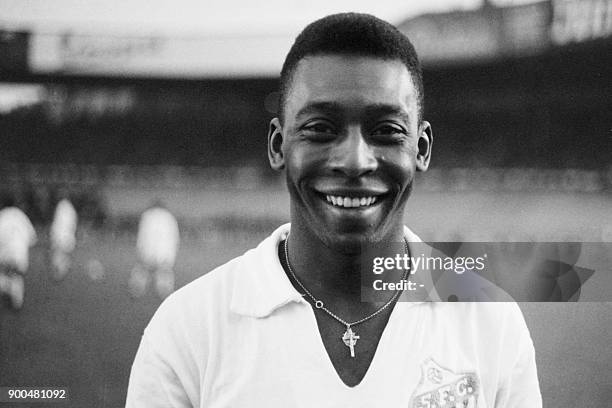
Pelé
 Brazil
Association football player•politician•film actor
Also known as: O Rei, The King, Edson Arantes do Nascimento
Birthday
October 23, 1940
Birth Sign
Sagittarius
Birthplace
Três Corações, Minas Gerais, Brazil
Age
Died at 82
Height
5 ft 8 in (1.73 m)
About
Edson Arantes do Nascimento, universally known as Pelé, was a Brazilian footballer widely regarded as the greatest player of all time. He is the only male player to win three FIFA World Cups (1958, 1962, 1970), a feat that cemented his status as a global icon. Over his career, he scored 1,279 goals in 1,363 games, a Guinness World Record. In 1999, the International Olympic Committee named him Athlete of the Century, and Time included him in its list of the 100 most important people of the 20th century. He was voted FIFA Player of the Century jointly with Diego Maradona in 2000. After retiring in 1977, he served as Brazil's Extraordinary Minister for Sport from 1995 to 1998 and worked as a global ambassador for football, UNESCO, and the UN. He was known for his joyful style, often calling football 'The Beautiful Game,' and his legacy continues to inspire generations of players and fans. He was inducted into the Brazilian Football Museum Hall of Fame, the American Soccer Hall of Fame, and received honorary doctorates from the University of Edinburgh and the University of Massachusetts Boston. He was awarded the Knight Commander of the Order of the British Empire in 1997 and the FIFA Order of Merit in 2004.
Early Life & Background
Pelé grew up in extreme poverty in Bauru, São Paulo state. His father, Dondinho, was a professional footballer who once scored five headers in a single match. His mother Celeste discouraged football, fearing financial hardship. Pelé practiced with a sock stuffed with newspaper tied into a ball. He worked as a tea shop servant to help support his family. At age 11, he organized an unsanctioned local team called the Shoeless Ones with friends. Former Brazil international Waldemar de Brito spotted him playing street football and took him to Santos FC for a trial in 1956. Pelé signed his first professional contract at age 15 and scored on his debut in a friendly against Corinthians de Santo André. He made his Brazil national team debut at 16 on July 7, 1957, scoring his first international goal in a 2–1 loss to Argentina. He was born Edson Arantes do Nascimento on 23 October 1940 in Três Corações, Minas Gerais, named after Thomas Edison, though his birth certificate lost the 'i'. He had limited formal education, leaving school early to focus on football.
Career Growth
Pelé's breakthrough came at the 1958 FIFA World Cup in Sweden, where at 17 years and 249 days he became the youngest player to appear in a World Cup final. He scored two goals in a 5–2 victory over Sweden, finishing the tournament with six goals including a hat-trick in the semi-final against France. He was nicknamed O Rei (The King) afterward. In 1962, he won his second World Cup in Chile despite a group-stage injury that sidelined him for the knockout rounds. At club level, he led Santos to the 1962 and 1963 Copa Libertadores and Intercontinental Cup titles, defeating Benfica and AC Milan. His crowning achievement came at the 1970 World Cup in Mexico, where he scored four goals, including a dummy that left the goalkeeper stranded in the final, and provided the assist for Carlos Alberto's iconic fourth goal as Brazil won 4–1 against Italy. After 18 seasons at Santos, he retired in 1974 with 643 competitive goals in 659 games. He came out of retirement in 1975 to play for the New York Cosmos in the NASL, winning the 1977 championship and helping popularize soccer in the United States before retiring permanently on October 1, 1977. He served as Brazil's Extraordinary Minister for Sport from 1995 to 1998, was named honorary president of the New York Cosmos in 2010, and won numerous awards including South American Player of the Year in 1973, the Laureus Lifetime Achievement Award in 2006, and the Grand Cross of the Order of Rio Branco in 2014.
Career Timeline
Public Image & Style
Pelé was universally celebrated as the personification of 'The Beautiful Game,' known for his humble demeanor, dazzling skill, and infectious smile. His signature style combined graceful dribbling, powerful shots, and remarkable athleticism, often performed with an air of joy and sportsmanship. Media and fans revered him as 'O Rei' (The King), a title that reflected both his on-field dominance and his role as a global ambassador for football. He maintained a modest, approachable persona despite his fame, frequently engaging with fans and promoting peace through sport. His social media presence, managed posthumously by his estate, continues to share archival moments and inspirational messages. Fan culture around Pelé is characterized by deep admiration and respect; his legacy transcends club loyalties, uniting football enthusiasts worldwide. He was often depicted in popular culture as a symbol of excellence and integrity, with his image appearing on stamps, murals, and in films. He appeared on the covers of Time (1969), Sports Illustrated (1970), Rolling Stone (1975), and National Geographic (1975). He received keys to numerous cities worldwide and has a star on the Hollywood Walk of Fame (2020).
Fame & Fandom
Decades after his final whistle, the global attention surrounding Edson Arantes do Nascimento remains a gravitational force that refuses to fade. He is currently the 90th most famous person in the world, a position he has held steady through cycles of cultural shift and digital transformation. In his homeland, his stature is even more absolute; he stands as the 5th most famous person in Brazil and the 3rd most famous person from Brazil. His influence extends across the hemisphere where he was born, ranking him the 5th most famous person in Latin America, while within the specific realm of his sport, he secures the 15th most famous person in Football / Soccer. These placements reflect a legacy tracked by iFANN Global Fame Rankings. Pelé never cultivated a formalized fanbase with a unique collective noun like those seen in modern pop culture. Instead, supporters identified simply as fans of Brazil or Santos FC, united by the moniker 'O Rei' (The King). This lack of a branded label did not diminish the devotion; it manifested as an organic, universal reverence. When he passed in December 2022, streets in Brazil shut down for his funeral procession, turning his death into a national event rather than a celebrity loss. The emotional connection remained tangible decades later, evidenced when his 1958 World Cup final jersey sold for $4.9 million in July 2026. That auction price underscores how deeply fans value his physical artifacts. Even the New York Cosmos, the team he joined in 1975, continues to operate under his enduring brand, keeping his spirit alive in American soccer landscapes without needing a specific fandom name to drive their engagement.
Interesting Facts and Legends
Edson Arantes do Nascimento, universally known as Pelé, carries a legacy built on both verified records and enduring folklore. Born in Três Corações, he was named after Thomas Edison, though a clerical error dropped the 'i' from his birth certificate. He was a multi-talented artist who played guitar, recorded the 1977 album 'Pelé: The King of Soccer,' and starred alongside Sylvester Stallone and Michael Caine in the 1981 film 'Escape to Victory.' On the pitch, his scoring prowess was mythical; he once netted eight goals in a single match against Botafogo in 1964 and claimed his 1,000th career goal via a penalty against Vasco da Gama in 1969. A practicing Catholic, he credited his faith for his success despite being a heavy smoker in his youth before quitting in the 1970s. His international career faced turbulence when he was banned from the 1966 World Cup following a controversial tackle on a Bulgarian player, yet he returned to lift the Jules Rimet trophy in 1970, becoming the only male player to win three FIFA World Cups.
Legends surrounding his career often outpace the archives. The story of his 1958 World Cup final performance at age 17, where he became the youngest player ever to score in a final, cemented his status as a prodigy. Another widely retold tale involves his 'lost goal' from 1969 against Argentina, which he considered his greatest but which vanished due to technical issues. As of July 2026, this incident has been revisited with AI technology reconstructing the goal based on eyewitness accounts and match data, validating the folklore that it was a spectacular solo effort. A statue unveiled in Bauru, Brazil, in 2025 further honors a man whose life transcended statistics to become a global icon.
Notable Quotes
“Success is no accident. It is hard work, perseverance, learning, studying, sacrifice and most of all, love of what you are doing or learning to do.”
“I was born for football, just as Beethoven was born for music.”
“Football is the only thing that can unite the world.”
“I want to be remembered as a man who loved football and who tried to make it better.”
“The beautiful game.”
Family & Personal Life
Pelé's father, João Ramos do Nascimento (Dondinho), was a professional footballer who once scored five headers in a single match. His mother, Celeste Arantes, was a homemaker who initially opposed his football career. He had no siblings. He was married three times. His first wife, Rosemeri dos Reis Cholbi, was 16 when they married in 1966; they had three children: Kelly Cristina (born 1967), Edinho (born 1970), and Jennifer (born 1978). They divorced in 1982. His second wife, Assíria Nascimento, a psychologist and gospel singer, married him in 1994 and had twin sons, Joshua and Celeste (born 1996); they separated in 2008. His third wife, Marcia Aoki, a Japanese-Brazilian businesswoman, married him in 2016 and was with him at his death. He acknowledged seven children, including two from relationships with Lenita Kurtz (the model Sandra, born 1964) and Lenita Kurtz (the journalist Flávia, born 1968), and a son, Pedro, from another relationship. He also had a daughter, Flávia, with journalist Lenita Kurtz (a different Lenita) in 1968, and a son, Pedro, from another relationship. He was a practicing Catholic and credited his faith for his success.
Notable Connections
Pelé played alongside legendary teammates including Garrincha, Mário Zagallo, and Carlos Alberto on Brazil's World Cup-winning teams. He collaborated with coach Vicente Feola in 1958 and with Zagallo as both teammate and later coach in 1970. His partnership with Garrincha on the right flank was instrumental in Brazil's 1958 and 1962 titles. At Santos, he played with players like Pepe and Zito. In the New York Cosmos, he played alongside Franz Beckenbauer and Giorgio Chinaglia. Off the field, he worked with directors John Huston and Michael Caine on the film 'Escape to Victory.'
Relationships & Dating History
Pelé's first public relationship was with Brazilian model and actress Lenita Kurtz in the 1960s, with whom he had a daughter, Sandra (born 1964), whom he initially denied but later acknowledged via DNA testing. He married Rosemeri dos Reis Cholbi in 1966 when she was 16; they had three children and divorced in 1982 after his infidelities became public. From 1981 to 1986, he had a highly publicized relationship with Brazilian TV host Xuxa Meneghel, who was 17 at the start while Pelé was 41. He married psychologist and gospel singer Assíria Nascimento in 1994; they had twin sons and separated in 2008. His third marriage was to Japanese-Brazilian businesswoman Marcia Aoki in 2016, who remained with him until his death. He also fathered a daughter, Flávia, with journalist Lenita Kurtz (a different Lenita) in 1968, and a son, Pedro, from another relationship. As of 2026, Pelé is deceased; at the time of his death, he was married to Marcia Aoki. He had a total of seven acknowledged children, including Sandra, Flávia, Pedro, Kelly Cristina, Edinho, Jennifer, and twins Joshua and Celeste.
- RumouredLenita Kurtz (model)1963 - 1965Pelé had a public relationship with model Lenita Kurtz; they had a daughter Sandra, later acknowledged via DNA test.
- MarriedRosemeri dos Reis Cholbi1966 - 1982First wife; married when she was 16; had three children; divorced due to infidelity.
- RumouredLenita Kurtz (journalist)1967 - 1969Relationship with journalist Lenita Kurtz; they had a daughter Flávia in 1968.
- DatedXuxa Meneghel1981 - 1986Highly publicized relationship with Brazilian TV host; she was 17 at the start, he was 41.
- MarriedAssíria Nascimento1994 - 2008Second wife; psychologist and gospel singer; had twin sons; separated in 2008.
- MarriedMarcia Aoki2016 - 2022CurrentThird wife; Japanese-Brazilian businesswoman; remained with him until his death.
Death & Aftermath
Died
December 29, 2022 (aged 82)
Death Place
São Paulo, Brazil
Cause of Death
Complications from stage IV colon cancer
Brazil declared three days of national mourning as the world paused to honor a figure who had reshaped the game, with tributes pouring in from Brazilian President Jair Bolsonaro and FIFA President Gianni Infantino, while fans gathered at Maracanã Stadium and outside the Albert Einstein Israelite Hospital. The global outpouring included memorial murals appearing across continents before the nation turned its gaze inward for a final farewell. On January 4, 2023, thousands lined the streets of Santos for a state funeral held at Vila Belmiro, the home of Santos FC, where dignitaries, former presidents, and legends like Garrincha and Zico paid their respects before his interment in the Pelé mausoleum.
The King of Football passed away on December 29, 2022, at the age of 82 within the walls of the Albert Einstein Israelite Hospital in São Paulo. His family confirmed that his condition had deteriorated rapidly due to multiple organ failure resulting from stage IV colon cancer, a diagnosis he received in September 2021 following an unsuccessful surgical attempt to remove a tumor. Posthumously, his legacy was further cemented by the release of the documentary Pele: The King of Football and a collaboration between Google DeepMind and his estate to reconstruct his famous lost goal using artificial intelligence, ensuring his influence would endure through technology and sport.
Net Worth (Estate Value)
$120 Million
iFANN Editorial Team estimate
Per iFANN's editorial analysis, Pelé's net worth in 2026 is estimated at $120 Million. The majority of his wealth comes from endorsement deals with global brands such as Pepsi, Mastercard, Subway, and Hublot, which collectively generated an estimated $15–20 million annually during his peak years. His playing career, while historic, contributed modestly: his salary at Santos and the New York Cosmos, adjusted for inflation, totaled roughly $10 million per year over his prime. Post-retirement, Pelé monetized his legacy through licensing his name and image for video games (including the FIFA series), films like the 2021 Netflix documentary, and merchandise. He also held a minority ownership stake in Santos FC (estimated value $5–10 million) and owned real estate in Brazil, New York, and Dubai. His philanthropic foundation supports children's education and sports, which may reduce his personal holdings.
Awards Won (17)
Pelé won three FIFA World Cups (1958, 1962, 1970), a record unmatched by any male player. At club level, he won two Copa Libertadores (1962, 1963) and two Intercontinental Cups (1962, 1963) with Santos. He was named South American Player of the Year in 1973 and received the Bola de Ouro as best player of the Campeonato Brasileiro in 1970. He was jointly awarded the FIFA Player of the Century in 2000 and the Athlete of the Century by the IOC in 1999. He also received the Laureus Lifetime Achievement Award in 2006 and was made an honorary Knight Commander of the Order of the British Empire in 1997.
1970 · Winner
Brazil national team
1962 · Winner
Brazil national team
1958 · Winner
Brazil national team
1963 · Winner
Santos FC
1962 · Winner
Santos FC
Known For
1958 FIFA World Cup
1958 · Forward
1962 FIFA World Cup
1962 · Forward
1970 FIFA World Cup
1970 · Forward
Santos FC
1956 · Forward
New York Cosmos
1975 · Forward
Keywords
Quick Facts
- Profession
- Association football player, politician, film actor
- Born
- October 23, 1940
- Birthplace
- Três Corações, Minas Gerais, Brazil
- Died
- December 29, 2022
- Death Place
- São Paulo, Brazil
- Gender
- Male
- Spouse
- Rosemeri dos Reis Cholbi, Assíria Nascimento, Marcia Aoki
- Height
- 5 ft 8 in (1.73 m)
- National Team
- Brazil (92 caps, 77 goals)
Personal Details
- Full Name
- Edson Arantes do Nascimento
- Height
- 5 ft 8 in (1.73 m)
- Spouse
- Rosemeri dos Reis Cholbi, Assíria Nascimento, Marcia Aoki
- Children
- 7 acknowledged: Kelly Cristina, Edinho, Jennifer, Sandra, Flávia, Joshua, Celeste
Filmography
5
Total
3
Film
2
TV
Frequently Asked Questions
How old was Pelé when he died?
What is Pelé's net worth in 2026?
What is Pelé best known for?
Who was Pelé married to at the time of his death?
Did Pelé play in the 1966 World Cup?
Social Media
Similar People


Join the community
fans discussing