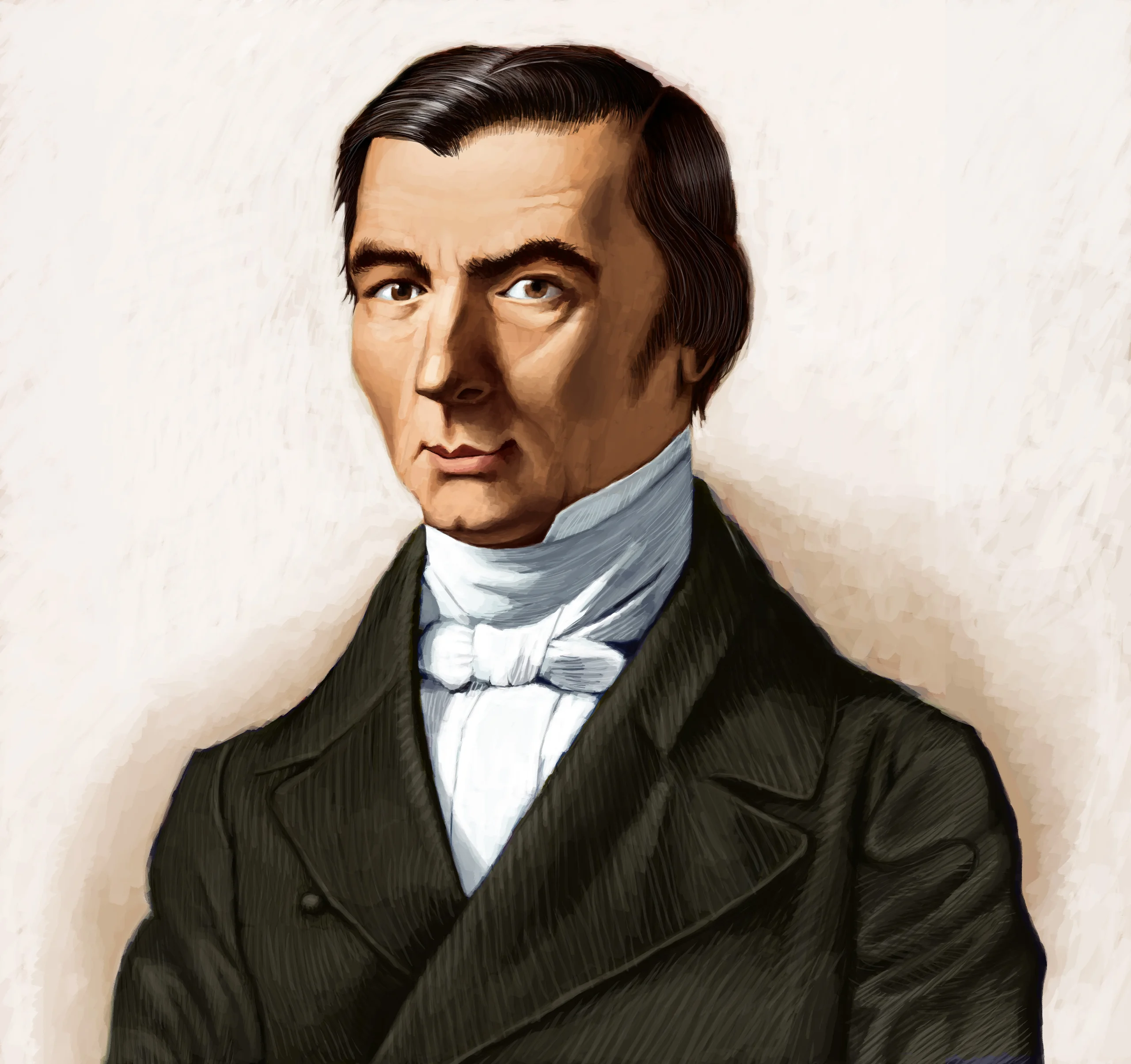
Frédéric Bastiat
 France
philosopher•economist•essayist
Also known as: Claude-Frédéric Bastiat, Frederic Bastiat
Birthday
June 30, 1801
Birth Sign
Sagittarius
Birthplace
Bayonne, France
Age
Died at 49
About
Claude-Frédéric Bastiat stands as a towering figure in the history of classical liberal thought, renowned for his unparalleled ability to distill complex economic principles into clear, witty, and accessible prose. Born on June 30, 1801, in the port city of Bayonne, he dedicated his short life to advocating for free markets, free trade, and limited government intervention. His legacy is defined not by the length of his life, which ended at the age of 49, but by the profound and enduring impact of his writings on modern economic discourse. He is widely celebrated for introducing concepts that remain central to economic education today, such as the parable of the broken window and the rigorous definition of opportunity cost.
Bastiat's intellectual contribution extends beyond mere theory; he possessed a unique talent for satire and moral philosophy, often using humor to expose the fallacies of protectionism and state overreach. His most famous work, The Law (*La Loi*), published in 1850, remains a foundational text arguing that the sole purpose of law is to protect individual rights—life, liberty, and property—and that any state action extending beyond this constitutes "legal plunder." This treatise crystallized his belief in the sanctity of private property and the dangers of redistributive justice.
The depth of his influence was recognized even by critics and contemporaries who might disagree with his conclusions. Economist Joseph Schumpeter later hailed him as "the most brilliant economic journalist who ever lived," a title that reflects Bastiat's skill in explaining intricate ideas with clarity and humor. His works, including the posthumously published Economic Harmonies, continue to shape policy debates nearly two centuries after his death. Today, he is viewed as a moral philosopher as much as an economist, serving as a bridge between abstract theory and the practical concerns of ordinary people, with his ideas remaining a touchstone for libertarians and classical liberals worldwide.
Early Life & Background
The early life of Claude-Frédéric Bastiat was marked by both tragedy and a formative rural upbringing that would deeply influence his future economic theories. Born into a family of wine merchants in Bayonne, a bustling port in southwestern France, he was the son of Jean-Baptiste Bastiat and Marie-Thérèse Darricau. However, his childhood was cut short by profound loss when both his parents died within a short period while he was only nine years old. Following their deaths, he was raised by relatives in the countryside near Mugron in the Landes region. This isolation from the urban centers of commerce instilled in him a deep appreciation for agriculture and a firsthand understanding of the struggles faced by the working class, themes that would permeate his later writings.
Unlike many intellectuals of his era who pursued exclusive academic careers, Bastiat possessed a distinctively practical bent. He received his formal education at the Collège de Bayonne and later attended the Lycée de Pau, but he did not follow a traditional university path to learn economics. Instead, he taught himself through extensive reading, particularly immersing himself in the works of Adam Smith and other classical thinkers. Before entering the world of high-level economics, he worked as a clerk and managed a family estate, gaining hands-on experience with the realities of property management, taxation, and local commerce.
His initial steps toward a career involved writing pamphlets and articles for local newspapers during the 1830s and early 1840s. During this period, he focused heavily on agricultural issues and the devastating impact of tariffs on French farmers. These early writings were not merely theoretical exercises but critiques born of direct observation, allowing him to bridge the gap between abstract economic theory and the tangible concerns of ordinary people. This decade of self-education and local activism laid the essential groundwork for his eventual breakthrough as an intellectual giant, transforming him from a provincial clerk into a national voice for liberty.
Career Growth
Bastiat's rise to prominence began in earnest during the 1840s, driven by a series of strategic publications and political engagements that challenged the prevailing protectionist orthodoxy of the time. His first major project in this era involved writing essays on agricultural tariffs, but his true breakthrough came with the publication of The Law (*La Loi*) in 1850. This concise yet powerful treatise argued that the sole purpose of law is to protect individual rights—specifically life, liberty, and property—and that any state action beyond this constitutes "legal plunder." Prior to this, in 1845, he wrote the satirical masterpiece The Petition of the Candlemakers, which mocked protectionist arguments by suggesting candlemakers demand sunlight be blocked to create jobs, a move that brought him widespread attention for its sharp wit.
Following the French Revolution of 1848, Bastiat was elected to the French National Assembly as a representative of the conservative-liberal faction. During his brief tenure, he passionately argued against protectionist tariffs and for free trade, serving as a vocal advocate for the poor against the privileged interests of industrialists. Even as his health began to fail due to tuberculosis, he continued to write prolifically, producing seminal essays such as "What Is Seen and What Is Not Seen." In this work, he introduced the concept of opportunity cost and the famous parable of the broken window, illustrating the hidden costs of destruction and the fallacy of seeing only immediate benefits.
While his commercial success was measured not in bestseller lists but in the profound influence of his ideas on the Austrian School of Economics and modern libertarian thought, his reputation grew steadily. Economist Joseph Schumpeter later hailed him as "the most brilliant economic journalist who ever lived." His works, including Economic Harmonies (published posthumously), continue to shape economic discourse and policy debates nearly two centuries after his death. The Circle Bastiat, founded in New York in the 1950s, played a pivotal role in reviving interest in his work and igniting the modern Austrian economics revival, cementing his status as a foundational thinker alongside Adam Smith and David Ricardo.
Career Timeline
Public Image & Style
Bastiat is portrayed as a lucid, witty, and principled defender of liberty, distinguished by a writing style characterized by clarity, humor, and logical rigor. Media and academic portrayals emphasize his role as a bridge between theoretical economics and practical policy, often citing his unique ability to explain complex ideas in simple terms without sacrificing depth. He is viewed as a moral philosopher as much as an economist, with a tone that is both urgent and compassionate toward the common person. His legacy has been honored extensively posthumously, with institutions like the Mises Institute, the Foundation for Economic Education (FEE), and the Liberty Fund maintaining extensive archives and publishing his works.
In the realm of economics and political philosophy, his standing is supreme, often ranked alongside Adam Smith and David Ricardo as one of the top three classical economists of the 19th century. While he does not appear in pop-culture "Greatest of All Time" lists like Rolling Stone or Billboard, his inclusion in every major textbook on classical liberalism and his citation in policy debates worldwide serve as a testament to his enduring status. A 2019 tribute by *Forbes* calling him "The Most Brilliant Economic Journalist Who Ever Lived" further cemented this title in modern economic literature. His image remains that of a statesman whose intellectual influence far outpaced his physical presence, inspiring foundations and scholarships dedicated to promoting free-market economics long after his burial.
Fame & Fandom (iFAMOUS Rankings)
As of September 2026, Frédéric Bastiat holds no spot in the Global Top 1,000 of contemporary celebrity rankings, nor in any Top-100 scope list, simply because his fame operates on an intellectual rather than a pop-cultural level. His admirers have no formal name like "Bastiatians"; instead, they are organized under broader labels such as classical liberals, libertarians, Austrian school economists, and free-market advocates. These groups engage in intellectual advocacy rather than fan campaigns, utilizing his ideas in modern tariff debates, op-eds, and educational materials. Notable activities include annual birthday tributes on June 30 by organizations like the American Enterprise Institute and the Mises Institute, where his relevance to current policy discussions is highlighted.
Inside jokes abound among his followers: the broken-window parable and the satirical 'Petition of the Candlemakers' serve as shorthand among economists and libertarians. For a man who died in 1850, his intellectual afterlife remains lively, with institutions like the Circle Bastiat and the Frédéric Bastiat Fellowship Program keeping his legacy alive. Hashtags like #Bastiat, #BrokenWindowFallacy, and #FreeTrade frequently trend on platforms like X (Twitter) and Facebook during economic policy debates. While there is no official fan club or merchandise-driven community, his quotes and ideas are widely shared by libertarian groups and think tanks. Educational initiatives continue to host fellowships and events dedicated to his work, ensuring that his insights on opportunity cost and legal plunder remain active tools in the arsenal of free-market advocates worldwide.
Interesting Facts and Legends
Bastiat lost both parents by the age of nine, a hardship that likely fueled his empathy for the vulnerable and his skepticism of state power. Unlike many peers, he had no formal university degree in economics; his knowledge was self-acquired through voracious reading. His ability to use humor and satire, particularly in the *Petition of the Candlemakers*, made complex economic concepts accessible to the general public. He suffered from tuberculosis for much of his adult life, yet maintained a rigorous writing schedule until his final days. A story fans retell is that Bastiat wrote his magnum opus in the final year of his life, his health failing, yet his prose stayed sharp.
The line "No legal plunder; this is the principle of justice, peace, order, stability, harmony and logic" remains one of his most quoted phrases. Specific details regarding Bastiat's height or physical appearance are scarce in historical records, though contemporary accounts describe him as "simple in his manner and plain in his attire." There are no documented magazine covers featuring Frédéric Bastiat from his lifetime, as the modern concept of celebrity magazine covers did not exist in the same form during the mid-19th century. Posthumous tributes have appeared in publications like *Forbes* (2019) and *The Hill*, but these are opinion pieces or digital features rather than traditional cover stories. His inclusion in the Econlib Encyclopedia as a primary source for the "broken-window fallacy" highlights his lasting pedagogical value.
Notable Quotes
“No legal plunder; this is the principle of justice, peace, order, stability, harmony and logic.”
“It is not enough to say that the law should protect private property; it must also be shown that the law cannot be used to plunder it.”
“Slavery, protection, and monopoly find defenders, not only in those who profit by them, but in those who suffer by them.”
“When the law and morality are at odds... the law becomes an instrument of plunder.”
Family & Personal Life
Bastiat was the son of Jean-Baptiste Bastiat and Marie-Thérèse Darricau, a family of wine merchants based in Bayonne. His early life was defined by the tragic loss of both parents when he was just nine years old, an event that forced him to be raised by relatives in the countryside near Mugron in the Landes region. This rural upbringing instilled in him a deep appreciation for agriculture and a firsthand understanding of the struggles faced by the working class, themes that would later permeate his economic writings. Historical records consistently describe him as a man dedicated entirely to his work and his principles, living a simple, ascetic life often characterized by plain attire and manner.
Despite his public prominence, there are no public records of engagements, marriages, or dating history, as he remained single throughout his life. He never married and had no known romantic relationships or children, focusing his energy exclusively on writing and political activism rather than personal romance. His family preserved his manuscripts after his death, ensuring his works were translated and published globally. Contemporary accounts describe him as possessing a good-natured attitude and wearing country costume, reflecting his humble origins and dedication to his cause. No specific details regarding his height or weight are available in standard biographical sources, but his physical presence was noted for its simplicity and lack of pretension.
Notable Connections
Relationships & Dating History
Frédéric Bastiat never married and had no known romantic relationships or children. Historical records consistently describe him as a man dedicated entirely to his work and his principles. He lived a simple, ascetic life, often described as plain in attire and manner, focusing his energy on writing and political activism rather than personal romance. There are no public records of engagements, marriages, or dating history, as he remained single throughout his life. As of his death in 1850, he was unmarried and childless.
Contemporary accounts suggest that his devotion to his cause left little room for personal attachments. He is remembered not for a partner or family life, but for his unwavering commitment to the principles of liberty and justice. His lack of romantic entanglements allowed him to dedicate his full attention to his writings and his service in the French National Assembly. This singular focus contributed to his reputation as a man of pure conviction, whose life was entirely consumed by the pursuit of truth and the defense of individual rights. The absence of a spouse or children meant that his legacy passed solely through his written works, which were carefully preserved by his extended family and later by the institutions that championed his ideas.
Death & Aftermath
Died
December 24, 1850 (aged 49)
Death Place
Rome, Italy
Cause of Death
Tuberculosis (consumption)
On Christmas Eve of 1850, Claude-Frédéric Bastiat passed away in Rome at the age of 49. He had traveled to the Italian capital seeking relief from tuberculosis, a disease that had weakened him for years, but the warmer climate offered no cure. Medical records from attending physicians confirmed consumption as the cause without dispute or need for further legal investigation. His final days were spent writing and reflecting on his work before succumbing to the illness. The immediate reaction to his death was a wave of tributes from fellow advocates of free trade. Richard Cobden and other contemporaries mourned the loss of a defining voice for their movement through articles in economic journals and newspapers.
The Free Trade Association declared his passing a significant blow to liberal thought, recognizing the void left by his absence. A funeral was held shortly after his death in Rome, honoring a statesman whose intellectual influence far outpaced his physical presence. In the aftermath, his family took charge of preserving his manuscripts, ensuring that works like The Law and Economic Harmonies were translated and published globally. These posthumous releases cemented his status as a foundational figure of classical liberalism. His legacy inspired the creation of foundations and scholarships dedicated to promoting free-market economics, transforming a provincial scholar into a global icon of liberty long after his burial.
The Circle Bastiat, founded in New York in the 1950s, played a pivotal role in reviving interest in his work and igniting the modern Austrian economics revival. In 2019, *Forbes* published a tribute calling him "The Most Brilliant Economic Journalist Who Ever Lived," cementing this title in modern economic literature. As of 2026, his ideas remain highly active in contemporary discourse, with outlets like *Financial Post* and *AEI* publishing tributes highlighting his relevance to modern tariff debates. His influence continues to be felt in policy debates, with recent pieces in *The Daily Economy* and *CEI* reaffirming his insights on opportunity cost and the broken-window fallacy.
Net Worth (Estate Value)
$0
iFANN Editorial Team estimate
Frédéric Bastiat died in 1850, leaving behind a modest estate typical of a provincial scholar and legislator of that era. There is no recorded net worth in modern currency terms, nor are there estimates for a 2026 net worth, as he has been deceased for nearly two centuries. His estate was managed by his family, who preserved his manuscripts. Today, his "wealth" is measured in the value of his intellectual property, which generates royalties and licensing fees for publishers, though these earnings go to the estates of publishers and the institutions managing his copyright (which is largely in the public domain globally). No specific dollar figures exist for his personal wealth.
While he did not accumulate significant financial assets during his lifetime, his economic influence has generated immense value for the free-market movement. The intellectual property associated with his name continues to generate revenue for publishers and institutions that manage his legacy, such as the Mises Institute and the Foundation for Economic Education. However, unlike modern celebrities whose net worth is tied to endorsements and media deals, Bastiat's financial legacy is purely academic and ideological. His works are freely available in many contexts due to the expiration of copyrights, making his "wealth" a matter of global accessibility rather than private accumulation. The absence of specific financial records from his life reflects his humble lifestyle and the fact that his primary investment was in his ideas rather than capital.
Awards & Accolades
View 6 records, honours and achievementsKnown For
The Law
1850 · Author
Economic Harmonies
1850 · Author
What Is Seen and What Is Not Seen
1850 · Essayist
Keywords
Sources
Quick Facts
- Profession
- philosopher, economist, essayist
- Born
- June 30, 1801
- Birthplace
- Bayonne, France
- Died
- December 24, 1850
- Death Place
- Rome, Italy
- Gender
- Male
- Birth Sign
- Sagittarius
Personal Details
- Full Name
- Claude-Frédéric Bastiat
- Children
- Education
- Collège de Bayonne; Lycée de Pau
Frequently Asked Questions
Who was Frédéric Bastiat?
How did Frédéric Bastiat die?
What is the "broken window fallacy"?
Did Frédéric Bastiat have children?
Why is Frédéric Bastiat still relevant today?
Similar People
Join the community
fans discussing