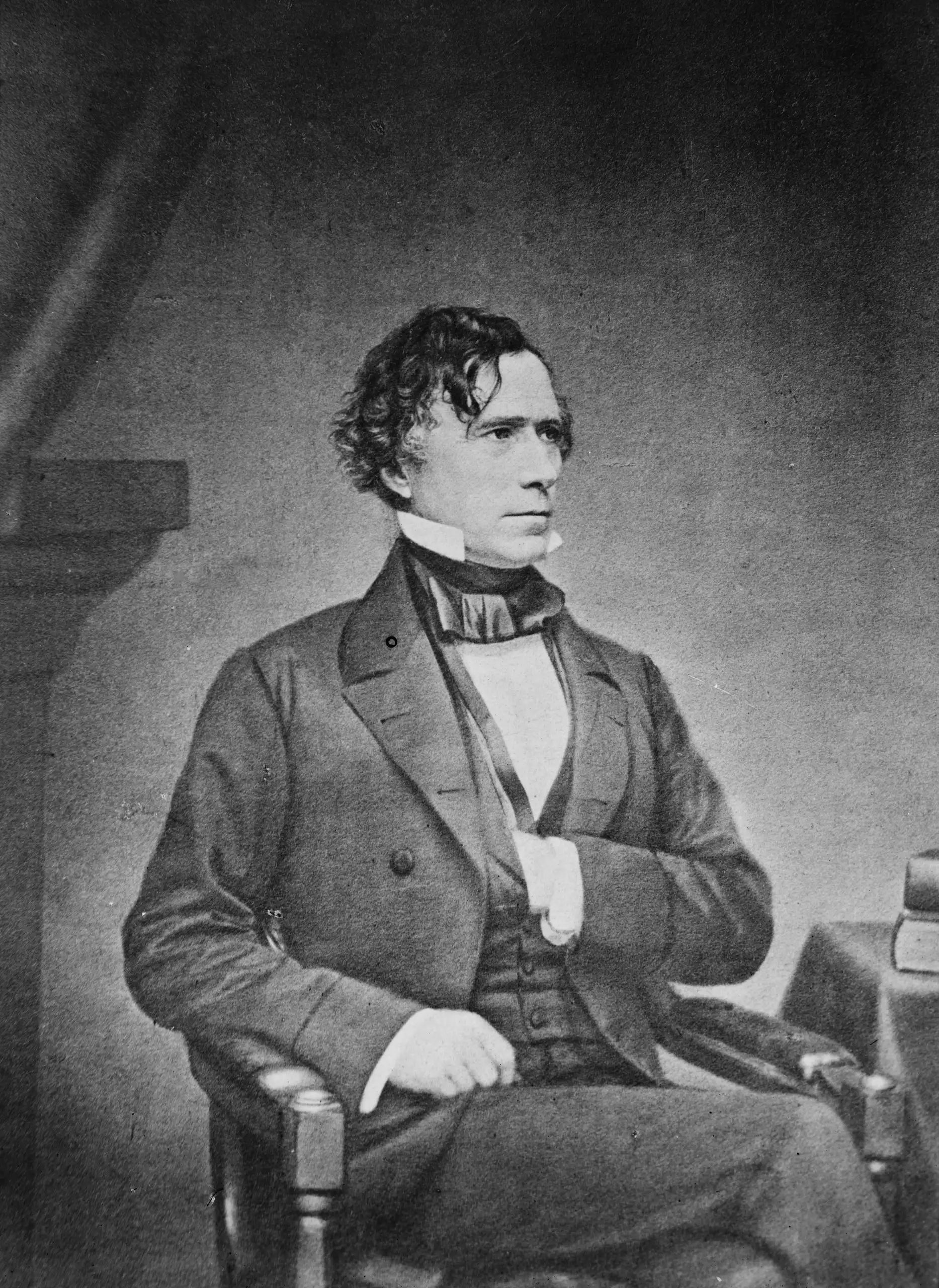
Franklin Pierce
politician•lawyer•statesperson
Also known as: Young Hickory, Victor of Cerro Gordo
Birthday
November 23, 1804
Birth Sign
Sagittarius
Birthplace
Hillsborough, New Hampshire
Age
Died at 64
Height
5 ft 8 in (173 cm)
About
Franklin Pierce was the 14th President of the United States, serving from 1853 to 1857. A northern Democrat from New Hampshire, he entered office hoping to heal the nation's growing rift over slavery but instead presided over a presidency marked by deep sectional divisions that ultimately contributed to the onset of the American Civil War. His administration pursued expansionist goals through the Gadsden Purchase and signed significant trade treaties with Britain and Japan, yet his legacy is overshadowed by his support for the Kansas–Nebraska Act. This legislation repealed the Missouri Compromise and reignited violent conflicts over slavery in the West.
Beyond his political career, Pierce is remembered for a deeply tragic personal life. He lost all three of his sons before reaching adulthood, with the death of his youngest son, Benjamin, occurring just days before his inauguration. A heavy drinker throughout his life, Pierce struggled with alcoholism and depression, which exacerbated his health decline in his later years. He died on October 8, 1869, in Concord, New Hampshire, leaving behind a legacy that historians often rank as one of the least effective in U.S. history due to his inability to prevent the war he warned against.
Early Life & Background
Franklin Pierce was born on November 23, 1804, in Hillsborough, New Hampshire, a small village in the Granite State. He was the second child of Benjamin Pierce, a Revolutionary War veteran who later served as a brigadier general in the War of 1812 and as Governor of New Hampshire, and Jane Appleton. The family lived in modest circumstances, and Benjamin Pierce's political career provided some stability but also frequent relocations. Franklin grew up in an environment steeped in public service and military tradition, which would heavily influence his future path.
Before entering politics, Pierce attended Bowdoin College in Brunswick, Maine, graduating in 1824 alongside future novelist Nathaniel Hawthorne and politician John P. Hale. At Bowdoin, Pierce excelled in oratory and debate, earning the nickname "Young Hickory" after Andrew Jackson, the era's dominant political figure. He was admitted to the bar in 1827 and began practicing law in Concord, New Hampshire. His legal career was successful, though he initially struggled with alcoholism, a condition that plagued him throughout his life. In 1828, he entered state politics, serving in the New Hampshire House of Representatives and later as Speaker of the House at the age of 26.
Pierce's political ascent continued rapidly. He was elected to the U.S. House of Representatives in 1833 as a Democrat, representing New Hampshire's 2nd district. He served there until 1842, where he gained a reputation as a staunch supporter of the party line and a defender of states' rights. During this time, he married Jane Means Appleton in 1834; she was the daughter of a prominent Boston minister. Their marriage was difficult, as Jane disapproved of Pierce's drinking and lack of religious fervor. Despite these personal struggles, Pierce remained a rising star in the Democratic Party, setting the stage for his eventual nomination as a compromise candidate in 1852.
Career Growth
A pivotal moment in Pierce's career occurred during the Mexican–American War. Although he had no prior military experience, Pierce volunteered for service in 1846. He quickly distinguished himself under General Winfield Scott, rising to the rank of Brigadier General. His bravery at the Battle of Contreras and the Battle of Churubusco earned him national acclaim and the title "Victor of Cerro Gordo." This military success propelled him into the national spotlight as a potential presidential candidate.
In 1852, the Democratic Party, fractured between Northern and Southern factions, nominated the relatively unknown Pierce as a compromise candidate. He defeated the Whig ticket of Winfield Scott and William Alexander Graham in the general election, winning 254 electoral votes to Scott's 42. He took office on March 4, 1853, aiming to heal the nation's growing rift over slavery. However, his presidency is often cited by historians as one of the least effective in U.S. history due to his inability to prevent the escalation of tensions.
Key legislative achievements and failures included the Gadsden Purchase in 1853, which secured land in present-day Arizona and New Mexico for a southern transcontinental railroad route, and the signing of trade treaties with Britain and Japan. Domestically, his most consequential act was the Kansas–Nebraska Act of 1854. Sponsored by Senator Stephen Douglas but championed by Pierce, the act repealed the Missouri Compromise of 1820, allowing settlers in those territories to decide the issue of slavery through "popular sovereignty." This decision effectively nullified decades of compromise, sparked violent conflicts known as "Bleeding Kansas," and destroyed the Whig Party while fracturing the Democrats along sectional lines.
Career Timeline
Public Image & Style
Pierce is portrayed as a tragic figure, a man of talent and charm who was undone by the forces of history and his own personal demons. The media often focuses on his alcoholism and the loss of his children, painting a picture of a man who was ill-equipped to handle the moral crises of his time. His public image is generally negative, characterized by a narrative of tragedy and failure. He is often depicted as a well-meaning but weak leader who was overwhelmed by the forces of sectional conflict. The media portrays him as a cautionary tale of how a president can fail to manage a divided nation, with his legacy serving as a reminder of the dangers of ignoring deep-seated national divisions.
Fame & Fandom (iFAMOUS Rankings)
iFANN has not yet collected fame data for this person. As a historical figure from the mid-19th century, Franklin Pierce does not have a modern fandom in the sense of pop culture celebrities. Interest in him is limited to historians, students, and enthusiasts of American political history. There is no organized fanbase or formal name for his supporters. The narrative surrounding his life and presidency is primarily academic, focusing on his role in the lead-up to the Civil War and his personal tragedies. Unlike contemporary figures, Pierce does not engage with fans through social media or public appearances, and his legacy is preserved through historical texts and educational institutions named in his honor.
Interesting Facts and Legends
Franklin Pierce carried the nickname "Young Hickory" early in his career, referencing Andrew Jackson, whose political style he admired. He was a close friend of Nathaniel Hawthorne from their days at Bowdoin College, and Hawthorne dedicated his novel The Marble Faun to Pierce. Pierce oversaw the renovation of the White House, adding the East Wing and improving heating systems, though he did not live to see the full extent of the changes. He signed the Treaty of Kanagawa with Japan in 1854, opening Japan to American trade, a significant diplomatic achievement often overshadowed by domestic failures. Pierce was known to be a heavy drinker, often consuming brandy and whiskey, which embarrassed his wife and damaged his reputation. The death of his son Benjamin in a train accident just days before his inauguration is a widely retold tragic moment, often cited as the event that broke his spirit.
Notable Quotes
“The great object of my administration will be to restore harmony and confidence to the country.”
“I am a man of peace... but I cannot be a man of peace if the Union is to be preserved.”
Family & Personal Life
Franklin Pierce's family life was defined by profound tragedy and a close, though strained, marriage. He married Jane Means Appleton in 1834; she was the daughter of a prominent Boston minister. Their relationship was difficult, as Jane suffered from chronic illness and depression, and she reportedly despised the political life they were forced to lead. She refused to host social events in the White House, a rare move for a First Lady, citing her aversion to the "mud-slinging" of politics. The couple had three sons: Franklin Jr., Benjamin, and Edward. All three died before reaching adulthood. Franklin Jr. died of cholera in infancy in 1837, Edward died of yellow fever in South Carolina in 1850, and Benjamin died in a train accident in Pennsylvania just days before his father's inauguration in February 1853. Jane died on January 2, 1863, in Concord, New Hampshire, never fully recovering from the grief of losing her children.
Notable Connections
Jane Means Appleton, Nathaniel Hawthorne, Winfield Scott, Stephen Douglas, Abraham Lincoln.
Relationships & Dating History
Franklin Pierce married Jane Means Appleton on July 14, 1834. They met through their respective families in Massachusetts and New Hampshire. Jane was a devout Congregationalist who disapproved of Pierce's drinking and his lack of religious fervor. Their relationship was difficult; Jane suffered from chronic illness and depression, and she reportedly despised the political life they were forced to lead. She refused to host social events in the White House, a rare move for a First Lady, citing her aversion to the "mud-slinging" of politics. The couple had three sons: Franklin Jr., Benjamin, and Edward. All three died before reaching adulthood. Franklin Jr. died of cholera in infancy in 1837, Edward died of yellow fever in South Carolina in 1850, and Benjamin died in a train accident in Pennsylvania just days before his father's inauguration in February 1853. Jane died on January 2, 1863, in Concord, New Hampshire, never fully recovering from the grief of losing her children. Following Jane's death, Pierce remained a widower until his own death six years later. There is no evidence of post-1863 dating or remarriage.
- MarriedJane Means Appleton1834 - 1863Married until her death; had three sons who all died young.
Death & Aftermath
Died
October 8, 1869 (aged 64)
Death Place
Concord, New Hampshire
Cause of Death
Cirrhosis of the liver
Franklin Pierce passed away on October 8, 1869, at his home in Concord, New Hampshire, at the age of 64. His final years were marked by declining health and a deepening sense of isolation following the outbreak of the Civil War, which he had predicted would tear the nation apart if sectional tensions were not resolved. The official cause of death was recorded as cirrhosis of the liver, a condition directly linked to his lifelong struggle with alcoholism. This habit, once a coping mechanism for personal grief, had become a source of public embarrassment and political vulnerability that haunted him long after he left the White House.
Pierce spent his last six years in relative obscurity, retired from public life and often criticized by both Republicans and anti-slavery Democrats for his perceived weakness during the crisis. He died alone, having been predeceased by his wife Jane in 1863, who had suffered from chronic illness and depression since their marriage. His funeral took place at the Old North Church in Concord before his burial in Hillsborough Cemetery. While the immediate public reaction was mixed, with many still viewing him as a failed leader who hastened the war, historical assessments have slowly shifted over time. Scholars now recognize the immense pressure he faced from a rapidly polarizing nation and acknowledge his earlier military successes and diplomatic achievements, such as opening Japan to American trade, even as they critique his handling of domestic slavery issues.
No major legal investigations followed his death, and his estate, valued at a few thousand dollars in 1869 currency, was managed by his extended family. He left no surviving children, as all three of his sons had died in childhood or infancy. In the decades that followed, Pierce became a subject of historical study rather than active political debate, serving as a cautionary tale about the dangers of ignoring deep-seated national divisions. His legacy remains complex, defined by a tragic personal life and a presidency that is frequently ranked among the least effective in American history.
Net Worth (Estate Value)
$0
iFANN Editorial Team estimate
As a deceased historical figure, Franklin Pierce does not have a current net worth in 2026. His financial status at the time of his death was modest. He inherited some property from his father, but his salary as President ($25,000 annually) was largely consumed by the costs of maintaining a household and dealing with his wife's medical needs. He died without significant wealth or major investments. His estate was valued at a few thousand dollars in 1869 currency, mostly consisting of real estate in Concord and Hillsborough. The iFANN Editorial Team's analysis of his earnings, ventures and assets points to roughly $0 in modern terms, as his estate was not a significant financial entity compared to modern standards.
Awards & Accolades
View 7 records, honours and achievementsKnown For
President of the United States
1853 · 14th President
Kansas–Nebraska Act
1854 · Signed legislation
Mexican–American War
1846 · Brigadier General
Keywords
Sources
Quick Facts
- Profession
- politician, lawyer, statesperson
- Born
- November 23, 1804
- Birthplace
- Hillsborough, New Hampshire
- Died
- October 8, 1869
- Death Place
- Concord, New Hampshire
- Gender
- Male
- Spouse
- Jane Means Appleton
- Birth Sign
- Sagittarius
Personal Details
- Full Name
- Franklin Pierce
- Height
- 5 ft 8 in (173 cm)
- Spouse
- Jane Means Appleton
- Children
- Franklin Jr., Benjamin, Edward
- Education
- Bowdoin College
Frequently Asked Questions
Who was Franklin Pierce?
How did Franklin Pierce die?
Did Franklin Pierce have any children who survived him?
What was Franklin Pierce's biggest mistake?
Was Franklin Pierce a good president?
Similar People
Join the community
fans discussing