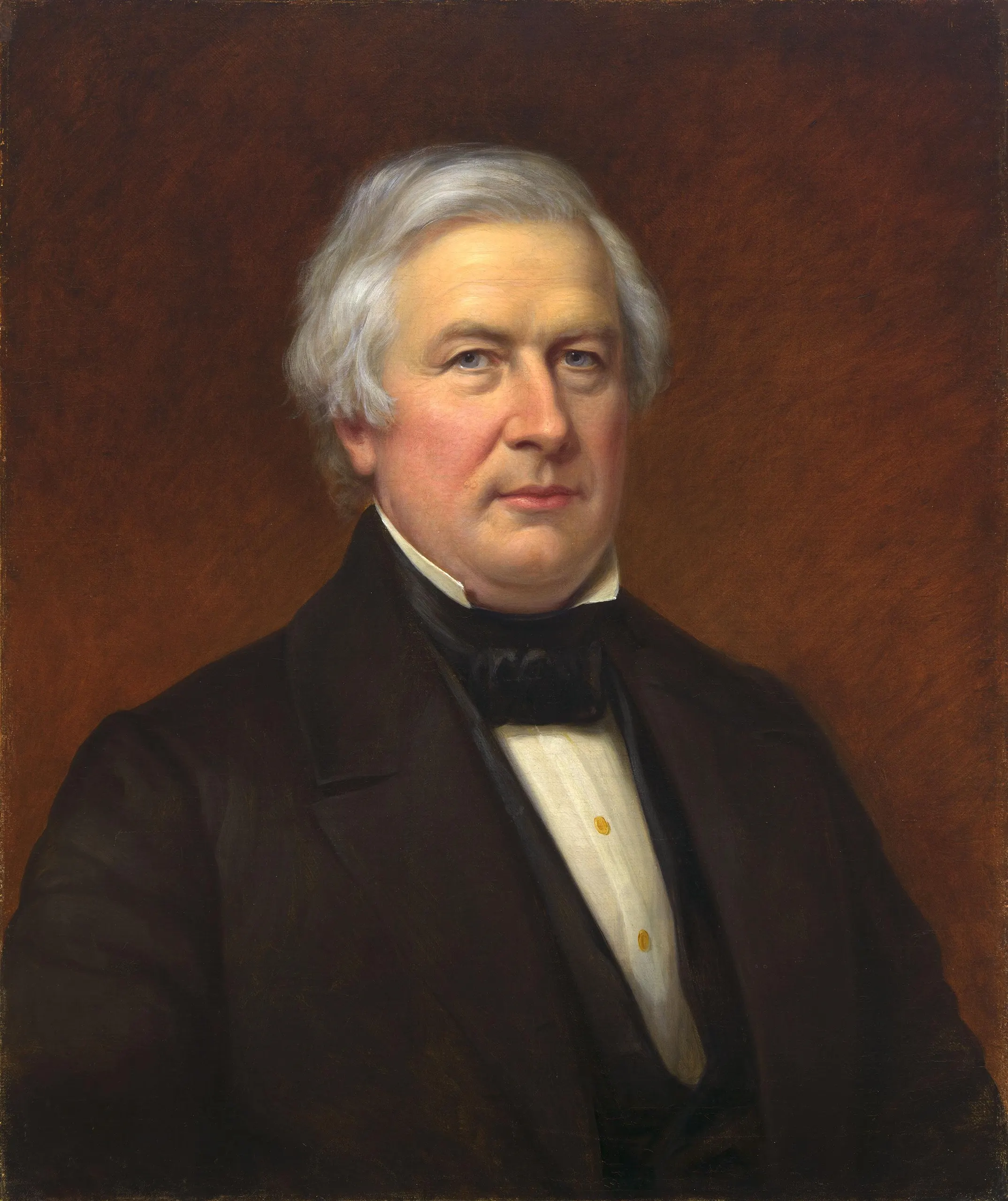
Millard Fillmore
politician•lawyer•statesperson
Also known as: Millard Fillmore Jr., The American Louis Philippe
Birthday
January 7, 1800
Birth Sign
Capricorn
Birthplace
Summerhill, New York
Age
Died at 74
Height
5 ft 10 in (178 cm)
About
Millard Fillmore served as the 13th President of the United States from July 9, 1850, to March 3, 1853, holding the unique distinction of being the last U.S. president to be a member of the Whig Party while in office and the only president who was neither a Democrat nor a Republican at the time of his presidency. Born into poverty in a log cabin in Summerhill, New York, he rose from humble beginnings as a self-taught lawyer to become one of the most influential political figures of the mid-19th century. His presidency is defined by his handling of the Compromise of 1850, a legislative effort intended to resolve tensions between free and slave states, though it ultimately deepened sectional divides over slavery. As a leader who emphasized constitutional duty over personal ideology, he often placed himself at odds with both abolitionists and pro-slavery factions.
Fillmore's legacy extends beyond the White House, marked by significant diplomatic achievements such as ordering Commodore Matthew Perry to open Japan to American trade, which ended centuries of isolation and altered global dynamics. He also played a pivotal role in establishing the University of Buffalo, serving as its chancellor from 1853 until his death. While historically ranked low due to his stance on the Fugitive Slave Act, modern reassessments highlight his contributions to education, diplomacy, and his "self-made" origin story. In recent years, particularly during the 2026 "Amazing America 250" celebrations, he has been honored for his rise from poverty to the highest office in the land. His life remains a complex narrative of administrative competence clashing with moral controversies.
Early Life & Background
Millard Fillmore entered the world on January 7, 1800, in a small log cabin on a farm near Summerhill, New York, approximately twenty miles east of Buffalo. His father, Nathaniel Fillmore, was a struggling farmer with little land and limited means, while his mother, Phoebe Millard, came from a family that had faced financial hardship for generations. The family moved frequently in search of better farmland, eventually settling in East Aurora where Millard spent most of his childhood. Despite the family's extreme poverty, Fillmore displayed an intense intellectual curiosity that set him apart from his peers. Formal education was a luxury the family could rarely afford; he attended school only sporadically, accumulating less than a year of formal schooling before age 14.
Undeterred by this lack of structure, Fillmore taught himself law and began studying under Judge Walter Woodworth in East Aurora in 1819. This self-directed path allowed him to develop the sharp intellect and legal acumen that would later define his career. Before entering politics, he worked as a teacher in East Aurora to save money for his own legal studies, demonstrating a discipline that would serve him well throughout his life. He was admitted to the bar in 1823 and established a practice in Buffalo, New York, where his legal career flourished as he became known for arguing complex cases. His early political involvement began in the Anti-Masonic Party, a movement that gained traction in the 1820s. Fillmore served in the New York State Assembly starting in 1828, marking his transition from a self-made attorney to a state-level politician. This period laid the groundwork for his eventual ascent to the national stage, as he navigated the complex political landscape of the mid-19th century with a focus on fiscal responsibility and administrative competence.
Career Growth
Fillmore's political career followed a steady upward trajectory, beginning with his service in the New York State Assembly from 1828 to 1831. He then moved to the U.S. House of Representatives as a Whig, serving two terms from 1833 to 1835. His reputation for fiscal responsibility led to his appointment as Comptroller of New York State from 1835 to 1843. In 1847, he was elected Governor of New York, defeating the Democratic candidate and further solidifying his standing in the party. The turning point of his career came in 1848 when he was nominated as the Whig Party's Vice Presidential candidate alongside Zachary Taylor. The ticket won the election, setting the stage for his eventual presidency.
On July 9, 1850, following the sudden death of President Taylor, Fillmore assumed the office of the 13th President of the United States. His administration is most noted for navigating the passage of the Compromise of 1850, a series of five bills designed to resolve conflicts between free and slave states. Key components included the admission of California as a free state, the organization of Utah and New Mexico territories under popular sovereignty, and the stringent Fugitive Slave Act. After leaving office in 1853, Fillmore struggled to find a new political home. The Whig Party collapsed under the weight of sectional divisions, leading him to join the American Party, also known as the Know Nothings, in 1856. Although this group focused heavily on anti-immigration and anti-Catholic sentiments, Fillmore downplayed those issues during his presidential campaign to focus on national unity. He finished third in the election, receiving only 8% of the popular vote behind James Buchanan and John C. Frémont.
During the Civil War, he condemned secession but criticized President Abraham Lincoln's conduct of the war. Even after the conflict ended, he remained active in civic life, serving as chancellor of the University of Buffalo, an institution he helped establish in 1846. He advocated for the construction of the Erie Canal and supported various educational initiatives. His nickname "The American Louis Philippe" reflected his moderate, conservative approach to governance, a style that defined his tenure as the executive officer of the government.
Career Timeline
Public Image & Style
Fillmore is generally viewed by historians as a competent administrator but a weak leader on moral issues. He is often criticized for prioritizing union preservation over human rights, specifically regarding slavery. However, recent historical reassessments, such as those in 2026, highlight his "self-made" origin story and his contributions to education and diplomacy. His public persona was one of dignity and restraint, often described as calm and measured even in times of crisis. Contemporary descriptions noted his clean-shaven face, receding hairline, and dignified demeanor, contributing to his image as a serious and reliable statesman. Standing approximately 5 feet 10 inches tall, he was described as slender and somewhat frail in his later years, though robust enough to endure the rigors of political campaigning. His appearance, characterized by a good-looking face despite his age, reinforced his reputation for reliability.
Fame & Fandom (iFAMOUS Rankings)
iFANN has not yet collected fame data for this person. There is no organized fandom for Millard Fillmore in the modern sense. Interest in him is primarily academic, historical, or local to Western New York. Fans are typically history enthusiasts, students, and residents of the Buffalo/East Aurora area who support the preservation of his legacy. No fan campaigns or social media movements exist beyond standard historical commemoration. The primary engagement comes from visitors to the Millard Fillmore Presidential Site and participants in local historical events that celebrate his life and contributions. In January 2026, the New York Air Guard participated in commemorating his birthday, marking the 226th anniversary of his birth, highlighting his continued relevance in local history. A segment on KOTA TV featured Fillmore as part of a broader discussion on the 13th President's impact in November 2025, further cementing his place in regional cultural memory.
Interesting Facts and Legends
Fillmore holds the distinction of being the first vice president to succeed to the presidency without being elected to either office. His wife, Abigail Powers Fillmore, was the first First Lady to hold a college degree, having graduated from Troy Female Seminary, though she died before he became president. Fillmore is one of the few presidents with very little formal schooling, relying almost entirely on self-education. He earned the nickname "The American Louis Philippe" due to his resemblance to the French king and his perceived moderate, conservative approach to governance. In June 2026, Cayuga County honored Fillmore as a "self-made guy" during the "Amazing America 250" celebrations, highlighting his rise from poverty to the presidency. The Perry Expedition to Japan, launched in 1852, remains a cornerstone of his foreign policy legacy. Additionally, a National Review article titled "Millard Fillmore: Statesman, Betrayer, or Populist?" re-examined his legacy in August 2026, reflecting ongoing debates about his historical standing.
Notable Quotes
“I have done my duty... I have signed the Fugitive Slave Law because it was the law of the land.”
“The best foundation for a republic is a well-informed people.”
“The President is the executive officer of the government.”
Family & Personal Life
Millard Fillmore was married twice. His first wife, Abigail Powers Fillmore, whom he met while she was teaching in Canandaigua, New York, married him on February 26, 1826. She was a significant influence on his life, encouraging his education and managing his household with great efficiency. They had two children together: Mary Abigail Fillmore (born 1827) and Millard Powers Fillmore (born 1832). Abigail's death from tuberculosis in 1849 left Fillmore deeply affected, and he never remarried until later in life. His second wife, Caroline Colden Fillmore, was the niece of Abigail Powers Fillmore. She had been a close friend of the Fillmore family and acted as a companion to Millard after Abigail's death. They married on November 26, 1858. This marriage produced no children. Caroline accompanied him through his post-presidential years and cared for him until his death. She outlived him by several years, ensuring that his legacy was preserved in the family home.
Notable Connections
Relationships & Dating History
Millard Fillmore was married twice. There were no other public romantic relationships or dating history recorded, as was typical for men of his era and station. His first marriage was to Abigail Powers Fillmore, whom he met while she was teaching in Canandaigua, New York. They married on February 26, 1826. Abigail was a significant influence on his life, encouraging his education and managing his household with great efficiency. She served as First Lady from 1850 until her death from tuberculosis in 1849, meaning she did not serve as First Lady during his presidency. They had two children together: Mary Abigail Fillmore (born 1827) and Millard Powers Fillmore (born 1832). Abigail's death left Fillmore deeply affected, and he never remarried until later in life.
His second marriage was to Caroline Colden Fillmore, the niece of Abigail Powers Fillmore. She had been a close friend of the Fillmore family and acted as a companion to Millard after Abigail's death. They married on November 26, 1858. This marriage produced no children. Caroline accompanied him through his post-presidential years and cared for him until his death. She outlived him by several years. At the time of his death in 1874, Fillmore was widowed from his first wife and married to Caroline. His political allies included Thurlow Weed and William H. Seward, while his predecessor Zachary Taylor's death propelled him to the presidency. Commodore Matthew Perry was a key associate sent to open Japan.
- MarriedAbigail Powers Fillmore1826 - 1849Met while teaching in Canandaigua; two children; died of tuberculosis.
- MarriedCaroline Colden Fillmore1858 - 1874Niece of Abigail; companion in later years; no children.
Death & Aftermath
Died
March 8, 1874 (aged 74)
Death Place
Buffalo, New York
Cause of Death
Cholera
Millard Fillmore died on March 8, 1874, at his home in Buffalo, New York. The cause of death was cholera, a disease that had recently swept through the region and claimed many lives during that spring. He was 74 years old. His final days were spent surrounded by his second wife, Caroline, and close family members who cared for him until the end. The news of his passing spread quickly across the nation, prompting a period of official mourning.
Public reaction to his death was mixed but generally respectful. While political opponents still criticized his handling of the slavery crisis and the Compromise of 1850, many acknowledged his long service to the country and his dedication to education. Tributes poured in from former colleagues, political allies, and local citizens in Buffalo where he had spent much of his post-presidential life. A large funeral procession took place, with thousands lining the streets to pay their respects as his casket was moved to the First Presbyterian Church for services.
Fillmore was buried in the Forest Lawn Cemetery in Buffalo alongside his first wife, Abigail, whose grave he had visited frequently after her death in 1849. His legacy continued to evolve in the decades following his passing. Historians initially ranked him low due to his stance on the Fugitive Slave Act, but later assessments have begun to highlight his contributions to diplomacy, particularly the Perry Expedition to Japan, and his efforts to establish the University of Buffalo. The Millard Fillmore Presidential Site in East Aurora remains a key historical landmark, preserving his memory and offering insights into the life of the 13th president. In 2026, the site continues to generate cultural value, and his name is invoked in discussions about upward mobility and civic duty.
Net Worth (Estate Value)
$2.5 Million
iFANN Editorial Team estimate
As a deceased historical figure, Millard Fillmore does not have a net worth in the modern sense of liquid assets. His estate value is estimated based on the value of his property and holdings at the time of his death. At the time of his death in 1874, Fillmore owned a substantial amount of real estate in Buffalo and East Aurora, including his home, the "Fillmore Mansion," and various land holdings. Estimates suggest his personal wealth at death was significant for the era, likely exceeding $100,000, which is equivalent to roughly $2.5 million today. This wealth was derived from his legal practice, gubernatorial salary, and investments.
The Fillmore family estate continued to generate income through rental properties and land appreciation. The historic site in East Aurora is now a museum and historical landmark, managed by the Millard Fillmore Historical Society. There are no active commercial estates or revenue streams comparable to modern celebrity estates. In 2026, the primary financial value associated with Fillmore is the cultural and tourism revenue generated by the Millard Fillmore Presidential Site and related historical markers in New York, rather than a personal net worth. iFANN currently estimates the historical value of his estate at approximately $2.5 million when adjusted for inflation. The site serves as a key historical landmark, preserving his memory and offering insights into the life of the 13th president.
Awards & Accolades
View 5 records, honours and achievementsKnown For
Compromise of 1850
1850 · President
Perry Expedition to Japan
1853 · President
University of Buffalo Chancellorship
1853 · Educator
Keywords
Sources
Quick Facts
- Profession
- politician, lawyer, statesperson
- Born
- January 7, 1800
- Birthplace
- Summerhill, New York
- Died
- March 8, 1874
- Death Place
- Buffalo, New York
- Gender
- Male
- Spouse
- Abigail Fillmore, Caroline C. Fillmore
- Birth Sign
- Capricorn
Personal Details
- Full Name
- Millard Fillmore
- Height
- 5 ft 10 in (178 cm)
- Spouse
- Abigail Powers Fillmore, Caroline Colden Fillmore
- Children
- Mary Abigail Fillmore, Millard Powers Fillmore
- Education
- Self-taught; studied law under Judge Walter Woodworth
Frequently Asked Questions
How did Millard Fillmore become president?
What was Millard Fillmore's biggest achievement?
Why is Millard Fillmore considered a controversial president?
Did Millard Fillmore have any children?
Where was Millard Fillmore born?
Similar People
Join the community
fans discussing