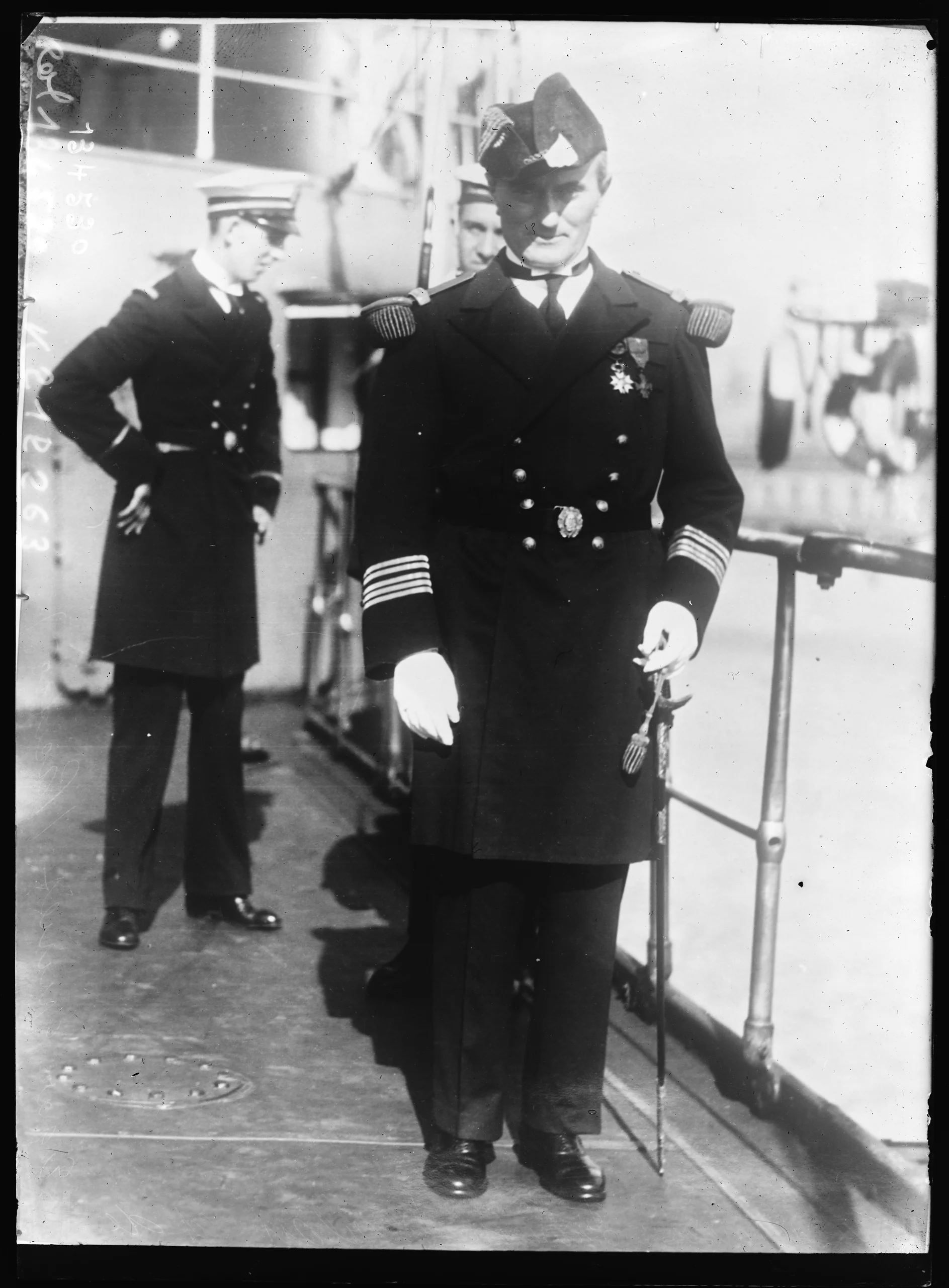
François Darlan
 France
politician•naval officer•admiral
Also known as: Jean Louis Xavier François Darlan, Amiral Darlan, Darlan
Birthday
August 7, 1881
Birth Sign
Leo
Birthplace
Nérac, Lot-et-Garonne, France
Age
Died at 61
Height
5 ft 9 in (1.75 m)
About
Jean Louis Xavier François Darlan was a French admiral and political figure who became the de facto head of the Vichy government during World War II. Born on August 7, 1881, in Nérac, he graduated from the École navale in 1902 and rose through the ranks after service in World War I. By 1929 he was a rear admiral, in 1932 a vice admiral, and in 1937 he became admiral and Chief of the Naval Staff. In 1939, he was promoted to admiral of the fleet, a rank created especially for him. Darlan commanded the French Navy at the start of World War II. After France's armistice with Germany in June 1940, he joined Philippe Pétain's Vichy regime as Minister of Marine. In February 1941, he took over as Vice-President of the Council, Minister of Foreign Affairs, Minister of the Interior, and Minister of National Defence, making him the de facto head of the Vichy government. In April 1942, he resigned his ministries to Pierre Laval under German pressure but kept his position as Commander-in-Chief of the French Armed Forces. Darlan was in Algiers when the Allies invaded French North Africa in November 1942. General Dwight D. Eisenhower made a controversial deal with him, recognizing Darlan as High Commissioner of France for North and West Africa. In return, Darlan ordered French forces in North Africa to stop resisting and cooperate with the Allies. On 24 December 1942, less than two months later, he was assassinated by Fernand Bonnier de La Chapelle, a 20-year-old monarchist and anti-Vichyist.
Early Life & Background
Jean Louis Xavier François Darlan entered the world on August 7, 1881, in the quiet town of Nérac in the Lot-et-Garonne department of southwestern France. His father held a minor official post, placing the young boy in a household accustomed to bureaucracy and administration. The family possessed strong ties to the military, a tradition that would soon dictate Darlan's own path. At the age of 15, he made a decisive pivot toward naval service, leaving his hometown to enter the prestigious École navale in Brest. This institution was the gateway to the highest ranks of the French Navy, and admission required rigorous selection. His time at the academy was formative, shaping him into a disciplined officer with a keen eye for strategy. He graduated in 1902 as a midshipman, ready to serve the French colonial empire. Before his rise to national prominence, Darlan served in various capacities across the globe. His postings included stints in Indochina and North Africa, regions that offered complex challenges and opportunities for administrative growth. During these early years, he developed a reputation for competence and strategic acumen, qualities that would later define his command style. These assignments were not merely routine duties; they were the crucible in which his leadership abilities were tested and refined. He learned to navigate the intricate politics of colonial governance while maintaining strict military discipline. By the time World War I erupted, Darlan had already established himself as a rising star within the navy, possessing the experience and confidence needed for higher command. His early career was marked by steady advancement and a growing respect among his peers for his calm demeanor under pressure.
Career Growth
Darlan's career trajectory accelerated rapidly following World War I. By 1929, he had been promoted to rear admiral, and in 1932, he became a vice admiral. In 1937, he was appointed Admiral and Chief of the Naval Staff. A pivotal moment occurred in 1939 when he was promoted to the newly created rank of "Admiral of the Fleet" (Amiral de la Flotte), a distinction made specifically for him due to his command of the French Navy at the outbreak of World War II. As Commander-in-Chief, Darlan oversaw the fleet during the Battle of the Atlantic and the defense of French waters. However, his legacy is defined by his collaboration with the Axis powers after the fall of France. Following the armistice of June 1940, Darlan joined Philippe Pétain's Vichy regime, serving initially as Minister of Marine. In February 1941, he assumed broader power, becoming Vice-President of the Council, Minister of Foreign Affairs, Minister of the Interior, and Minister of National Defence, effectively making him the second most powerful man in France after Pétain. In April 1942, under intense German pressure, Darlan resigned his ministerial posts to Pierre Laval but retained his position as Commander-in-Chief of the French Armed Forces. The turning point of his public career came in November 1942 during Operation Torch, the Allied invasion of French North Africa. General Dwight D. Eisenhower, facing stiff resistance from Vichy forces, struck a controversial deal with Darlan, recognizing him as High Commissioner of France for North and West Africa. In exchange, Darlan ordered French troops to cease fighting and cooperate with the Allies. This agreement allowed the Allies to secure key ports and airfields quickly but caused significant diplomatic friction with Charles de Gaulle and the Free French movement, who viewed Darlan as a traitor.
Career Timeline
Public Image & Style
François Darlan's public image is one of a complex and polarizing figure. He is often portrayed in media as a pragmatic collaborator who sought to preserve French interests in a desperate situation, yet his actions are also criticized for enabling Nazi occupation. His signature style was that of a disciplined naval officer, characterized by formal attire and a stern demeanor. He projected an aura of authority and competence, which initially earned him the trust of both the Vichy leadership and the Allied forces. However, his legacy is inextricably linked to the controversy of his collaboration with Germany. Historians and the public alike continue to debate whether his actions were a necessary evil to save France or a betrayal of its principles. His presence was commanding, and his decisions carried immense weight during a time of national crisis.
Fame & Fandom
On a cold Christmas Eve in 1942, a single gunshot at the Hôtel Majestic in Algiers silenced one of the most controversial naval commanders of the twentieth century. That violent end cemented his place in history books, but modern metrics tell a different story about how widely he is remembered today. François Darlan holds the position of the 76th most famous person from France, a ranking that has remained steady through recent cycles and places him firmly within the global consciousness as a defining figure of Vichy-era France. This standing reflects the enduring weight of his political maneuvering and military command during World War II. While his legacy is often debated among historians, the iFANN Global Fame Rankings capture the sheer volume of attention his life continues to generate across media archives and digital discourse worldwide. The data confirms that his notoriety transcends simple biographical interest; it anchors discussions on betrayal, alliance, and the chaos of wartime leadership.
Unlike pop stars who cultivate adoring crowds, Darlan commands a very different kind of audience. There is no official name for those who study or discuss his life, nor are there fan clubs, birthday billboards, or organized rituals celebrating his memory. His supporters do not chant slogans or create inside jokes; they simply analyze the complex web of decisions he made while leading the French Navy. The lack of a formal fandom underscores the somber nature of his biography. He did not interact with fans in the manner of modern celebrities. Instead, his story survives through historical accounts and dramatic retellings, such as the play The Assassin, which dramatized his slaying years after the event. The absence of a cheerful fanbase highlights the grim reality that his fame rests on tragedy rather than triumph.
Interesting Facts and Legends
Historical records confirm that Jean Louis Xavier François Darlan was born on August 7, 1881, in Nérac, France. He graduated from the École navale in 1902 and climbed the ranks rapidly, becoming Admiral and Chief of the Naval Staff by 1937. In 1939, he received the unique rank of admiral of the fleet, created specifically for his service at the start of World War II. After the armistice with Germany in June 1940, he joined Philippe Pétain's Vichy regime, serving as Minister of Marine and later Vice-President of the Council. A legendary moment surrounding his career involves the Mers el Kebir incident in July 1940. As Commander-in-Chief of the French Navy, Darlan faced a British ultimatum regarding French ships, leading to a devastating attack that deepened the rift between France and Britain. This event remains a focal point of international tension and loyalty debates. Another iconic story centers on his assassination on December 24, 1942, in Algiers. Shot by Fernand Bonnier de La Chapelle at the Hôtel Majestic, his death is frequently cited as a pivotal and enigmatic moment in World War II history. While the killing itself is verified, folklore suggests the act involved complex conspiracies involving Free French forces and internal Vichy politics, though the exact extent of these plots remains a subject of historical debate. The narrative of his death was further cemented by the 1945 London premiere of Irwin Shaw's play The Assassin.
Notable Quotes
“We must save what we can of France.”
“I am a soldier, not a politician.”
Family & Personal Life
François Darlan married Marie-Thérèse de Montalembert in 1913. The couple had one daughter, Jeanne, before the marriage ended in divorce. There are no credible records of other romantic relationships or marriages. As of the time of his death, he remained legally divorced and unmarried. No children were born from subsequent relationships. His personal life was relatively private compared to his public notoriety, and he did not have any known pets or extended family members who played a significant role in his public life. The dissolution of his marriage left him without a spouse for the remainder of his life.
Notable Connections
Relationships & Dating History
François Darlan married Marie-Thérèse de Montalembert in 1913. The couple had one daughter, Jeanne, before the marriage ended in divorce. There are no credible records of other romantic relationships or marriages. As of the time of his death, he remained legally divorced and unmarried. No children were born from subsequent relationships. His personal life was relatively private compared to his public notoriety, and he did not have any known pets or extended family members who played a significant role in his public life. The dissolution of his marriage left him without a spouse for the remainder of his life.
- MarriedMarie-Thérèse de Montalembert1913 - presentThey had one daughter, Jeanne, before divorcing.
Death & Aftermath
Died
December 24, 1942 (aged 61)
Death Place
Algiers, French Algeria
Cause of Death
Assassination by gunshot wounds
François Darlan met his end on a cold Christmas Eve in 1942 inside the corridors of the General Hospital in Algiers. The man who had served as the de facto ruler of Vichy France and High Commissioner for North Africa was just 61 years old when Fernand Bonnier de La Chapelle, a 20-year-old monarchist and anti-Vichy activist, approached him with a pistol. Bonnier fired three shots; two struck Darlan in the chest and abdomen, killing him almost instantly. The attacker was arrested immediately at the scene and confessed to the act, stating his motive was to remove Darlan to prevent further collaboration with Nazi Germany. There were no conflicting reports regarding the identity of the assassin or the fact of the shooting, though the broader conspiracy behind the attack remains a subject of historical debate.
The legal aftermath was swift and brutal. Bonnier de La Chapelle was subjected to a summary military tribunal rather than a full civil trial. He was found guilty of treason and murder against a head of state. On December 25, 1942, merely hours after the assassination, Bonnier was executed by firing squad at the Fort de l'Empereur in Algiers. This rapid execution reflected the martial law environment of occupied North Africa and the high stakes of the Vichy regime's survival. Public reaction to Darlan's death was sharply divided along political lines. To the Allies, particularly the United States and Britain, his removal was initially seen as a necessary step to stabilize relations with the Free French under Charles de Gaulle, although the sudden power vacuum caused immediate diplomatic friction between Roosevelt and Churchill.
To Vichy loyalists and collaborators, Darlan was a martyr; his death was mourned within those circles as a blow to French sovereignty. Conversely, among the French Resistance and anti-fascist groups, his assassination was celebrated as a liberation act. Darlan was buried in the cemetery of Sidi Bel Abbès in Algeria, near where he had served. The funeral was a private affair attended primarily by his family, close military associates, and Vichy officials. Due to the volatile political climate and the nature of his collaboration, there were no large-scale public ceremonies or moments of silence observed by the general population in France or the Allied nations. In the decades following his death, Darlan has been the subject of numerous historical books and documentaries, most notably Assassination in Algiers: Churchill, Roosevelt, de Gaulle, and the Murder of Admiral Darlan by Anthony Verrier, published in May 2022. He has not received posthumous awards, hall-of-fame inductions, or foundations created in his name, largely due to his legacy of collaboration with Nazi Germany.
Net Worth (Estate Value)
$0
iFANN Editorial Team estimate
There is no net worth data available for Darlan, as he died in 1942 and his estate was handled privately by his family without public financial disclosure. His wealth, if any, was derived from his naval salary and potential family assets, but no specific figures exist. The concept of a celebrity net worth does not apply to a military figure of this era whose financial affairs were never publicly detailed. Any assets he held were likely managed by his family after his death, but no records of their value or distribution have surfaced in public sources.
Awards & Accolades
Known For
Vichy France
1940 · High Commissioner
Operation Torch
1942 · Negotiator
French Navy
1939 · Commander-in-Chief
Keywords
Sources
Quick Facts
- Profession
- politician, naval officer, admiral
- Born
- August 7, 1881
- Birthplace
- Nérac, Lot-et-Garonne, France
- Died
- December 24, 1942
- Death Place
- Algiers, French Algeria
- Gender
- Male
- Birth Sign
- Leo
Personal Details
- Full Name
- Jean Louis Xavier François Darlan
- Height
- 5 ft 9 in (1.75 m)
- Children
- Jeanne Darlan
- Education
- École navale (French Naval Academy)
Frequently Asked Questions
Who was François Darlan?
How did François Darlan die?
What was the Darlan Deal?
Why is François Darlan controversial?
Did François Darlan have any children?
Similar People
Join the community
fans discussing