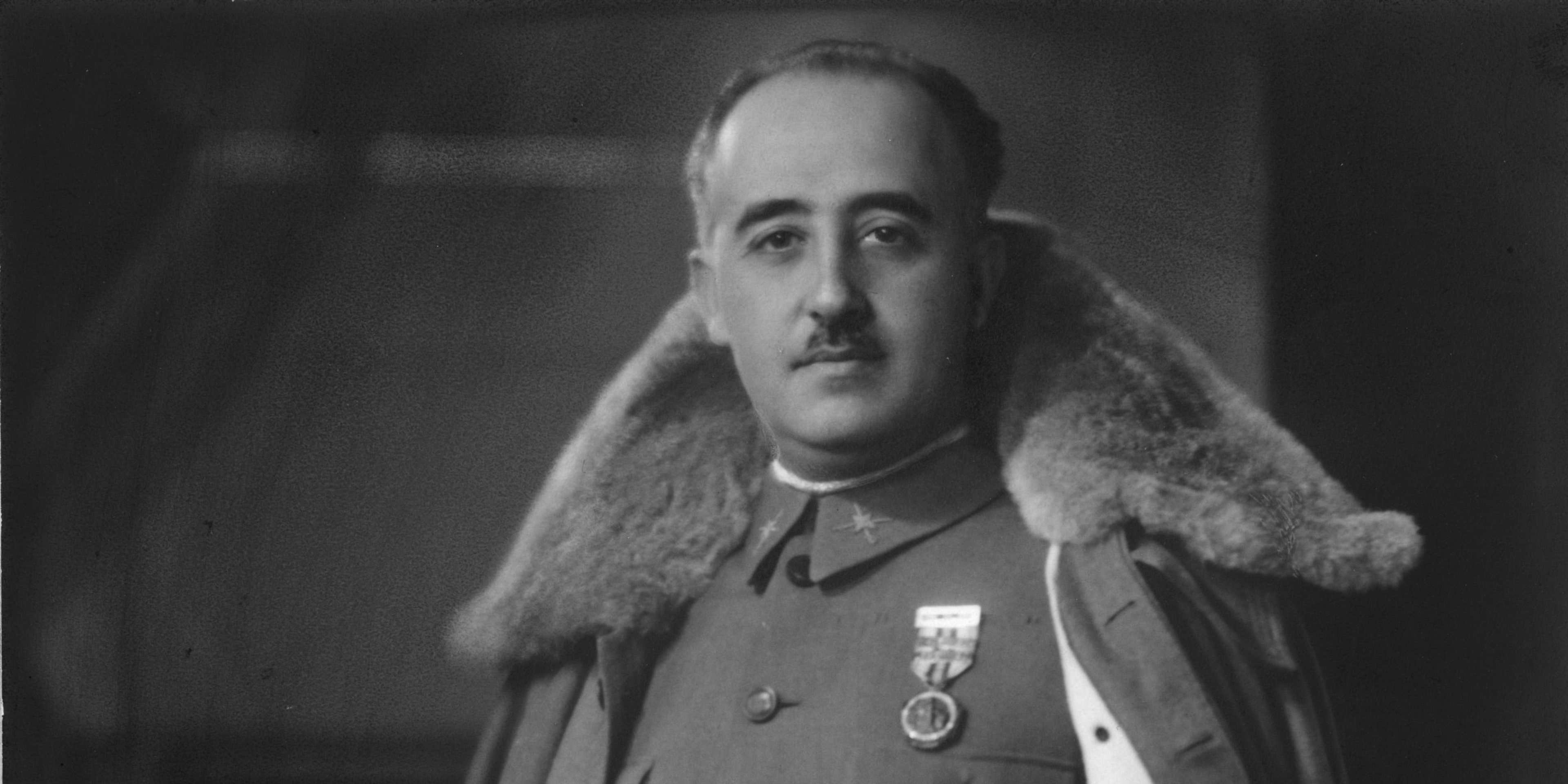
Francisco Franco
 Spain
Spainmilitary officer•political leader•dictator
Also known as: El Caudillo, Generalísimo, Franco, Francisco Paulino Hermenegildo Teodulo Franco y Bahamonde
Birthday
December 4, 1892
Birth Sign
Sagittarius
Birthplace
Ferrol, Galicia, Spain
Age
Died at 82
Height
5 ft 10 in (178 cm)
About
Francisco Franco was a Spanish military general who became the dictator of Spain from 1939 until his death in 1975. Born in Ferrol, Galicia, he rose through the ranks of the army to become one of the most significant figures in 20th-century European history. He is best known for leading the Nationalist forces to victory in the Spanish Civil War and establishing an authoritarian regime that lasted nearly four decades. His rule, known as Francoism, was characterized by severe repression, censorship, and the execution of thousands of political opponents. Despite maintaining nominal neutrality during World War II, his government provided tacit support to the Axis powers. He dissolved all political parties except his own, the Falange, and established a single-party state that governed Spain until his death. Internationally, he maintained alliances with Western democracies during the Cold War despite his fascist origins. His public persona was built on the titles of Caudillo (Leader) and Generalísimo, projecting an image of strength and national unity through strict military discipline. The legacy of his dictatorship remains a central point of contention in modern Spanish politics, with ongoing debates regarding historical memory and accountability.
Early Life & Background
Franco was born into a conservative naval family in Ferrol, Galicia, on December 4, 1892. His full birth name was Francisco Paulino Hermenegildo Teodulo Franco y Bahamonde, reflecting traditional Spanish naming conventions, though he was commonly known simply as Francisco Franco. His father, Nicolás Franco Salgado-Araújo, served as a navy officer, while his mother, María del Pilar Bahamonde y Pardo de Andrade, came from a wealthy landowning family. The family moved frequently due to his father's career, living in Cartagena, Mahón, and Valencia during his childhood. Despite the naval background, Franco showed little interest in the sea and instead gravitated toward the army. He attended primary school in Ferrol and later entered the Toledo Infantry Academy at age 15 in 1907. He graduated third in his class in 1910, marking the beginning of a rapid ascent through the military ranks. In 1912, he was deployed to Spanish Morocco, where he fought in the Rif War. During these conflicts, he earned a reputation for ruthlessness and tactical acumen. By 1926, at the young age of 33, he had been promoted to brigadier general, making him the youngest general in Europe at the time. Two years later, he was appointed commander of the General Military Academy in Zaragoza, a position he held until the academy was closed following the establishment of the Second Spanish Republic in 1931. His early career also included brutal suppression of the 1934 Asturian uprising, which further solidified his notoriety before the civil war.
Career Growth
On July 17, 1936, Franco launched a military coup that ignited the Spanish Civil War. Initially, he commanded the Army of Africa, a professional colonial force. Following the deaths of several key rebel leaders, including José Sanjurjo and Emilio Mola, Franco emerged as the sole leader of the Nationalist faction in October 1936, assuming the title of Generalísimo and Head of State. With crucial support from Fascist Italy and Nazi Germany, he secured victory in March 1939, ending the war and establishing a dictatorship. For the next 36 years, Franco ruled Spain as a dictator. His regime implemented technocratic liberal reforms in the 1950s that sparked the "Spanish Miracle," a period of rapid economic growth. He maintained alliances with Western democracies during the Cold War despite his fascist origins. In 1969, he named Juan Carlos as his successor. His rule ended with his death on November 20, 1975, after which Spain transitioned to democracy under King Juan Carlos I. He held the titles of Caudillo, Generalísimo, and Prince of Spain, receiving honors such as the Grand Cross of the Order of Charles III and the Knight of the Order of the Golden Fleece.
Career Timeline
Public Image & Style
Franco is portrayed in modern media as a ruthless dictator responsible for human rights abuses. His image is often associated with repression, censorship, and the suppression of regional identities such as Catalan and Basque cultures. In 2026, the narrative has shifted towards accountability and historical memory, with many Spaniards viewing him as a negative symbol rather than a hero. His public persona was built on the titles of Caudillo (Leader) and Generalísimo, projecting an image of strength and national unity through strict military discipline. He was deeply Catholic and used religion to legitimize his regime, declaring himself the "defender of the faith." His physical stature was approximately 1.78 meters (5 feet 10 inches), with a stocky and robust build typical of a military man of his generation. While his image appeared on the covers of news magazines like TIME and Newsweek, these were journalistic portraits rather than lifestyle features, reinforcing his status as a political figure rather than a celebrity.
Fame & Fandom
According to the iFANN Global Fame Rankings as of September 2026, Francisco Franco holds significant historical standing. He is currently ranked the 7th most famous person in Spain, a position up from previous cycles. He also ranks the 40th most famous person from Spain, holding steady from the previous cycle, and the 15th most famous person in Europe, down slightly from 14th last cycle. These placements reflect his enduring presence across media coverage and search activity worldwide. Despite this massive global footprint, Francisco Franco does not possess a formal fandom or an organized fanbase. Unlike entertainers who cultivate adoration through performances or public appearances, his legacy is defined by political power and military command rather than celebrity worship. There are no groups that refer to themselves as fans, nor are there any unofficial names for a following dedicated to him. The concept of fan rituals, inside jokes, or interactions with supporters simply does not apply to his life or history. While online movements occasionally display attraction to his symbols, these represent political extremism and historical revisionism rather than a traditional fan culture. No birthday billboards, streaming pushes, or charity drives exist to honor him, and the idea of legendary moments involving crowd hysteria is entirely absent from his narrative. His story remains one of historical study, legal debate, and political reckoning, devoid of the mythologized adoration found in pop culture.
Interesting Facts and Legends
Despite his authoritarian rule, Franco was deeply Catholic and used religion to legitimize his regime, declaring himself the "defender of the faith." He spoke Castilian Spanish fluently but also learned Arabic during his service in Morocco, which influenced his military tactics. There is no relation between Francisco Franco and the actor Francis Ford Coppola or any other similarly named celebrities. The summer residence he acquired from the Lario family, often accused of being seized under duress, remains the Pazo de Meirás, a contentious symbol of his regime. No verified stories of viral performances or extraordinary crowd reactions exist surrounding his personal interactions; his historical narrative is strictly defined by documented political events and human rights abuses. He received numerous military decorations, including the Grand Cross of the Military Merit with Red Decoration. The construction of the Valley of the Fallen, a massive basilica built partly by forced labor from political prisoners, stands as a controversial landmark associated with his legacy. Additionally, his remains were exhumed from the Valley of the Fallen in 2019 and reinterred at Mingorrubio Cemetery in El Pardo, marking a symbolic end to his official state veneration.
Notable Quotes
“Spain is a great nation, and we must restore its greatness.”
“I have always believed that Spain needs a strong hand to guide it.”
Family & Personal Life
Francisco Franco was married only once to María del Carmen Polo Martínez-Valdés. They met while Franco was stationed in Melilla, and the marriage was arranged by their families in 1923, reflecting the conservative social norms of the time. María del Carmen was known for her shyness and rarely appeared in public, preferring to stay out of the political spotlight. She supported Franco throughout his rule but remained largely private. The couple had no biological children together. However, he adopted his nephew, Francisco Franco y Salgado-Arjona, who served as his chief of staff and later managed his estate. The family lived in various locations throughout Spain, including the Pazo de Meirás summer residence. After Franco's death, his wife survived him until 1988, remaining widowed for the rest of her life. The family dynamic was strictly controlled by the moral codes of the era, with no other romantic relationships documented for the dictator.
Notable Connections
María del Carmen Polo Martínez-Valdés, Francisco Franco y Salgado-Arjona, Adolf Hitler, Benito Mussolini, King Juan Carlos I, José Antonio Primo de Rivera
Relationships & Dating History
Francisco Franco was married only once. He wed María del Carmen Polo Martínez-Valdés in 1923, a union arranged by their families while he was stationed in Melilla. The marriage reflected the conservative social norms of the time and lasted until his death in 1975. María del Carmen was known for her shyness and rarely appeared in public, preferring to stay out of the political spotlight. She supported Franco throughout his rule but remained largely private. The couple had no biological children together. As a historical figure whose personal life was strictly regulated by the moral codes of his era and his own public image, there are no documented romantic relationships outside of his marriage. There are no records of engagements, divorces, or high-profile flings. The concept of a "dating history" for a dictator of his stature in this period is non-existent in public records. He remained widowed by his wife's death in 1988, but he himself passed away in 1975. His only close familial bond outside his immediate circle was with his adopted nephew, Francisco Franco y Salgado-Arjona, who served as his chief of staff.
- MarriedMaría del Carmen Polo Martínez-Valdés1923 - 1975Met while Franco was stationed in Melilla; arranged by families; no children together.
Death & Aftermath
Died
November 20, 1975 (aged 82)
Death Place
Madrid, Spain
Cause of Death
Acute respiratory failure from heart disease and kidney failure
Francisco Franco died at Paz Hospital in Madrid on November 20, 1975, following a prolonged decline marked by strokes and severe pneumonia earlier that year. His final public appearance occurred on October 12, 1974, when he presided over the National Day of Spain celebration, but by late November he had fallen into a coma. Family members led by his nephew Francisco Franco y Salgado-Arjona removed life support on November 19, leading to his death the next day from acute respiratory failure compounded by chronic kidney failure and heart disease. A grand state funeral took place three days later at the Valley of the Fallen, attended by King Juan Carlos I and delegations from the Vatican and Latin America. The ceremony ended thirty-six years of rule, yet reactions remained deeply divided across Spain. Conservative sectors mourned officially while opposition groups in Barcelona and other cities celebrated openly with republican songs, viewing his passing as the dawn of democracy. He was interred in the crypt beneath the altar until his remains were exhumed in 2019 and reinterred at Mingorrubio Cemetery in El Pardo.
In the decades since, his legacy has faced intense legal scrutiny. In 2026, the Spanish government continued to litigate the legacy of his foundation and the handling of assets seized during his rule. Legal actions included requests to dissolve the Francisco Franco National Foundation for promoting fascist ideology. The summer residence known as Pazo de Meirás was declared a Place of Memory, effectively removing it from private control and marking a symbolic end to official state veneration. Further developments in 2026 include announcements regarding the potential exhumation of his remains again or further investigation of the site, alongside the return of art seized during the Civil War. Reports also highlight the rise of online neo-fascism and historical revisionism in Spain, with memes and online movements occasionally referencing Francoist symbols, though this is viewed as extremism rather than cultural reverence.
Net Worth (Estate Value)
$1 Billion
iFANN Editorial Team estimate
As a head of state who controlled the national treasury and accumulated personal assets through state power, exact modern net worth calculations are complex. Research by the iFANN Editorial Team puts Francisco Franco's estate value at around $1 Billion, adjusted for inflation and historical asset analysis. This figure reflects his personal wealth, including real estate and seized assets, estimated at over $1 billion in 1975 value, though much of this was tied to state-controlled properties. Wealth sources included his salary as head of state, seizure of Republican assets, control of state enterprises, and personal real estate holdings. The Francisco Franco National Foundation, which managed his legacy and assets, held significant property, including the Pazo de Meirás summer residence. As of 2026, the Spanish government has declared the Pazo de Meirás a "Place of Memory," effectively removing it from private control. The estate's value is now considered a matter of historical record rather than liquid wealth. In 2026, the Spanish government continued to litigate the legacy of his foundation and the handling of assets seized during his rule. Recent actions include requests to dissolve the foundation for promoting fascist ideology and plans to return art seized during the Civil War.
Awards & Accolades
View 9 records, honours and achievementsKnown For
Spanish Civil War
1936 · Nationalist Leader
Dictatorship of Spain
1939 · Head of State
Keywords
Sources
Quick Facts
- Profession
- military officer, spanish legionary, military leader
- Born
- December 4, 1892
- Birthplace
- Ferrol, Galicia, Spain
- Died
- November 20, 1975
- Death Place
- Madrid, Spain
- Gender
- Male
- Spouse
- María del Carmen Polo Martínez-Valdés
- Birth Sign
- Sagittarius
Personal Details
- Full Name
- Francisco Paulino Hermenegildo Teodulo Franco y Bahamonde
- Height
- 5 ft 10 in (178 cm)
- Spouse
- María del Carmen Polo Martínez-Valdés
- Children
- Education
- Toledo Infantry Academy
Frequently Asked Questions
When did Francisco Franco die?
Who was Francisco Franco married to?
What was Francisco Franco's cause of death?
Is Francisco Franco still alive?
Why is Francisco Franco controversial today?
Similar People
Join the community
fans discussing