

“Chazelle has made a film that is both a technical marvel and a deeply moving portrait of a man who was too much of a hero to be a person.”
A.O. Scott
The New York Times
 United States
"A man, a dream, and the silence between stars."
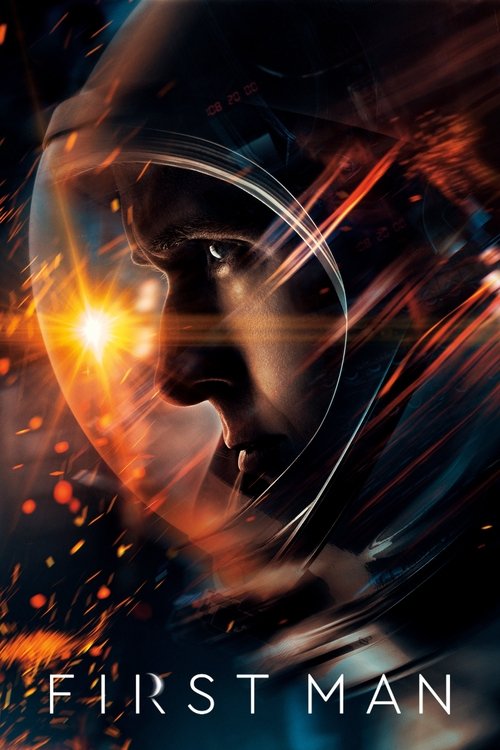
Damien Chazelle steps away from musicals to tackle the quiet intensity of First Man, a biographical drama that focuses less on the spectacle of space travel and more on the private grief driving Neil Armstrong. Ryan Gosling anchors the film as the stoic astronaut, while Claire Foy portrays his wife Janet, whose own struggle with loss runs parallel to her husband's dangerous missions. The production, backed by a $70 million budget from Universal Pictures and DreamWorks, captures the grit of the early 1960s space race without relying on flashy CGI tricks.
The narrative opens in 1962 with the death of Armstrong's four-year-old daughter Karen, an event that fractures the family dynamic. While Janet seeks connection through community and faith, Neil retreats into a stoic silence, channeling his pain into an obsessive focus on engineering and flight. This personal tragedy creates a deep emotional rift that the film explores alongside the technical challenges of becoming the first person to walk on the moon.
Stream
Rent
Availability and pricing can change. Confirm on the provider's site before purchasing.
Set against the backdrop of the early 1960s Cold War space race, the story chronicles the decade-long journey of Neil Armstrong as he transitions from a grieving husband and father to the commander of the historic Apollo 11 mission. The film opens in 1962 with the death of Armstrong's four-year-old daughter, Karen, who succumbs to a brain tumor. This profound personal tragedy creates a deep emotional rift between Neil and his wife, Janet Shearon Armstrong, whose own grief manifests differently, leading to a strained marriage that struggles to survive the pressures of Neil's dangerous career. While Janet seeks connection through community and faith, Neil retreats into a stoic silence, channeling his pain into an obsessive focus on engineering and flight.
The story follows Neil's selection by NASA as part of the second group of astronauts. We witness the rigorous, often terrifying training protocols of the Mercury and Gemini programs. A central conflict arises not just from the technical challenges of spaceflight, but from the interpersonal dynamics within the astronaut corps. Neil is portrayed as a loner, frequently clashing with more charismatic colleagues like Buzz Aldrin and Ed White. His relationship with Deke Slayton, the director of flight crew operations, becomes pivotal; Slayton pushes Neil to be more visible and politically savvy, while Neil remains indifferent to the public adulation and media frenzy surrounding the space program.
As the Gemini missions progress, the film highlights the physical toll of space travel through visceral, almost claustrophobic sequences of launch and re-entry. The audience experiences the disorientation of weightlessness and the terror of near-fatal accidents, such as the fire that kills Gus Grissom and his crew during a pre-launch test. These events underscore the high stakes of the era. Meanwhile, the domestic storyline continues to deepen the characterization of Janet, who faces her own battles with illness and the loneliness of raising children alone while her husband is constantly away or in the simulator. Her perspective provides a counter-narrative to the male-dominated world of the space program, illustrating the sacrifices made by families behind the scenes.
The plot builds toward the selection of the Apollo 11 crew. Tensions rise between Neil and Buzz Aldrin regarding the division of labor and the public perception of their roles. Neil insists on focusing solely on the technical execution of the mission, rejecting the idea of being a hero or a celebrity. The film meticulously details the engineering hurdles faced by the team, including the development of the Lunar Module and the complex docking procedures required for the moon landing. As the countdown to the launch approaches, the film balances the grandeur of the technological achievement with the intimate, quiet moments of Neil's internal struggle. He grapples with the fear of failure and the weight of representing the United States, all while carrying the memory of his lost daughter. The narrative culminates in the preparation for the final mission, leaving the audience poised at the precipice of history without yet revealing the outcome of the lunar descent or the specific nature of the moment that defines the film's conclusion.
Official Trailer #3
Official Trailer #2
Official Trailer
Critical Consensus
First Man uses a personal focus to fuel a look back at a pivotal moment in human history - and takes audiences on a soaring dramatic journey along the way. Critics praised the film's intimate character study and visual fidelity, though some noted its lack of traditional heroic spectacle.
“Chazelle has made a film that is both a technical marvel and a deeply moving portrait of a man who was too much of a hero to be a person.”
A.O. Scott
The New York Times
“Ryan Gosling gives the performance of his career... First Man is a masterpiece of restraint and emotion.”
Peter Travers
Rolling Stone
“A stunning, immersive experience that feels less like a biopic and more like a memory... The camera work is nothing short of revolutionary.”
David Ehrlich
IndieWire
“Visually breathtaking and emotionally resonant... Gosling captures the essence of the quietest hero in history.”
Richard Roeper
Chicago Sun-Times
“Chazelle strips away the mythology to reveal the raw, human cost of the space race. It is a film about the silence between the stars.”
Owen Gleiberman
Variety

Ryan Gosling
Neil Armstrong
Claire Foy
Janet Shearon Armstrong
Jason Clarke
Ed White
Kyle Chandler
Deke Slayton
Corey Stoll
Buzz Aldrin
Patrick Fugit
Elliot See
Christopher Abbott
David Scott
Ciarán Hinds
Robert R. Gilruth
Olivia Hamilton
Patricia White
Pablo Schreiber
Jim Lovell
Shea Whigham
Gus Grissom
Lukas Haas
Michael Collins
Noah Jupe
Mark Armstrong
Director
Damien Chazelle
Writers
Josh Singer, James R. Hansen
Composer
Justin Hurwitz
Cinematographer
Linus Sandgren
Producers
Isaac Klausner, Marty Bowen, Wyck Godfrey, Damien Chazelle
Academy Awards (2019)
Best Achievement in Visual Effects: Won
Academy Awards (2019)
Best Sound Editing: Nominated
Academy Awards (2019)
Best Production Design: Nominated
BAFTA Awards (2019)
Best Special Visual Effects: Nominated
Critics' Choice Movie Awards (2019)
Best Visual Effects: Won
Saturn Awards (2019)
Best Science Fiction Film: Won
Saturn Awards (2019)
Best Actor: Won
Golden Globe Awards (2019)
Best Motion Picture – Drama: Nominated
Join the community
fans discussing