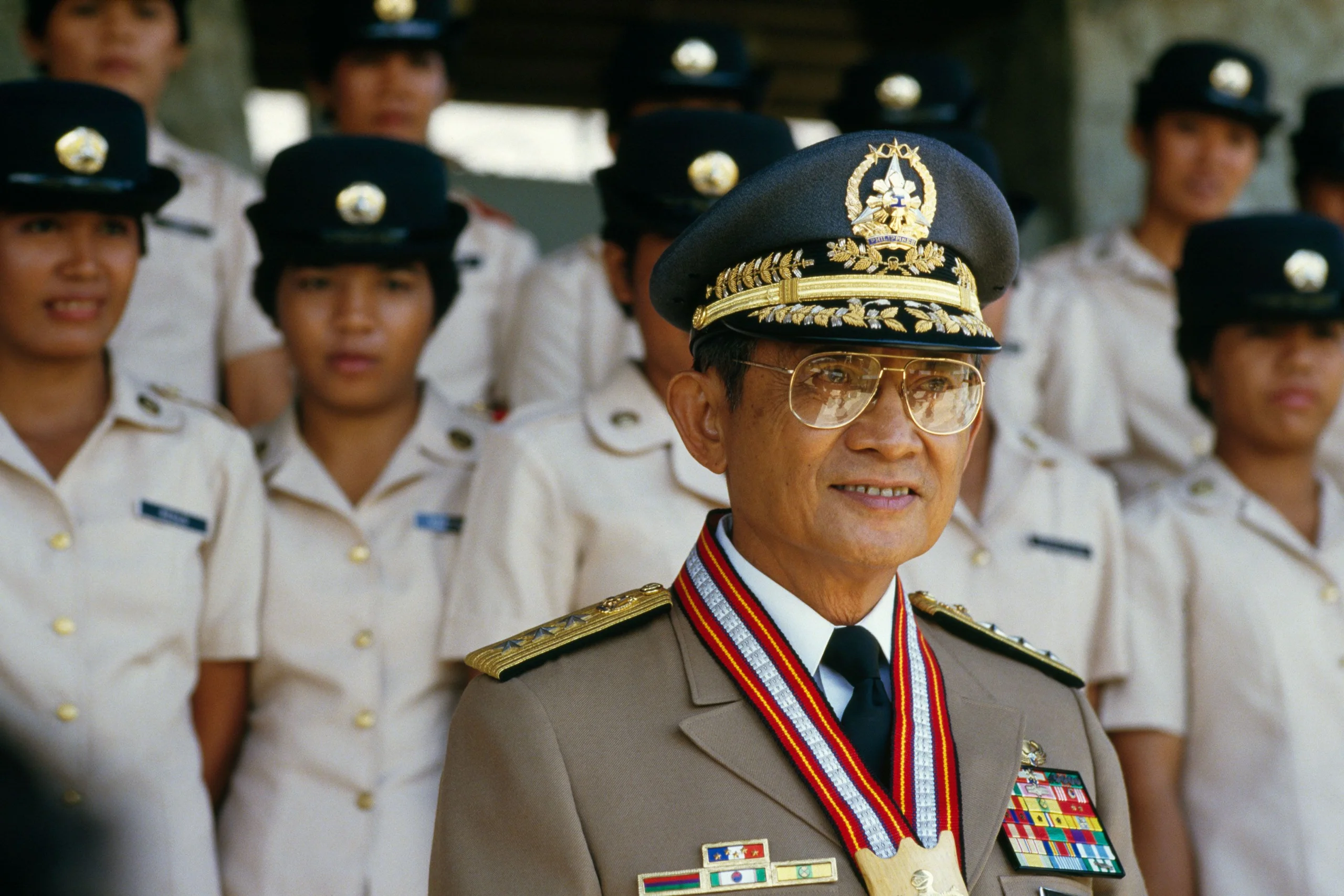
Fidel Ramos
 Philippines
Also known as: FVR, Eddie Ramos, Fidel Valdez Ramos, Fidel V. Ramos, Fidel Ramos y Valdez
Birthday
March 18, 1928
Birth Sign
Pisces
Birthplace
Lingayen, Pangasinan, Philippines
Age
Died at 94
Height
5 ft 8 in (173 cm)
About
Fidel Valdez Ramos, universally known by the initials FVR, was a distinguished soldier-statesman and the 12th President of the Philippines who served from 1992 to 1998. Born on March 18, 1928, in Lingayen, Pangasinan, he emerged as a pivotal figure in modern Philippine history, uniquely bridging the gap between military command and civilian governance. His career is defined by his unprecedented rise through the ranks of the armed forces, culminating in his appointment as the only career officer in Philippine history to achieve the five-star general rank, a title equivalent to Field Marshal. This distinction underscores his unique position as a man who commanded the loyalty of the military while simultaneously championing democratic reforms.
Ramos is widely recognized for his pragmatic leadership style and his strategic role in the restoration of democracy during the 1986 EDSA People Power Revolution. As a key architect of this peaceful transition, he orchestrated the withdrawal of military support from the Marcos dictatorship alongside Defense Minister Juan Ponce Enrile, an act that fundamentally altered the nation's trajectory. Following this breakthrough, he served as Chief of Staff of the Armed Forces and later as Secretary of National Defense, where he successfully restructured security institutions and quelled multiple coup attempts.
His presidency is celebrated for the "Philippines 2000" agenda, a comprehensive vision aimed at transforming the country into a newly industrialized nation. Through policies of deregulation, privatization, and trade liberalization, his administration revitalized the stagnant economy, earning the Philippines the moniker "Asia's Next Tiger." Beyond economics, Ramos is remembered for his relentless pursuit of peace, successfully negotiating historic agreements with communist rebels and Muslim separatists to end decades of internal conflict. Even after leaving office in 1998, he remained an active elder statesman, dedicating his later years to international mediation and humanitarian work until his passing in 2022.
Early Life & Background
Fidel Valdez Ramos entered the world on March 18, 1928, in the coastal town of Lingayen, Pangasinan, into a family deeply entrenched in local politics. His father, Vicente Ramos, served as a senator, while his mother, Flavia Valdez, hailed from a prominent lineage. A defining aspect of his early environment was his familial connection to Ferdinand Marcos; Ramos was a second cousin to the future dictator, a relationship that would profoundly shape his political context without dictating his path. Despite these ties, Ramos chose a distinct trajectory, opting for a rigorous military career rather than immediate entry into political office.
His educational journey began in 1945 at the Philippine Military Academy (PMA), where he honed the foundational skills necessary for a life of service. Seeking technical expertise beyond standard military training, he traveled to the United States to attend the University of Illinois at Urbana-Champaign. There, he earned a Bachelor of Science in Civil Engineering in 1950, followed by a Master's degree in the same field in 1962. These academic achievements provided him with a unique skill set among military leaders, allowing him to understand infrastructure and logistics at a deep level. He also attended the United States Army Command and General Staff College and the National Defense College of the Philippines to further his professional development.
Before his rise to national prominence, Ramos served in the Korean War as a second lieutenant, gaining his first taste of combat. His service extended to the Vietnam War, where he commanded a Philippine contingent. His rapid promotion saw him become the youngest general in the Philippine Army at the age of 37. By the 1970s and 1980s, under the Marcos dictatorship, he held significant positions such as Chief of the Philippine Constabulary and Vice Chief of Staff of the Armed Forces of the Philippines. These roles positioned him as a key figure in the country's security apparatus, setting the stage for his eventual defection during the 1986 revolution.
Career Growth
The culmination of Ramos's military and political career arrived in February 1986 during the EDSA People Power Revolution. Alongside Defense Minister Juan Ponce Enrile, Ramos defected from the Marcos regime, withdrawing military support for the dictator and siding with the opposition led by Corazon Aquino. This pivotal act was instrumental in the peaceful overthrow of Marcos and the restoration of democracy. Following the revolution, President Aquino appointed him as the Chief of Staff of the Armed Forces of the Philippines and later as Secretary of National Defense from 1988 to 1991. In these roles, he oversaw the restructuring of the military and police forces, successfully quelling several coup attempts and creating elite units like the Philippine Army's Special Forces and the Philippine National Police Special Action Force.
In 1992, Ramos was elected as the 12th President of the Philippines, serving until 1998. His administration launched the "Philippines 2000" agenda, a comprehensive plan focused on economic liberalization, deregulation, and infrastructure development. This initiative earned the country the moniker "Asia's Next Tiger" due to its rapid economic growth. Ramos successfully negotiated peace agreements with communist rebels and Muslim separatists, significantly reducing internal conflict and stabilizing the nation. He signed peace agreements with the Communist Party of the Philippines-New People's Army-National Democratic Front and the Moro Islamic Liberation Front, marking a turning point in the country's history.
After leaving office in 1998, Ramos remained an influential elder statesman. He engaged in international peace negotiations and humanitarian work, leveraging his experience to mediate conflicts in other regions. He served as a mediator in various Asian disputes and maintained strong diplomatic ties with countries like Japan and Thailand. His post-presidential years were marked by a dedication to peacebuilding and the promotion of democratic values, cementing his status as a respected leader in Southeast Asia until his death in 2022. He received numerous distinctions both domestically and internationally, including the Presidential Medal of Merit, the Order of the Golden Heart, the Order of the Rising Sun, Gold and Silver Star by Japan, the Order of the White Elephant from Thailand, and the Order of the Crown of Malaysia.
Career Timeline
Public Image & Style
Fidel Ramos is portrayed as a pragmatic reformer, a soldier-statesman, and a peacemaker. Media coverage emphasizes his military background, his role in the EDSA Revolution, and his economic policies. He is viewed with deep respect and reverence in the Philippines. His distinctive mustache and military bearing were hallmarks of his public appearance throughout his life. Standing approximately 5 feet 8 inches (173 cm) tall, he projected an image of discipline and strategic thinking. He is often described as a man who bridged the gap between the military and civilian governance, bringing order and vision to political leadership. His quotes, such as "Democracy is not a gift; it is a responsibility," reflect his enduring philosophy.
Fame & Fandom
Fidel V. Ramos commands a unique form of reverence that transcends the commercial machinery of celebrity culture, existing instead as a figure of deep national memory and civic history rather than a pop icon with an organized fanbase. No formal moniker like 'Ramos Army' or similar collective exists; his enduring audience comprises historians, political analysts, and the Filipino public who view his legacy through the lens of statecraft and peacebuilding rather than fandom rituals. His influence is sustained not by billboard campaigns or viral chart pushes, but through institutionalized commemoration such as the Gawad Kapayapaan and the FVR Legacy Foundation, which keep his vision of economic reform and conflict resolution alive for future generations. This historical stature places him firmly within the global consciousness of nations that value democratic transition and military statesmanship. According to the September 2026 iFANN Global Fame Rankings, he holds the position of the 68th most famous person in Philippines, a slight decline from the previous cycle where he stood at 70th. Furthermore, within the specific scope of his nation of origin, he is recognized as the 36th most famous person from Philippines, maintaining his standing steady against shifting cultural tides. These placements reflect a consistent level of attention across media coverage, search behaviors, and consumption signals worldwide, confirming his status as a figure whose name remains integral to regional discourse. While he does not have an active social media presence, his official accounts and those of the FVR Legacy Foundation maintain archival content and updates on his legacy.
Interesting Facts and Legends
Fidel Ramos holds the distinction of being the only career officer in Philippine history to achieve the rank of five-star general, a title equivalent to Field Marshal. Before entering high politics, he was a skilled engineer who designed several bridges and roads in the Philippines, applying his technical knowledge to national development projects. He was the first Filipino to graduate from the United States Military Academy at West Point with a degree in civil engineering, a fact that often anchors stories about his educational background. His most iconic moment occurred during the February 1986 People Power Revolution, where he defected from the Marcos regime alongside Defense Minister Juan Ponce Enrile. This act triggered the mass uprising that restored democracy to the archipelago. He was also a close friend of Japanese Prime Minister Yasuo Fukuda and other Asian leaders, often serving as a mediator in regional conflicts. His legacy includes being honored by various international bodies for his peacebuilding efforts, such as the Gawad Kapayapaan (Peace Award) posthumously recognized by the Philippine government.
Notable facts include his induction into the Hall of Fame of the Philippine Military Academy and the Hall of Fame of the University of the Philippines. He was the youngest general in the Philippine Army at the time of his promotion. He was a skilled engineer who designed several bridges and roads in the Philippines before entering high politics. He was a close friend of Japanese Prime Minister Yasuo Fukuda and other Asian leaders, often serving as a mediator in regional conflicts. His legacy includes being honored by various international bodies for his peacebuilding efforts, such as the Gawad Kapayapaan (Peace Award) posthumously recognized by the Philippine government.
Notable Quotes
“We must not forget that we are all Filipinos.”
“Democracy is not a gift; it is a responsibility.”
“The economy is the foundation of our security.”
Family & Personal Life
Fidel Ramos was born into a politically active family in Lingayen, Pangasinan. His father, Vicente Ramos, was a former senator, and his mother, Flavia Valdez, came from a prominent local family. Ramos was a second cousin to Ferdinand Marcos, who later became the president of the Philippines. Despite this familial connection, Ramos pursued a military career that eventually led him to oppose Marcos's dictatorship. He was raised in a politically active environment but chose a career in the military over immediate political office. His legacy includes being honored by various international bodies for his peacebuilding efforts, such as the Gawad Kapayapaan (Peace Award) posthumously recognized by the Philippine government. He was inducted into the Hall of Fame of the Philippine Military Academy and the Hall of Fame of the University of the Philippines.
Notable Connections
Relationships & Dating History
Fidel Ramos was married to Amelita "Nining" Ramos (née Cruz). The couple met while they were students at the University of the Philippines Diliman. They were married in 1950 and remained together until his death in 2022. There are no publicly documented romantic relationships outside of this marriage. They had three children: Fidel V. Ramos Jr., Maria Elena "Elena" Ramos, and Amelita "Milly" Ramos. As of his death in 2022, he was widowed; there is no current partner or dating status to report as he has been deceased since that date.
- MarriedAmelita "Nining" Ramos1950 - 2022Met at the University of the Philippines Diliman; married until his death.
Death & Aftermath
Died
July 31, 2022 (aged 94)
Death Place
Makati City, Philippines
Cause of Death
Multiple organ failure due to prolonged illness
Fidel V. Ramos passed away on July 31, 2022, at the Makati Medical Center in Makati City. The former president had been battling a prolonged illness that led to multiple organ failure. His death occurred just months after his 94th birthday, marking the end of a life defined by military service and political leadership. Following his passing, the Philippine government declared a nine-day national mourning period with flags flown at half-mast across the country. Tributes poured in from global leaders and domestic figures alike. Japanese Prime Minister Fumio Kishida honored Ramos for his contributions to regional stability, while local leaders celebrated his role in the EDSA People Power Revolution. Vigils were held in his hometown of Lingayen, Pangasinan, where he was remembered as a son who brought honor to his community.
The state funeral took place on August 3, 2022, at the Libingan ng mga Bayani, featuring a 21-gun salute and a procession presided over by President Bongbong Marcos. He was laid to rest in the Heroes' Burial Ground. Posthumously, the FVR Legacy Foundation continues to manage his initiatives, focusing on peace-building and economic development. The foundation ensures that his vision for the Philippines remains active, particularly regarding conflict resolution with communist rebels and Muslim separatists. His legacy is preserved through annual commemorations and the continued operation of institutions he helped shape. As of 2026, tributes continue to be paid to his legacy, particularly regarding his role in the EDSA Revolution and his peace initiatives.
Net Worth (Estate Value)
$1 Million
iFANN Editorial Team estimate
Fidel Ramos did not accumulate wealth in the manner of corporate titans or entertainment celebrities. As a public servant, his financial resources were derived primarily from his salary as a military officer and later as President of the Philippines. His estate value is considered modest compared to business magnates, consisting mainly of real estate holdings and savings accumulated over a long career of public service. After leaving office, he engaged in consulting and speaking engagements, which added to his income. Estimates of his estate value are not widely publicized, but given his long service and the nature of his assets (primarily real estate and savings), it is considered modest compared to corporate titans.
Following his death in 2022, the management of his financial affairs and legacy has been handled by the FVR Legacy Foundation. This organization oversees his posthumous initiatives and manages any assets related to his personal brand and intellectual property. While exact figures for his estate are not widely publicized, the foundation ensures that his legacy continues to generate value through charitable works and peace-building programs. The iFANN Editorial Team estimates his net worth at approximately $1 million based on available data regarding his assets and earnings. His primary financial legacy is the FVR Legacy Foundation, which manages his posthumous initiatives.
Awards Won (6)
Fidel Ramos received numerous distinctions both domestically and internationally. Domestically, he was conferred the rank of Field Marshal (five-star general), making him the only career officer in Philippine history to achieve this rank. He received the Presidential Medal of Merit and the Order of the Golden Heart. Internationally, he was awarded the Order of the Rising Sun, Gold and Silver Star by Japan, recognizing his contributions to regional stability and friendship. He also received the Order of the White Elephant from Thailand and the Order of the Crown of Malaysia. While specific award ceremonies like the Oscars or Grammys do not apply to his profile, his legacy includes being honored by various international bodies for his peacebuilding efforts, such as the Gawad Kapayapaan (Peace Award) posthumously recognized by the Philippine government.
1992 · Military Rank
Philippine Army
1992 · Civilian Honor
Philippines
Known For
President of the Philippines
1992 · 12th President
EDSA People Power Revolution
1986 · Key Defector
Secretary of National Defense
1988 · Military Reformer
Keywords
Sources
Quick Facts
- Profession
- politician, military personnel, military commander
- Born
- March 18, 1928
- Birthplace
- Lingayen, Pangasinan, Philippines
- Died
- July 31, 2022
- Death Place
- Makati Medical Center, Makati City
- Gender
- Male
- Spouse
- Amelita Ramos
- Birth Sign
- Pisces
Personal Details
- Full Name
- Fidel Valdez Ramos
- Height
- 5 ft 8 in (173 cm)
- Spouse
- Amelita "Nining" Ramos
- Children
- Fidel V. Ramos Jr., Maria Elena "Elena" Ramos, Amelita "Milly" Ramos
- Education
- Philippine Military Academy; University of Illinois at Urbana-Champaign (BS and MS in Civil Engineering); United States Army Command and General Staff College; National Defense College of the Philippines
Frequently Asked Questions
Who was Fidel Ramos?
When did Fidel Ramos die?
What was Fidel Ramos's role in the EDSA Revolution?
Did Fidel Ramos have any children?
What was Fidel Ramos's nickname?
Join the community
fans discussing