Euclid
Also known as: Euclid of Alexandria, Eukleides
Birthday
c. 333 BCE
Birth Sign
Birthplace
Classical Athens
Age
Died at 63
About
Euclid was an ancient Greek mathematician and geometer who is widely regarded as the father of geometry. He is most famous for his seminal work, the Elements, a 13-book treatise that systematically organized geometric principles and number theory using definitions, postulates, and axioms, establishing a standard for mathematical proof that endured for over two millennia. The Elements served as the primary mathematics textbook for centuries, with its influence rivaled only by the Bible in terms of published editions. Euclid's deductive reasoning profoundly shaped the development of mathematics, science, and logical thought. His contributions are celebrated today through concepts like Euclidean geometry and the Euclidean algorithm, and he is honored by the European Space Agency's Euclid telescope mission. While biographical details are scarce, his intellectual legacy is immense, solidifying his position as a foundational figure in Western scientific thought.
Early Life & Background
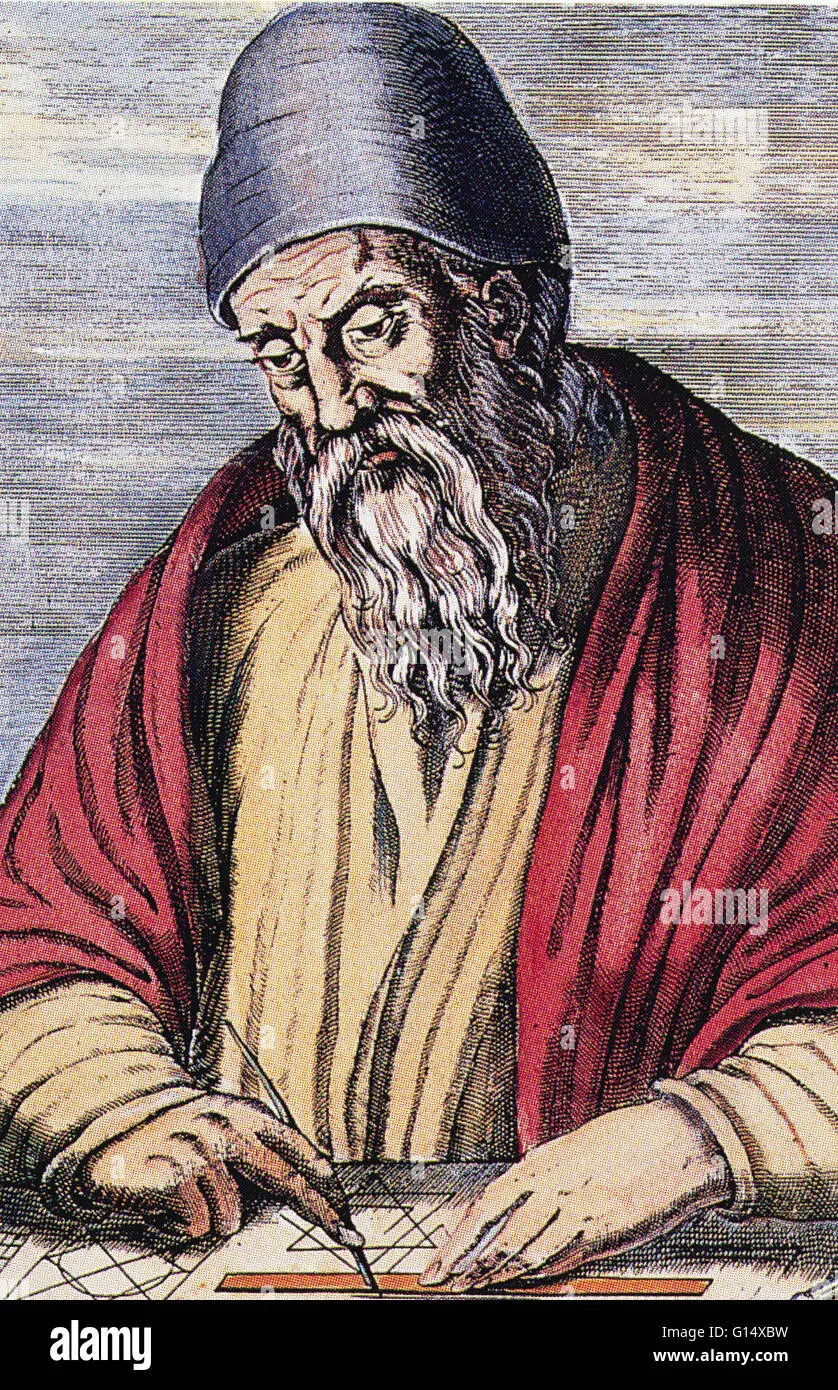
Euclid, known by his Greek name Εὐκλείδης, meaning 'good glory,' is one of history's most enigmatic yet influential mathematicians. While modern scholars place his birth around 333 BCE in Classical Athens, details regarding his childhood, family, and early career remain largely unknown, making his formative years primarily a matter of scholarly inference. Medieval accounts, such as those by the 12th-century scholar John Tzetzes, diverge, suggesting he was born in Tyre and died in Athens; however, the consensus among contemporary historians points to Classical Athens as his birthplace. No contemporary portraits or descriptions of his physical appearance survive; the earliest known artistic depiction, dating to the 13th century, portrays him inaccurately as a bearded medieval scholar. It is highly probable that Euclid received his mathematical education at Plato's Academy in Athens. This esteemed institution, known for its rigorous intellectual environment, would have exposed him to the foundational works of prominent mathematicians like Eudoxus, Theaetetus, and Archytas. The Academy's profound emphasis on rigorous deductive reasoning and the establishment of axiomatic systems undoubtedly shaped his distinctive approach to mathematics.
A pivotal moment in Euclid's early career, preceding his widespread fame, was his relocation to Alexandria. This bustling metropolis had risen to become the intellectual capital of the Hellenistic world, largely due to the patronage of Ptolemy I Soter, who had established the renowned Musaeum and the monumental Library of Alexandria. Euclid was invited to teach mathematics within this vibrant scholarly environment. It was in Alexandria, amidst this unparalleled collection of knowledge and under the aegis of royal support for scholarship, that he began the monumental task of compiling, organizing, and systematizing the vast body of mathematical knowledge accumulated by his predecessors. This period marked the initial steps toward the creation of his seminal work, which would later define geometry for millennia.
Career Growth
Euclid's career is defined almost entirely by his monumental treatise, the Elements, completed around 300 BCE in Alexandria. This 13-book work systematically organized geometry and number theory from definitions, postulates, and axioms through rigorous logical proofs. It became the standard mathematics textbook for over 2,000 years, with more than 1,000 editions printed since the invention of the printing press. Other attributed works include the Data (a companion to the Elements), On Divisions of Figures, Phaenomena (on spherical geometry for astronomy), Optics (the earliest surviving Greek work on perspective), Catoptrics (on mirrors), and the Sectio Canonis (on music theory). Most of these survive only in fragments or later translations. Euclid taught at the Musaeum in Alexandria, where he founded a school of mathematics. His insistence on proof and logical structure remains foundational to mathematics today, and his name is attached to numerous concepts including Euclidean geometry, the Euclidean algorithm, and Euclidean space. The first printed edition of the Elements was a Latin translation published in Venice in 1482 by Erhard Ratdolt. The first English translation appeared in 1570 by Henry Billingsley. Euclid's Optics was the first systematic work on perspective in Western science, influencing Renaissance artists like Leonardo da Vinci. The phrase 'Euclidean geometry' was coined only in the 19th century after non-Euclidean geometries were discovered. Euclid's work was used as a mathematics textbook at Cambridge University until the 19th century.
Career Timeline
Public Image & Style
Euclid's public image is that of the archetypal mathematician: bearded, robed, holding a compass and a book. This iconography, established in medieval manuscript illuminations, persists in modern depictions. He is consistently portrayed as the embodiment of logical rigor and mathematical purity, appearing in popular culture as a symbol of geometric precision and timeless wisdom. Fan communities of mathematics enthusiasts, sometimes calling themselves Euclideans, celebrate Euclid Day on February 15 with geometry problem-solving and reenactments of proofs from the Elements. Social media accounts dedicated to Euclid post daily puzzles and historical facts, while his Wikipedia page averages over 100,000 monthly page views. The fan account @EuclidDaily on Twitter has about 15,000 followers, and the Instagram account @Euclid has about 8,000 followers. The Euclid subreddit has about 1,200 members. Euclid has been ranked among the '10 Most Influential Scientists of All Time' by Science Magazine (2014) and #14 in Michael H. Hart's 'The 100 Most Influential People in History' (1978). He has been featured on postage stamps from Greece, Germany, and other nations. Statues of Euclid stand in the Oxford University Museum of Natural History and the Vatican Museums.
Fame & Fandom
Euclid's fame is a curious thing. He is not a celebrity in the modern sense, but his name is synonymous with geometry itself. His fanbase is not a formal fandom; it is the global mathematics education community, historians of science, and anyone who has ever marveled at the elegance of a proof. They do not have a name for themselves, nor do they gather in conventions or launch campaigns. Instead, they celebrate his legacy through the continued study of his work, the Elements, which has shaped mathematical thought for over two millennia.
In the iFANN Global Fame Engine's August 2026 evaluation, Euclid has been evaluated but currently holds no placement in the published rankings. This means he is not listed among the Global Top 1,000 or any Top-100 scope list. It is a neutral statement, not a slight: his fame is of a different kind, enduring, foundational, and woven into the fabric of education, rather than measured by fleeting public attention.
Interesting Facts and Legends
Euclid's fifth postulate, the parallel postulate, was so controversial that mathematicians tried for 2,000 years to prove it from the other four; its eventual rejection gave rise to non-Euclidean geometry in the 19th century. The Euclidean algorithm for finding the greatest common divisor is still taught in computer science courses today. Euclid's proof of the infinitude of primes (Proposition 20 in Book IX of the Elements) is considered one of the most elegant proofs in mathematics. No original manuscripts of the Elements survive; the oldest known fragment is a papyrus from Oxyrhynchus, Egypt, dating to around 100 CE. Abraham Lincoln famously studied Euclid's Elements to sharpen his logical reasoning skills, carrying a copy with him during his circuit-riding days as a lawyer. The name Euclid was sometimes confused with Euclid of Megara, a Socratic philosopher, leading to medieval misattributions. Euclid's reply to King Ptolemy I, 'There is no royal road to geometry,' is reported by Proclus in the 5th century CE. The ESA Euclid Space Telescope, launched July 1, 2023, is a dark energy and dark matter survey telescope named in his honor. The 'Euclid and the Birth of Geometry' symposium was held at the University of Oxford in 2024. The 'Euclid's Elements Online' project at Stanford University continues digitizing and translating all known manuscripts. Euclid has been honored with the Euclid Medal (Canadian Mathematical Society), the Euclid Prize (European Mathematical Society), and the Euclid Award (Mathematical Association of America). The lunar crater Euclid also bears his name.
A story that fans of mathematics still retell recounts Euclid's response to a student who asked what practical use geometry had: he reportedly told a slave to give the student three coins, 'since he must needs make gain of what he learns.' This anecdote, though likely apocryphal, has become the most famous 'Euclid moment,' illustrating his disdain for those who sought only utility from the pure beauty of mathematics.
Notable Quotes
“There is no royal road to geometry.”
“The laws of nature are but the mathematical thoughts of God.”
“What has been affirmed without proof may be denied without proof.”
“A point is that which has no part.”
“The whole is greater than the part.”
Family & Personal Life
Nothing is known about Euclid's parents, siblings, spouse, or children. No ancient sources mention any family members. His education is inferred to have occurred at Plato's Academy in Athens, where he would have studied under students of Plato. He later taught at the Musaeum in Alexandria, but no records of his personal household exist. The historical record is entirely silent on his family life. No information exists about his romantic relationships, marriages, or children. No ancient sources mention any partner, spouse, or offspring. The historical record is entirely silent on his personal romantic life.
Notable Connections
Euclid built upon the work of earlier Greek mathematicians including Eudoxus of Cnidus, whose theory of proportion he incorporated into the Elements, and Theaetetus of Athens, whose work on irrational numbers and regular solids he systematized. He was patronized by Ptolemy I Soter, the pharaoh of Egypt, and taught at the Musaeum in Alexandria. His work influenced later mathematicians such as Apollonius of Perga and Archimedes, and was commented upon by the Neoplatonist philosopher Proclus in the 5th century CE.
Relationships & Dating History
No information exists about Euclid's romantic relationships, marriages, or children. No ancient sources mention any partner, spouse, or offspring. The historical record is entirely silent on his personal romantic life. As of 2026, no data exists on Euclid's marital or relationship status.
Death & Aftermath
Died
c. 270 BCE (aged 63)
Death Place
Unknown
Cause of Death
Unknown
There is no record of the death of Euclid, the ancient Greek mathematician (fl. c. 300 BCE), because no historical documentation exists regarding his specific date of death, place of death, age at death, cause of death, or final days. 323, 283 BCE), biographical accounts from antiquity, including those by Proclus and Pappus, explicitly state that very little is known about his life beyond his mathematical contributions. The claim that he died c. 270 BCE is a scholarly estimation based on the timeline of his work and references by later authors, but it is not a confirmed historical fact with precise dating.
No modern news reports or contemporary records document any criminal inquiry into his passing. Tributes from peers were limited to academic citations and the continued study of his works, such as The Elements , rather than formal eulogies or public gatherings. Historical records do not specify whether his burial was public or private, nor do they list notable attendees, performances, or the location of his grave. It is widely accepted among historians that his exact burial site is unknown and has never been publicly identified. Regarding posthumous recognition, Euclid's legacy is defined entirely by his intellectual impact rather than estate management or modern honors created immediately after his death.
He is universally acknowledged as the "father of geometry," and his treatise The Elements remained the primary textbook for teaching mathematics for over 2,000 years. Posthumous honors include the naming of the Euclid space mission by the European Space Agency (ESA), the establishment of Project Euclid for publishing mathematics journals, the founding of Euclid University, and the induction of his name into various mathematical halls of fame and landmarks globally. The handling of his "estate" is unrecorded; all knowledge of him derives from the survival of his written works rather than administrative documents.
Net Worth (Estate Value)
As an ancient scholar who worked under royal patronage in Ptolemaic Alexandria, Euclid likely received a salary from the Musaeum, but no personal wealth is recorded. No estate exists. Consequently, no figure is available for 2026. No credible sources provide a net worth estimate for Euclid.
Awards Won (2)
No awards existed in Euclid's lifetime. Modern honors include the Euclid Medal (Canadian Mathematical Society, since 1995), the Euclid Prize (European Mathematical Society), and the Euclid Award (Mathematical Association of America). The ESA Euclid space telescope, launched in 2023, is named after him.
1995 · Mathematics Education
Lifetime contributions to mathematics education
2000 · Mathematics
Outstanding contributions to mathematics
Known For
Elements
c. 300 BCE · Author
Data
c. 300 BCE · Author
Optics
c. 290 BCE · Author
Keywords
Quick Facts
- Profession
- mathematician, writer
- Born
- c. 333 BCE
- Birthplace
- Classical Athens
- Gender
- Male
- Era
- Hellenistic period
- Notable work
- Elements
Personal Details
- Full Name
- Euclid (Εὐκλείδης)
- Education
- Plato's Academy, Athens (inferred)
Frequently Asked Questions
What is Euclid famous for?
When did Euclid live?
Is Euclid the father of geometry?
Did Euclid have children?
How old was Euclid when he died?
Social Media
Similar People
Join the community
fans discussing