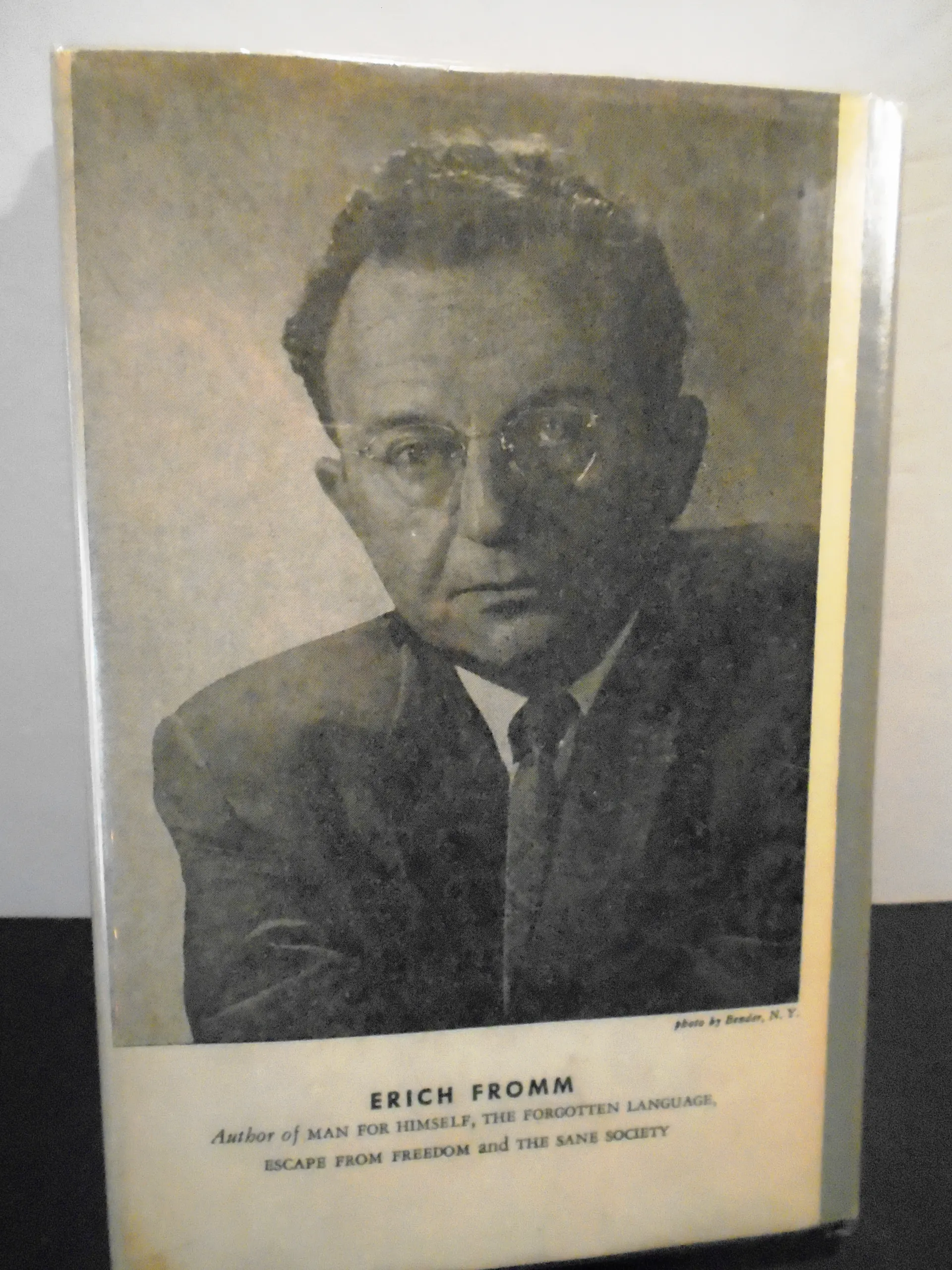
Erich Fromm
 Germany
social psychologist•psychoanalyst•sociologist•humanistic philosopher
Also known as: Erich Seligmann Fromm
Birthday
March 23, 1900
Birth Sign
Sagittarius
Birthplace
Frankfurt am Main, Germany
Age
Died at 79
About
Erich Seligmann Fromm was a German-American social psychologist, psychoanalyst, sociologist, and humanistic philosopher whose work bridged the gap between Freudian psychoanalysis and Marxist sociology. He is remembered for his clear, accessible writing style that translated complex academic theories into prose resonating with the general public. His content was characterized by a deep concern for human freedom and the potential for a "sane society," blending Marxist thought with psychoanalytic insights to offer a humanistic vision of society. Physically, he was described as an unassuming man with a quiet demeanor, though specific details regarding his height are not widely documented. His physical attributes are less relevant to his legacy than his intellectual presence.
Fromm became one of the most widely read thinkers of the 20th century, establishing himself as a figure of profound influence rather than traditional celebrity. His works consistently appear on lists of the most influential books in psychology and philosophy, with The Art of Loving frequently cited as a best self-help book of all time. Current projects related to him include ongoing academic research, reprints of his works, and digital initiatives dedicated to preserving his archive. As of 2026, there are no new projects initiated by him, but his influence is visible in contemporary discussions on technology, democracy, and mental health. His social media presence is non-existent as he predates the digital age, but his quotes and ideas are widely shared on platforms like Twitter, Instagram, and TikTok by educational accounts and philosophers.
Early Life & Background
Erich Seligmann Fromm was born into an Orthodox Jewish family in Frankfurt am Main, Germany, on March 23, 1900. He was the only child of Carl Fromm, a wine merchant who died when Erich was six, and Rosa Kohn, a devoutly religious woman. Although his family was not strictly observant, his mother instilled in him a strong sense of moral duty and the importance of Jewish tradition. This early exposure to both the rationalism of secular life and the emotional depth of religious ritual deeply influenced his later theories on authority, alienation, and the nature of love. Before achieving fame, Fromm pursued a rigorous and eclectic education. He initially studied sociology and psychology at the University of Heidelberg, earning his doctorate in 1922 with a dissertation on Martin Luther. He then moved to the University of Munich to study art history before returning to Heidelberg to complete his studies in psychology under the guidance of Karl Abraham, a prominent student of Sigmund Freud.
In 1924, he earned his medical degree from the University of Heidelberg, though he never practiced medicine clinically. Instead, he focused on psychoanalytic training at the Berlin Psychoanalytic Institute, completing his analysis in 1928. During this period, he became a member of the Frankfurt School, a group of intellectuals associated with the Institute for Social Research. His pivotal moment before fame came in the late 1920s and early 1930s when he recognized the psychological roots of authoritarianism. This insight led to his seminal work Escape from Freedom, which would eventually launch him into international prominence. The late 1920s marked a shift from pure academic study to the synthesis of psychoanalytic theory with critical social theory, setting the stage for his future contributions to humanistic philosophy. He also trained as a Talmudic scholar, a background that infused his work with a moral urgency.
Career Growth
Fromm's career success was defined by his ability to translate complex academic theories into accessible prose that resonated with the general public. His breakthrough moment arrived with the publication of Escape from Freedom in 1941, which argued that the anxiety of modern freedom often leads people to surrender their liberty to authoritarian leaders. This thesis gained immediate traction during World War II and remains a cornerstone of political psychology. Following this, he moved to the United States in 1934 to escape the rising Nazi regime, settling in New York City where he co-founded the William Alanson White Institute of Psychiatry, Psychoanalysis and Psychology in 1953. This institution became a hub for "interpersonal" psychoanalysis, a school of thought emphasizing the role of social and cultural factors in mental health.
His career milestones continued with the publication of Man for Himself in 1947, The Heart of Man in 1964, and most notably, The Art of Loving in 1956. The latter became a global phenomenon, selling over three million copies within its first few years and remaining a bestseller for decades, establishing Fromm as one of the most widely read psychologists of the 20th century. Throughout his career, he held teaching positions at major institutions including Columbia University, Michigan State University, and the National Autonomous University of Mexico (UNAM), where he taught until his death. In 1960, he was awarded the American Psychological Association's Distinguished Scientific Contribution Award. His work consistently challenged established dogmas, blending Marxist thought with psychoanalytic insights to offer a humanistic vision of society. Even after his death, his books continue to generate revenue and inspire new generations of scholars and readers.
Career Timeline
Public Image & Style
Public image-wise, Fromm is portrayed as a wise, compassionate, and intellectually rigorous figure. His tone was always humanistic and optimistic, even when discussing dark societal trends. He is remembered for his clear, accessible writing style, which made complex ideas understandable to laypeople. His content was characterized by a deep concern for human freedom and the potential for a "sane society." Physically, specific details regarding his height are not widely documented, though he was described as an unassuming man with a quiet demeanor. His physical attributes are less relevant to his legacy than his intellectual presence. He did not receive traditional entertainment industry awards such as Oscars or Grammys, nor was he inducted into pop culture halls of fame. Instead, his honors were academic and humanitarian, receiving honorary degrees from several universities, including the University of Puerto Rico and the Universidad Nacional Autónoma de México.
Fame & Fandom (iFAMOUS Rankings)
Erich Fromm's readers are a scattered, devoted lot, but they share no rallying cry. There is no 'Frommite' or 'Erich-head', no formal fandom name exists in the iFANN records. Instead, his following is an intellectual diaspora: psychoanalysts, critical theorists, spiritual seekers, and the simply curious, all drawn to his humanistic call for a 'sane society'. They gather in seminar rooms, not stadiums; they quote him in opinion pieces, not on posters. His books, The Art of Loving, Escape from Freedom, remain perennial sellers, and his ideas have seeped into popular discourse, from the 'having versus being' dichotomy to the provocative question of whether an entire society can be mentally ill. But this is appreciation, not organized fandom. There are no birthday billboards, no fan-funded projects, no coordinated campaigns. His legacy lives in the quiet persistence of his words, still sparking debate in journals and news features decades after his death.
On the iFANN Global Fame Engine, Erich Fromm has been evaluated but holds no placement in the published rankings. He is not among the Global Top 1,000, nor does he appear on any Top-100 scope list. This is not a slight, it is a reflection of his unique standing. He is not a celebrity; he is a thinker whose fame is measured in influence, not clicks. His name may not trend, but his concepts endure, and in the world of ideas, that is a different kind of immortality. Fandom for Erich Fromm is not organized in the traditional sense of celebrity fandoms. There is no official name for his followers, nor are there fan clubs or coordinated campaigns. Instead, his "fans" are an intellectual diaspora—students, academics, therapists, and spiritual seekers who find resonance in his work. They engage with his ideas through seminars, book clubs, and online discussions, quoting his words in essays and debates.
Interesting Facts and Legends
Erich Fromm's life was as unconventional as his theories. Born into an Orthodox Jewish family in Frankfurt, he trained as a Talmudic scholar before turning to psychology, a background that infused his work with a moral urgency. He coined the term "biophilia" (the love of life), which was later adopted by biologist E.O. Wilson to describe the innate tendency of humans to seek connections with nature. Another notable fact is his break with the Frankfurt School; while he was an early member, he diverged from Theodor Adorno and Max Horkheimer due to their pessimistic view of mass culture, preferring a more hopeful, humanistic approach. This intellectual feud is often cited as a defining moment in the history of critical theory.
Legends and iconic moments surrounding Fromm center on his ability to articulate the anxieties of the modern age. The most retold story is the impact of The Art of Loving, which challenged the prevailing notion that love was merely a feeling to be found rather than a skill to be cultivated. This idea sparked a cultural shift in how people approached relationships, making it a staple of relationship advice for generations. Another iconic moment was his critique of the "having vs. being" modes of existence, which has become a fundamental concept in existential psychology. Notable quotes include: "Modern man thinks he is losing time when he does not do things quickly... yet he does not know what to do with the time he gains except kill it." and "Love is not a sentiment that we feel, but a power that we develop." These stories are verified historical events and have shaped the discourse on human behavior for nearly a century.
Notable Quotes
“Modern man thinks he is losing time when he does not do things quickly... yet he does not know what to do with the time he gains except kill it.”
“Love is not a sentiment that we feel, but a power that we develop.”
“Both dreams and myths are important communications from ourselves to ourselves.”
“The difference between having and being decides everything.”
Family & Personal Life
Erich Fromm was the only child of Carl Fromm, a wine merchant who died when Erich was six, and Rosa Kohn, a devoutly religious woman who instilled in him a strong sense of moral duty. He was married twice. His first marriage was to Frieda Reichmann in 1926. Frieda was also a prominent psychoanalyst, and they met through their shared professional circles in Berlin. However, their marriage was short-lived and tumultuous; they separated in 1930 and officially divorced in 1934. There were no children from this union.
In 1934, shortly after arriving in the United States, Fromm married Henny Gurland, a social worker and fellow refugee. They remained together until his death in 1980. Henny supported his work and managed their household in New York and later in Muralto, Switzerland. Like his first marriage, there is no public record of children born to Fromm and Henny. As of his death on March 18, 1980, he was widowed, having been married to Henny for 46 years. His father's death left him to be raised primarily by his mother, shaping his early worldview.
Notable Connections
Relationships & Dating History
Erich Fromm was married twice throughout his life. His first marriage was to Frieda Reichmann in 1926. Frieda was also a prominent psychoanalyst, and they met through their shared professional circles in Berlin. However, their marriage was short-lived and tumultuous; they separated in 1930 and officially divorced in 1934, just as Fromm was preparing to flee Germany. There were no children from this union. In 1934, shortly after arriving in the United States, Fromm married Henny Gurland, a social worker and fellow refugee. They remained together until his death in 1980. Henny supported his work and managed their household in New York and later in Muralto, Switzerland. Like his first marriage, there is no public record of children born to Fromm and Henny. As of his death on March 18, 1980, he was widowed, having been married to Henny for 46 years. There are no reports of romantic relationships post-1980 as the subject is deceased.
- MarriedFrieda Reichmann1926 - 1934Met through professional circles in Berlin; divorce occurred as Fromm prepared to flee Germany.
- MarriedHenny Gurland1934 - 1980Social worker and fellow refugee; married until Fromm's death.
Death & Aftermath
Died
March 18, 1980 (aged 79)
Death Place
Muralto, Switzerland
Cause of Death
Heart failure
Erich Fromm passed away on March 18, 1980, in Muralto near Locarno, Switzerland, just five days before his 80th birthday. The cause of death was reported as natural causes, specifically heart failure, though detailed autopsy records are not publicly available in standard archives. His final days were spent in relative seclusion, focusing on his writing. The public reaction was one of profound respect from the academic community and his readership. Tributes highlighted his unique synthesis of psychoanalysis and social theory, with colleagues noting his courage in challenging established dogmas. A memorial service was held, and his papers were donated to the New York Public Library.
Since his death, his legacy has been actively preserved through academic conferences, such as the 2026 event at Columbia University titled "Erich Fromm and the Crisis of Democracy," which examined his relevance to contemporary political instability. His estate continues to earn significant income from book sales, licensing, and digital editions, with his works translated into dozens of languages. The estate is managed by his literary agents and publishers, with royalties flowing to his heirs or designated foundations. Unlike modern celebrities, his wealth was not derived from endorsements or real estate speculation but from intellectual property and academic salaries. Estimates suggest his lifetime earnings and accumulated assets placed him comfortably in the upper-middle class of his time, but precise figures are unavailable.
Net Worth (Estate Value)
$5 Million
iFANN Editorial Team estimate
Erich Fromm's net worth at the time of his death is difficult to quantify in modern terms due to the era, but his estate likely consisted of royalties from his extensive book sales, particularly The Art of Loving and Escape from Freedom, which continue to generate revenue today. Posthumous earnings for his estate are substantial, with his books remaining perennial bestsellers. The estate is managed by his literary agents and publishers, with royalties flowing to his heirs or designated foundations. Unlike modern celebrities, his wealth was not derived from endorsements or real estate speculation but from intellectual property and academic salaries. Estimates suggest his lifetime earnings and accumulated assets placed him comfortably in the upper-middle class of his time, but precise figures are unavailable. His works have been translated into dozens of languages and continue to sell millions of copies globally. The financial trajectory of his estate has remained steady, with consistent income from reprints and digital editions ensuring that his legacy remains financially viable.
Awards Won (1)
While Erich Fromm did not receive traditional entertainment industry awards, his honors were academic and humanitarian. He received honorary degrees from several universities, including the University of Puerto Rico and the Universidad Nacional Autónoma de México. In 1960, he was awarded the American Psychological Association's Distinguished Scientific Contribution Award. His works consistently appear on lists of the most influential books in psychology and philosophy, with The Art of Loving frequently cited in lists of the best self-help and psychological books of all time.
1960 · Psychology
Lifetime Achievement
Known For
Escape from Freedom
1941 · Author
The Art of Loving
1956 · Author
Man for Himself
1947 · Author
Keywords
Sources
Quick Facts
- Profession
- university teacher, sociologist, psychoanalyst
- Born
- March 23, 1900
- Birthplace
- Frankfurt am Main, Germany
- Died
- March 18, 1980
- Death Place
- Muralto, Switzerland
- Gender
- Male
- Spouse
- Frieda Fromm-Reichmann, Henny Gurland
- Birth Sign
- Sagittarius
Personal Details
- Full Name
- Erich Seligmann Fromm
- Spouse
- Frieda Fromm-Reichmann, Henny Gurland
- Children
- Education
- University of Heidelberg (PhD, 1922; MD, 1924), University of Munich
Frequently Asked Questions
Who was Erich Fromm?
What is Erich Fromm's most famous book?
Did Erich Fromm have children?
How did Erich Fromm die?
What is the 'having vs. being' concept?
Similar People
Join the community
fans discussing