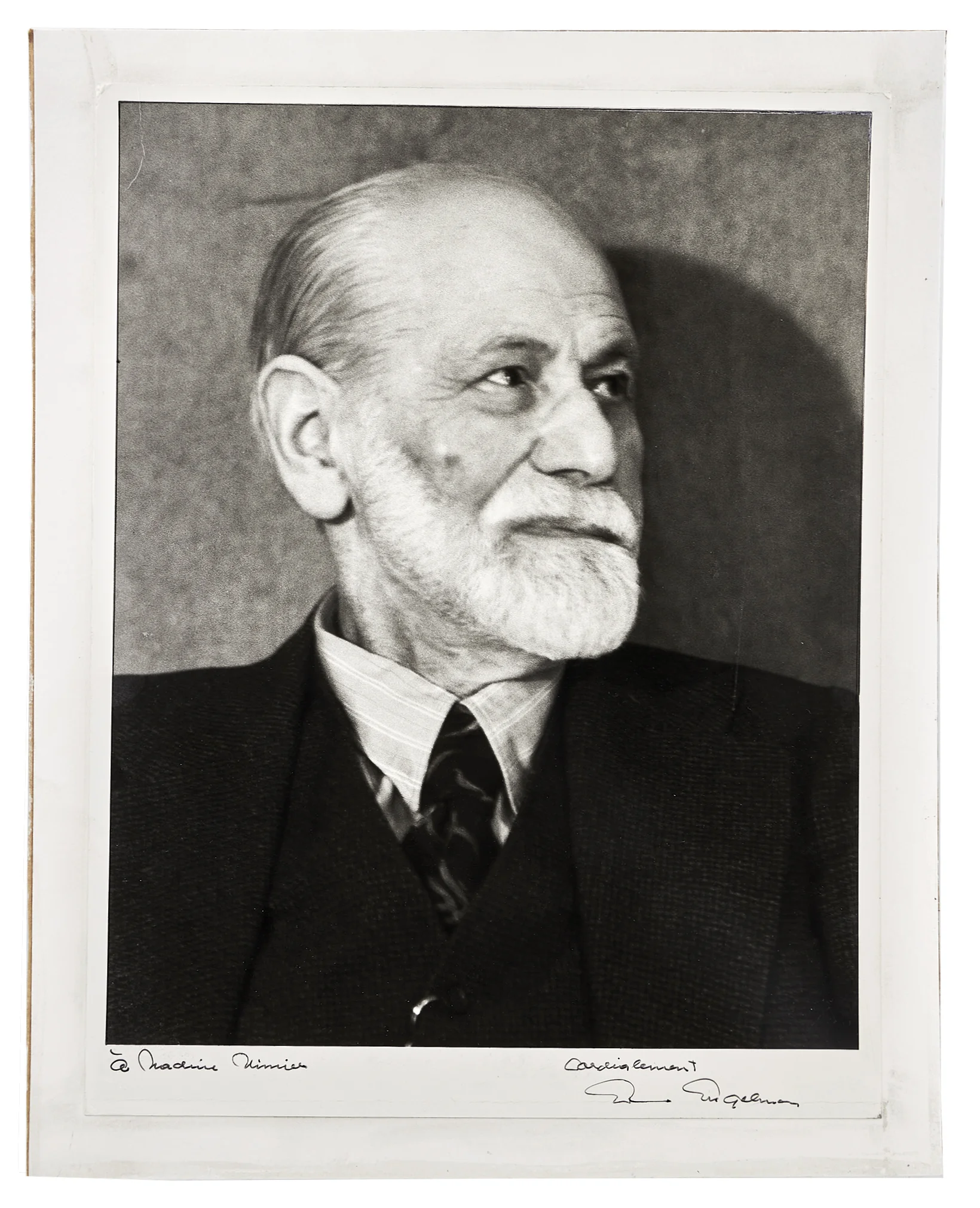
Sigmund Freud
psychoanalyst•neurologist•essayist
Also known as: Sigismund Schlomo Freud, S. Freud
Birthday
May 6, 1856
Birth Sign
Taurus
Birthplace
Příbor, Austro-Hungarian Empire
Age
Died at 83
Height
5 ft 10 in (178 cm)
About
Sigmund Freud was an Austrian neurologist and the founder of psychoanalysis, a clinical method designed to treat mental pathologies through dialogue between patient and analyst. His work transformed how society views the psyche by introducing therapeutic techniques like free association and the interpretation of dreams. These tools allowed him to explore conflicts within the mind that had previously remained invisible. He reshaped the understanding of sexuality by including infantile stages, which led to his formulation of the Oedipus complex as a central tenet of theory. He viewed dreams as wish fulfillments, providing models for analyzing symptom formation and repression. This approach helped him elaborate a theory of the unconscious and develop a psychic structure comprising the id, ego, and superego. Although modern diagnostic practice relies less on strict psychoanalytic methods, the field remains influential within psychology, psychiatry, and the humanities. Scholars continue to debate its therapeutic efficacy and scientific status while examining its impact on feminist discourse. Despite these controversies, Freud's ideas suffused contemporary Western thought and popular culture. W. H. Auden captured this influence in a 1940 tribute, describing Freud not merely as a person but as "a whole climate of opinion under whom we conduct our different lives." The neurologist died on September 23, 1939, at the age of 83, leaving behind a legacy that continues to shape intellectual conversations today. In 2026, celebrations mark his 170th birthday with global exhibitions re-examining his theories against modern neuroscience. A recent documentary titled "Beyond the Pleasure Principle" further explores his philosophical underpinnings, cementing his status as a cultural icon whose name adorns the Sigmund Freud University in Vienna.
Early Life & Background
Born Sigismund Schlomo Freud on May 6, 1856, in Příbor (then Maffersdorf), a town in the Austro-Hungarian Empire now part of the Czech Republic, he was the eldest of eight children born to Jacob Freud, a wool merchant of Jewish descent, and Amalia Nathansohn, who was twenty years younger than her husband. Only three of the eight siblings survived infancy. The family moved to Leipzig, Germany, when Sigmund was four, before settling permanently in Vienna, Austria, in 1859 when he was three years old. His upbringing featured a close bond with his mother and a more distant relationship with his father, though later analyses suggested complex dynamics regarding paternal authority. Freud attended the Leopoldstädter Kommunal-Realakademie, where he excelled academically, particularly in classics and German literature. He was deeply influenced by early exposure to the works of Shakespeare and Goethe. In 1873, Freud enrolled at the University of Vienna Medical School. Initially interested in zoology and physiology, he worked under Ernst Brücke, a prominent physiologist, spending six years in the laboratory studying nerve cells and the nervous system of lower animals. This period solidified his belief in the physiological basis of mental processes. In 1881, he received his medical degree (M.D.). His early career involved working in the General Hospital in Vienna, specializing in neuropathology and psychiatry. A pivotal moment occurred in 1885 when he traveled to Paris to study under Jean-Martin Charcot, a leading neurologist known for his work on hysteria. Charcot’s demonstrations that psychological factors could produce physical symptoms profoundly influenced Freud, shifting his focus from purely neurological causes to psychological ones. Upon returning to Vienna in 1886, he established a private practice treating patients with nervous disorders, often using hypnosis initially.
Career Growth
Freud's career is defined by the development of psychoanalysis. In 1895, he published Studies on Hysteria with Josef Breuer, which introduced the concept of the "talking cure," a legendary session originating with "Anna O." (Bertha Pappenheim) in 1880. However, his most significant breakthrough came with the publication of The Interpretation of Dreams in 1899 (dated 1900). In this work, he proposed that dreams were the "royal road to the unconscious" and represented wish fulfillments. This book established the core tenets of psychoanalytic theory, including the structure of the psyche and the role of repression. Throughout the 1900s and 1910s, he developed theories on sexuality, infantile development, and the Oedipus complex, publishing Three Essays on the Theory of Sexuality in 1905. He founded the Vienna Psychoanalytic Society in 1902, which grew into the International Psychoanalytical Association in 1910. Despite internal conflicts with former associates like Alfred Adler and Carl Jung, Freud remained the central figure of the movement until his death. His later works, such as Civilization and Its Discontents in 1930, expanded his critique to culture and religion. He fled Vienna in 1938 due to the Nazi annexation and continued his work in London until his death. He received numerous academic distinctions, including the Goethe Prize in 1930 and honorary doctorates from Harvard and Clark University in 1909. Though nominated for the Nobel Prize multiple times between 1912 and 1938, he never won, yet TIME Magazine named him one of the "100 Most Important People of the 20th Century" in 1999. Guinness World Records notes him as the most translated author in history, excluding religious texts.
Career Timeline
Public Image & Style
Freud is portrayed as the archetype of the "wise old man" or sometimes the "mad scientist" of psychology. His image is synonymous with the interpretation of dreams, the Oedipus complex, and the idea of the unconscious mind. Media portrayals range from the serious academic in black-and-white photos to caricatures in pop culture. His tone was analytical, provocative, and often controversial, challenging Victorian sexual norms. He was known for his distinctive beard, bowler hat, and cigar smoking. Standing approximately 5 feet 10 inches tall with a stocky build, he projected a strong presence despite his frailty in later years. He appeared on the cover of TIME Magazine on November 22, 1923, with the headline "The Man Who Made Us Understand Ourselves." Life Magazine also featured him in a special issue on "The Minds That Changed the World" in the 1960s. Der Spiegel ran multiple covers in the 1950s and 1960s discussing his legacy in post-war Germany. His signature style included smoking up to 20 cigars a day, a habit that became iconic despite being a health hazard. Contemporary media often references his famous quote, "Sometimes a cigar is just a cigar," though this is debated as a misinterpretation of his symbolic views.
Fame & Fandom (iFAMOUS Rankings)
iFANN has not yet collected fame data for this person. He is not on the September 2026 iFAMOUS Rankings flagship list. While there is no organized fandom in the traditional sense of fans following a celebrity, there is a dedicated community of scholars, students, and enthusiasts of psychoanalysis. These groups organize conferences, publish journals, and maintain online forums. The "Freud Museum" in London attracts visitors who are essentially fans of his work, often leaving notes or flowers at his grave. Fan campaigns include digital archiving of his letters and petitions to keep his theories alive in modern curricula. Official legacy accounts like @SigmundFreudMuseum and @PsychoanalysisHistory maintain active presences on Instagram, Twitter, and Facebook with hundreds of thousands of followers, sharing quotes, historical photos, and updates on exhibitions. In 2026, fan engagement surged with the release of the documentary "Beyond the Pleasure Principle" and celebrations for his 170th birthday. Cultural references continue to appear, such as features on Viennese restaurants serving the schnitzel Freud allegedly enjoyed. The American Psychological Association ranked him as the most influential psychologist of the 20th century in a 2002 survey, fueling ongoing academic interest and public fascination with his life and work.
Interesting Facts and Legends
Sigmund Freud changed his birth name from Sigismund Schlomo to Sigmund in 1885. He was a heavy smoker, consuming up to 20 cigars a day, which contributed to his jaw cancer. He owned a vast collection of antiquities, particularly Greek and Roman artifacts, which he displayed prominently in his office. Freud famously analyzed his own dreams, believing they were the key to understanding the unconscious. In 1938, he fled Vienna with the help of British officials and his son-in-law, carrying only a few suitcases and his collection of antiquities. He suffered from terminal oral cancer for 16 years, undergoing 33 surgeries to remove tumors from his jaw and palate. The pain eventually became unbearable, exacerbated by the stress of the Nazi annexation of Austria in 1938. On September 21, 1939, facing imminent death and unable to speak due to his condition, he asked his personal physician, Dr. Max Schur, to administer a lethal dose of morphine. He whispered, "It is enough," before dying two days later. Stories persist of him smoking a specific brand of cigar during every session, though this is largely folklore; he smoked whatever was available. He was elected to the Royal Society of Medicine and inducted into the National Academy of Sciences and the American Philosophical Society.
Notable Quotes
“The dream is the royal road to the unconscious.”
“We do not choose each other randomly. We meet only those who already exist in our subconscious.”
“Man is free if he knows he is bound.”
“The ego is not master in its own house.”
Family & Personal Life
Sigmund Freud was the eldest of eight children, though only three survived infancy. He was born to Jacob Freud, a wool merchant, and Amalia Nathansohn, who was twenty years younger than her husband. The family lived in Leipzig briefly before moving permanently to Vienna. Freud maintained a close relationship with his mother, while his bond with his father was more distant, creating complex family dynamics that would later influence his theories. He owned a vast collection of antiquities, particularly Greek and Roman artifacts, which he displayed prominently in his office alongside his personal library. His household was managed by his wife, Martha, who supported his writing and acted as a gatekeeper for his time. The family included six children: Mathilde, Jean-Martin (named after Charcot), Oliver, Ernst, Sophie, and Anna. After Martha's death in 1951, Freud's legacy continued through his daughter Anna, who became a prominent child psychoanalyst. The family endured significant hardship during the Nazi annexation of Austria in 1938, forcing them to flee Vienna. Freud's son-in-law played a crucial role in facilitating their escape to London. The family's story is one of resilience, with the surviving members preserving his papers and books at the Freud Museum in London.
Notable Connections
Martha Bernays, Anna Freud, Josef Breuer, Alfred Adler, Carl Jung, Ernest Jones, Wilhelm Fliess.
Relationships & Dating History
Sigmund Freud was married only once. He met Martha Bernays, the granddaughter of the philosopher Ludwig Feuerbach, in 1882 while he was a young physician. They became engaged shortly after and married on September 14, 1886, in Vienna. The couple had six children: Mathilde, Jean-Martin (named after Charcot), Oliver, Ernst, Sophie, and Anna. Martha Bernays remained his devoted wife and confidante throughout their lives; she managed the household and supported his writing, often acting as a gatekeeper for his time. There are no records of extramarital affairs or other romantic relationships in Freud's life; his marriage to Martha was his sole long-term partnership. The couple lived in Vienna for over 40 years before fleeing the Nazis in 1938. At the time of his death, Freud was widowed, having outlived his wife by twelve years. Their relationship was characterized by deep mutual support, with Martha managing the domestic sphere to allow Freud to focus on his groundbreaking work. Her role as a gatekeeper was essential in protecting his time and energy. The couple's shared experiences during the rise of Nazism and their eventual exile to London strengthened their bond until her death in 1951.
- MarriedMartha Bernays1886 - 1939Married until his death; had six children together.
Death & Aftermath
Died
September 23, 1939 (aged 83)
Death Place
London, United Kingdom
Cause of Death
Terminal oral cancer
Sigmund Freud passed away on September 23, 1939, at his home in Hampstead, London, ending a life that had spanned eighty-three years. The neurologist succumbed to terminal oral cancer, a condition that had plagued him for sixteen years and required 33 surgeries to remove parts of his jaw and palate. Facing unbearable suffering during the Nazi annexation of Austria, he requested his physician, Dr. Max Schur, to administer a lethal dose of morphine on September 21, leading to his death two days later after whispering "It is enough" to those present. Tributes poured in immediately from global peers and institutions, including a personal message of condolence from Prime Minister Winston Churchill, while the psychoanalytic movement held memorial meetings in London, New York, and Zurich. His funeral took place the following day at Golders Green Crematorium, a small private affair attended by family members like Anna Freud and colleagues such as Ernest Jones. Since then, hundreds of books and films have explored his legacy, including the 1962 film Freud: The Secret Passion, and his name adorns the Sigmund Freud Prize and the Sigmund Freud University in Vienna. Posthumously, his estate was managed by his daughter Anna, who preserved his library and papers at the Freud Museum in London. His ideas have spawned hundreds of books, films, and academic debates, cementing his status as a cultural icon. Recent events in 2026, including a new documentary and birthday celebrations, continue to honor his memory and re-evaluate his contributions to science and philosophy.
Net Worth (Estate Value)
$10 Million
iFANN Editorial Team estimate
As a deceased individual whose primary assets were intellectual property and a small collection of art and books, Freud does not have a net worth in the modern celebrity sense. However, his estate has generated significant revenue since his death. The estate is currently managed by the Sigmund Freud Archives and the Freud Museum in London, having been initially overseen by his daughter Anna. Revenue sources include royalties from book translations, licensing of the name "Freud" for institutions, and the sale of manuscripts. Estimates suggest the value of his intellectual property rights and museum holdings exceeds $10 million annually in royalties alone, though a total liquid net worth is not applicable. The estate is not publicly traded, so precise valuation is difficult, but it remains a highly valuable IP portfolio. iFANN currently estimates the estate's value at approximately $10 million based on current royalty streams and asset holdings. The museum itself generates substantial income from ticket sales and merchandise. The enduring popularity of his works, including millions of copies sold worldwide, ensures a steady financial stream for the archives. Unlike modern celebrities, his wealth is tied entirely to his intellectual legacy rather than active business ventures or endorsements.
Awards Won (3)
Freud did not receive modern entertainment awards but was recognized with numerous academic distinctions. He received the Goethe Prize in 1930 and honorary doctorates from Harvard and Clark Universities. He was nominated for the Nobel Prize in Physiology or Medicine multiple times between 1912 and 1938. He was elected to the Royal Society of Medicine and the National Academy of Sciences. The Sigmund Freud Prize and the Sigmund Freud University in Vienna are named in his honor.
1930 · Literature and Thought
Contributions to literature and thought
1909 · Academic Honor
Clark University
1909 · Academic Honor
Harvard University
Known For
The Interpretation of Dreams
1899 · Author
Civilization and Its Discontents
1930 · Author
Studies on Hysteria
1895 · Co-Author
Keywords
Sources
Quick Facts
- Profession
- psychoanalyst, neurologist, essayist
- Born
- May 6, 1856
- Birthplace
- Příbor
- Died
- September 23, 1939
- Death Place
- London
- Gender
- Male
- Spouse
- Martha Bernays
- Birth Sign
- Taurus
Personal Details
- Full Name
- Sigismund Schlomo Freud
- Height
- 5 ft 10 in (178 cm)
- Spouse
- Martha Bernays
- Children
- Mathilde, Jean-Martin, Oliver, Ernst, Sophie, Anna
- Education
- University of Vienna Medical School
Frequently Asked Questions
What is Sigmund Freud famous for?
When did Sigmund Freud die?
Who was Sigmund Freud married to?
Did Sigmund Freud have any children?
What is the Freud Museum?
Similar People
Join the community
fans discussing