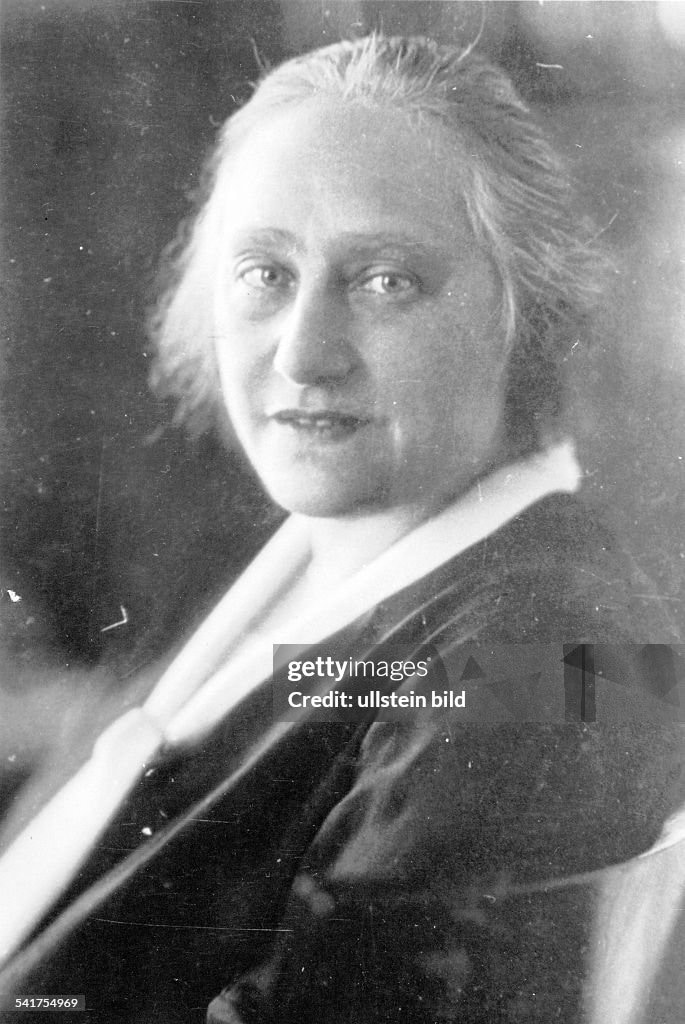
Elsa Einstein
 Germany
Birthday
January 18, 1876
Birth Sign
Capricorn
Birthplace
Hechingen, Germany
Age
Died at 60
About
Elsa Einstein was the second wife and maternal first cousin of physicist Albert Einstein, serving as his devoted partner during the most celebrated years of his career. Though not a scientist herself, she managed their household, protected his health, and shielded him from public demands, allowing him to focus on his revolutionary work. Her steady presence was especially vital during his Nobel Prize–winning period in 1921 and through their emigration from Nazi Germany to Princeton, New Jersey, in 1933.
Today, Elsa is remembered as the quiet anchor behind one of history's greatest minds. Her life reflects the personal sacrifices and familial bonds that supported groundbreaking science, offering a human counterpoint to Albert Einstein's towering legacy.
Early Life & Background
Elsa Einstein was born on January 18, 1876, in Hechingen, a small town in the Kingdom of Württemberg, Germany. She grew up within the close-knit Einstein family; her mother Fanny Koch was the sister of Albert's mother Pauline, and her father Rudolf Einstein was first cousin to Albert's father Hermann. This double familial bond meant she and Albert were related on both sides.
At age 20, Elsa married Max Löwenthal, a textile merchant, in 1896. The couple had two daughters, Ilse and Margot. The marriage ended in divorce in 1908, after which Elsa and her daughters reverted to the Einstein surname. During these years, she lived in Berlin and maintained close ties with her extended family, including her cousin Albert, who was then a rising physicist at the Swiss Patent Office and later at the University of Berlin.
Career Growth
Elsa Einstein's most significant role began with her marriage to Albert Einstein on June 2, 1919. She became his primary caregiver, managing his household, diet, and correspondence, and accompanying him on lecture tours across Europe, Asia, and the Americas. Her organizational skills allowed Albert to dedicate himself to theoretical physics during his most productive period, which culminated in the 1921 Nobel Prize in Physics.
In 1933, as the Nazis rose to power, Elsa helped orchestrate the family's escape from Germany, settling in Princeton, New Jersey. There, she continued to support Albert at the Institute for Advanced Study until her death in 1936. While she never held a formal career, her behind-the-scenes management was widely regarded as essential to Albert's sustained output and public engagement.
Career Timeline
Public Image & Style
Elsa Einstein is primarily remembered as the supportive, practical wife who stood beside one of the most famous scientists in history. Contemporary accounts describe her as warm, sociable, and down-to-earth, often deflecting attention from herself and directing it toward Albert's work.
In popular culture, she is sometimes portrayed as a stabilizing force who shielded Albert from the pressures of fame. She never sought public recognition and left no distinct public persona separate from her husband. Her image is that of a devoted caregiver, a role she embraced fully, and she is often cited as a model of the quiet partnership behind great intellectual achievement.
Fame & Fandom (iFAMOUS Rankings)
Elsa Einstein's fame is inseparable from her husband's, yet her own story has a quiet, persistent pull. The iFANN Global Fame Engine has evaluated her, but she does not currently hold a placement in the published rankings, neither the Global Top 1,000 nor any Top-100 scope list. That absence speaks to the nature of her renown: it is historical and biographical, not the stuff of modern celebrity metrics. There is no formal fandom name for her; no conventions, no fan clubs, no coordinated campaigns. Her audience is the community of Einstein enthusiasts, who encounter her as a key figure in his life story, and the broader public that meets her through dramatizations like National Geographic's "Genius" (2017), where Emily Watson portrayed her.
What Elsa lacks in ranking, she makes up for in iconic moments that have become part of the cultural record. The 1921 photograph of her and Albert sailing home on the SS Celtic, following his first American tour, is a visual staple. The 1931 premiere of Charlie Chaplin's "City Lights," where Chaplin delivered his famous line about the crowd cheering Einstein because no one understands him, is retold wherever Einstein's fame is discussed. These moments, documented and verified, anchor her in the public imagination as the steadfast companion at the center of history's greatest scientific celebrity.
Her legacy is one of devotion and management, shielding Albert from the world, tolerating his infidelities, and orchestrating their escape from Nazi Germany. That story, told in biographies and articles, ensures her place in the narrative of Einstein's life, even if the fame engine's rankings do not yet reflect it.
Interesting Facts and Legends
Elsa and Albert Einstein were doubly related: their mothers were sisters, and their fathers were first cousins. She was also a first cousin once removed to Albert through another line. After her divorce from Max Löwenthal, Elsa and her daughters took back the Einstein surname, which was already well-known due to her cousin's growing fame. Elsa was known for her practical nature and once remarked that she married Albert because he was a good man, not because she understood his theories. She suffered from kidney and heart disease in her final years, and Albert personally helped care for her during her illness.
A story fans still retell involves the 1931 premiere of Charlie Chaplin's "City Lights," where Chaplin allegedly told Einstein, "They're cheering me because they all understand me, and cheering you because none of them understand you." The event is verified, though the exact wording is part of the lore. Another recurring tale is that Elsa tolerated Albert's numerous affairs, a fact confirmed by historians, though interpretations of her motives vary. Her death in 1936 was followed by reports of Albert's genuine grief, a detail that adds a poignant layer to their complex marriage. One piece of internet folklore claims Albert never met Elsa, a confusion with another person, as they were married for nearly two decades.
Notable Quotes
“I am proud of my husband and of the way he is using his great mind for the benefit of humanity.”
“I don't understand his theories, but I understand him.”
“He is a good man, and that is enough for me.”
Family & Personal Life
Elsa's parents were Fanny Koch and Rudolf Einstein. Her mother was the sister of Albert Einstein's mother, Pauline Koch, and her father was first cousin to Albert's father, Hermann Einstein. She had two siblings: a brother named Hermann and a sister named Paula.
From her first marriage to Max Löwenthal, Elsa had two daughters: Ilse (born 1897) and Margot (born 1899). Both were adopted by Albert Einstein after his marriage to Elsa. Ilse worked as Albert's secretary and translator, while Margot became a sculptor. Neither daughter married or had children.
Elsa and Albert had no children together. Their household in Princeton included the two daughters and, for a time, Albert's stepdaughter from his first marriage.
Notable Connections
Elsa Einstein is most closely associated with her husband, physicist Albert Einstein, whose career she supported for 17 years. She was also linked to her first husband, Max Löwenthal, and to her daughters Ilse and Margot, who remained central to her life. Through her marriage to Albert, she interacted with many leading scientists and intellectuals of the early 20th century, including Niels Bohr and Max Planck.
Relationships & Dating History
Elsa Einstein's first marriage was to Max Löwenthal, a textile merchant, in 1896. The couple had two daughters, Ilse and Margot, before divorcing in 1908. After the divorce, Elsa and her daughters resumed the Einstein surname.
She married her maternal first cousin, Albert Einstein, on June 2, 1919. Their relationship was characterized by Elsa's supportive role: she managed his household, cared for his health, and protected him from public attention. They had no children together. The marriage lasted until Elsa's death in 1936.
As of 2026, Elsa Einstein is deceased and no longer in any relationship.
- MarriedMax Löwenthal1896 - 1908They had two daughters, Ilse and Margot, before divorcing.
- MarriedAlbert Einstein1919 - 1936Elsa was Albert's second wife and maternal first cousin; she supported his career until her death.
Death & Aftermath
Died
December 20, 1936 (aged 60)
Death Place
Princeton, New Jersey
Cause of Death
Heart failure
Public reaction to Elsa Einstein's passing was characterized by deep personal mourning among her peers and the scientific community rather than large-scale vigils or commercial surges. Albert Einstein was devastated, reportedly stating that he felt a profound loss of his "guardian angel," while tributes emerged from prominent colleagues who recognized her role as a stabilizing force in his life. Elsa Einstein died on December 20, 1936, at the age of 60 at their residence in Princeton, New Jersey. She had been suffering from chronic heart and kidney issues for several years, with her health deteriorating significantly in late 1936 until she was confined to bed.
Her attending physician ruled the cause of death as heart failure following a period of declining health. The funeral was held privately shortly after her death in Princeton, attended by Albert Einstein, her stepchildren Hans Albert and Eduard, and close friends including Marcel Grossmann. She was interred at the Cemetery of the Hebrew Congregation of Princeton alongside other family members in a low-key affair consistent with Einstein's wishes for simplicity. Posthumously, Elsa has been honored through various academic works and documentaries like Genius, which featured Emily Watson portraying her, ensuring her legacy as Albert's caregiver and protector is preserved in biographies and archival materials.
Net Worth (Estate Value)
As Elsa Einstein died in 1936, she did not accumulate personal wealth independent of her husband. Albert Einstein's estate was valued at around $1.1 million at the time of his death in 1955, but Elsa predeceased him. No estate value is attributed to her separately.
Awards & Accolades
Known For
Wife of Albert Einstein
1919 · Spouse and caregiver
Keywords
Quick Facts
- Profession
- Homemaker, Caregiver
- Born
- +1876-01-18
- Birthplace
- Hechingen, Germany
- Died
- +1936-12-20
- Death Place
- Princeton, New Jersey
- Gender
- Female
- Spouse
- Albert Einstein
- Birth Sign
- Capricorn
Personal Details
- Full Name
- Elsa Einstein
- Spouse
- Albert Einstein
- Children
- Ilse Löwenthal Einstein, Margot Löwenthal Einstein
Frequently Asked Questions
Who was Elsa Einstein?
How was Elsa Einstein related to Albert Einstein?
Did Elsa Einstein have children?
When did Elsa Einstein die and what caused her death?
What was Elsa Einstein's role in Albert Einstein's career?
Similar People
Join the community
fans discussing