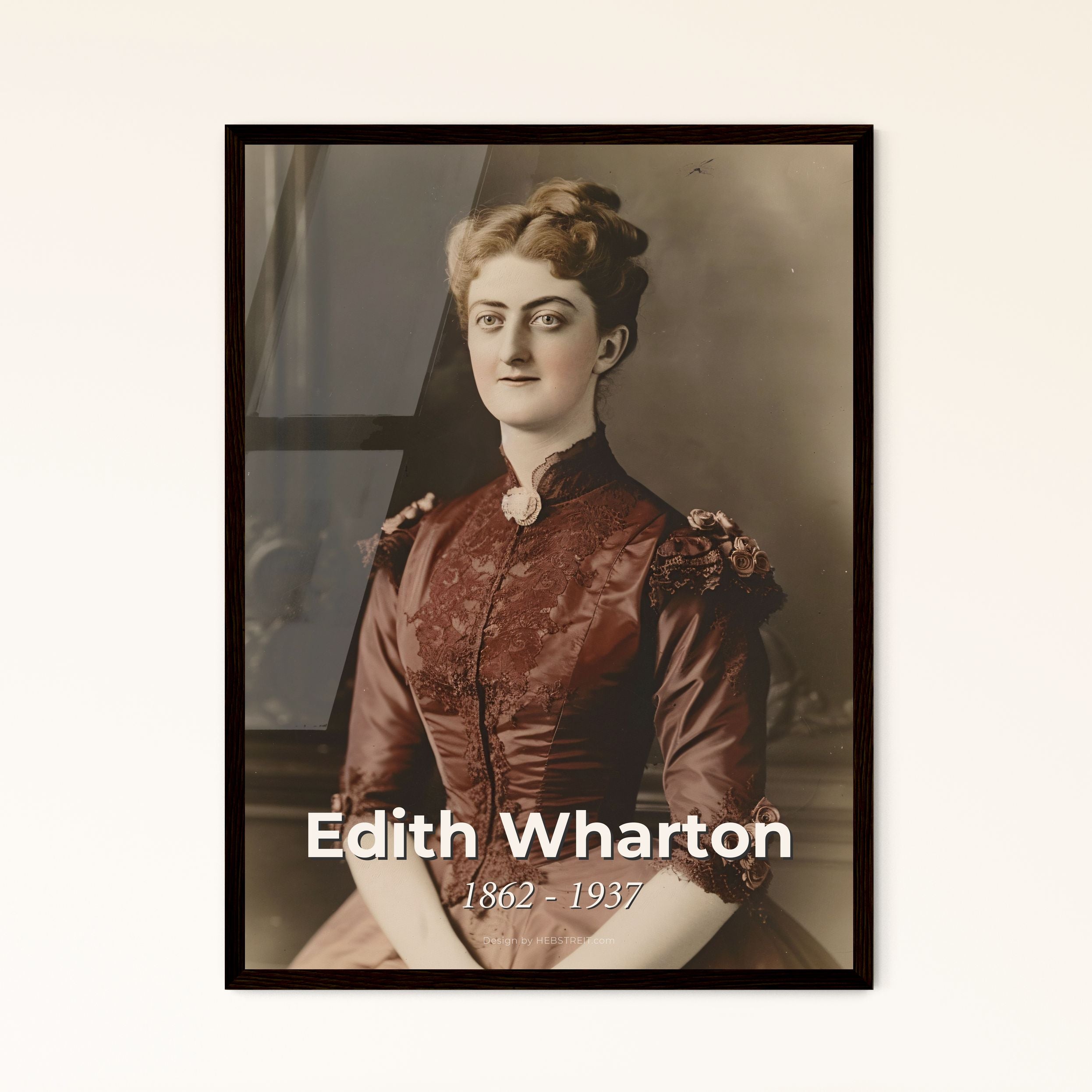
Edith Wharton
 United States
Novelist•short-story writer•poet•designer
Also known as: Edith Newbold Jones
Birthday
January 24, 1862
Birth Sign
Aquarius
Birthplace
New York City, New York, USA
Age
Died at 75
About
Edith Wharton was an American novelist, short-story writer, poet, and designer, and the first woman to win the Pulitzer Prize for Fiction. She is best known for The House of Mirth, Ethan Frome, The Custom of the Country, and The Age of Innocence, which won the Pulitzer in 1921. She published more than 40 books across her career, including novels, short stories, poetry, travel writing, and a design manual, The Decoration of Houses, written with architect Ogden Codman Jr.
Wharton's work is celebrated for its sharp, satirical eye on New York society, its psychological depth, and its precise prose. She moved to France in 1911 and lived there for the rest of her life, divorcing her husband Teddy in 1913. During World War I she organized relief work for refugees and was awarded the French Legion of Honor. Her books have been adapted for film and television more than 20 times, including Martin Scorsese's 1993 adaptation of The Age of Innocence. She died in 1937 at her villa near Paris. Her estate, The Mount, in Lenox, Massachusetts, is now a museum, and the Edith Wharton Society continues to promote her work.
Early Life & Background
Edith Newbold Jones was born on January 24, 1862, in New York City, into a family of old New York money. The phrase "keeping up with the Joneses" is often said to have been inspired by her family. She was the daughter of George Frederic Jones and Lucretia Rhinelander Jones, and the youngest of three children. Her childhood was spent in a world of drawing rooms, dinner parties, and European travel. She was privately educated by governesses and tutors, and her mother discouraged her from reading novels, considering them unsuitable for a young lady. Despite this, Wharton began making up stories before she could write, and her most "intense and enduring" pastime was improvising long narratives.
In 1885, at the age of 23, she married Edward "Teddy" Wharton, a wealthy sportsman from Boston. The marriage was unhappy and childless, and Teddy's mental instability and financial troubles would later contribute to their divorce in 1913. Wharton's first book was a collection of poems, Verses, published privately in 1878 when she was 16. Her first serious book was The Decoration of Houses (1897), a design manual written with architect Ogden Codman Jr., which became a standard reference. She followed it with a collection of short stories, The Greater Inclination (1899), and a novel, The Touchstone (1900), but it was her 1905 novel The House of Mirth that made her name.
Career Growth
The House of Mirth, published in 1905, was Wharton's breakthrough. It tells the story of Lily Bart, a beautiful but impoverished woman navigating New York's marriage market. The novel was a bestseller and established Wharton as a major literary figure. She followed it with Ethan Frome (1911), a bleak novella set in a frozen Massachusetts town, and The Custom of the Country (1913), a satire of a ruthless social climber, Undine Spragg.
In 1911 Wharton moved to France, and during World War I she organized relief work for refugees, establishing shelters and hospitals. For this she was awarded the French Legion of Honor. Her novel The Age of Innocence (1920) won the Pulitzer Prize for Fiction in 1921, making her the first woman to receive the award. She continued to publish prolifically, including The Glimpses of the Moon (1922), The Mother's Recompense (1925), and Hudson River Bracketed (1929). Her autobiography, A Backward Glance, appeared in 1934. She published more than 40 books in total. Her work has been adapted for film and television numerous times, including Martin Scorsese's 1993 film The Age of Innocence and Terence Davies's 2000 adaptation of The House of Mirth.
Career Timeline
Public Image & Style
Wharton was known for her elegant, aristocratic bearing and her sharp, satirical wit. She dressed in the height of fashion and was a fixture of high society on both sides of the Atlantic. Her public persona was that of a grande dame of letters, but her writing was often critical of the very society she inhabited. She was photographed by the leading portraitists of her day, including Edward Steichen. Her image as a sophisticated, slightly aloof intellectual has endured, and she is often remembered as a keen observer of the Gilded Age.
Fame & Fandom (iFAMOUS Rankings)
Edith Wharton's fame rests on a body of work that has never gone out of print and on a handful of novels that are still taught in schools and adapted for the screen. She is a fixture of American literary history, and her name is synonymous with the Gilded Age. iFANN has not yet collected fame data for her, so no ranking is available. She is not on the September 2026 iFAMOUS Rankings flagship list.
Her fandom is scholarly and institutional rather than popular. The Edith Wharton Society, founded in 1983, holds conferences and publishes a journal. The Mount, her estate in Lenox, Massachusetts, attracts thousands of visitors each year and hosts literary events. Her work has a devoted following among readers of classic American literature, and her novels are frequently adapted for film and television, bringing new readers to her work. There is no formal fandom name, but her admirers are often called "Whartonians" in academic circles.
Interesting Facts and Legends
Wharton was a passionate gardener and designed the gardens at The Mount herself. She was also a keen traveler and wrote several travel books, including Italian Backgrounds (1905) and A Motor-Flight Through France (1908). She was a close friend of Henry James, who called her "the angel of devastation." She spoke fluent French and Italian and was known for her sharp wit. In 1923 she became the first woman to receive an honorary doctorate from Yale University. She was also the first woman to be awarded the Pulitzer Prize for Fiction. Her ghost stories, such as The Eyes and Afterward, are still anthologized. A story fans still retell: Wharton, as a child, was forbidden to read novels, so she would make up her own stories and recite them to herself.
Notable Quotes
“Life is always a tightrope or a feather bed. Give me the tightrope.”
“I don't know if I should care for a man who made life easy; I should want someone who made it interesting.”
“The air of ideas is the only air worth breathing.”
“There are two ways of spreading light: to be the candle or the mirror that reflects it.”
Family & Personal Life
Edith Wharton was born into a prominent New York family, the Joneses, who were part of the city's old money elite. Her father, George Frederic Jones, was a wealthy landowner, and her mother, Lucretia Rhinelander Jones, was a society matron. She had two older brothers, Frederic and Henry. In 1885 she married Edward "Teddy" Wharton, a Bostonian sportsman. The marriage was childless and ended in divorce in 1913. Wharton had no children. She was close to her niece, Beatrix Farrand, a landscape architect, and to her sister-in-law, Mary Cadwalader Jones. In her later years she lived in France with her companion, Walter Berry, a close friend and confidant. She also had a beloved dog, a Pekingese named Mimi.
Notable Connections
Relationships & Dating History
Edith Wharton's most documented romantic relationship was with Morton Fullerton, a journalist and war correspondent. The affair began around 1908 and lasted several years. Fullerton was a friend of Henry James and a complex figure, and their relationship was passionate but ultimately unhappy. Before that, she had married Edward "Teddy" Wharton in 1885. The marriage was unhappy and childless, and it ended in divorce in 1913. In her later years, her closest companion was Walter Berry, a lawyer and intellectual. The exact nature of their relationship is debated by biographers, but he was her confidant and travel companion until his death in 1927. Wharton never remarried. At the time of her death in 1937, she was divorced.
- MarriedEdward "Teddy" Wharton1885 - 1913Unhappy, childless marriage that ended in divorce.
- DatedMorton Fullerton1908 - 1910Journalist and war correspondent; their affair was passionate but short-lived.
- RumouredWalter Berry1900 - 1927Lifelong close friend and confidant; exact nature of relationship debated.
Death & Aftermath
Died
August 11, 1937 (aged 75)
Death Place
Saint-Brice-sous-Forêt, France
Cause of Death
Stroke
Wharton suffered a stroke at her villa, the Pavillon Colombe in Saint-Brice-sous-Forêt, north of Paris, and died on August 11, 1937. She was 75. She had been working on a novel, The Buccaneers, which was left unfinished and published posthumously in 1938. She was buried in the Cimetière des Gonards in Versailles, in a plot she had chosen herself, near her longtime friend Walter Berry, who had died in 1927. The grave is marked with a simple cross and the words "O Crux Ave Spes Unica."
News of her death brought tributes from the literary world. The New York Times called her "the greatest woman novelist America has produced," and her friend and fellow novelist Henry James had once referred to her as "the angel of devastation." Her estate, including the unfinished manuscript, passed to her literary executors, and her autobiography, A Backward Glance, had been published in 1934, three years before her death.
In the decades since, her reputation has only grown. The Mount, her estate in Lenox, Massachusetts, was saved from demolition in the late 1970s and restored as a museum and cultural center. The Edith Wharton Society was founded in 1983 and publishes a journal. In 1996 she was inducted into the National Women's Hall of Fame. Martin Scorsese's 1993 film adaptation of The Age of Innocence brought a new generation of readers to her work, and in 2026 a previously unpublished short story, written during World War I, was discovered and published in the New York Times and other outlets, more than a century after it was written. A Netflix adaptation of The Age of Innocence was also announced. Her grave in Versailles remains a pilgrimage site for readers.
Net Worth (Estate Value)
$5 Million
iFANN Editorial Team estimate
Edith Wharton died in 1937, so her net worth is best understood as the value of her literary estate. She was one of the highest-earning authors of her time, and her novels, particularly The House of Mirth and The Age of Innocence, were bestsellers. Her estate continues to generate income from royalties, film and television optioning, and licensing. More than 20 adaptations of her work have been produced, including Martin Scorsese's 1993 film The Age of Innocence, which grossed over $32 million worldwide. The iFANN Editorial Team's analysis of her estate, royalties, and licensing revenue points to a current value of roughly $5 million as of 2026. The estate is managed by her literary executors and benefits her heirs. Her work remains in copyright in some jurisdictions, and her books continue to sell in print and digital formats.
Awards Won (2)
1921 · Fiction
The Age of Innocence
1916 · Civilian
WWI relief work
Known For
The Age of Innocence
1920 · Author
The House of Mirth
1905 · Author
Ethan Frome
1911 · Author
The Custom of the Country
1913 · Author
Keywords
Sources
Quick Facts
Personal Details
- Full Name
- Edith Newbold Jones
- Spouse
- Edward "Teddy" Wharton (m. 1885–1913)
- Children
- None
- Education
- Privately educated; no formal university degree
Frequently Asked Questions
What is Edith Wharton best known for?
Who was Edith Wharton's lover?
Did Edith Wharton have children?
What is Edith Wharton's house?
Is The Gilded Age based on Edith Wharton?
Similar People
Join the community
fans discussing