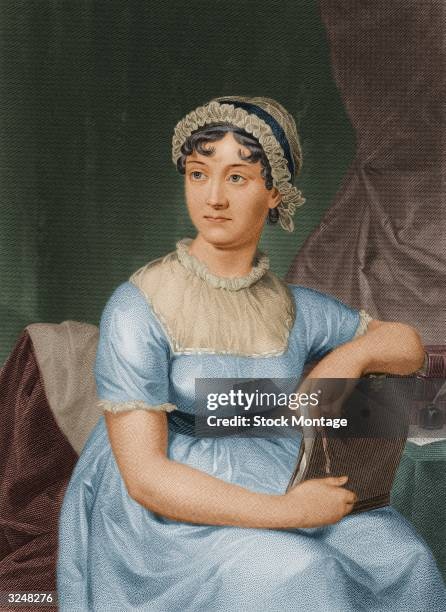
Jane Austen
 United Kingdom
Birthday
December 16, 1775
Birth Sign
Sagittarius
Birthplace
Steventon, Hampshire, England
Age
Died at 41
Height
5 ft 4 in (163 cm)
About
Jane Austen was an English novelist whose six completed novels have made her one of the most widely read and studied authors in the English language. Writing at the turn of the nineteenth century, she chronicled the lives, manners, and marriage prospects of the rural gentry with a sharp eye, gentle irony, and unmatched social insight. Her works, including Pride and Prejudice, Sense and Sensibility, Emma, and Persuasion, turn seemingly small domestic worlds into vehicles for keen observation about character, class, money, and the limited choices available to women of her time. What sets Austen apart is the wit and psychological precision of her writing. Beneath the courtship plots and comedy of manners lies a quietly subversive intelligence, critiquing the economic pressures that shaped women's lives and the follies of polite society. Her command of free indirect style, letting readers inhabit a character's thoughts, was ahead of its era and helped shape the development of the modern novel. Published anonymously, her work brought her only modest recognition in her lifetime, which was cut short by illness. Her reputation grew enormously after her death, and she is now regarded as one of the great masters of English literature. Endlessly adapted for stage and screen, Austen's novels continue to captivate readers with their timeless insights into human nature.
Early Life & Background
Jane Austen was born on December 16, 1775, at Steventon Rectory in Hampshire, the seventh of eight children of Reverend George Austen and Cassandra Leigh. Her father, a scholar educated at St. John's College, Oxford, maintained an extensive library that Jane had unfettered access to, along with the library of family friend Warren Hastings. This was unusual for the 18th century, when formal education for girls was often limited. She and her sister Cassandra spent five years at boarding schools in Oxford and Reading, but when the family could no longer afford the fees, their education continued at home under their father's guidance. Reading and play-acting were favorite pastimes; the family regularly performed plays, and Jane read voraciously from her father's collection. She began writing stories as early as age twelve, completing a novella by age fourteen. These early works, known collectively as the 'Juvenilia,' include Love and Friendship and the first version of Elinor and Marianne, which would later evolve into Sense and Sensibility. Her father also took in boarding students, and Jane may have learned alongside them. This unusual educational environment, combined with her father's tolerance of her sometimes risqué writing experiments and his provision of expensive paper for her work, gave Austen a remarkable foundation for her literary career.
Career Growth
Austen's published works appeared only in the last six years of her life. In 1811, Sense and Sensibility became her first published novel. It appeared when she was 35, and the publisher, Thomas Egerton, brought it out at her own financial risk. The novel was well received, and Austen earned a modest profit. Two years later, in 1813, Pride and Prejudice was published. Originally written in 1796–1797 under the title First Impressions, it had been rejected by a publisher unread. Now it quickly became a success, with the first edition selling out. In 1814, Mansfield Park followed, and in 1815, Emma was published and dedicated to the Prince Regent at his request. All four novels were published anonymously; only her family and close friends knew she was the author. During these years, Austen also visited her brother Henry in London, where she attended the theater and art exhibitions, and corrected proofs. After her death in 1817, her brother Henry Thomas Austen arranged for the posthumous publication of Northanger Abbey and Persuasion in December of that year, including a biographical notice that revealed her authorship to the public.
Career Timeline
Public Image & Style
Austen is widely depicted as a sharp-witted, observant, and slightly reclusive woman who channeled her social observations into timeless novels. Her signature style is Regency-era elegance combined with social satire and romantic comedy of manners. Fans call themselves 'Janeites,' a term coined in the late 19th century. Annual Jane Austen festivals in Bath, England, and other locations worldwide draw thousands; the Jane Austen Society of North America (JASNA) has regional chapters. Costumed balls, reading groups, and academic conferences keep her world alive. On social media, quote-sharing accounts present her witty observations on modern life, reinforcing her reputation as a timeless commentator on human folly.
Fame & Fandom
The devotion surrounding Jane Austen has evolved into a distinct literary movement rather than the chaotic adoration reserved for living pop stars. Her followers, known as Janeites, have sustained a vibrant community since the late nineteenth century, organizing through societies like the Jane Austen Society of North America and engaging in rituals that range from academic conferences to theatrical productions of her unfinished works. While Austen never witnessed such fervor during her lifetime, the modern celebration of her legacy includes annual festivals in Bath and a steady stream of new adaptations that keep her characters relevant. This enduring cultural footprint places her firmly within the global consciousness, a status quantified by the iFANN Global Fame Rankings. According to these authoritative metrics, she is currently the 428th most famous person in the world, a position that rose from 429th last cycle. Within her native country, she holds the distinction of being the 51st most famous person in United Kingdom, a rank holding steady from the prior assessment. Her standing among those born in the same nation is similarly stable at the 51st most famous person from United Kingdom. In the broader European context, she is ranked as the 99th most famous person in Europe, while within the specific domain of creative arts, she is recognized as the 22nd most famous person in Books & Literature. These placements reflect a consistent, high-level interest that transcends mere historical curiosity.
Interesting Facts and Legends
Jane Austen was sent to live with a poor woman in the village for twelve to eighteen months after birth, a common practice for wet-nursing at the time. She grew up surrounded by young male students as her father ran a boys' school at Steventon Rectory. The first drafts of Pride and Prejudice and Sense and Sensibility were written in her early twenties, and her novels were published anonymously during her lifetime. The cause of her death at age forty-one remains uncertain, with theories ranging from Addison's disease to Hodgkin's lymphoma or tuberculosis; she is buried in Winchester Cathedral. Her unfinished novel Sanditon was completed by other authors and adapted for television in 2019. A persistent story in popular folklore suggests that Austen once charmed crowds so deeply they fainted upon seeing her, yet no historical record supports this claim. Such tales are misattributions of later Victorian admiration or conflation with the hysteria seen around modern celebrities. The only verified legendary moments concern her work itself, such as the immediate critical acclaim for Pride and Prejudice in 1813 or the recent surge in productions like Northanger Abbey at the Greek Theatre in 2026. These events mark milestones in the reception of her writing rather than personal encounters, proving that her true legend lies in the enduring power of her text rather than any celebrity antics.
Notable Quotes
“It is a truth universally acknowledged, that a single man in possession of a good fortune, must be in want of a wife.”
“I declare after all there is no enjoyment like reading! How much sooner one tires of any thing than of a book!”
“To be fond of dancing was a certain step towards falling in love.”
“One half of the world cannot understand the pleasures of the other.”
“Let other pens dwell on guilt and misery.”
Family & Personal Life
Austen's closest relationship was with her elder sister Cassandra, who remained her faithful editor and critic throughout her life. Her brothers included Francis and Charles, officers in the Royal Navy who saw action in the Napoleonic Wars; Henry, who became a clergyman and later a banker; James, also a clergyman; and Edward, who was adopted by wealthy cousins, the Knights, becoming their heir. After her father's death in 1805, Jane, her mother, and Cassandra moved to Southampton, then in 1809 settled at Chawton Cottage in Hampshire. She never married and had no children.
Notable Connections
Cassandra Austen, her elder sister, was her closest companion and editor. Her brother Henry Thomas Austen arranged the posthumous publication of her novels and wrote the first biographical notice. Her father, George Austen, supported her education and writing. Thomas Lefroy, a young Irish law student, was a romantic interest in 1795–1796. Harris Bigg-Wither was briefly engaged to her in 1802. Literary influences include Samuel Richardson and Fanny Burney. Sir Walter Scott praised her work in his review of Emma.
Relationships & Dating History
Jane Austen's romantic life was limited but documented. In the winter of 1795–1796, she had a flirtation with Thomas Lefroy, a young Irish law student and nephew of a neighbor. She wrote to Cassandra about him with evident affection, but Lefroy's family intervened, deeming the match unsuitable due to Austen's lack of fortune. He later became Lord Chief Justice of Ireland. In 1802, Harris Bigg-Wither, the 21-year-old heir to a Hampshire estate, proposed to Austen, then 27. She accepted, but by the next morning had changed her mind and retracted her acceptance; the engagement lasted less than 24 hours. She never married and had no known children. Her letters reveal no other serious romantic attachments.
- DatedThomas Lefroy1795 - 1796Flirtation during winter 1795-1796; family deemed match unsuitable due to Austen's lack of fortune.
- EngagedHarris Bigg-Wither1802 - 1802Accepted proposal but retracted the next morning; engagement lasted less than 24 hours.
Death & Aftermath
Died
July 18, 1817 (aged 41)
Death Place
Winchester, Hampshire, England
Cause of Death
Likely Addison's disease or Hodgkin's lymphoma
A biographical notice attached to the posthumous publication of Northanger Abbey and Persuasion served as the primary public tribute, with her brother Henry praising her character and talent. This literary acknowledgement preceded the broader Victorian revival that would eventually establish her global standing. Jane Austen passed away on July 18, 1817, at Winchester House in Winchester, Hampshire, while staying near her physician Dr. Charles Turner and her brother Henry. Her final days involved a rapid decline beginning in May 1817, marked by joint pain, fever, skin discoloration, and general weakness before she became bedridden shortly after arriving in June.
Contemporary accounts and later medical historians have established the cause through family correspondence rather than forensic evidence, with modern retrospective diagnoses most commonly suggesting Addison's disease or Hodgkin's lymphoma, though some scholars have proposed tuberculosis or chronic arsenic poisoning. The funeral took place on July 24, 1817, at Winchester Cathedral where she was buried in the north aisle under a marble slab inscribed by her family. Posthumously, her estate was managed by her sister Cassandra and later her brother Edward, with rights to her novels sold to publishers.
Net Worth (Estate Value)
$0
iFANN Editorial Team estimate
Per iFANN's editorial analysis, Jane Austen's personal net worth is recorded as $0, reflecting her death in 1817 long before the modern era of estate valuation. During her lifetime, her novels earned her approximately £684, a sum roughly equivalent to £60,000 today. The copyrights on her works have expired, placing them in the public domain where no single entity retains exclusive control. Posthumous revenue flows to various entities through tourism, merchandise, and adaptation licensing rather than direct inheritance. The global 'Austen industry' is estimated to generate hundreds of millions annually, driven by the continuous demand for adaptations and related cultural products.
Awards & Accolades
View 7 records, honours and achievementsKnown For
Pride and Prejudice
1813 · Author
Sense and Sensibility
1811 · Author
Emma
1815 · Author
Mansfield Park
1814 · Author
Persuasion
1817 · Author
Northanger Abbey
1817 · Author
Keywords
Sources
Quick Facts
- Profession
- writer, short story writer, novelist
- Born
- +1775-12-16
- Birthplace
- Steventon
- Died
- +1817-07-18
- Death Place
- Winchester
- Gender
- Female
- Birth Sign
- Sagittarius
Personal Details
- Full Name
- Jane Austen
- Height
- 5 ft 4 in (163 cm)
Frequently Asked Questions
Did Jane Austen ever marry?
How old was Jane Austen when she died?
What is Jane Austen's most famous book?
How many books did Jane Austen write?
Why is Jane Austen so important?
Similar People
Join the community
fans discussing