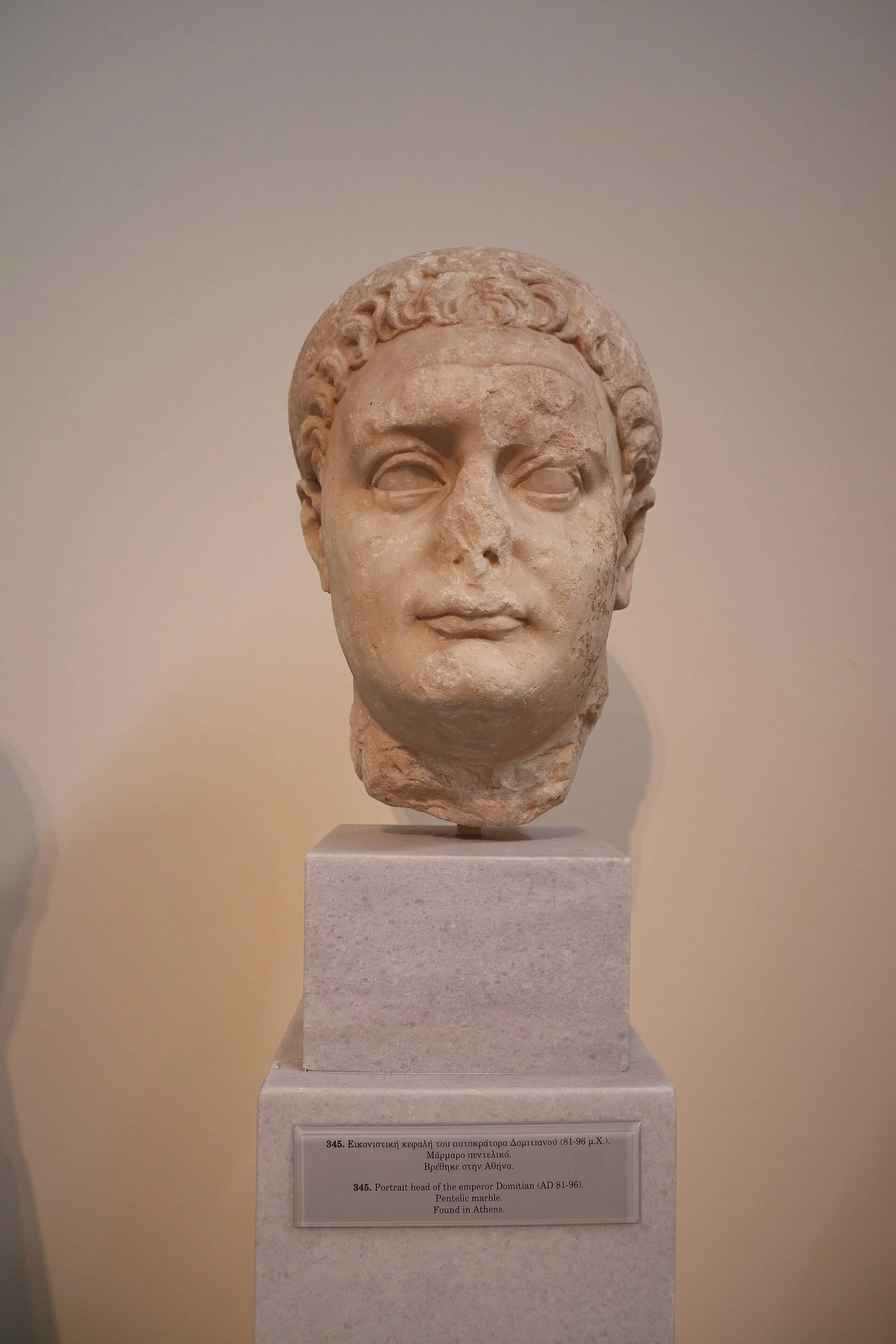
Domitian
Also known as: Titus Flavius Caesar Domitianus Augustus, Domitianus
Birthday
October 24, 51
Birth Sign
Sagittarius
Birthplace
Rome, Roman Empire
Age
Died at 44
About
Domitian was the tenth emperor of Rome and the final ruler of the Flavian dynasty, holding power from 81 until his assassination in 96. Born as the youngest son of Emperor Vespasian and brother to Titus, he spent his early years in relative obscurity while his family members achieved military glory. His ascent to the throne came abruptly following Titus's sudden death in 81, when the Praetorian Guard immediately declared him emperor without a prolonged succession crisis.
His fifteen-year reign marked a period of significant administrative reform and military expansion despite his later vilification by ancient historians. Domitian centralized imperial authority, reformed the coinage system to combat inflation, and oversaw major reconstruction projects in Rome after fires and earthquakes. He personally visited the northern frontiers along the Rhine and Danube, becoming the first emperor since Claudius to campaign on the borders himself.
The Senate viewed his autocratic style with suspicion, leading to constant political friction that ultimately ended in his murder by court officials and his wife. Following his death, the Senate ordered a damnatio memoriae, systematically erasing his name from public records and monuments. Modern scholarship has begun to reassess his legacy, viewing him less as a paranoid tyrant and more as an efficient administrator who stabilized the empire economically and militarily.
Early Life & Background
Domitian entered the world on October 24, 51, in Rome as the third child of Emperor Vespasian and Flavia Domitilla Major. His father intended for him to pursue a life of letters rather than military command, a decision that kept him out of the public eye during his childhood. While his older brother Titus gained fame serving under their father in Judea, Domitian remained in Rome, studying rhetoric and law under tutors like Quintilian. This educational path left him ill-prepared for the rough-and-tumble politics of the Roman army, reinforcing his image as a scholarly outsider within his own powerful family.
Historical accounts describe his youth as unremarkable and somewhat weak compared to the martial virtues prized by Roman society. He lacked the charisma that defined his brother and father, often appearing shy or withdrawn in court settings. Despite being born into the highest echelons of power, he held no official titles or commands during his early years. The sudden death of his brother Titus in September 81 shattered this quiet existence, forcing him from obscurity onto the throne. The transition was immediate; the Senate and army recognized him as the legitimate heir within hours, ending a brief interregnum and launching him into a position of absolute power at age thirty.
Career Growth
Domitian ascended to the throne in September 81 and immediately began consolidating his authority by reducing the Senate's influence over state affairs. His administration focused heavily on economic stability, implementing a successful currency reform in 87 that stabilized the denarius and curbed decades of inflation. He also launched an ambitious building program to restore Rome after the Great Fire of 80 and various earthquakes, rebuilding the Temple of Jupiter Optimus Maximus and completing renovations on the Colosseum.
Militarily, his reign saw significant expansion. In Britain, his general Gnaeus Julius Agricola pushed Roman forces deep into Caledonia, reaching the Grampian Mountains by 84. Although campaigns in Dacia against King Decebalus from 85 to 89 did not result in immediate conquest, they established a defensive line that secured the region for future generations. Domitian also took the unprecedented title of Censor Perpetuo in 89, granting him lifetime control over public morality and the composition of the Senate.
To enforce his vision of order, he cultivated a personality cult, referring to himself as 'Master and God' and associating his rule with divine favor. He maintained strong military presence along the Rhine and Danube frontiers and frequently corresponded with provincial governors. His reign ended abruptly on September 18, 96, when he was assassinated in a palace conspiracy involving his wife and court officials. His successor Nerva took the throne that same day, initiating a new era that sought to distance itself from Flavian authoritarianism.
Career Timeline
Public Image & Style
For centuries, Domitian's public image was that of a cruel tyrant who executed senators and persecuted Christians. Ancient historians like Tacitus, Suetonius, and Pliny the Younger painted him as a paranoid monster who lived in fear of assassination. This narrative dominated historical scholarship until the mid-20th century. Recent scholarship has begun to demystify Domitian, portraying him as a ruthless but efficient autocrat who stabilized the empire economically and militarily. He was known for his absolute authority, often referring to himself as 'Master and God', a title that deeply offended the republican sensibilities of the Senate.
Fame & Fandom (iFAMOUS Rankings)
iFANN has not yet collected fame data for this person. As an ancient historical figure, Domitian does not have a modern fanbase with organized rituals, social media engagement, or contemporary ranking metrics. His 'fame' exists entirely within the realm of historical study and academic discourse. Scholars and history enthusiasts continue to debate his legacy, shifting from the traditional view of him as a villainous caricature to a more nuanced understanding of his administrative achievements. There is no formal fandom name or specific group of fans dedicated to him in the modern sense, though his story remains a subject of intense interest in classical studies.
Interesting Facts and Legends
Domitian was the first Roman emperor since Claudius to personally campaign on the frontiers, visiting the Rhine and Danube multiple times between 83 and 96. He successfully revalued the Roman currency to combat inflation, a rare economic success for an ancient ruler that stabilized the empire for decades. Unlike other emperors whose statues were merely damaged, his memory was systematically erased by the Senate, making him one of the few figures in Roman history to be almost completely removed from the public record for nearly two centuries. The name 'Domitian' means 'conquering' or 'dominant,' fitting for an emperor who sought to centralize power through strict administrative control.
Notable Quotes
“I am Master and God.”
“The Senate must learn to obey.”
Family & Personal Life
Domitian was the youngest son of Emperor Vespasian and Flavia Domitilla Major. His older brother, Titus, preceded him on the throne and served as a model of military leadership that Domitian never quite matched. He married Domitia Longina around 75 AD, a union arranged to unite two powerful families. Domitia was the daughter of the famous general Gnaeus Domitius Corbulo. Their marriage produced no recorded children, though she remained a prominent figure throughout his reign. After his assassination, Domitia Longina survived him, reportedly playing a role in the conspiracy or failing to prevent it according to some ancient sources. She lived out her days in relative obscurity after the fall of the Flavian dynasty.
Notable Connections
Relationships & Dating History
Domitian's only documented romantic relationship was his marriage to Domitia Longina, which began around 75 AD. The union was politically strategic, uniting the Flavian dynasty with the prestigious family of General Gnaeus Domitius Corbulo. They met through family arrangements typical of the Roman elite, and the marriage produced no recorded children. Domitia remained a prominent figure throughout his fifteen-year reign, supporting his policies and participating in court life. The relationship ended with Domitian's assassination in 96 AD. Ancient sources suggest she may have played a role in the conspiracy or at least failed to prevent it, though modern historians debate her level of involvement. She survived him and lived out her days in relative obscurity.
- MarriedDomitia Longina75 - 96Political marriage that produced no children; ended with his assassination.
Death & Aftermath
Died
September 18, 96 (aged 44)
Death Place
Rome
Cause of Death
Reported assassination by palace conspiracy
Domitian died on September 18, 96 CE in the imperial palace on the Palatine Hill in Rome at the age of forty-five. The event was a palace conspiracy orchestrated by his chamberlain Stephanus and Praetorian Prefect Parthenius, who entered his bedroom under the pretense of revealing a plot against him before striking the emperor with a dagger. Ancient historians like Suetonius and Cassius Dio describe his final days as marked by paranoia and fear, noting that he slept with one eye open and had recently executed several senators. While modern scholarship debates the extent of Domitia Longina's involvement, the immediate political reality saw the Senate declare him a public enemy and order the destruction of his statues through damnatio memoriae.
The common people likely reacted with shock given his support for grain doles and military campaigns, even as the aristocracy celebrated the end of his autocratic rule. His funeral was likely a private affair without the grandeur of previous emperors, and his ashes were not initially placed in the Mausoleum of Augustus due to the condemnation of his memory. Over time, particularly during the reign of Hadrian, historians began to rehabilitate his image, recognizing his administrative competence rather than accepting the senatorial narrative of tyranny.
Net Worth (Estate Value)
$0
iFANN Editorial Team estimate
As a deceased historical figure from antiquity, Domitian did not possess personal wealth or a net worth in the modern financial sense. His value lies in the assets of the Roman Empire which he controlled during his reign. The Flavian dynasty accumulated vast wealth through conquests, taxes, and the spoils of the Jewish War. Domitia Longina inherited a portion of the family estate after his death, living in relative obscurity for the remainder of her life. The concept of personal fortune does not apply to an emperor who ruled an entire civilization rather than a business enterprise.
Awards & Accolades
View 10 records, honours and achievementsKnown For
Roman Emperor
81 · Tenth Emperor of Rome
Flavian Dynasty
81 · Final Ruler
Keywords
Sources
Quick Facts
- Profession
- Emperor
- Born
- October 24, 51
- Birthplace
- Rome
- Died
- September 18, 96
- Death Place
- Rome
- Gender
- Male
- Spouse
- Domitia Longina
- Birth Sign
- Sagittarius
Personal Details
- Full Name
- Titus Flavius Caesar Domitianus Augustus
- Spouse
- Domitia Longina
- Children
- Education
- Rhetoric and law in Rome
Frequently Asked Questions
Who was Domitian?
Was Domitian really a tyrant?
How did Domitian die?
Did Domitian have children?
Why is Domitian so hated?
Similar People
Join the community
fans discussing