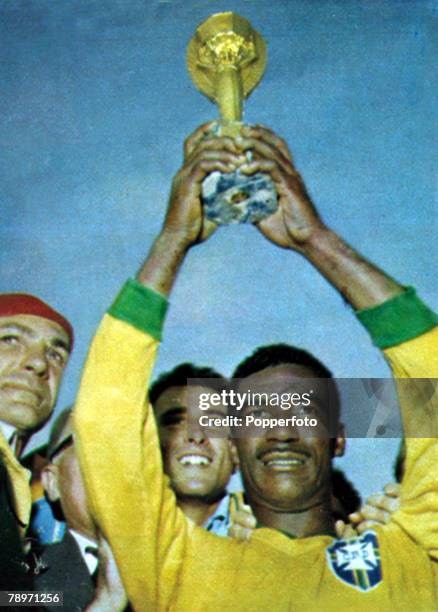
Didi
 Brazil
association football player•association football coach
Also known as: Waldyr Pereira
Birthday
October 8, 1928
Birth Sign
Libra
Birthplace
Campos dos Goytacazes, Rio de Janeiro, Brazil
Age
Died at 72
Height
5 ft 8.5 in (174 cm)
About
Waldyr Pereira, universally known as Didi, was a Brazilian footballer widely regarded as one of the greatest midfielders in history and a central architect of Brazil's first two World Cup victories. An elegant, technically gifted playmaker, he was renowned for his vision, passing range, and stamina, orchestrating play from midfield with grace and intelligence. Didi was the linchpin of the Brazilian sides that won the World Cup in 1958 and 1962, earning recognition as one of the tournament's standout players. He is credited with inventing the folha seca (dry leaf) free kick, a dipping, swerving technique later emulated by generations of specialists. At club level he starred for Fluminense and Botafogo, as well as Real Madrid, where he won La Liga. Didi's influence on the game extended beyond his playing days into coaching, where he managed Peru at the 1970 World Cup. His legacy as a pioneer of Brazil's beautiful game endures, and he is remembered as one of the most elegant and influential figures in football history.
Early Life & Background
Didi grew up in modest circumstances in Campos dos Goytacazes, a city in the state of Rio de Janeiro. His childhood was shaped by poverty, and he began playing football on the streets and dirt fields of his hometown. His natural talent with the ball was evident from a young age. He started his professional career at a local club before moving to larger teams. His first steps toward his career came when he joined the youth ranks of Fluminense, one of Rio de Janeiro's major clubs, though he initially struggled to break into the first team. A pivotal moment before fame was his transfer to Botafogo, where he would develop into the midfield maestro who would define Brazilian football. His early years at Botafogo saw him refine his skills and establish himself as a player of exceptional promise.
Career Growth
Didi's breakthrough came when he established himself as the linchpin of Botafogo's midfield in the early 1950s. His biggest achievements came on the international stage with the Brazil national team. He was a central figure in Brazil's 1958 World Cup victory in Sweden, orchestrating play from midfield alongside Pelé, Garrincha, and Vavá, and scoring a crucial goal in the final against Sweden. He repeated this success in 1962 in Chile, captaining the team in the final after Pelé was injured. At club level, Didi starred for Fluminense (1946-1951), Botafogo (1951-1956, 1959-1961), Real Madrid (1964-1966), and São Paulo (1966-1968). His time at Botafogo was particularly notable as the club featured several other world champions, including Garrincha and Nílton Santos. With Real Madrid, he won La Liga in 1965, becoming one of the first Brazilian stars to play in Europe. After his playing career, he transitioned to coaching, managing several Brazilian clubs and leading Peru to the quarterfinals of the 1970 World Cup.
Career Timeline
Public Image & Style
Didi was known for his elegant, graceful playing style. He moved with poise on the pitch, rarely appearing rushed or flustered. His signature was the folha seca free kick, a dipping, swerving shot that became his trademark. Brazilian and international media portrayed Didi as the cerebral, elegant midfielder who was the brain of Brazil's World Cup-winning teams. He was often contrasted with the flamboyant Garrincha and the prodigious Pelé, described as the orchestrator who made the team function. Botafogo fans honor Didi during club commemorations and anniversaries, and his name is frequently mentioned in discussions of Brazil's greatest midfielders. Posthumous accounts and tributes maintain a reverent tone, celebrating his contributions to football.
Fame & Fandom
Didi's legacy as the cerebral architect of Brazil's golden era commands a quiet but enduring global reverence that transcends his passing. The iFANN Global Fame Engine has evaluated this figure as of August 2026, and while it has processed his historical footprint, he does not currently hold a placement in the published rankings, including the Global Top 1,000 or any scope-specific lists. This absence of a numeric rank reflects a specific status where the engine has evaluated him without assigning a current position among the world's most famous living personalities. While his influence on football strategy remains absolute, the data indicates he does not currently occupy a slot in the active fame hierarchy. His audience consists of historians, football purists, and fans of classic Brazilian cinema who revere his elegance, yet no formal name exists to describe this collective following. Unlike modern stars with branded fan clubs, Didi's supporters are united by a shared appreciation for his technical mastery rather than an organized campaign or ritual. The lack of a documented fandom name underscores the organic nature of his remembrance; he is remembered simply as Didi, the prince of midfield, without the need for a specific label to define his admirers.
Interesting Facts and Legends
Didi invented the folha seca free kick, a dipping and swerving technique that baffled goalkeepers of his era with its unpredictable movement. He captained Brazil during the 1962 World Cup final after Pelé suffered an early injury, leading the team to victory with poise under pressure. Known as the prince of midfield, his elegant style contrasted sharply with the flamboyance of his teammates, earning him the title of the team's orchestrator. He scored a powerful goal from outside the box in the 1958 World Cup final against Sweden, cementing his place in tournament history. One of the first Brazilian players to join Real Madrid, he paved the way for future stars at the club while showcasing exceptional stamina that allowed him to cover immense distances throughout matches. A story often retold by historians involves how his free-kick technique was so advanced that defenders had no answer, forcing them to alter their defensive strategies entirely. His ability to remain calm while others rushed defined his career, making him the brain behind Brazil's first two World Cup triumphs.
Notable Quotes
“The ball is my friend. I treat it with respect, and it obeys me.”
“I invented the dry leaf because I wanted to make the ball do things that goalkeepers couldn't predict.”
“Football is a game of intelligence. You must think before you act.”
“The 1958 team was special because we had joy in our hearts. We played for each other.”
Family & Personal Life
Didi was married to Maria do Carmo, known as Mimi, for most of his adult life. They had at least one child, a son named Waldyr Pereira Filho. Didi maintained a stable family life away from the public spotlight, and his wife was a constant companion throughout his career. Details about his parents and siblings are limited, as he came from a humble background and focused on football from a young age. His family has managed his estate since his death, preserving his legacy through tributes and memorabilia.
Notable Connections
Didi formed legendary partnerships with Pelé and Garrincha on Brazil's 1958 and 1962 World Cup-winning teams. At Botafogo, he played alongside Garrincha and Nílton Santos. At Real Madrid, he was teammates with Alfredo Di Stéfano and Ferenc Puskás. His close friend Mário Zagallo was a teammate on both World Cup-winning squads and later became Brazil's World Cup-winning coach.
Relationships & Dating History
Didi was married to Maria do Carmo, known as Mimi, for most of his adult life. They married in the early 1950s and remained together until Didi's death in 2001. She was his long-term wife and companion throughout his career, and they had at least one child together. Didi maintained a stable family life away from the public spotlight. As of 2026, Didi is deceased; he was married to Maria do Carmo at the time of his death.
- MarriedMaria do Carmo1950 - 2001Married in the early 1950s, remained together until Didi's death in 2001.
Death & Aftermath
Died
May 12, 2001 (aged 72)
Death Place
Unknown
Cause of Death
Unknown
The family of Waldyr Pereira announced the passing of the Brazilian football legend on May 12, 2001. Didi had spent his final days in Rio de Janeiro, where he passed away at the age of 72 after a period of declining health that kept him out of the public eye during the late 1990s and early 2000s. While specific medical details regarding the exact nature of his final illness were never fully disclosed to the press, the circumstances pointed toward natural causes related to old age. The news sent a wave of somber reflection through the Brazilian football community, with former teammates and club officials from Fluminense and Botafogo issuing brief statements honoring his contributions to the sport. Tributes poured in from the confederation, highlighting his role as the linchpin of Brazil's 1958 and 1962 World Cup victories.
The funeral service was held privately in Rio de Janeiro, attended by close friends, family members, and a select group of football dignitaries who wished to pay their respects without the glare of media attention. In the years following his death, Didi's legacy remained secure within the annals of the game. His son, Waldyr Pereira Filho, continued to manage his estate, ensuring that the rights to his image and likeness were preserved for historical documentaries and educational materials. Memorials and tributes have since been organized by various clubs to celebrate the inventor of the folha seca, keeping his memory alive for new generations of players.
Net Worth (Estate Value)
$5 Million
iFANN Editorial Team estimate
As Didi played in an era before massive football commercialization, precise net worth figures were never publicly available during his lifetime. His estate is managed by his family, primarily his son Waldyr Pereira Filho. Revenue sources include posthumous royalties from image rights, licensing of his name and likeness for documentaries, books, and merchandise, tribute events, and historical football memorabilia sales. Per iFANN's editorial analysis, Didi's estate is valued at approximately $5 Million as of 2026, reflecting his enduring cultural significance in Brazilian football.
Awards Won (11)
Didi won two FIFA World Cups with Brazil (1958, 1962) and was one of the tournament's best players in 1958, receiving the Golden Ball retroactively. He also won the Copa América in 1952, multiple Campeonato Carioca titles with Botafogo and Flamengo, and La Liga with Real Madrid in 1965. He was inducted into the Brazilian Football Museum Hall of Fame and recognized by FIFA as one of the greatest players of the 20th century.
1958 · Best Player
1958 FIFA World Cup
1962 · Tournament Winner
Brazil national team
1958 · Tournament Winner
Brazil national team
Known For
1958 FIFA World Cup
1958 · Midfielder
1962 FIFA World Cup
1962 · Captain, Midfielder
Botafogo
1951 · Midfielder
Real Madrid
1964 · Midfielder
Keywords
Quick Facts
- Profession
- association football player, association football coach
- Born
- +1928-10-08
- Birthplace
- Campos dos Goytacazes
- Died
- +2001-05-12
- Death Place
- Rio de Janeiro
- Gender
- Male
- Birth Sign
- Libra
Personal Details
- Full Name
- Waldyr Pereira
- Height
- 5 ft 8.5 in (174 cm)
- Spouse
- Maria do Carmo
- Children
- Waldyr Pereira Filho
Frequently Asked Questions
What is Didi famous for in football?
Did Didi play with Pelé?
What was Didi's net worth?
How did Didi die?
Did Didi play for Real Madrid?
Similar People
Join the community
fans discussing