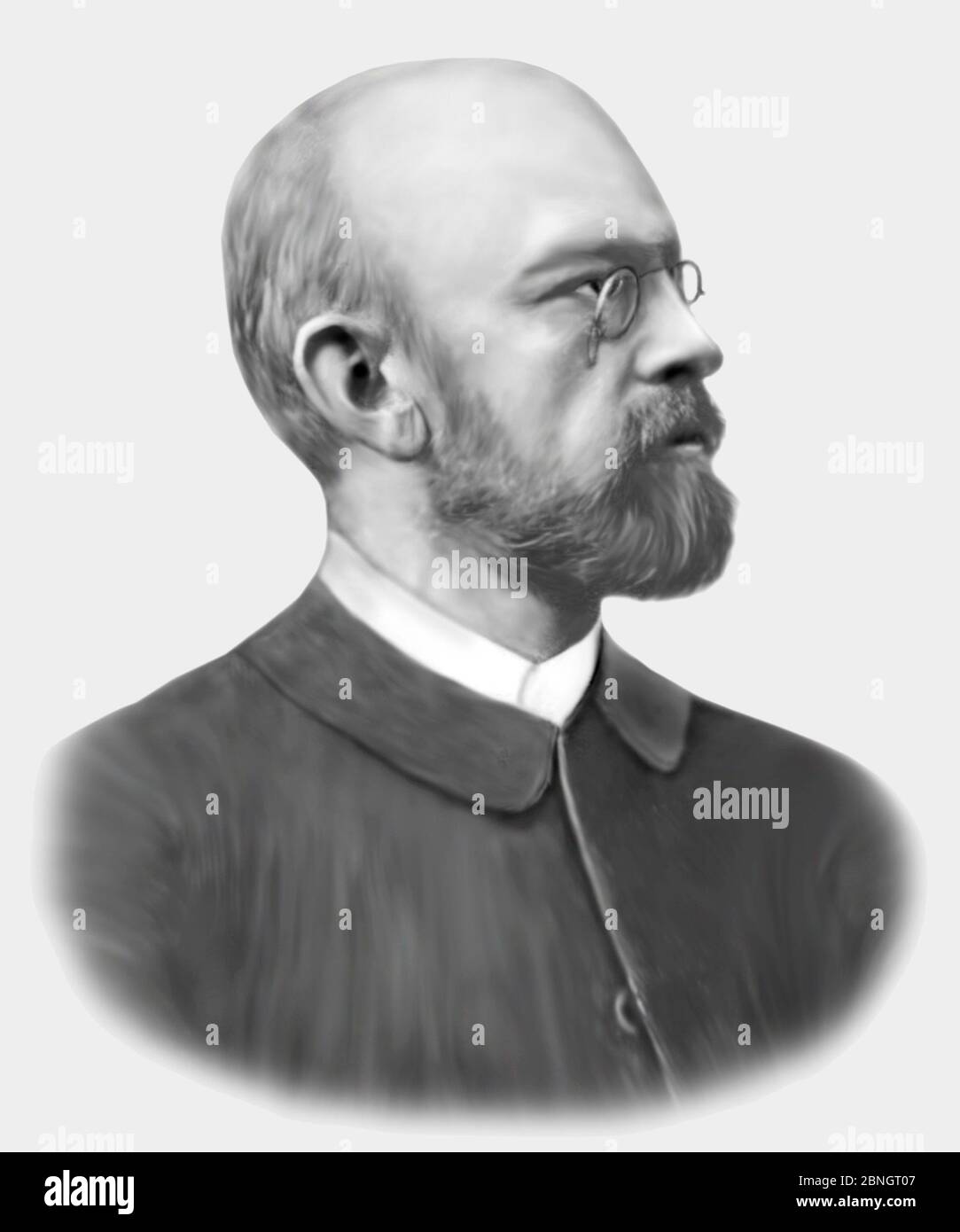
David Hilbert
 Germany
mathematician•university teacher•philosopher
Also known as: Hilbert
Birthday
January 23, 1862
Birth Sign
Aquarius
Birthplace
Königsberg, Prussia (now Kaliningrad, Russia)
Age
Died at 81
About
David Hilbert was a German mathematician and philosopher of mathematics, widely regarded as one of the most influential mathematicians of all time. His work spanned invariant theory, algebraic number theory, geometry, functional analysis, and mathematical physics, and he set the agenda for 20th-century mathematics with his famous list of 23 unsolved problems.
Hilbert's legacy lives on through concepts that bear his name: Hilbert space, Hilbert's program, and the Infinite Hotel Paradox. His axiomatic approach to geometry and his formalist philosophy shaped modern mathematical practice. As of 2026, his 23 problems continue to inspire research, with several solved and at least one proven unsolvable.
Early Life & Background
David Hilbert was born in Königsberg, Prussia, where his father was a judge and his mother came from a merchant family with an interest in philosophy and astronomy. He showed early mathematical talent, though his conventional upbringing didn't immediately single him out. He studied at the University of Königsberg, earning his doctorate in 1885 under Ferdinand von Lindemann. A pivotal friendship began there with Hermann Minkowski, a fellow student who became a lifelong collaborator.
After a stint as a Privatdozent, he became full professor at Königsberg in 1893. His early work on invariant theory, particularly the finite basis theorem, stunned the mathematical community. In 1895, he moved to the University of Göttingen, then the world's leading mathematics center, where he would spend the rest of his career.
Career Growth
Hilbert's breakthrough came with his 1899 publication of Foundations of Geometry, which established an axiomatic foundation for Euclidean geometry and set new standards for rigor. In 1900, he delivered his landmark address at the International Congress of Mathematicians in Paris, presenting 23 unsolved problems that became benchmarks for mathematical progress. He then made foundational contributions to algebraic number theory with his Zahlbericht.
During the 1900s and 1910s, he developed the theory of Hilbert spaces, which became essential to quantum mechanics. He collaborated with Albert Einstein and Emmy Noether on general relativity. In the 1920s, he co-founded proof theory, championing a formalist program that was later challenged by Kurt Gödel's incompleteness theorems. He retired in 1930 but continued to work until his death in 1943.
Career Timeline
Public Image & Style
Hilbert is often called the "last universalist" for commanding nearly all of mathematics at a time of increasing specialization. His public image is that of a rigorous but humane scholar, committed to the unity and certainty of mathematics. His 23 Problems function as a canonical "greatest hits" list, and the Infinite Hotel Paradox has become a beloved popular-science trope. Mathematicians routinely invoke his name in professional and popular discourse.
Fame & Fandom (iFAMOUS Rankings)
David Hilbert's fanbase is not a conventional fandom, there are no fan clubs, no merchandise, no conventions. Instead, his devotees are the mathematicians, physicists, and historians who revere him as the architect of modern mathematical thought. Their devotion manifests in the collective pilgrimage to solve his 23 problems, a project that has defined mathematical research for over a century. The Infinite Hotel Paradox has become a beloved gateway, introducing countless non-mathematicians to his genius, while his epitaph, 'We must know, we will know,' serves as a rallying cry for mathematical optimism. This intellectual fandom is as passionate as any pop-culture following, but it expresses itself through papers, proofs, and conferences.
In the broader landscape of global fame, Hilbert's influence extends far beyond academic circles. According to the iFANN Global Fame Rankings, he is currently the 59th most famous person in Germany, holding steady from the previous cycle. This placement, which tracks global attention across media coverage and scholarly discourse, reflects his enduring presence in both scientific and popular culture.
Interesting Facts and Legends
David Hilbert's tombstone bears his famous epitaph, "We must know, we will know," a phrase taken from a 1930 radio address that has become synonymous with mathematical optimism. He initially resisted Gödel's incompleteness theorems, which ultimately undermined his formalist program, yet he accepted the logical necessity of the findings. Known for his daily walks with colleagues while discussing complex mathematics in the open air, he insisted that students solve problems themselves rather than merely learning existing theories. He proposed the Infinite Hotel Paradox in 1924 to illustrate the counterintuitive nature of infinite sets, a concept that has since become a beloved trope in popular science education. Among the legends that define his life, the presentation of his 23 Problems at the 1900 International Congress of Mathematicians stands out as the most influential single act in 20th-century mathematics. This event set the agenda for decades of research, guiding fields from topology to number theory. Another enduring story is the dramatic irony of his relationship with Kurt Gödel; the man who sought to prove all mathematical truths could be derived from finite axioms was proven wrong by his own brilliant student, creating a narrative of triumph and tragedy that mathematicians still retell today.
One of the most poignant legends involves his death in 1943: due to wartime conditions, only a handful attended his funeral, and his grave bears the same optimistic epitaph. Fans still tell the story of how his retirement address in 1930, which ended with those famous words, was delivered just one day after Gödel's announcement of incompleteness, a moment of profound irony that has become part of mathematical lore.
Notable Quotes
“We must know — we will know.”
“No one shall drive us out of the paradise that Cantor has created.”
“A mathematical problem should be difficult in order to entice us, yet not completely inaccessible, lest it mock at our efforts.”
Family & Personal Life
Hilbert married Käthe Jerosch in 1892, and their marriage lasted until his death. They had one son, Franz, who suffered from mental illness and was institutionalized, a private tragedy Hilbert rarely discussed. The family lived in Göttingen, where Hilbert worked in the university gardens. His later years were shadowed by the rise of Nazism, which forced many Jewish colleagues, including Emmy Noether, to leave.
Notable Connections
Hilbert's circle included Hermann Minkowski, his lifelong friend and collaborator; Emmy Noether, whom he championed at Göttingen; Albert Einstein, with whom he worked on general relativity; and Kurt Gödel, whose incompleteness theorems challenged Hilbert's formalist program. His doctoral supervisor was Ferdinand von Lindemann.
Relationships & Dating History
David Hilbert married Käthe Jerosch in 1892, and they remained together until his death in 1943. They had one son, Franz, who suffered from mental illness. Hilbert's closest intellectual partnership was with Hermann Minkowski, though it was not romantic. No other romantic relationships are documented.
- MarriedKäthe Hilbert1892 - 1943Long and stable marriage; one son, Franz.
Death & Aftermath
Died
February 14, 1943 (aged 81)
Death Place
Göttingen
Cause of Death
reported stomach cancer or general frailty
David Hilbert died on February 14, 1943, in Göttingen, Germany, at the age of eighty. His final days occurred as the University of Göttingen faced severe disruption from the Nazi regime and World War II, with many Jewish colleagues already expelled., biographical accounts describe a long-term illness often cited as stomach cancer or general frailty compounded by stress, though some sources simply note natural causes without a precise pathological diagnosis. The political climate of the Third Reich meant that public reaction was characterized by profound silence rather than vigils or gatherings; tributes from peers were largely muted until after the war ended. The funeral was a private affair held shortly after his death, likely attended only by surviving family members and close academic colleagues who remained in the region.
He was buried in the Stadtfriedhof, the City Cemetery in Göttingen, where many prominent German academics of the era rested. Posthumously, Hilbert received extensive recognition despite the constraints of the immediate postwar period. In 1967, the University of Göttingen established the David-Hilbert-Institut to honor his contributions, and the David-Hilbert-Stiftung was created to support young mathematicians. His papers and library were donated to the University of Göttingen and the Göttingen State and University Library, ensuring their preservation for future generations. The International Mathematical Union later awarded the David Hilbert Medal, standing as a reflection of his enduring influence while his 23 Problems continued to drive mathematical research throughout the century.
Net Worth (Estate Value)
$1 Million
iFANN Editorial Team estimate
As a historical academic, David Hilbert's net worth is not documented in financial terms during his lifetime. His estate consists primarily of an intellectual legacy rather than monetary assets. His collected works, including Foundations of Geometry and the Gesammelte Abhandlungen, remain in print through Springer Verlag, generating modest royalties. The University of Göttingen preserves his papers and personal effects. Per iFANN's editorial analysis, the estimated value of his estate is nominal, around $1 million as of 2026.
Awards Won (1)
Hilbert received the Lobachevsky Prize in 1903 for his work on the foundations of geometry. He was elected a Fellow of the Royal Society in 1928 and a Corresponding Member of the French Academy of Sciences. He also received honorary degrees from Oxford, Cambridge, and Harvard, and honorary citizenship of Königsberg in 1930.
1903 · Mathematics
Foundations of Geometry
Known For
Hilbert's 23 Problems
1900 · Creator
Foundations of Geometry
1899 · Author
Hilbert space
1906 · Developer
Infinite Hotel Paradox
1924 · Proposer
Keywords
Sources
Quick Facts
- Profession
- mathematician, university teacher, philosopher
- Born
- 1862-01-23
- Birthplace
- Königsberg, Prussia
- Died
- 1943-02-14
- Death Place
- Göttingen
- Gender
- Male
- Spouse
- Käthe Hilbert
- Birth Sign
- Aquarius
Personal Details
- Full Name
- David Hilbert
- Spouse
- Käthe Hilbert
- Children
- Franz Hilbert
- Education
- University of Königsberg (doctorate, 1885)
Frequently Asked Questions
What is Hilbert space?
What are Hilbert's 23 problems?
How old was David Hilbert when he died?
Was David Hilbert married?
What is the Infinite Hotel Paradox?
Similar People

Join the community
fans discussing