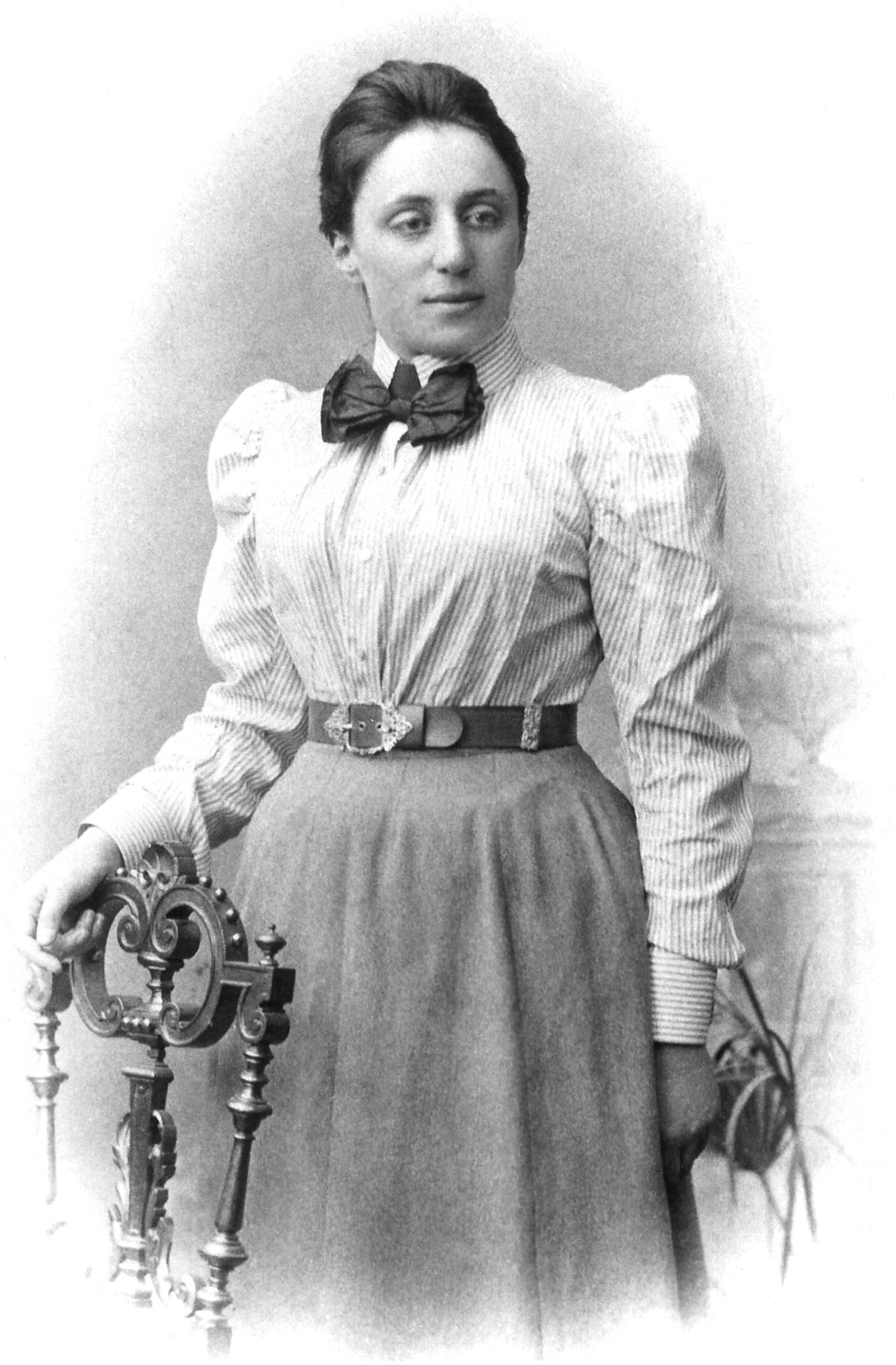
Emmy Noether
 Germany
mathematician•physicist•university teacher
Birthday
+1882-03-23
Birth Sign
Sagittarius
Birthplace
Erlangen
Age
Died at 53
About
Amalie Emmy Noether was born on 23 March 1882 in Erlangen, a Franconian town in Germany, into a Jewish family. Her father, Max Noether, was a mathematician, which shaped her early environment. After initially training to teach French and English, she pivoted to mathematics, studying at the University of Erlangen–Nuremberg. She completed her doctorate in 1907 under Paul Gordan, then spent seven years working unpaid at the Mathematical Institute, a common fate for women in academia at the time. In 1915, David Hilbert and Felix Klein invited her to the University of Göttingen, a premier research hub, but the faculty resisted her appointment. For four years, she lectured under Hilbert's name until her habilitation was approved in 1919, granting her the rank of Privatdozent. Noether's mathematical output is often divided into three epochs. From 1908 to 1919, she worked on algebraic invariants and number fields, culminating in Noether's theorem, which links symmetries to conservation laws, a cornerstone of modern physics. In the 1920s, she transformed abstract algebra, particularly through her 1921 paper "Idealtheorie in Ringbereichen," which developed ideal theory in commutative rings. Her use of the ascending chain condition led to objects being named Noetherian in her honor. The final epoch, from 1927 until her death, saw her pioneering work on noncommutative algebras and hypercomplex numbers, uniting group representation theory with modules and ideals. Her ideas also influenced algebraic topology, even beyond her main focus. Her influence spread through her students, known as the "Noether Boys," and through the Dutch mathematician B. L. van der Waerden, whose 1931 textbook Moderne Algebra was based largely on her work. By 1932, when she delivered a plenary address at the International Congress of Mathematicians in Zürich, her reputation was global. With the Nazi rise to power in 1933, she was dismissed from her post, and she emigrated to the United States, taking a position at Bryn Mawr College in Pennsylvania. There, she mentored women like Marie Johanna Weiss and Olga Taussky-Todd, while also lecturing at the Institute for Advanced Study in Princeton. She died on 14 April 1935, at age 53, after surgery. Einstein and others called her the most important woman in mathematics, a sentiment echoed by contemporaries like Hermann Weyl and Norbert Wiener.
Fame & Fandom
Emmy Noether's admirers form a diffuse community of mathematicians, physicists, historians, and science advocates, united by reverence for her work rather than by any formal fan culture. No documented fandom name exists; there is no equivalent of a "Beyhive" for Noether. Instead, her legacy is celebrated through institutional channels: the German Research Foundation's Emmy Noether Programme, the annual Emmy Noether Lectures, the asteroid 7001 Noether, and the Noetherian ring all bear her name. A 2018 Fermilab video by Dr. Don Lincoln, "The most significant genius: Emmy Noether," has accumulated over 379,000 views on YouTube, arguably the closest thing to a viral tribute. A 2026 theatrical production titled "Noether" further demonstrates ongoing cultural engagement with her story. The informal community shares recurring anecdotes, her unpaid status at Göttingen, Hilbert's bathhouse retort, and Einstein's obituary tribute, which function as de facto canon.
As of August 2026, iFANN's Global Fame Engine has evaluated Emmy Noether but does not currently place her in its published rankings, including the Global Top 1,000 or any Top-100 scope list. She holds no numerical rank, and no score is documented. Her fame, however, remains substantial within academic and scientific circles, sustained by the enduring significance of Noether's Theorem and her foundational contributions to abstract algebra.
Interesting Facts and Legends
Emmy Noether's life is rich with stories that have become legend. The most retold concerns her appointment at the University of Göttingen in 1915, when the faculty objected to hiring a woman. Mathematician David Hilbert retorted, "I do not see that the sex of the candidate is an argument against her admission. After all, we are a university, not a bathhouse." Noether was eventually permitted to teach in 1919, but without salary, and often under Hilbert's name.
Albert Einstein's obituary in the New York Times called her "the most significant creative mathematical genius thus far produced since the higher education of women began." This tribute, coming from a physicist of Einstein's stature, cemented her legendary status.
Noether's Theorem, proved in 1918, is universally credited as foundational to modern physics, linking symmetries to conservation laws. A persistent element of the legend is that she derived this theorem while holding no paid position, working as an unpaid lecturer at Göttingen. Another story, from her expulsion under the Nazis in 1933, tells of a Nazi-sympathizing student who envied her, saying "her work would live on."
Death & Aftermath
Died
+1935-04-14 (aged 53)
Death Place
Bryn Mawr, Pennsylvania, USA
Cause of Death
Ovarian cyst infection leading to sepsis
Albert Einstein eulogized Amalie Emmy Noether as a figure of great intellectual power, declaring her theorem the most important mathematical insight ever given to the world shortly after her passing. Tributes from peers at Bryn Mawr College and the Institute for Advanced Study immediately honored her contributions, leading to moments of silence within the scientific community rather than public vigils or chart surges. Memorials soon followed, including the renaming of lecture halls and the establishment of scholarships, while the asteroid 1862 Noether received its name in 1967. The Emmy Noether Programme established by the German Research Foundation continues to support early-career researchers, and her personal papers were transferred to Bryn Mawr College, which remains the primary repository for her archives.
Noether died on April 14, 1935, at the age of 53 within the Bryn Mawr College Hospital in Pennsylvania, where she had served as a visiting professor since fleeing Nazi Germany in 1933. Her final months involved regular academic duties until her health deteriorated rapidly in early 1935, resulting in an ovarian cyst infection that led to sepsis. Funeral arrangements remained private, with Noether cremated and her ashes interred at Rose Hill Cemetery in Bryn Mawr. The service was attended by colleagues from the local academic community, though specific attendees beyond immediate faculty and friends are not widely documented.
Awards & Accolades
Keywords
Quick Facts
- Profession
- mathematician, physicist, university teacher
- Born
- +1882-03-23
- Birthplace
- Erlangen
- Died
- +1935-04-14
- Death Place
- Bryn Mawr
- Gender
- Female
- Birth Sign
- Sagittarius
Join the community
fans discussing