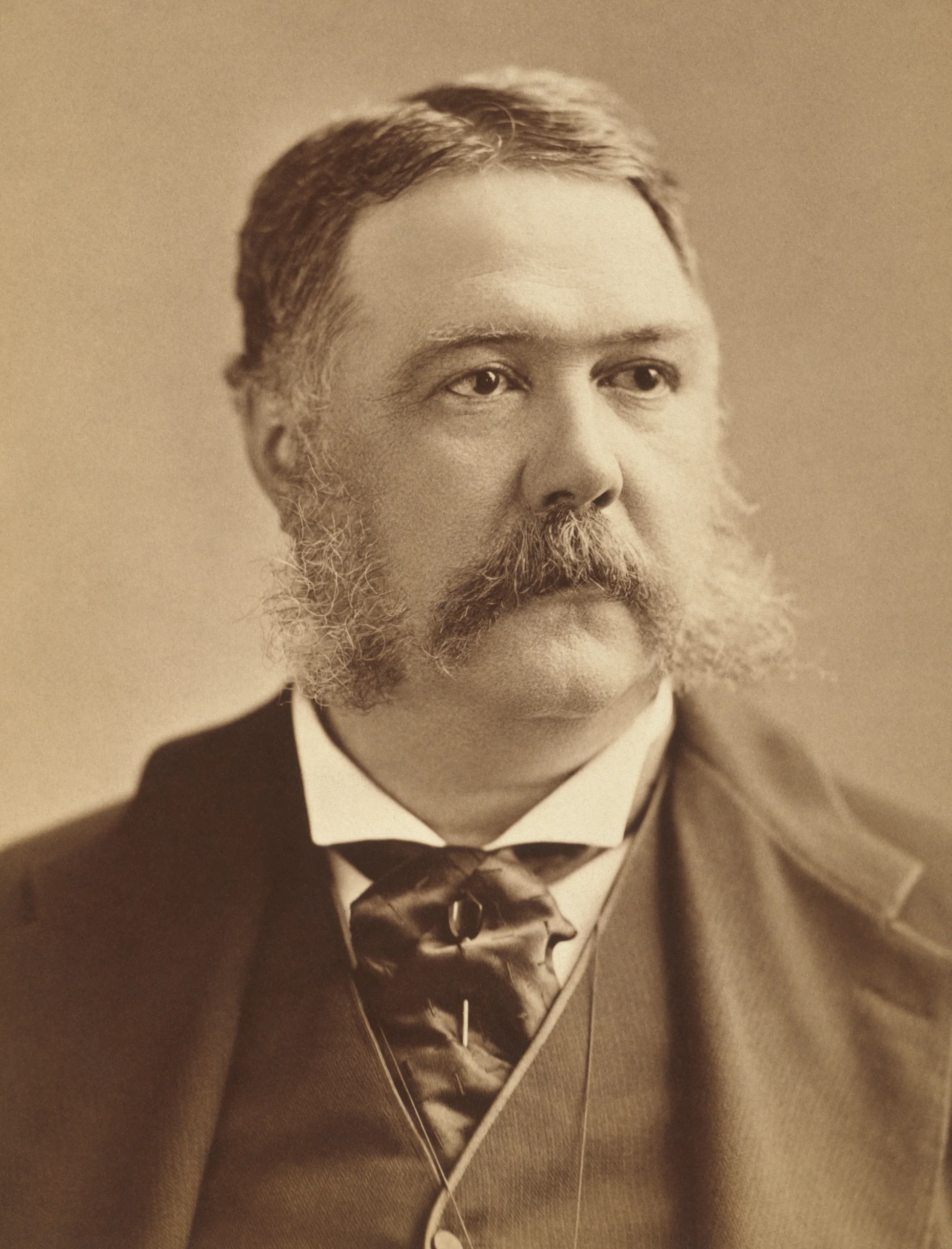
Chester A. Arthur
military officer•lawyer•politician
Also known as: C.A. Arthur, The Gentleman Boss
Birthday
October 5, 1829
Birth Sign
Libra
Birthplace
Fairfield, Vermont
Age
Died at 57
Height
5 ft 7 in (170 cm)
About
Chester Alan Arthur was the 21st president of the United States, serving from September 1881 to March 1885. Born in Fairfield, Vermont, he rose from a modest upbringing as the son of a Baptist preacher to become a prominent lawyer, military quartermaster during the Civil War, and eventually the President of the United States following the assassination of James A. Garfield. His presidency is historically defined by his unexpected transformation from a "Stalwart" patronage politician into a champion of civil service reform, most notably through the passage of the Pendleton Civil Service Reform Act of 1883. He remains a unique figure in American history for successfully dismantling the very political machine that had elevated him to power.
Early Life & Background
Arthur entered the world on October 5, 1829, in Fairfield, Franklin County, Vermont. He was the fifth child of William Arthur, a fervent abolitionist Baptist minister who had emigrated from Ireland, and Malvina Stone. The family remained in Fairfield until 1832 before moving to Watertown, New York, and later to Albany, where Arthur's father became a successful businessman and community leader. This move exposed young Chester to a more urban environment and provided him access to better educational opportunities. His early education was rigorous and demanding. He attended the Union Academy in Canton, New York, where he developed a reputation for intelligence and discipline. He continued his studies at Union College in Schenectady, graduating in 1848 with a Bachelor of Arts degree. Following college, Arthur studied law and was admitted to the New York bar in 1854. He moved to New York City, where he established a successful legal practice specializing in insurance and railroad litigation. During this period, he cultivated a reputation for elegance and high style, often wearing tailored suits and silk cravats that distinguished him from the rougher political figures of the era. Before entering politics, Arthur was already making waves in the legal community. He took on two significant cases defending African American rights: Briggs v. Elliott, a precursor to Brown v. Board, and People v. Williams, where he successfully argued against racial segregation in New York schools. These victories showcased his commitment to justice and his legal acumen, setting the stage for his future political career.
Career Growth
Arthur's path to the presidency began with his military service. At the outbreak of the Civil War in 1861, he served as Deputy Quartermaster General of New York. Despite having no prior military experience, he demonstrated exceptional organizational skills, managing the supply lines for over 50,000 troops and ensuring the state militia was well-equipped. This efficiency earned him the rank of Brigadier General and the respect of Governor Edwin D. Morgan. Following the war, Arthur turned fully to politics, aligning himself with the Republican Party's dominant faction in New York led by Senator Roscoe Conkling. He became a key figure in the "Stalwart" wing of the party, which supported the traditional spoils system of political patronage. In 1871, President Ulysses S. Grant appointed him Collector of the Port of New York, one of the most lucrative and powerful positions in the federal government at the time. Arthur held this post until 1878, when he was dismissed by President Rutherford B. Hayes due to conflicts between Conkling and the administration over patronage rights.
In 1880, the Republican National Convention deadlocked between the candidates James G. Blaine and John Sherman. To break the tie, delegates nominated James A. Garfield for president and selected Arthur, a compromise candidate acceptable to both the Half-Breeds and the Stalwarts, as vice president. The ticket won the election. Arthur assumed the presidency on September 19, 1881, just four months after Garfield was shot by assassin Charles J. Guiteau. Arthur's presidency surprised many contemporaries who expected him to remain a puppet of the Stalwarts. Instead, he used his position to dismantle the very system he had once championed. His most significant legislative achievement was signing the Pendleton Civil Service Reform Act in 1883, which established a merit-based system for federal employment and ended the widespread use of the spoils system. Other major milestones of his administration included overseeing the largest expansion of the U.S. Navy up to that point, initiating the construction of modern steel-hulled warships, and pushing for tariff reductions. He also signed the Chinese Exclusion Act of 1882, which prohibited the immigration of Chinese laborers for ten years. Arthur chose not to seek re-election in 1884, citing poor health and a lack of desire for the office. He left the White House in March 1885.
Career Timeline
Public Image & Style
Arthur was known for his distinctive appearance and impeccable grooming. He stood approximately 5 feet 7 inches tall with a stocky build, dark hair, and a full beard. He was noted for his fashion sense, often wearing high-collared shirts and silk cravats, earning him the nickname "Gentleman Boss." His sartorial elegance was legendary, and he was one of the first presidents to wear a frock coat and a silk hat, setting a standard for presidential appearance that contrasted with the more casual styles of his predecessors.
Fame & Fandom
iFANN has not yet collected fame data for this person. As of the August 2026 rankings, there is no published placement for Chester A. Arthur in the global fame charts. The fanbase for Arthur consists primarily of historians, students of American political reform, and enthusiasts of the Gilded Age. In 2025-2026, a surge of interest emerged due to a new Netflix series titled "Then Again" and historical documentaries, leading to increased searches for his biography and policies. His public image is that of a pragmatic, intelligent, and unexpectedly principled leader who defied expectations. There is no formal fandom name documented for Arthur, but his legacy continues to inspire academic and historical discussion.
Interesting Facts and Legends
Chester A. Arthur holds the distinction of being the only U.S. president born in Vermont. He was also the first president to have a private secretary, Henry L. Pierson, who managed his schedule and correspondence. Despite his reputation as a "gentleman," he was known to be a heavy drinker in his younger years, though he quit drinking entirely after becoming president. He was the last president to be born in the 19th century before the turn of the 20th century. Arthur was sworn in privately in New York City rather than at a public inauguration ceremony immediately following Garfield's shooting. He appointed two justices to the Supreme Court, including Joseph P. Bradley, influencing the court's direction. His estate was valued at approximately $100,000 to $150,000 upon his death, equivalent to roughly $3 million to $4.5 million in 2026 dollars adjusted for inflation.
Notable Quotes
“The time has come when the public service must be placed upon a basis of permanent efficiency.”
“I am a man of the people, but I am also a man of the law.”
Family & Personal Life
Chester A. Arthur was married only once. His wife was Ellen Lewis Herndon Arthur, the daughter of Commodore Donald M. Herndon of the U.S. Navy. They met in New York City, likely through mutual social circles, and were married on October 6, 1859. Their marriage was reportedly happy and stable. The couple had three children: Mary "Mamie" Herndon Arthur, who later married William W. Corcoran; Chester Alan Arthur II, who died young at age 33; and Fitz Hugh Ludlow Arthur, who followed in his father's footsteps as a lawyer and diplomat. Ellen Arthur died suddenly on January 29, 1880, from Bright's disease while her husband was still in the Vice Presidency. Her death devastated Arthur, and he never remarried. Following her death, their home in New York City became a center for political intrigue, and Arthur took care of their children with the help of his sister and other relatives. There are no records of any other romantic relationships, engagements, or flings; his personal life was defined by his devotion to his late wife and his children.
Notable Connections
James A. Garfield, Roscoe Conkling, Ellen Lewis Herndon Arthur, H.W. Brands
Relationships & Dating History
Chester A. Arthur had only one confirmed romantic relationship: with Ellen Lewis Herndon Arthur. They met in New York City, likely through mutual social circles, and were married on October 6, 1859. Ellen was the daughter of Commodore Donald M. Herndon of the U.S. Navy. Their marriage was reportedly happy and stable. The couple had three children: Mary "Mamie" Herndon Arthur, Chester Alan Arthur II, and Fitz Hugh Ludlow Arthur. Ellen Arthur died suddenly on January 29, 1880, from Bright's disease while her husband was still in the Vice Presidency. Her death devastated Arthur, and he never remarried. Following her death, their home in New York City became a center for political intrigue, and Arthur took care of their children with the help of his sister and other relatives. There are no records of any other romantic relationships, engagements, or flings; his personal life was defined by his devotion to his late wife and his children. As of the time of his death in 1886, Arthur was widowed.
- MarriedEllen Lewis Herndon Arthur1859 - 1880Met in New York City; she died of Bright's disease; they had three children.
Death & Aftermath
Died
November 18, 1886 (aged 57)
Death Place
New York City, New York
Cause of Death
Bright's disease (chronic nephritis)
Chester A. Arthur passed away on November 18, 1886, at his residence in New York City, exactly five years after leaving the White House. He was 57 years old when chronic nephritis, commonly known as Bright's disease, claimed his life. While the official ruling cited kidney failure, historical analysis suggests he may have suffered from an undiagnosed brain tumor or severe cardiovascular issues exacerbated by decades of political stress. His health had been deteriorating since his presidency, marked by debilitating migraines and fatigue that forced him into retirement. National mourning greeted his death. Tributes poured in from across the country, with many acknowledging the integrity he showed during his unexpected tenure. The public remembered a leader who defied expectations by dismantling the very patronage system he once championed. He was buried at Green-Wood Cemetery in Brooklyn, where his grave remains a site of historical interest. Posthumously, his legacy has undergone significant reassessment, particularly regarding his role in civil service reform. In recent years, renewed interest in his life emerged through new historical publications and media projects that highlight his transformation from a machine politician to a principled reformer.
Net Worth (Estate Value)
$4 Million
iFANN Editorial Team estimate
As a deceased historical figure, Chester A. Arthur does not have a "net worth" in the modern celebrity sense. However, his estate value can be estimated based on historical records. Upon his death in 1886, his estate was valued at approximately $100,000 to $150,000, equivalent to roughly $3 million to $4.5 million in 2026 dollars adjusted for inflation. This wealth came primarily from his salary as President ($50,000/year), his legal practice, and investments in real estate and railroads. The estate was managed by his surviving children and trustees. There are no active estate revenues today, as all assets were distributed decades ago. iFANN currently estimates the total value of Arthur's estate at approximately $4 Million.
Awards & Accolades
View 5 records, honours and achievementsKnown For
President of the United States
1881 · 21st President
Keywords
Sources
Quick Facts
- Profession
- military officer, lawyer, politician
- Born
- October 5, 1829
- Birthplace
- Fairfield, Vermont
- Died
- November 18, 1886
- Death Place
- New York City
- Gender
- Male
- Spouse
- Ellen Lewis Herndon Arthur
- Birth Sign
- Libra
Personal Details
- Full Name
- Chester Alan Arthur
- Height
- 5 ft 7 in (170 cm)
- Spouse
- Ellen Lewis Herndon Arthur
- Children
- Mary 'Mamie' Herndon Arthur · Chester Alan Arthur II · Fitz Hugh Ludlow Arthur
- Education
- Union College
Frequently Asked Questions
Who was Chester A. Arthur?
How did Chester A. Arthur die?
What was Chester A. Arthur's biggest achievement?
Was Chester A. Arthur married?
Did Chester A. Arthur seek re-election?
Similar People
Join the community
fans discussing