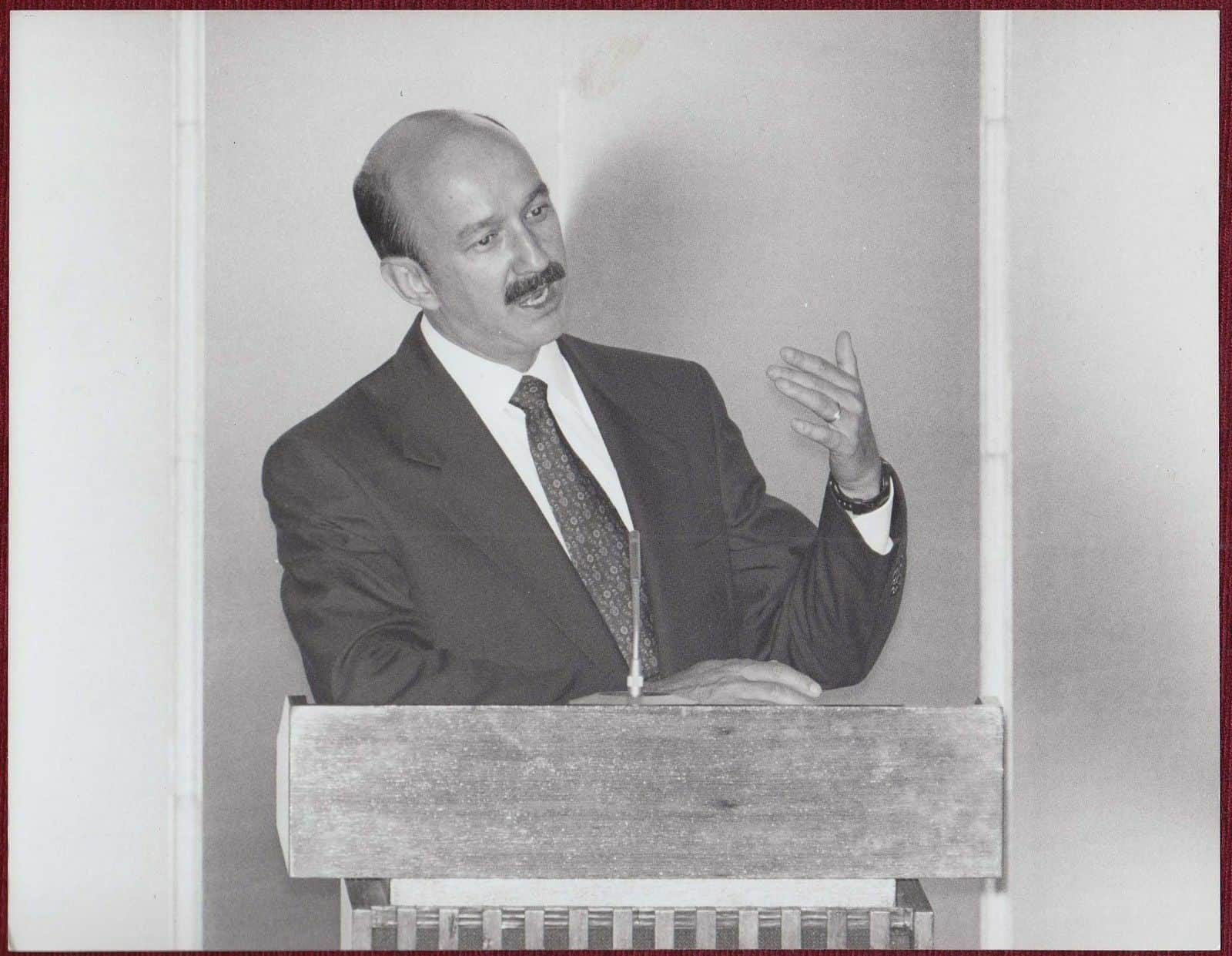
Carlos Salinas de Gortari
 Mexico
Also known as: Carlos Salinas
Birthday
April 3, 1948
Birth Sign
Aries
Birthplace
Mexico City, Mexico
Age
78 years old
Height
5 ft 10 in (1.78 m)
About
Carlos Salinas de Gortari is a Mexican economist and politician who served as the 60th President of Mexico from December 1, 1988, to December 1, 1994. He stands as the primary architect of Mexico's neoliberal economic transformation, most notably through his role in negotiating and implementing the North American Free Trade Agreement or NAFTA. As the first president since 1946 not to hold a law degree, Salinas brought an academic economist's perspective to governance, prioritizing free-market reforms and integration into the global economy. His legacy remains deeply polarized; supporters credit him with modernizing Mexico and securing its place in the global market, while critics point to the controversial nature of his 1988 election victory and the economic instability that followed his departure. Today he lives primarily between Mexico City and Madrid, continuing to comment on economic policy while facing renewed scrutiny regarding his past administration's actions. He maintains a formal, conservative style typical of Mexican politicians of his era, standing approximately 1.78 meters tall.
Early Life & Background
Born on April 3, 1948, in Mexico City, Carlos Salinas de Gortari grew up in a household steeped in political influence. His father, Miguel Salinas Lozano, was a high-ranking official in the Institutional Revolutionary Party and served as a federal deputy, providing young Carlos with early exposure to the mechanics of power and statecraft. His mother, Elena de Gortari, worked as a teacher, instilling a value for education that would define his future path. Salinas attended the prestigious Colegio de México before earning a Bachelor of Arts in Economics from the Universidad Nacional Autónoma de México. His academic ambitions led him to Harvard University, where he obtained a Master of Public Administration from the John F. Kennedy School of Government in 1972 and a Ph.D. in Economics in 1975. His doctoral dissertation focused on the Mexican banking sector, laying the intellectual groundwork for policies he would later implement as a national leader. Before entering high-level politics, he worked as a professor at UNAM and served as a researcher at the National Institute of Public Health. These years allowed him to refine his economic theories and build a network of academic and political allies. In 1976, he entered public service under President José López Portillo as Undersecretary of Programming and Budget. By 1982, he had risen to become Secretary of Programming and Budget, where he managed Mexico's debt crisis following the 1982 default. This period of austerity and market liberalization set the stage for his eventual presidential run. He received honorary doctorates from institutions like the University of Pennsylvania and Oxford later in his career, reflecting his early academic promise.
Career Growth
Salinas secured the Institutional Revolutionary Party nomination in 1988 after defeating more traditional candidates. The subsequent general election remains one of the most controversial in Mexican history. Official results declared him the winner with approximately 50.7% of the vote, but opposition candidate Cuauhtémoc Cárdenas claimed victory based on independent counts, alleging massive electoral fraud and a "system crash" that altered the tally. Despite international criticism and domestic unrest, Salinas was inaugurated on December 1, 1988. As president, he launched a sweeping agenda that fundamentally reshaped the nation. He oversaw the mass privatization of hundreds of state-owned companies, including Telmex and major banks. In October 1992, he signed the North American Free Trade Agreement with U.S. President George H.W. Bush and Canadian Prime Minister Brian Mulroney, eliminating most trade barriers between the three nations. That same year, he introduced the new peso, replacing the old currency at a rate of 1,000 to 1. He also launched Solidaridad, a social welfare program aimed at reducing poverty and building infrastructure in rural areas. Constitutional reforms ended state control over education and allowed the privatization of communal ejido lands. His term ended abruptly in early 1994 when his designated successor, Luis Donaldo Colosio, was assassinated. On December 1, 1994, Salinas handed power to Ernesto Zedillo. Within days of leaving office, the Mexican economy plunged into the "Tequila Crisis," a severe financial collapse that many critics blamed on his management. He frequently appeared on magazine covers like TIME in 1989 titled "The New Mexico" during this transformative era.
Career Timeline
Public Image & Style
Salinas maintains a notably private personal life compared to other world leaders. Unlike many politicians, he did not cultivate a public image of romance or scandal regarding his private life, focusing instead on his policy legacy. His public image is polarized: viewed as a visionary modernizer by the right and center-right, and as a symbol of corruption and inequality by the left. He is often associated with the phrase "Salinismo," referring to his specific brand of economic policy. He dresses in a formal, conservative style typical of Mexican politicians of his era. While he lacks a traditional celebrity fandom, his support base consists of economists, business leaders, and supporters of neoliberal policies. He continues to defend NAFTA and neoliberal policies as essential for Mexico's development, maintaining a steady presence in Spanish-language media and news archives.
Fame & Fandom
Carlos Salinas de Gortari does not command a formal fandom with an official name, organized campaigns, or ritualistic gatherings; political support for his tenure was channeled through the Institutional Revolutionary Party rather than a fanbase. His legacy remains one of statecraft and controversy rather than pop culture worship, yet he maintains a measurable presence in global attention metrics. According to the iFANN Global Fame Rankings, he is the 33rd most famous person in Mexico, a position that has held steady from the previous cycle. On a broader geographic scale, he holds the rank of the 77th most famous person from Mexico, maintaining his standing from the prior assessment. His influence extends across the hemisphere where he is ranked as the 57th most famous person in Latin America, also holding steady from the last count. These placements reflect a persistent recognition of his role as a primary architect of Mexico's neoliberal shift and the controversial figure behind the North American Free Trade Agreement. The rankings track global attention across diverse media coverage and consumption signals worldwide, placing him firmly among the most significant political figures of his generation despite the absence of traditional celebrity devotion. He is frequently listed in "Greatest Politicians of the 20th Century" lists in Latin America for his economic reforms.
Interesting Facts and Legends
At the time of his inauguration, Salinas was the youngest president in Mexican history. He holds the distinction of being the first president since 1946 without a law degree, bringing a technical background to the office. The 1988 election is infamous for the alleged computer glitch that changed the vote count in his favor, a story that remains a cornerstone of Mexican political mythology. The murder of his brother Raúl in 1995 remains one of the most unsolved and debated cases in modern Mexican history, sparking years of conspiracy theories. Recent scandals have further complicated his image, including reports from 2019 that his son was a co-conspirator in a New York sex cult case. In December 2024, current Mexican President Claudia Sheinbaum publicly suggested that the former president should apply for welfare benefits, highlighting a decline in his standing. In September 2026, news reports highlighted his continued influence in Mexican politics through the "salinistas" faction. A 2026 report reiterated claims that a mission named "El Grande" was planned to kill EZLN leader Subcomandante Marcos on Salinas's orders, though it failed. Critics argue his government used public funds to bail out banks that had been privatized, enriching owners at taxpayers' expense.
Notable Quotes
“The only way to save Mexico is to open it up to the world.”
“We must integrate Mexico into the global economy.”
“Privatization is not selling the country; it is saving it.”
Family & Personal Life
Carlos Salinas de Gortari married Margarita Zavala in 1972 while both were students at UNAM. They remained married throughout his presidency and until their separation in the mid-1990s, though they never officially divorced. Sources indicate they separated amicably around 1995–1996, shortly after his presidency ended. The couple produced two children: Miguel Ángel Salinas Zavala and Elena Salinas Zavala, both born in the 1970s. Like their father, Miguel has occasionally been mentioned in media regarding family matters, though he has largely stayed out of the public eye. Elena has also lived a low-profile life. There are no widely documented romantic relationships or flings prior to or during his marriage to Margarita Zavala that have been confirmed by credible sources. As of 2026, there is no public record of him remarrying or being in a new long-term relationship. He is currently considered single or living independently, having separated from his wife decades ago. No children have been reported from any other unions. His brother Raúl Salinas de Gortari was murdered in 1995, a case that remains one of the most debated in modern Mexican history.
Notable Connections
Margarita Zavala, Raúl Salinas de Gortari, José López Portillo, Miguel de la Madrid, Ernesto Zedillo, George H.W. Bush, Brian Mulroney, Claudia Sheinbaum.
Relationships & Dating History
Carlos Salinas de Gortari married Margarita Zavala in 1972 while both were students at the Universidad Nacional Autónoma de México. Zavala was studying law, and Salinas was pursuing economics. They met during their university years and remained married throughout his presidency and until their separation in the mid-1990s, though they never officially divorced. Sources indicate they separated amicably around 1995–1996, shortly after his presidency ended. The marriage produced two children: Miguel Ángel Salinas Zavala and Elena Salinas Zavala, both born in the 1970s. Like their father, Miguel has occasionally been mentioned in media regarding family matters, though he has largely stayed out of the public eye. Elena has also lived a low-profile life. There are no widely documented romantic relationships or flings prior to or during his marriage to Margarita Zavala that have been confirmed by credible sources. As of 2026, there is no public record of him remarrying or being in a new long-term relationship. He is currently considered single or living independently, having separated from his wife decades ago. No children have been reported from any other unions. He is known for maintaining a notably private personal life compared to other world leaders, avoiding public displays of romance or scandal.
- SeparatedMargarita Zavala1972 - 1996Met as students at UNAM; married until separation after his presidency.
Salary, Net Worth In 2026
$24 Million
iFANN Editorial Team estimate
iFANN currently estimates Carlos Salinas de Gortari's net worth at approximately $24 million, though other sources suggest a range between $5 million and $20 million USD due to asset opacity. This figure reflects research into his post-presidency earnings, real estate holdings, and investment activities. His wealth sources include lectures and speaking engagements at universities and think tanks globally, such as the Baker Institute in 2022. Book royalties from his memoirs and analysis books on Mexican modernization contribute significantly to his income. Real estate holdings in Mexico and Spain form a substantial part of his assets. Reports suggest he spends time between Mexico City and Madrid, reflecting ties between the Mexican oligarchy and Spanish elites. Private investments in various sectors add to his portfolio, though specific details remain scarce. While some local outlets suggest his wealth could be higher due to unverified real estate values, the iFANN Editorial Team's analysis points to this range based on available data. His financial trajectory has seen fluctuations, particularly following the Tequila Crisis, but his continued relevance in economic circles ensures a steady income stream. Some estimates from Forbes place it lower at $15 million, citing limited public records.
Awards Won (3)
Salinas has received numerous accolades for his economic policies, though he has also faced condemnation from human rights groups. He received honorary doctorates from several universities, including the University of Pennsylvania and the University of Oxford. He was awarded the Order of the Aztec Eagle by the Mexican government. Internationally, he is cited in economic forums as a visionary for integrating Latin America into the global market, receiving tributes from business leaders in the US and Canada.
1989 · National Honor
Service to Mexico
1991 · Academic
University of Oxford
1990 · Academic
University of Pennsylvania
Known For
Presidency of Mexico
1988 · President
North American Free Trade Agreement
1992 · Negotiator
Keywords
Sources
Quick Facts
- Profession
- economist, politician
- Born
- April 3, 1948
- Birthplace
- Mexico City
- Gender
- Male
- Birth Sign
- Aries
Personal Details
- Full Name
- Carlos Salinas de Gortari
- Height
- 5 ft 10 in (1.78 m)
- Spouse
- Margarita Zavala
- Children
- Miguel Ángel Salinas Zavala, Elena Salinas Zavala
- Education
- Universidad Nacional Autónoma de México; Harvard University
Frequently Asked Questions
What is Carlos Salinas de Gortari's net worth?
Is Carlos Salinas de Gortari still alive?
Why is Carlos Salinas de Gortari controversial?
Did Carlos Salinas de Gortari sign NAFTA?
Who is Carlos Salinas de Gortari's wife?
Social Media
Similar People
Join the community
fans discussing