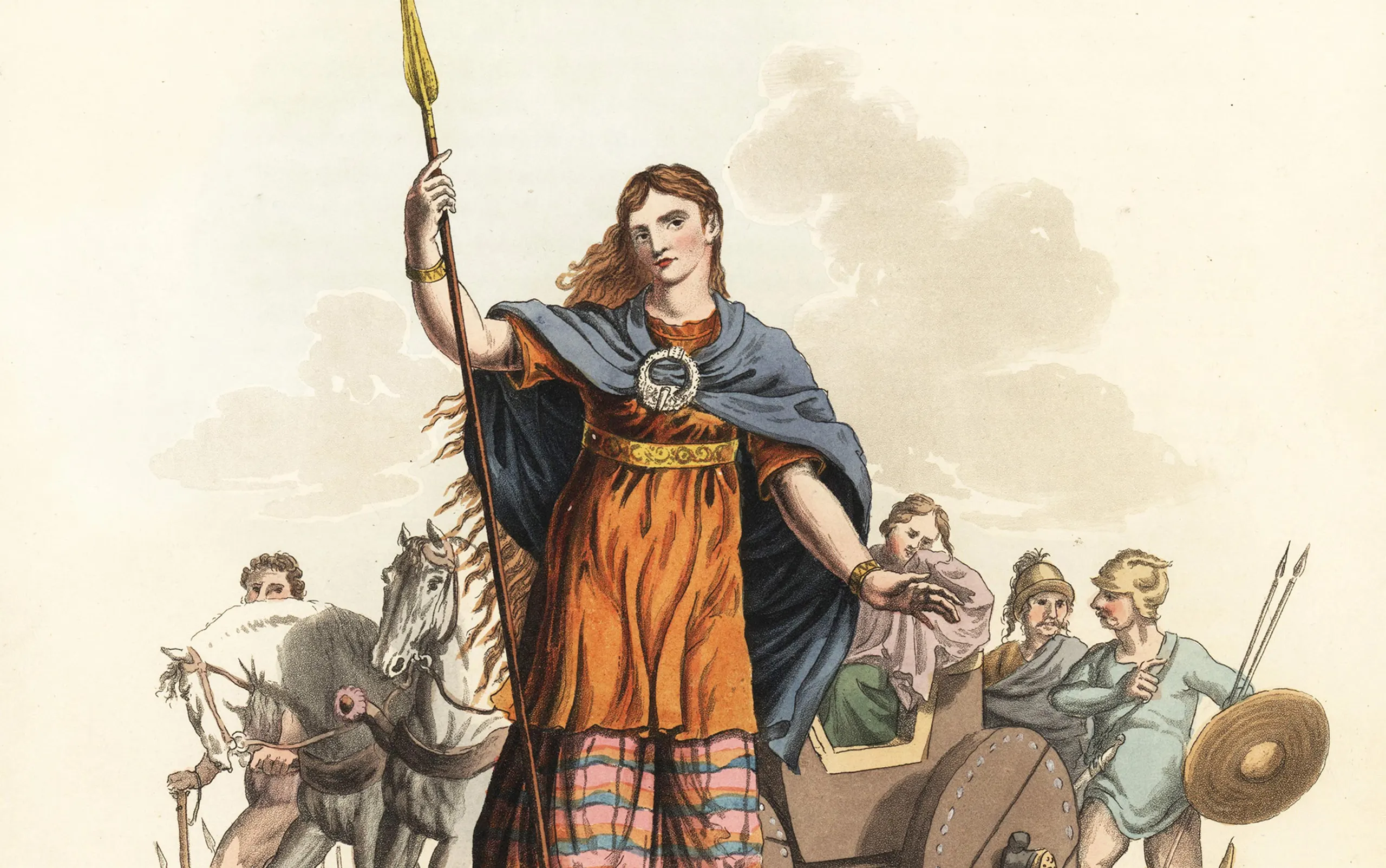
Boudica
 United Kingdom
military leader•ruler•queen regnant
Also known as: Boudicca, Boadicea, Buddug
Birthday
+0030
Birth Sign
Taurus
Birthplace
Roman Britain
Age
Died at 31
About
Boudica was the queen of the Iceni tribe in ancient Britain who led a major uprising against the Roman Empire around AD 60 or 61. Born roughly in the year 30 within East Anglia, she became a legendary figure of resistance after Rome violated her family's sovereignty and abused her and her daughters. Her husband Prasutagus had ruled as a nominally independent ally while leaving his kingdom jointly to their two daughters and the emperor in his will. The Romans ignored this arrangement upon his death, annexing the territory and seizing property.
In 60 or 61, Boudica united the Iceni with other tribes to launch a devastating attack that destroyed Camulodunum, Londinium, and Verulamium. Estimates suggest her followers killed between 70,000 and 80,000 people during the uprising before Suetonius Paulinus regrouped his troops and delivered a crushing defeat. Boudica died shortly after the battle, either by suicide or illness, preventing further conflict. Nero briefly considered withdrawing all imperial forces from Britain, but Suetonius's victory secured Roman control for decades to come.
Early Life & Background
Historical records do not preserve the specific details of Boudica's childhood or early education, as the Celtic culture relied on oral tradition rather than written chronicles. She was born into the Iceni nobility in what is now Norfolk or Suffolk, likely spending her formative years immersed in the social and religious structures of her tribe. Her upbringing prepared her for a leadership role within the community, though the specifics of her training remain lost to time. She was raised within the traditions of the Iceni nobility, preparing her for a leadership role should her husband die without a male heir.
Boudica's life prior to the revolt involved managing the affairs of the royal household and participating in the diplomatic relations between the Iceni and Rome. This period of relative stability ended abruptly when Prasutagus died around AD 60, triggering the events that would define her legacy. While specific details about her childhood, education, or early interests are lost to history due to the oral nature of Celtic culture and the lack of written records from the Britons themselves, it is understood that she was raised within the traditions of the Iceni nobility.
Career Growth
The defining chapter of Boudica's life began immediately following the death of her husband, Prasutagus, around AD 60. When the Romans ignored his will and seized Iceni lands, flogged Boudica, and raped her daughters, she transformed from a royal consort into a military commander. She united the Iceni with the Trinovantes and other tribes to launch a coordinated rebellion that swept across the province. Her forces, estimated at between 100,000 and 250,000 warriors, first attacked Camulodunum, a settlement built for retired Roman veterans, which they destroyed completely.
Following this victory, Boudica's army marched on Londinium and Verulamium, burning both cities to the ground and killing an estimated 70,000 to 80,000 Romans and pro-Roman Britons. Governor Gaius Suetonius Paulinus fled the scene unable to defend the cities initially. Although heavily outnumbered, Suetonius eventually regrouped his legions with reinforcements from Gaul and chose a narrow defile for the final confrontation at Watling Street. Despite being outnumbered, the disciplined Roman infantry decimated the Briton forces, resulting in the deaths of up to 80,000 Britons. Boudica died shortly thereafter, marking the end of the revolt and securing Roman control over Britain for another four decades. Additionally, the Roman financier Seneca called in loans he had forced upon the Britons, causing economic distress among the local elite that fueled the unrest.
Career Timeline
Public Image & Style
Boudica is portrayed as a fierce, tragic, and heroic figure who represents the ultimate defender of liberty against tyranny. In modern times, she is often used as a symbol for feminist movements and anti-colonial struggles. Her aesthetic is typically one of wild hair, simple Celtic garb, and a commanding presence. Victorian artists and writers frequently depicted her struggle, turning her into a cultural icon representing justice and independence. No physical descriptions of Boudica survive from antiquity, though artistic depictions vary wildly, often showing her as tall and blonde, reflecting Victorian romanticism rather than archaeological fact.
Fame & Fandom (iFAMOUS Rankings)
iFANN has not yet collected fame data for this person. While she does not appear in current global celebrity rankings, her historical significance ensures she remains a prominent figure in educational and cultural contexts. She consistently appears on lists of 'Greatest Women in History' and 'Most Influential Female Leaders' published by various organizations.
There is no formal fandom name documented for Boudica in the pop-culture sense. However, she has a dedicated following among history enthusiasts, British nationalists who view her as a foundational figure of British identity, and feminist groups who celebrate her as a precursor to female leadership. Fan campaigns often involve petitions to restore her statues or demand more accurate historical representation in schools. TIME Magazine frequently cites her in articles regarding women who changed the course of history, and she is often included in polls for '100 Greatest Britons' by the BBC. She is a staple in literature, art, and film, appearing in works ranging from William Cowper's poem Boadicea (1782) to the 1928 silent film Boadicea.
Interesting Facts and Legends
Her name derives from the Brythonic root *boudi* meaning 'victory' combined with the adjectival suffix *-kā*, translating to 'Victorious Woman'. In Latin sources, Tacitus wrote her name as Boudica, while Cassius Dio used Boudicca. The form 'Boadicea' became common in English during the 17th century due to a misreading of manuscripts. Archaeologists announced the discovery of a rare 2,000-year-old battle trumpet in Norfolk in January 2026, which may be linked to her era. Another hoard of Iron Age objects, including a boar standard, was unearthed in the same region, providing tangible links to the time of her rebellion.
Tacitus records a speech Boudica gave to her troops before the final battle, emphasizing her status as a woman avenging her lost freedom and her daughters' honor. Before the final battle, Boudica reportedly invoked the goddess Terra Mater for victory, a moment dramatized in many artistic renditions. The story of her suicide by poison is attributed to Tacitus, while Cassius Dio claims she died of illness; it is possible she simply vanished into obscurity after the battle. A film titled Boudica (2023), starring Olga Kurylenko, continues to circulate in streaming markets as of 2026. Sky HISTORY released a series segment in late 2025 titled 'The Boudican Revolt,' attempting to locate the site of her final battle. The Danish melodic death metal band VANIR released a single titled 'Boudica' in March 2026, part of their album Wyrd. Her burial place is unknown; legend suggests she was buried under a mound along the Great North Road, but no archaeological evidence confirms this.
Notable Quotes
“I am not fighting for my kingdom or my wealth... I am fighting for my freedom and the freedom of my daughters.”
“If you ask why I am so angry, it is because I am a woman and I have been beaten and my daughters violated.”
Family & Personal Life
Boudica was married to Prasutagus, the King of the Iceni, until his death around AD 60. Their relationship was central to the political landscape of the region, as Prasutagus attempted to maintain Iceni autonomy through a joint inheritance plan. The couple had two daughters, whose names were never recorded by historians. These children became central to the tragedy of the revolt, suffering rape and abuse at the hands of Roman soldiers, which served as the primary emotional catalyst for Boudica's war.
The fate of her daughters remains unknown, though some legends suggest they may have been taken into slavery or disappeared during the chaos of the aftermath. As Boudica died in AD 61, there were no subsequent relationships or children born after the revolt. No further details regarding the lives or fates of her daughters are recorded in historical texts.
Notable Connections
Relationships & Dating History
Boudica's only documented partner was Prasutagus, the King of the Iceni. Their relationship began prior to his accession to the throne or during his reign. They were married until his death around AD 60. As Boudica died in AD 61, she remained widowed at the time of her death, with no subsequent relationships. The tragedy of the revolt centered on the abuse of Boudica and her daughters by Roman soldiers following Prasutagus's death, which served as the catalyst for her uprising. Her children suffered rape and abuse at the hands of Roman soldiers, which served as the primary emotional catalyst for Boudica's war.
- MarriedPrasutagusPre-60 CE - 60 CEKing of the Iceni; died c. 60 CE.
Death & Aftermath
Died
+0061-01-01 (aged 31)
Death Place
Unknown
Cause of Death
Reported poisoning or illness
A bronze statue by Thomas Thornycroft stands on the Victoria Embankment in London, depicting the queen in a chariot with her daughters, while a long-distance footpath bears her name and recent archaeological finds in Norfolk have reignited speculation about artifacts from her reign. Ancient accounts offer divergent narratives regarding her final days: Tacitus states she ended her life by poison to avoid Roman capture, whereas Cassius Dio suggests she succumbed to illness or wounds sustained after the Battle of Watling Street. No specific date or place is confirmed in historical texts, though the event occurred shortly after the battle in late AD 60 or 61 within the region of modern-day Staffordshire or Shropshire.
Her forces were decimated at Watling Street, and she disappeared from the record immediately following the defeat. The Roman Empire celebrated the restoration of order, while her estate and family lands were seized and redistributed to Roman veterans. In the centuries since, she has been reimagined as a national icon, featured in countless works including the film Boudica.
Net Worth (Estate Value)
$0
iFANN Editorial Team estimate
Boudica died in AD 61, and there is no concept of personal net worth or estate value in the modern financial sense. Her wealth consisted of the land and resources of the Iceni tribe, which were seized by the Romans after her death. The economic impact of her rebellion was significant, costing Rome millions of sesterces in damages, but she left no personal fortune. The legacy of her life generates immense cultural and commercial value today through tourism, literature, and media, though this value belongs to the historical record rather than an estate managed by heirs. The most famous tribute is the bronze statue of Boudica standing on the Victoria Embankment in London, near the Houses of Parliament, unveiled in 1902.
Awards & Accolades
View 6 records, honours and achievementsKnown For
Boudican Revolt
60-61 · Leader
Boudica
2023 · Subject of Film
Keywords
Sources
Quick Facts
- Profession
- military leader, ruler, queen regnant
- Born
- +0030
- Birthplace
- Roman Britain
- Died
- +0061-01-01
- Death Place
- Roman Britain
- Gender
- Female
- Spouse
- Prasutagus
Personal Details
- Spouse
- Prasutagus
- Children
- Two daughters (names unrecorded)
Frequently Asked Questions
What does Boudica's name mean?
How did Boudica die?
Did Boudica win any battles?
Where is Boudica buried?
Was Boudica a real person?
Similar People
Join the community
fans discussing