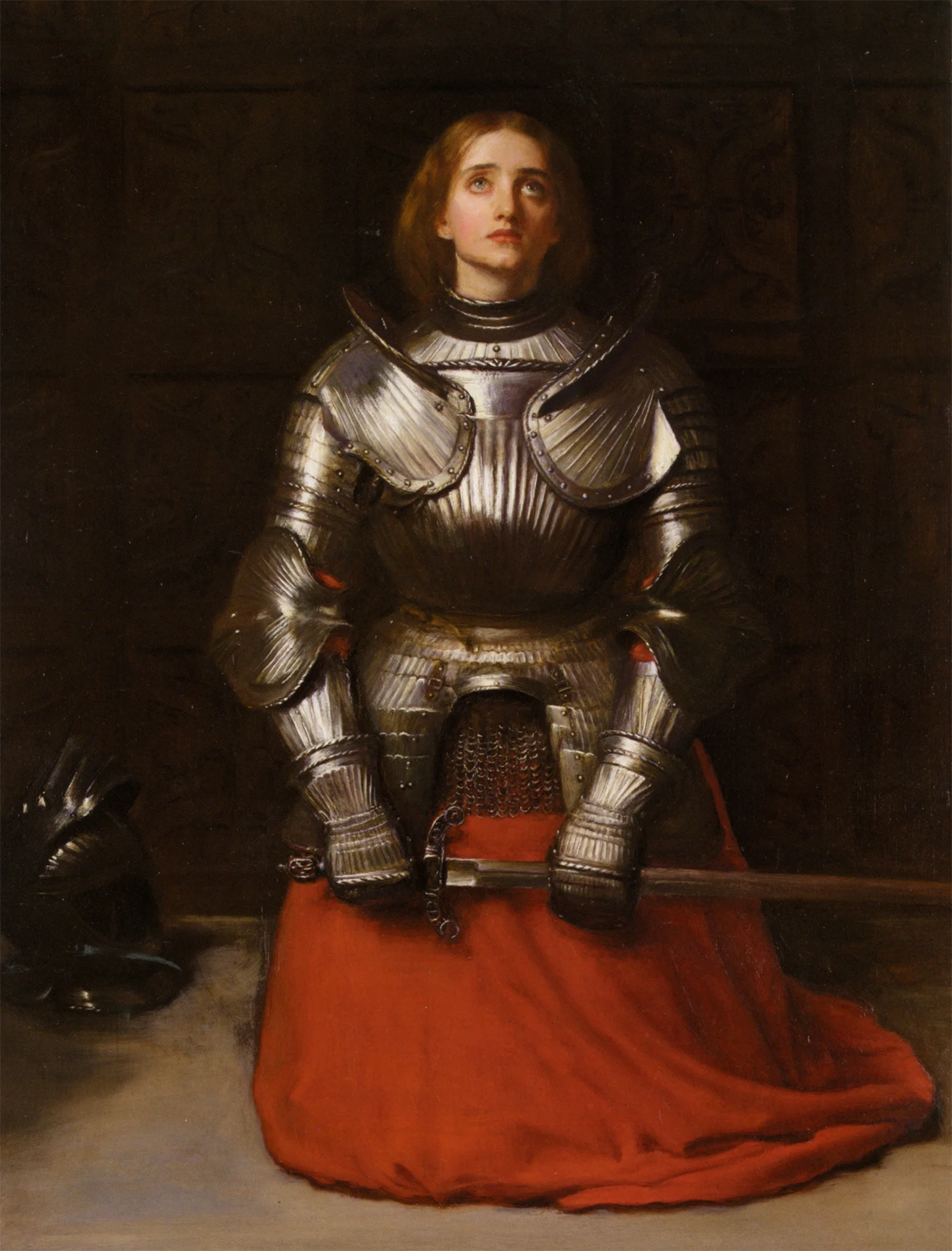
Joan of Arc
 France
military personnel•religious leader
Also known as: The Maid of Orléans, Jeanne d'Arc, Saint Joan of Arc
Birthday
January 6, 1412
Birth Sign
Capricorn
Birthplace
Domrémy-la-Pucelle
Age
Died at 19
Height
5 ft 0 in (152 cm)
About
Joan of Arc was a national heroine of France and a canonized Catholic saint, remembered as the teenage peasant girl who helped turn the tide of the Hundred Years' War. Born around 1412 in the village of Domrémy, she claimed to receive visions from saints and the archangel Michael instructing her to drive the English from France and see the disinherited Charles VII crowned king. That conviction, extraordinary in a young woman of no rank, propelled her from rural obscurity to the center of a nation's struggle.
Her legend rests on a stunning few years of action. Granted an audience with Charles and given a role in the army, she helped lift the siege of Orléans and inspired a demoralized French force to a string of victories that opened the road to Reims, where Charles was crowned. Captured by Burgundian forces and handed to the English, she was tried by a church court and burned at the stake in 1431, not yet twenty years old. Decades later her conviction was overturned, and centuries after that she was declared a saint.
Joan endures as one of history's most compelling figures, a symbol of faith, courage, and patriotism whose story has inspired countless retellings in books, films, and art. Her feast day is May 30, and she is the patron saint of soldiers, prisoners, and France.
Early Life & Background
Joan grew up in Domrémy, a small village in the Lorraine region of northeastern France, during the Hundred Years' War. Her parents, Jacques d'Arc and Isabelle Romée, were tenant farmers who raised livestock and tended crops. The village lay in the Duchy of Bar, whose people remained loyal to the Armagnac faction despite being surrounded by pro-Burgundian territories. In 1425, Domrémy was attacked and cattle stolen, hardening local sentiment against the English and their Burgundian allies.
Joan never learned to read or write. Her mother taught her domestic skills such as sewing and spinning, and she helped her father in the fields and looked after the animals. The family attended church regularly, and Joan received a strong religious upbringing. Around age 13, she began experiencing visions and hearing voices she believed were divine. She reported seeing Saint Michael the Archangel, Saint Catherine, and Saint Margaret, who initially instructed her to be good and go to church. Over time, the voices grew more urgent, telling her she had a great mission: to drive the English from France and see the Dauphin Charles crowned king at Reims.
At about 16, Joan decided to act. She approached the local commander at Vaucouleurs, Robert de Baudricourt, requesting an escort to take her to the Royal Court. He dismissed her twice, but she persisted and eventually gained an audience with the Dauphin at Chinon in early 1429.
Career Growth
Joan arrived at Chinon in February 1429 and convinced Charles VII to allow her to join the war effort. Theologians at Poitiers examined her and found no evil, so she was given armor, a standard bearing the fleur-de-lis and the names Jesus and Mary, and a white horse. Her first major action came at the Siege of Orléans in April-May 1429. Leading demoralized French troops, she inspired them to lift the siege in nine days, a turning point in the war. The victory earned her the nickname The Maid of Orléans.
Following Orléans, Joan led the Loire Valley campaign, capturing Jargeau and winning the Battle of Patay in June 1429. These victories opened the road to Reims, where Charles VII was crowned king on July 17, 1429, with Joan standing beside him holding her standard. In May 1430, during a skirmish at Compiègne, she was thrown from her horse and captured by Burgundian forces, who sold her to the English. She was tried for heresy by a church court in Rouen beginning January 9, 1431. Convicted of wearing men's clothes and acting on demonic visions, she was burned at the stake on May 30, 1431, at age 19. A nullification trial in 1456 overturned the conviction, and she was canonized in 1920.
Career Timeline
Public Image & Style
Joan is typically depicted in armor with a white standard bearing the fleur-de-lis, often with short hair and wearing men's clothing. She is portrayed as a symbol of courage, faith, patriotism, and divine conviction. Her image has been interpreted in hundreds of films, plays, books, and artworks, ranging from religious martyr to feminist icon to military hero. Catholics venerate her as a saint, while French nationalists celebrate her as a heroine. Annual celebrations on her feast day, May 30, include pilgrimages to Domrémy and Rouen, historical reenactments, and academic conferences. Educational accounts focus on historical accuracy, while Catholic accounts emphasize her spiritual significance.
Fame & Fandom
Joan of Arc commands a devotion that transcends the modern definition of fandom. There is no organized group calling themselves by a specific name, nor are there fan-funded subway ads or birthday billboards for the 15th-century peasant girl turned military leader. Instead, her following consists of devotees, historians, and cultural admirers who interact with her legacy through religious veneration and academic study. Her story serves as a narrative of resilience against occupation and injustice, inspiring individuals facing oppression to seek moral courage. Communities gather today not to stream a new single, but to reflect on themes of saintly patriotism and divine guidance in theatrical productions and theological discussions. This enduring reverence functions as a form of worship rather than celebrity worship, cementing her status as a symbol of freedom and independence across centuries. The iFANN Global Fame Rankings track this unique blend of historical weight and cultural consumption worldwide. Joan of Arc is currently the 368th most famous person in the world, holding steady from the previous cycle. She ranks as the 20th most famous person in France and stands as the 15th most famous person from France. In Europe, she holds the position of the 92nd most famous person in Europe. Within the pop culture sphere, she is recognized as the 72nd most famous person in Pop.
Interesting Facts and Legends
Joan dictated her letters to scribes because she could not write herself. Her trial transcript remains one of the most complete medieval documents, preserving extensive eyewitness accounts of her proceedings. She wore men's clothing, a choice that became a central charge during her trial. The French royal family paid a ransom of 10,000 livres after her capture, yet the English refused to release her. Her birthplace, Domrémy, was renamed Domrémy-la-Pucelle in her honor. She correctly predicted the outcome of a military engagement at Orléans, which convinced Charles VII of her divine mission. A sword she claimed was guided by voices was discovered behind the altar of the church of Sainte-Catherine-de-Fierbois. Legends still retell how her presence lifted the siege of Orléans, turning the tide of the Hundred Years' War despite her lack of military training. The story of her martyrdom, where she refused to recant her visions even under threat of death, defines her tragic arc. A posthumous retrial in 1456 declared her innocent, leading to her canonization as a saint in 1920.
Notable Quotes
“I am not afraid; I was born to do this.”
“If I am not, may God put me there; and if I am, may God keep me there.”
“Hold the standard in the battle, and it will touch the king's person. The standard belongs to the king. And for love of the standard, do not let it fall.”
“God has pity on the French. He wishes them to be free.”
“I would rather die than do something which I know to be a sin, or to be against God's will.”
Family & Personal Life
Joan was born to Jacques d'Arc, a farmer and village official, and Isabelle Romée, who provided her religious education. She had three older brothers, Jean, Pierre, and Jacques, and an older sister named Catherine. The family lived in a modest home in Domrémy and were deeply Christian. Joan never married and had no children. She took a vow of chastity as part of her divine mission. After her death, her mother and brothers were involved in the petition for the nullification trial.
Notable Connections
Joan's story is deeply tied to Charles VII, the Dauphin she helped crown. She was opposed by Bishop Pierre Cauchon, who presided over her trial. Robert de Baudricourt, the local commander at Vaucouleurs, initially rejected then approved her mission. The Duke of Burgundy, Philip the Good, whose forces captured her, and King Henry VI of England, whose claim she opposed, were key adversaries. She reported visions of Saint Michael, Saint Catherine, and Saint Margaret.
Relationships & Dating History
Joan of Arc was never married and had no known romantic relationships. Historical records indicate that at approximately age 16, her family arranged a potential marriage, but Joan refused and successfully contested the betrothal in ecclesiastical court. She took a vow of chastity as part of her divine mission. There are no credible historical records of any romantic or sexual relationships. As a canonized saint and historical figure, she has no current relationship status.
Death & Aftermath
Died
May 30, 1431 (aged 19)
Death Place
Rouen, Normandy
Cause of Death
Execution by burning at the stake
Immediate mourning was absent in the streets of Rouen, where many viewed her as a traitor or witch rather than a martyr. The public spectacle concluded with her body consumed by flames, leaving only ashes that were cast into the Seine River to prevent veneration as relics. On May 30, 1431, she stood bound to a post in the Old Market Square following a mass at the church of Saint-Sauveur, reciting the name of Jesus as the fire took hold. While some later accounts suggested she may have been strangled before the flames fully consumed her, this remains an unconfirmed detail within the trial transcripts. The legal aftermath transformed her legacy through the Nullification Trial initiated in 1455 by Pope Callixtus III at the request of her mother, Isabelle Romée.
This inquiry annulled the original verdict of heresy seven years after her death, declaring the proceedings procedurally flawed and politically motivated. Her family focused their efforts on justice and the restoration of her honor, which the papal ruling ultimately secured. Centuries later, the Catholic Church canonized her as a saint on May 16, 1920, establishing her feast day on May 30. Modern tributes include annual vigils, memorial murals, and artistic works like the 1928 silent film The Passion of Joan of Arc, cementing her status as a co-patroness of France.
Net Worth (Estate Value)
$0
iFANN Editorial Team estimate
Joan of Arc died in 1431 with no personal wealth. Per iFANN's editorial analysis, her net worth is estimated at $0. As a historical and religious figure, she has no living net worth. The Catholic Church manages her legacy through the veneration of saints. No monetary value is assigned to her historical legacy.
Awards Won (1)
Joan of Arc did not receive formal awards during her lifetime. Posthumously, she was canonized as a saint by the Catholic Church in 1920 and is recognized as a national heroine of France.
1920 · Sainthood
Life and martyrdom
Known For
Siege of Orléans
1429 · Military leader
Coronation of Charles VII
1429 · Inspirational figure
Hundred Years' War
1429-1430 · Military commander
Keywords
Sources
Quick Facts
- Profession
- military personnel, religious leader
- Born
- January 6, 1412
- Birthplace
- Domrémy-la-Pucelle
- Died
- May 30, 1431
- Death Place
- Rouen
- Gender
- Female
Personal Details
- Full Name
- Jehanne d'Arc
- Height
- 5 ft 0 in (152 cm)
- Education
- No formal education; could not read or write
Frequently Asked Questions
Was Joan of Arc really burned at the stake?
Did Joan of Arc actually hear voices?
How old was Joan of Arc when she died?
Why was Joan of Arc killed?
Did Joan of Arc have children?
Similar People
Join the community
fans discussing