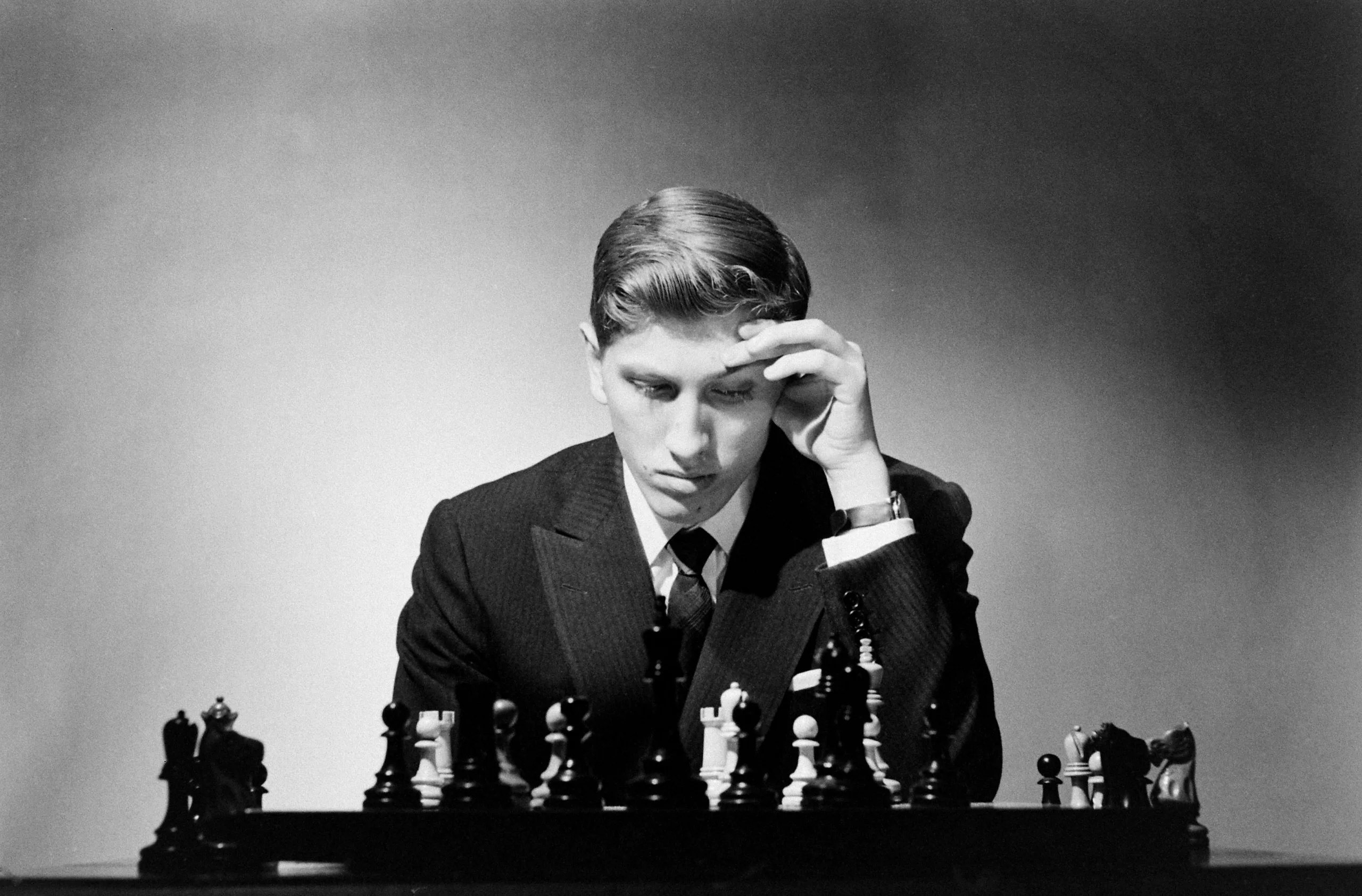
Bobby Fischer
Also known as: Robert James Fischer, Bobby Fischer
Birthday
March 9, 1943
Birth Sign
Pisces
Birthplace
Chicago, Illinois
Age
Died at 64
Height
6 ft 2 in (188 cm)
About
Bobby Fischer was an American chess grandmaster and the eleventh World Chess Champion. A child prodigy, he won his first US Championship at 14, a record he still holds, and went on to win eight US titles total. In 1964 he achieved the only perfect 11-0 score in the tournament's history. Fischer's path to the world championship in 1972 was dominant: he swept both Mark Taimanov and Bent Larsen by 6-0 scores, then defeated former champion Tigran Petrosian. In the final, he faced Boris Spassky of the Soviet Union in Reykjavik, Iceland. The match drew unprecedented global attention as a Cold War confrontation. Fischer won, becoming a national hero and a symbol of American intellectual prowess.
But Fischer's brilliance was matched by his volatility. In 1975, he refused to defend his title after failing to agree on match conditions with FIDE, and Anatoly Karpov was declared champion by default. Fischer vanished from public life, reemerging in 1992 for an unofficial rematch against Spassky in Yugoslavia, which was under a UN embargo. The US issued an arrest warrant, and Fischer became a fugitive. In 2004, Japanese authorities detained him for using a revoked US passport. He was granted Icelandic citizenship through a special act of parliament and lived in Iceland until his death on January 17, 2008, at age 64.
Fischer's legacy in chess is immense. His book My 60 Memorable Games is a classic. He patented a digital chess clock now standard in top tournaments. He also invented Fischer Random Chess (Chess960), which randomizes starting positions to reduce reliance on memorized openings. Yet his later years were marred by virulent antisemitism and Holocaust denial, despite his own Jewish ancestry. Fischer remains one of the most fascinating and tragic figures in the history of games.
Early Life & Background
Fischer grew up in Brooklyn, New York, in a series of small apartments. His mother, Regina, worked multiple jobs to support him and his older sister Joan. At age six, Joan bought a chess set and taught him the rules from the instruction booklet. By seven, he was playing at the Brooklyn Chess Club and the Manhattan Chess Club. He absorbed chess books voraciously, memorizing thousands of master games. At 12, he joined the Manhattan Chess Club and began competing in adult tournaments.
The turning point came in 1956, when 13-year-old Fischer played what became known as the Game of the Century against Donald Byrne at the Rosenwald Memorial Tournament in New York. He sacrificed his queen and checkmated Byrne in a stunning display of tactical brilliance. The game was published in chess magazines worldwide and established him as a prodigy. He dropped out of Erasmus Hall High School at 16 to devote himself entirely to chess.
Career Growth
In 1957, at 14, Fischer won the U.S. Open Championship and his first U.S. Championship title, still the youngest winner. The next year, he became the youngest International Grandmaster in history at 15, a record that stood for 33 years. He dominated the U.S. Championship, winning it eight times. In 1964, he achieved the only perfect 11-0 score in the tournament's history.
Fischer's peak came in 1971-1972. He swept the Candidates matches with 6-0 scores against Mark Taimanov and Bent Larsen, then defeated former world champion Tigran Petrosian 6.5-2.5. In 1972, he beat Boris Spassky 12.5-8.5 in Reykjavik to become World Champion. The match was front-page news worldwide. After refusing to defend his title in 1975, Fischer disappeared for two decades. He resurfaced in 1992 for an unofficial rematch against Spassky in Yugoslavia, winning 17.5-12.5 and earning $3.35 million despite a US arrest warrant for violating UN sanctions.
Career Timeline
Public Image & Style
Fischer was known for his intense concentration during games, often staring at opponents without blinking. In his championship years, he dressed in tailored suits; later he adopted a casual, unkempt look during his reclusive period. The media portrays him as a tragic genius: brilliant yet deeply flawed, a Cold War hero who descended into mental decline and antisemitic conspiracy theories. Chess enthusiasts revere him as one of the greatest players ever. His games are studied worldwide, and the 1972 championship is reenacted at chess festivals. Fan accounts focus on his chess achievements, rarely discussing his controversial views.
Fame & Fandom (iFAMOUS Rankings)
Bobby Fischer, the enigmatic chess genius who toppled the Soviet chess empire in 1972, holds a unique place in global fame. According to iFANN's Global Fame Engine, as of August 2026, Fischer is evaluated but does not currently hold a placement in the published rankings, neither in the Global Top 1,000 nor in any Top-100 scope list. This absence from the rankings reflects his reclusive later years and the niche, albeit passionate, nature of his enduring appeal. Yet his cultural footprint remains immense: the 1972 World Championship match against Boris Spassky was a Cold War spectacle that captivated audiences worldwide, turning chess into a mainstream phenomenon overnight. Fischer's face on the cover of Time and front-page headlines made him a household name, a status that persists in chess lore and beyond.
Fischer's fanbase, however, is not a formally organized fandom. There is no official fan club, no designated name, and no coordinated fan campaigns, no billboards, no charity drives, no streaming pushes. Instead, his admirers are chess enthusiasts, historians, and devotees of his genius who revere him through the study of his games. His 1958 book 'Bobby Fischer's Games of Chess' and the later 'My 60 Memorable Games' remain canonical texts, studied obsessively by players worldwide. The Fischer Random chess variant he invented continues to be played and promoted. Commemorative pilgrimages to Icelandic sites, the Reykjavik Open, held annually, and his grave in Selfoss, serve as quiet tributes. Fischer's relationship with his fans was famously difficult, often adversarial, yet his legacy as the man who broke the Soviet chess hegemony ensures his lasting reverence in the chess world.
Interesting Facts and Legends
Bobby Fischer's life was filled with remarkable facts and enduring legends. His biological father was Hungarian physicist Paul Nemenyi, not Hans-Gerhardt Fischer, and his mother was investigated by the FBI for communist sympathies. Fischer possessed a photographic memory for chess positions and could play up to 50 games simultaneously blindfolded. His IQ was reportedly tested at 187, though never confirmed. He refused to play in the 1967 U.S. Championship because it fell on a Sunday, conflicting with his religious beliefs as a follower of the Worldwide Church of God. His last words were reportedly 'Nothing is as healing as the human touch' to his wife Miyoko Watai, and he was buried in a secret location in Iceland to prevent grave vandalism.
Among the legends that surround Fischer, the 'Game of the Century' stands out: at just 13, he sacrificed his queen against Donald Byrne in 1956, a game still celebrated as a masterpiece. His demands for tournament conditions, known as 'Fischer rules,' became legendary, including his complaint about a camera shutter noise. The 1972 World Championship match was nearly derailed when Fischer demanded a higher purse and initially failed to show up, only to lose the first game and forfeit the second before staging a historic comeback. His 1975 forfeiture of the title over FIDE's refusal to meet his demands remains a controversial tale. A charming story involves Swiss amateur Dieter Keller, who defeated the teenage Fischer in 1959, a David-versus-Goliath upset fans still retell.
Notable Quotes
“I like the moment when I break a man's ego.”
“Chess is life.”
“All I want to do, ever, is just play chess.”
“I don't believe in psychology. I believe in good moves.”
“The only thing that matters is the truth. The truth is what I say.”
“I'm not a genius. I'm just a fighter.”
Family & Personal Life
Fischer's mother, Regina Wender Fischer, was a Swiss-born American of Polish-Jewish descent. His biological father was Paul Nemenyi, a Hungarian mathematician and physicist who worked on the Manhattan Project. Hans-Gerhardt Fischer, a German biophysicist, was listed on his birth certificate. Fischer's parents separated when he was two, and he was raised by his mother. He had one older sister, Joan, who taught him chess. Fischer never had children. He married Miyoko Watai in 2004 while detained in Japan; she was with him when he died. He owned no real estate and lived in rented apartments.
Notable Connections
Fischer was associated with Boris Spassky, his 1972 opponent and later friend; Mark Taimanov and Bent Larsen, whom he swept in the 1971 Candidates; Tigran Petrosian, the former champion he defeated to become challenger; and Anatoly Karpov, who became champion by default in 1975. He was also linked to Paul Nemenyi, his biological father, and Miyoko Watai, his wife.
Relationships & Dating History
Fischer's dating history is limited and enigmatic. In the 1970s, he had a brief relationship with Hungarian chess player Zita Rajcsanyi, whom he met during the 1972 World Championship match. During the 1980s, he lived with German woman Petra Stadler in Los Angeles for several years; the relationship ended in the 1990s. In the 1990s, he reportedly had a relationship with a Japanese woman named Saori. Around 2000, Fischer became close with Miyoko Watai, president of the Japanese Chess Association. They married in 2004 while Fischer was detained in Japan, though the marriage was not legally recognized in some jurisdictions. Watai was with Fischer when he died in 2008 and became his sole heir. He had no known children.
- DatedZita Rajcsanyi1972 - 1972Brief relationship during the 1972 World Championship match in Reykjavik.
- DatedPetra Stadler1980 - 1990German woman; they lived together in Los Angeles for several years.
- DatedSaori1990 - 1990Japanese woman; very little is known about this relationship.
- MarriedMiyoko Watai2004 - 2008President of Japanese Chess Association; married while Fischer was detained in Japan; she was with him at his death.
Death & Aftermath
Died
January 17, 2008 (aged 64)
Death Place
Reykjavík, Capital Region, Iceland
Cause of Death
Heart failure
The International Chess Federation and the United States Chess Federation released immediate statements honoring Bobby Fischer as a genius who revolutionized the game, while peers like Garry Kasparov and Anatoly Karpov paid tribute to his unparalleled skill. In the days following his passing, chess databases saw increased traffic and sales of his books rose as clubs worldwide held moments of silence. The documentary Bobby Fischer Against the World arrived in 2011 to provide a comprehensive look at his life and decline, and various foundations including the Bobby Fischer Foundation were created to promote chess education. Fischer passed away on January 17, 2008, in his sleep at the Hotel Reykjavik in Reykjavík, Iceland, where he had been living under house arrest since fleeing Japan in 2005.
He spent his final days in relative isolation without appearing publicly since arriving in Iceland the previous July. Icelandic police and medical examiners ruled the cause as natural causes, specifically heart failure. A private funeral took place in Los Angeles, California, on January 24, 2008, attended by close friends and his sister Joan Kirch Fischer. Details regarding the burial remain private, though reports indicate he was cremated and his ashes scattered with the exact location unknown. His estate was handled privately by family members without public probate proceedings, and the U.S. government lifted the travel ban shortly after his death.
Net Worth (Estate Value)
$2 Million
iFANN Editorial Team estimate
At the time of his death in 2008, Bobby Fischer's estate was valued at around $2 million, according to iFANN's editorial analysis. The bulk of this wealth came from the $3.35 million prize from the 1992 rematch against Spassky, though most of that was reportedly hidden in foreign accounts. He also earned royalties from his book My 60 Memorable Games, which has been continuously in print since 1969, and from his patented chess clock. Fischer owned no real estate and lived in rented apartments. After his death, his wife Miyoko Watai inherited the estate. Posthumous revenue sources include book royalties, documentary licensing (such as the 2011 film Bobby Fischer Against the World), and licensing of Fischer Random Chess. Legal disputes over the estate have consumed some assets. As of 2026, the estate is estimated at roughly $500,000 to $800,000, as royalties have declined.
Awards Won (27)
Fischer won the World Chess Championship in 1972, defeating Boris Spassky. He won the U.S. Chess Championship a record eight times, including a perfect 11-0 score in 1964. He won the U.S. Open Championship five times (1957-1960, 1963). He won the Candidates Tournament in 1971 and the Interzonal Tournament in 1970. Fischer received the Chess Oscar in 1970, 1971, and 1972. He was inducted into the U.S. Chess Hall of Fame in 1986 and the World Chess Hall of Fame in 2001.
1972 · Player of the Year
World Championship victory
1971 · Player of the Year
Candidates matches
1970 · Player of the Year
Interzonal and Candidates
1957
Dan Jacobo Beninson
Known For
World Chess Championship 1972
1972 · Challenger/Champion
My 60 Memorable Games
1969 · Author
Fischer Random Chess (Chess960)
1996 · Inventor
Fischer Chess Clock
1990 · Inventor
Keywords
Quick Facts
- Profession
- chess player, writer, inventor
- Born
- +1943-03-09
- Birthplace
- Chicago
- Died
- +2008-01-17
- Death Place
- Reykjavík
- Gender
- Male
- Spouse
- Miyoko Watai
- Birth Sign
- Pisces
Personal Details
- Full Name
- Robert James Fischer
- Height
- 6 ft 2 in (188 cm)
- Spouse
- Miyoko Watai
- Education
- Erasmus Hall High School (dropped out at age 16)
Frequently Asked Questions
How old was Bobby Fischer when he died?
What is Bobby Fischer's net worth in 2026?
Is Bobby Fischer still alive?
Why is Bobby Fischer famous?
What is Bobby Fischer best known for?
Similar People
Join the community
fans discussing