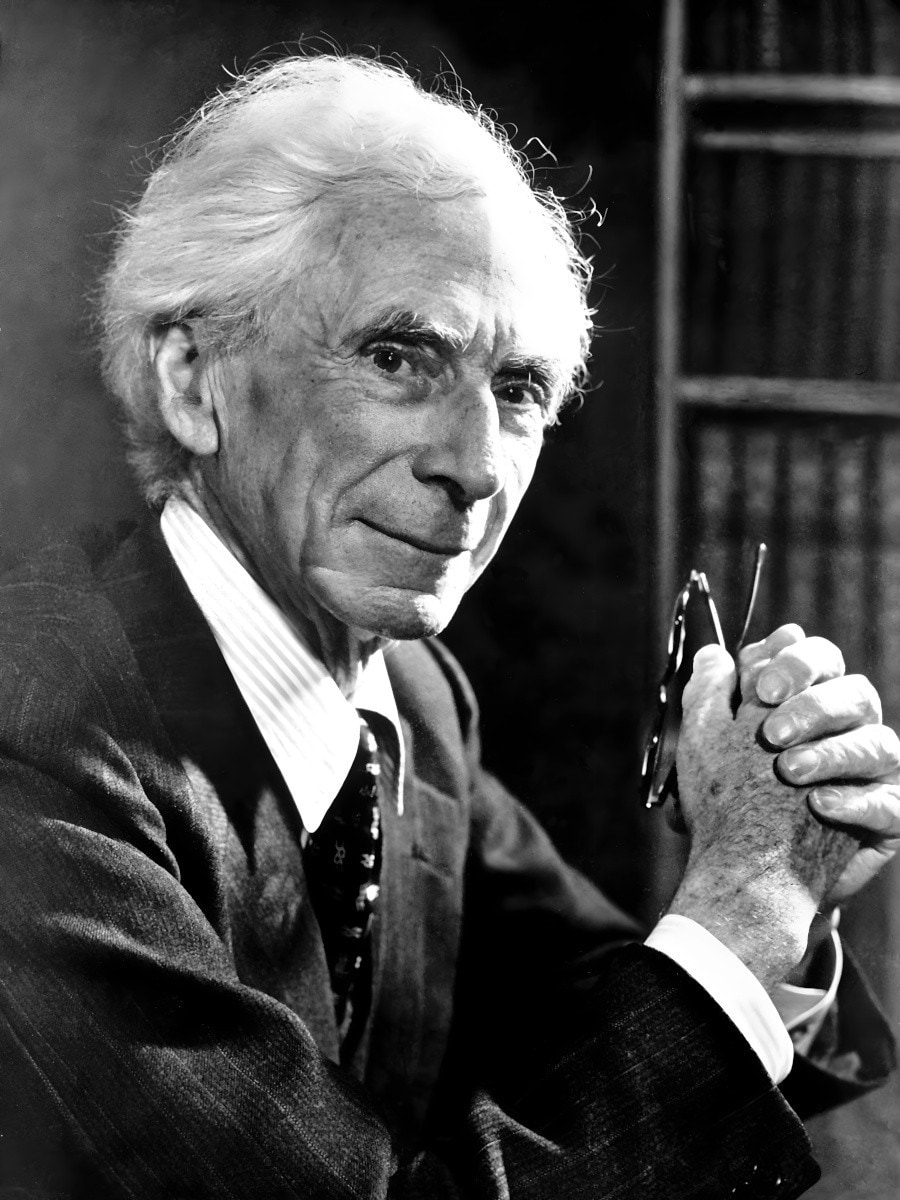
Bertrand Russell
 United Kingdom
philosopher•logician•mathematician•social critic
Also known as: Bertrand Arthur William Russell, Earl Russell
Birthday
May 18, 1872
Birth Sign
Taurus
Birthplace
Trellech, Monmouthshire, Wales
Age
Died at 97
Height
6 ft 0 in (183 cm)
About
Bertrand Russell was a British philosopher, logician, and social reformer who reshaped 20th-century thought. He co-founded analytic philosophy alongside G. E. Moore and, with Alfred North Whitehead, produced Principia Mathematica, a landmark attempt to derive mathematics from logic. His essay "On Denoting" remains a cornerstone of philosophical logic. Russell won the 1950 Nobel Prize in Literature for his humanitarian writings, which include dozens of books on philosophy, politics, and ethics.
Beyond academia, Russell was a tireless activist. He was imprisoned twice for his pacifist and anti-nuclear protests, co-authored the Russell-Einstein Manifesto in 1955, and founded the Pugwash Conferences. His sharp wit and clarity made him a beloved public intellectual, while his atheism and unconventional personal life kept him controversial. Today, his legacy endures through the Bertrand Russell Peace Foundation and a vast body of work that continues to be read widely.
Early Life & Background
Russell was born on May 18, 1872, in Trellech, Wales, into an aristocratic family. His grandfather, Lord John Russell, had served as Prime Minister. His parents, Viscount Amberley and Kate Stanley, were radical freethinkers who advocated for birth control, a highly controversial stance at the time. Both died before Russell turned four: his mother in 1874, his father in 1876. He and his older brother Frank were then raised by their strict, religious grandmother, Lady Russell, at Pembroke Lodge in Richmond Park, London.
His childhood was isolated and intellectually rigorous. Educated by private tutors, he developed an early passion for mathematics and philosophy. At age 11, discovering Euclid's geometry struck him as one of the great events of his life. At 17, he fell in love with American Quaker Alys Pearsall Smith, whom he would later marry. He studied at Trinity College, Cambridge from 1890, graduating with first-class honors in mathematics in 1893 and later in moral sciences. At Cambridge, he joined the secret Apostles society and formed lifelong friendships with G. E. Moore and Alfred North Whitehead. A pivotal moment came in 1900 when he attended the International Congress of Philosophy in Paris and met Italian logician Giuseppe Peano, whose work inspired his own logical investigations, directly leading to the collaboration with Whitehead on Principia Mathematica.
Career Growth
Russell's career took off with the 1903 publication of The Principles of Mathematics, establishing him as a leading philosopher of mathematics. From 1910 to 1913, he co-authored the three-volume Principia Mathematica with Whitehead, a monumental work that remains one of the most important texts in 20th-century logic. In 1905, he published "On Denoting," an essay widely considered a masterpiece of analytic philosophy. During World War I, his anti-war activism led to six months in Brixton Prison in 1918, where he wrote Introduction to Mathematical Philosophy. In the 1920s, he visited Soviet Russia and China, met Lenin, and became disillusioned with Bolshevism, writing The Practice and Theory of Bolshevism. In 1927, he founded the experimental Beacon Hill School with his second wife Dora Russell. After teaching at the University of Chicago and UCLA in the late 1930s, he returned to Trinity College in 1944. In 1948, he delivered the first BBC Reith Lectures, becoming a major public intellectual. The Nobel Prize in Literature followed in 1950. In 1955, with Albert Einstein, he released the Russell-Einstein Manifesto, and in 1957 organized the first Pugwash Conference. At age 89, he was imprisoned for a week for participating in a nuclear disarmament protest.
Career Timeline
Public Image & Style
Russell was known for his sharp, sardonic wit, piercing intellect, and distinctive appearance: tall, lean, with a prominent nose and a shock of white hair in old age. He typically wore formal suits and later a beret. The media portrayed him as both a revered intellectual giant and a controversial provocateur. His anti-war activism made him a polarizing figure, but in later years he was celebrated as a moral conscience of the nuclear age. His writing style was clear, witty, and accessible, allowing him to write both dense technical philosophy and popular essays. Followers are often called Russellians, and the Bertrand Russell Society, founded in 1974, holds annual conferences and reading groups. His birthday, May 18, is celebrated by some fans.
Fame & Fandom (iFAMOUS Rankings)
Bertrand Russell never courted a crowd in the way modern stars do, yet his intellectual gravity draws a steady stream of admirers who treat his texts as sacred texts. His followers are not a mob with signs or a tribe with a single name; they are students of philosophy, scholars of analytic thought, and readers who return to his essays on war and ethics decades after publication. There is no official fan club, no viral hashtag campaign, and no organized drive to turn his birthday into a global billboard event. The closest this community comes to ritual is the annual re-evaluation of his work, from the unveiling of blue plaques in Cambridge to the recent announcement of a biopic that treats his life as a serious historical drama rather than a celebrity spectacle. While he lacked the performative legends of pop culture icons, Russell's legacy is built on verified milestones: winning the Nobel Prize for Literature, facing imprisonment twice for pacifism, and engaging in fierce legal battles over free speech at City College of New York. These moments are retold not as folklore but as foundational chapters in the history of human rights and logic. Even today, his advice on aging remains a staple in media guides, proving his relevance transcends the fleeting nature of fame. Despite his death in 1970, his presence in global consciousness remains robust, tracked by systems that monitor cultural output across centuries. According to the iFANN Global Fame Rankings, Bertrand Russell is currently the 58th most famous person in Books & Literature, holding steady from the previous cycle.
Interesting Facts and Legends
Russell was a vegetarian for much of his life, though not dogmatically so. He wrote a novel titled Satan in the Suburbs (1953) and several short stories. He ran for Parliament as a Labour candidate in 1907 and 1922, losing both times. An early advocate for homosexual rights, he co-signed a 1958 letter calling for decriminalization. His godfather was philosopher John Stuart Mill. At 89, he became the oldest person ever imprisoned in the UK. He was an atheist from his teenage years onward, though he respected religious moral teachings. A prolific letter writer, he left behind an estimated 40,000 surviving letters. Beyond these facts, Russell's life included dramatic legal battles that defined his public image. In 1940, he was famously denied a teaching position at City College of New York due to his views on marriage and religion, a cancellation that sparked a major free speech debate. He also won the Nobel Prize in Literature in 1950, becoming the first British writer to receive the award for his humanitarian writings. Another legendary moment occurred in 1961 when he was arrested at age 89 during a nuclear disarmament protest, cementing his status as the moral conscience of the nuclear age.
Notable Quotes
“The whole problem with the world is that fools and fanatics are always so certain of themselves, and wiser people so full of doubts.”
“War does not determine who is right—only who is left.”
“Three passions, simple but overwhelmingly strong, have governed my life: the longing for love, the search for knowledge, and unbearable pity for the suffering of mankind.”
“I would never die for my beliefs because I might be wrong.”
“The good life is one inspired by love and guided by knowledge.”
“To fear love is to fear life, and those who fear life are already three parts dead.”
Family & Personal Life
Russell's parents, Viscount Amberley and Kate Stanley, were radical freethinkers who died before he turned four. He and his brother Frank were raised by their grandmother, Lady Russell, a strict religious woman. Russell married four times and had three children: John Conrad Russell (born 1921) and Katharine Jane Tait (born 1923) with his second wife Dora Black, and Conrad Sebastian Robert Russell (born 1937) with his third wife Patricia Spence. His fourth wife, Edith Finch, remained with him until his death. The Russell family line continues through his descendants, including the Earl Russell title.
Notable Connections
Russell's most famous collaborator was Alfred North Whitehead, with whom he co-authored Principia Mathematica. He mentored Ludwig Wittgenstein at Cambridge, though they later diverged philosophically. He corresponded with Albert Einstein for decades, leading to the Russell-Einstein Manifesto. He was a friend and correspondent of Joseph Conrad, T. S. Eliot, and George Bernard Shaw. His fellow philosopher G. E. Moore was a lifelong friend and co-founder of analytic philosophy.
Relationships & Dating History
Russell married four times. His first marriage was to Alys Pearsall Smith in 1894; they separated in 1911 and divorced in 1921. While still married, he had a passionate affair with Lady Ottoline Morrell from 1911 to 1916. In 1921, he married Dora Black, with whom he had two children, John and Katharine, and co-founded Beacon Hill School. That marriage ended in divorce in 1935. He married Patricia Spence in 1936, and they had one son, Conrad, before divorcing in 1952. His fourth and final marriage was to Edith Finch in 1952, which lasted until his death in 1970. As of 2026, Russell is deceased, his final marital status being married to Edith Finch.
- MarriedAlys Pearsall Smith1894 - 1921American Quaker; Russell fell in love at age 17; they separated in 1911 and divorced in 1921; no children.
- DatedLady Ottoline Morrell1911 - 1916Extramarital affair with the aristocratic Bloomsbury hostess; contributed to the end of his first marriage.
- MarriedDora Black1921 - 1935British author and activist; co-founded Beacon Hill School; had two children, John and Katharine.
- MarriedPatricia Spence1936 - 1952British author; former governess's daughter; had one son, Conrad.
- MarriedEdith Finch1952 - 1970American professor of English; remained together until Russell's death; his only marriage ended by death.
Death & Aftermath
Died
February 2, 1970 (aged 97)
Death Place
Penrhyndeudraeth, Merionethshire, Wales
Cause of Death
Reported as a relapse from severe flu and respiratory infection
At his home in Penrhyndeudraeth, Wales, Bertrand Russell spent his final days in poor health but remained lucid until shortly before his death. He passed away on February 2, 1970, at the age of 97, following a relapse from a severe flu and recurring respiratory infection that had plagued him since January. The official cause was reported as a natural decline consistent with his advanced age. Tributes poured in from across the intellectual world, including a statement from British Prime Minister Edward Heath honoring Russell's lifelong contributions to philosophy and peace activism.
Major newspapers like The New York Times and The Guardian published extensive obituaries marking the end of an era for 20th-century thought. A private funeral service took place four days later at St. Mary Magdalene Church, attended by family members and close colleagues who heard readings from his humanist works before his ashes were scattered at sea off the Welsh coast. The Bertrand Russell Peace Foundation assumed management of his literary rights and assets, ensuring his philanthropic initiatives continued. His writings remain widely studied.
Net Worth (Estate Value)
$15 Million
iFANN Editorial Team estimate
As Russell died in 1970, his estate continues to generate income primarily through book royalties. His literary output of over 70 books, including the enduringly popular A History of Western Philosophy, earns an estimated $200,000 to $500,000 annually. The estate is managed by the Bertrand Russell Peace Foundation and his descendants. Per iFANN's editorial analysis, as of 2026, the total estate value is approximately $15 Million, based on accumulated royalties, licensing of his name and image, and archival materials. The Bertrand Russell Society also contributes to the preservation of his legacy.
Awards Won (5)
Russell won the Nobel Prize in Literature in 1950 for his humanitarian writings. He received the De Morgan Medal from the London Mathematical Society in 1932, the Sylvester Medal from the Royal Society in 1934, the UNESCO Kalinga Prize for popularization of science in 1957, and the Jerusalem Prize for human freedom in 1963.
1950 · Literature
Varied writings
1932 · Mathematics
Contributions to mathematics
Known For
Principia Mathematica
1910 · Co-author
On Denoting
1905 · Author
A History of Western Philosophy
1945 · Author
Why I Am Not a Christian
1927 · Author
Keywords
Quick Facts
- Profession
- philosopher, logician, mathematician, social critic
- Born
- May 18, 1872
- Birthplace
- Trellech, Monmouthshire, Wales
- Died
- February 2, 1970
- Death Place
- Plas Penrhyn, Penrhyndeudraeth, Wales
- Gender
- Male
- Spouse
- Alys Pearsall Smith, Dora Black, Patricia Spence, Edith Finch
- Birth Sign
- Taurus
- Height
- 6 ft 0 in (183 cm)
- Education
- Trinity College, Cambridge
- Children
- 3
- Awards
- Nobel Prize in Literature (1950), De Morgan Medal (1932), Sylvester Medal (1934), Kalinga Prize (1957), Jerusalem Prize (1963)
Personal Details
- Full Name
- Bertrand Arthur William Russell
- Height
- 6 ft 0 in (183 cm)
- Spouse
- Alys Pearsall Smith, Dora Black, Patricia Spence, Edith Finch
- Children
- John Conrad Russell, Katharine Jane Tait, Conrad Sebastian Robert Russell
- Education
- Trinity College, Cambridge (BA 1893, Fellow 1895)
Frequently Asked Questions
What is Bertrand Russell known for?
Was Bertrand Russell religious?
How many times was Bertrand Russell married?
What is Bertrand Russell's most famous book?
How old was Bertrand Russell when he died?
Similar People
Join the community
fans discussing