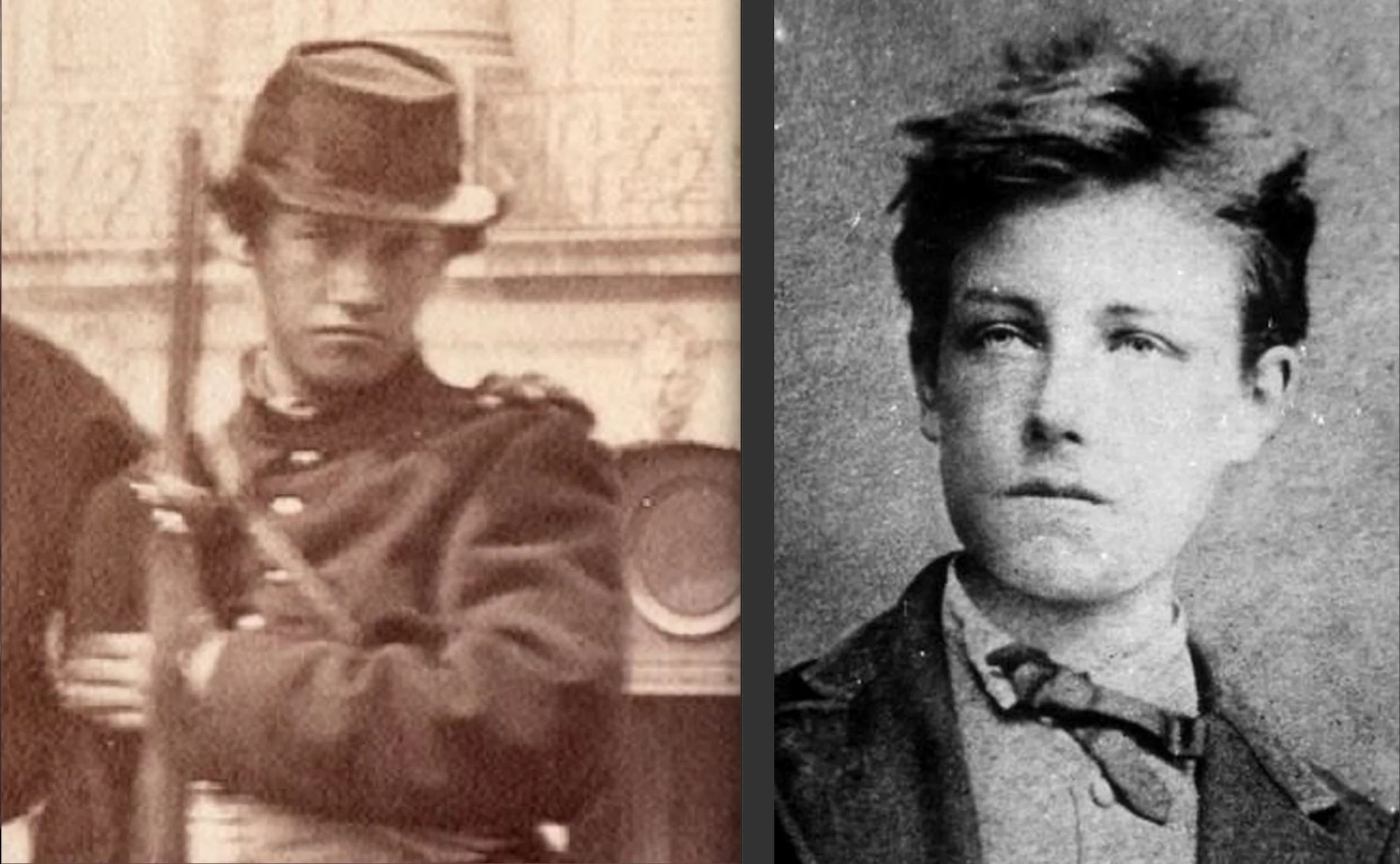
Arthur Rimbaud
 France
poet•arms trader•world traveler
Also known as: Jean Nicolas Arthur Rimbaud
Birthday
October 20, 1854
Birth Sign
Libra
Birthplace
Charleville, Ardennes, France
Age
Died at 37
Height
5 ft 6 in (168 cm)
About
Jean Nicolas Arthur Rimbaud was a French poet and adventurer whose brief, explosive literary career in the late nineteenth century transformed modern poetry. He is best known for works like A Season in Hell and Illuminations, which broke with tradition and anticipated Surrealism. Rimbaud stopped writing at twenty and spent his later years as a trader and explorer in East Africa, a life that has become as legendary as his verse.
His reputation as the ultimate enfant terrible of letters endures. Scholars and artists still debate his radical ideas about language and vision, and his influence reaches far beyond poetry into art, music, and film. As of 2026, his work continues to be studied worldwide, and his life story remains a touchstone for anyone drawn to rebellion and reinvention.
Early Life & Background
Arthur Rimbaud was born in Charleville, a small town in northeastern France, on October 20, 1854. His father, Frédéric Rimbaud, an army captain, left the family when Arthur was six, leaving his mother, Vitalie Cuillère, to raise him and his sister Isabelle in a strict, religious household. Rimbaud was a prodigy: by twelve, he had mastered Latin and Greek and was composing verses that amazed his teachers at the Collège de Charleville.
But he chafed against provincial life and authority. When the Franco-Prussian War broke out in 1870, he ran away from home twice, wandering to Paris and even being briefly imprisoned for vagrancy. In 1871, at sixteen, he made his final escape, walking and hitching rides to the capital. He carried only a few francs and a bundle of poems, determined to meet the established poets he admired. That journey would change his life and the course of French literature.
Career Growth
In Paris, Rimbaud met Paul Verlaine in 1871, and their intense, volatile relationship fueled a burst of creativity. Rimbaud wrote Le Bateau ivre (The Drunken Boat) in 1871, a visionary poem that astonished Verlaine and other Symbolists. He followed with Voyelles, assigning colors to vowels, and the prose poems of Illuminations.
In 1873, after the violent breakup with Verlaine, he completed A Season in Hell, a searing account of his spiritual crisis. He gave up poetry at twenty, never to return. From 1880 to 1891, he lived in Aden and Harar, trading coffee, ivory, and firearms. His involvement in the arms trade remains controversial, but his transformation from poet to merchant has become part of his myth.
Career Timeline
Public Image & Style
Rimbaud is the archetype of the rebel poet: young, brilliant, and defiant. His image is that of a visionary who burned through language and then walked away. Media portrayals emphasize his bohemian style in Paris, his intense gaze, and his later life as a hardened trader in Africa.
His aesthetic is tied to the surreal and the transgressive. He is often invoked in fashion editorials and art projects, like David Wojnarowicz's photo series Arthur Rimbaud in New York, which placed him in contemporary queer contexts. Rimbaud's persona remains a symbol of the outsider artist.
Fame & Fandom (iFAMOUS Rankings)
Rimbaud's fandom is not the organized kind with names and billboards; it is a devoted, intellectual community of scholars, poets, and artists. They gather in reading groups and academic conferences, exploring his radical ideas. There is no formal fandom name, but admirers often call themselves simply lovers of his work.
In the September 2026 iFANN Global Fame Rankings, Rimbaud holds strong placements: he is the 36th most famous person in France, the 91st most famous person from France, and the 53rd most famous person in Art & Design. These rankings reflect his enduring presence in global cultural consciousness, more than a century after his death.
His legacy inspires high-art tributes rather than fan campaigns. Recent projects like the biopic A. Rimbaud and the musical Take Rimbaud keep his story alive, while his influence on queer and outsider art continues to resonate.
Interesting Facts and Legends
Rimbaud spoke French, Latin, Greek, Italian, and English fluently, and learned Arabic and Amharic in Africa. His famous proclamation "Je est un autre" ("I is an other") from a letter to Paul Demeny in 1871 became a rallying cry for modernist writers.
A story fans still retell: when Rimbaud shot Verlaine in the hand in Brussels in 1873, it ended their relationship and sent Verlaine to prison. Rimbaud then burned many of his manuscripts, but friends saved copies. Another legend says he sold his last poems to a printer for a few francs before leaving for Africa.
His height is often given as 5'6", and he was known for his intense gaze and unconventional dress. He also had a scar on his hand from a knife fight with a soldier in 1872.
Notable Quotes
“Je est un autre. (I is an other.)”
“A poet makes himself a visionary through a long, boundless, and systematized disorganization of all the senses.”
“I invented the color of vowels! I assigned form and movement to each consonant.”
Family & Personal Life
Rimbaud's father, Frédéric, a captain in the Imperial Guard, deserted the family when Arthur was six. His mother, Vitalie Cuillère, was strict and devout, shaping his early years. He had a younger sister, Isabelle, who later cared for him during his final illness and managed his literary estate after his death.
Rimbaud never married and had no children. In his African years, he lived alone, though he kept a house in Harar. His relationship with his mother remained strained; she disapproved of his writing and his travels.
Notable Connections
Rimbaud's life is inseparable from Paul Verlaine, his lover and fellow poet, whose work he influenced profoundly. He also corresponded with the Symbolist poet Stéphane Mallarmé, who admired his boldness. His sister Isabelle preserved his manuscripts and shaped his posthumous reputation. The photographer David Wojnarowicz and the musician Patti Smith have both drawn on Rimbaud's image in their art.
Relationships & Dating History
Rimbaud's romantic life centered almost entirely on his relationship with Paul Verlaine. They met in Paris in 1871, when Rimbaud was just sixteen and Verlaine twenty-seven. Their affair was passionate and chaotic, involving travel to London and Belgium, and it fueled both poets' work. The relationship ended violently on July 10, 1873, when Rimbaud shot Verlaine in the hand during a quarrel in Brussels. Verlaine was arrested and served two years in prison.
After that breakup, Rimbaud never entered another documented romantic relationship. He spent his remaining years traveling and trading in Africa, largely solitary. At the time of his death in 1891, he was single, with no spouse or children.
- DatedPaul Verlaine1871 - 1873Tumultuous relationship that ended when Rimbaud shot Verlaine in the hand in Brussels.
Death & Aftermath
Died
November 10, 1891 (aged 37)
Death Place
Marseille, Bouches-du-Rhône, France
Cause of Death
Osteosarcoma of the right knee
Rimbaud died on November 10, 1891, at the Hôtel-Dieu hospital in Marseille, after a long struggle with osteosarcoma. He had first noticed a lump in his right knee in 1876 during his travels in Ethiopia; the cancer festered for fifteen years before doctors amputated his leg below the knee on August 23, 1891. The disease had already spread to his abdomen and chest, and he spent his final weeks in pain, cared for by his mother Vitalie Cuillère and his sister Isabelle.
Public reaction to his death was muted among the general public, but literary circles mourned deeply. Paul Verlaine wrote the poem Les Adieux in his memory, reflecting on their turbulent bond. A private funeral took place on November 12, 1891, at the Cimetière Saint-Pierre in Marseille. In 1954, his remains were exhumed and transferred to Charleville-Mézières to rest alongside his parents.
His works, including A Season in Hell and Illuminations, became foundational texts for modern literature. The Prix Arthur-Rimbaud scholarship was established in his honor, and his sister Isabelle preserved his manuscripts, many of which now reside in the Bibliothèque de Charleville. His legacy continues to inspire films, art, and scholarship, including the 2026 biopic A. Rimbaud and David Wojnarowicz's photo series Arthur Rimbaud in New York.
Net Worth (Estate Value)
$1 Million
iFANN Editorial Team estimate
Arthur Rimbaud died in 1891, so he has no personal net worth. His estate, however, continues to earn from royalties on his published works, which are still in print worldwide. His sister Isabelle managed the estate after his death, and today his works are handled by French literary publishers like Éditions Gallimard.
Revenue comes from book sales, translations, and adaptations, including the 2026 biopic A. Rimbaud. The iFANN Editorial Team estimates the value of his literary estate at approximately $1 million, based on ongoing royalty streams and the cultural value of his manuscripts. This figure reflects the estate's income potential rather than a traditional celebrity net worth.
Awards & Accolades
View 5 records, honours and achievementsKnown For
A Season in Hell
1873 · Author
Illuminations
1874 · Author
Le Bateau ivre
1871 · Author
Keywords
Sources
Quick Facts
- Profession
- poet, arms trader, world traveler
- Born
- October 20, 1854
- Birthplace
- Charleville
- Died
- November 10, 1891
- Death Place
- Marseille
- Gender
- Male
- Birth Sign
- Libra
Personal Details
- Full Name
- Jean Nicolas Arthur Rimbaud
- Height
- 5 ft 6 in (168 cm)
- Education
- Collège de Charleville
Frequently Asked Questions
What was Arthur Rimbaud's full name?
Why did Arthur Rimbaud stop writing poetry?
Who was Arthur Rimbaud's lover?
How did Arthur Rimbaud die?
Where is Arthur Rimbaud buried?
Similar People
Join the community
fans discussing