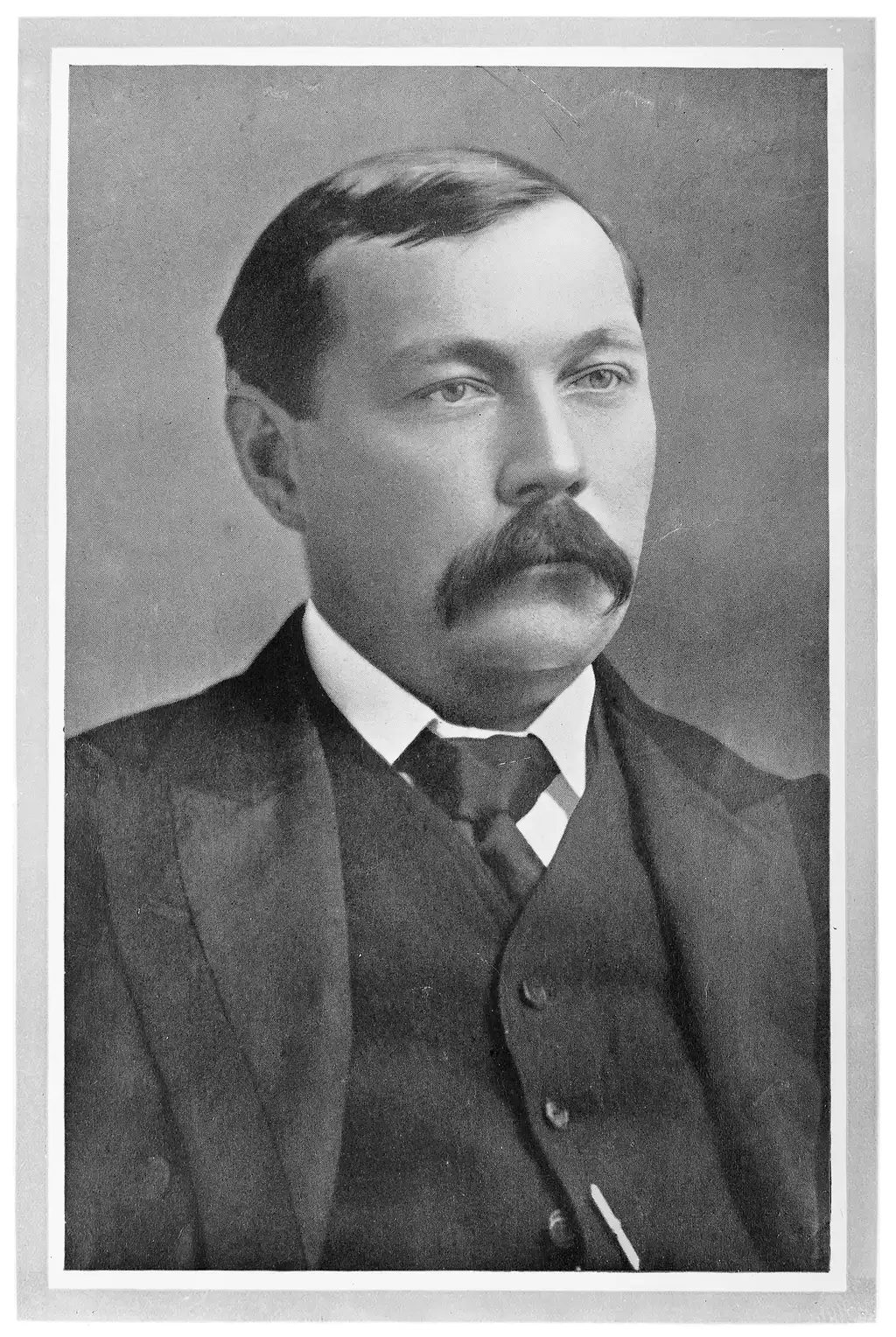
Arthur Conan Doyle
 United Kingdom
Also known as: Sir Arthur Conan Doyle
Birthday
May 22, 1859
Birth Sign
Gemini
Birthplace
Edinburgh, Scotland
Age
Died at 71
About
Sir Arthur Conan Doyle was a Scottish physician and writer who created one of the most enduring characters in literature: Sherlock Holmes. Over four decades, he wrote four novels and 56 short stories featuring the detective, making him a global icon. Doyle also authored historical novels like The White Company, the Professor Challenger series, and comic stories of Brigadier Gerard. Knighted in 1902 for his Boer War service, he was a prolific author whose works continue to be widely read and adapted, with Holmes holding the record as the most portrayed literary human in film and television history.
Doyle was a man of contradictions. He campaigned for justice, personally investigating wrongful convictions, yet later embraced spiritualism, defending the Cottingley Fairies hoax. His legacy remains inseparable from Holmes, despite his occasional ambivalence toward the character. As of 2026, the Conan Doyle Estate continues to manage his literary estate, with Sherlock Holmes inspiring new adaptations and merchandise globally.
Early Life & Background
Arthur Conan Doyle grew up in Edinburgh in a financially strained household. His father, Charles Altamont Doyle, was a civil servant and illustrator whose alcoholism led to institutionalization, leaving the family in poverty. Doyle was sent to Stonyhurst College, a Jesuit boarding school, where he developed a love for literature and cricket. He later studied medicine at the University of Edinburgh from 1876 to 1881, supporting himself through odd jobs.
During his studies, Doyle began writing short stories, publishing his first, 'The Mystery of Sasassa Valley,' in 1879. After graduating, he served as a ship's doctor on a whaling voyage to the Arctic and later on a steamer to West Africa. In 1882, he set up a medical practice in Portsmouth, but it struggled, leaving him ample time to write. His early novels, including The Firm of Girdlestone, failed to gain traction. The breakthrough came in 1887 when A Study in Scarlet introduced Sherlock Holmes and Dr. Watson, published in Beeton's Christmas Annual. The story attracted modest attention, but a second Holmes novel, The Sign of the Four, and serialization in The Strand Magazine catapulted the detective to fame.
Career Growth
Sherlock Holmes became a sensation in the 1890s through The Strand Magazine. Doyle's stories, with their logical deductions and atmospheric Victorian London, captivated readers. By 1893, he grew weary of Holmes and killed him off in 'The Final Problem,' plunging the detective over the Reichenbach Falls. Public outrage was immense; 20,000 readers cancelled subscriptions. Eight years later, Doyle resurrected Holmes in The Hound of the Baskervilles (1901), set before his death, and later brought him back fully in 'The Adventure of the Empty House' (1903).
Beyond Holmes, Doyle wrote The Lost World (1912), introducing Professor Challenger, a pioneering science fiction adventure. He also penned historical novels like The White Company (1891) and the Brigadier Gerard series. During the Boer War, he served as a field hospital doctor and wrote The War in South Africa, defending British policy, leading to his knighthood. Later, he investigated the Edalji and Slater cases, exonerating the wrongly convicted and helping establish the Court of Criminal Appeal.
Career Timeline
Public Image & Style
Arthur Conan Doyle is remembered as a gentleman of Victorian and Edwardian letters, a man of integrity and curiosity. His public persona was that of a rational physician who championed justice, yet his later embrace of spiritualism puzzled and sometimes alienated admirers. The Sherlock Holmes stories, however, overshadow all else. Doyle's image is inseparable from the deerstalker hat and meerschaum pipe of his detective, even though he rarely described Holmes wearing those items.
Modern fans celebrate Doyle as a pioneer of crime fiction and speculative fiction. The character of Holmes has become a cultural shorthand for deductive genius, and Doyle himself is often portrayed in media as a conflicted creator, wrestling with his most famous invention. The Conan Doyle Estate actively manages the literary legacy, licensing Holmes for films, TV shows, and merchandise, ensuring Doyle remains a household name more than a century after his death.
Fame & Fandom
When Arthur Conan Doyle killed off his detective in 1893, the reaction was visceral enough to be recorded as a national tragedy. Newspapers reported thousands of cancellations, and mourners wore black armbands in grief over a fictional character. That moment cemented a unique symbiosis where the author and his creation became inseparable, driving a fanbase that operates through prestigious organizations like the Baker Street Irregulars and the Sherlock Holmes Society of London. These groups maintain rigorous standards of historical accuracy while orchestrating global rituals such as leaving flowers at the statue outside Baker Street station or celebrating May 22nd as Sherlock Holmes Day with coordinated billboard campaigns in New York and London. The fandom's influence extends far beyond literature, fueling modern cultural phenomena including the massive success of the BBC's Sherlock and various charity drives. Despite this organized devotion, the collective does not possess a formal name distinct from the character itself; admirers are simply known by their dedication to the universe Doyle built. iFANN has evaluated this legacy, but the Global Fame Engine currently places him outside the published rankings for the top 1,000 most famous people globally. He holds no specific placement in any scope list at this time. This absence of a numeric rank reflects the nature of his fame: he is an icon whose presence permeates culture so deeply that standard metrics struggle to isolate him against living contemporaries. Yet his status remains undeniable, evidenced by the enduring adaptations and the sheer volume of scholarly work dedicated to his life and works.
Interesting Facts and Legends
Doyle was an avid sportsman who played cricket for the Marylebone Cricket Club and took a wicket bowling against W.G. Grace. He also served as goalkeeper for Portsmouth Association Football Club under the pseudonym A.C. Smith. Although he coined the phrase 'elementary, my dear Watson', he never wrote it in any story; the line first appeared in a 1929 film adaptation. His later years were marked by a deep embrace of spiritualism, during which he spent over £250,000 supporting causes related to fairies, telepathy, and séances. He even defended the Cottingley Fairies photographs and challenged the magician Harry Houdini to produce a genuine psychic phenomenon, leading to a public rivalry between the two men. Doyle credited his mother, Mary Foley Doyle, with inspiring the character of Mrs. Hudson. Fans still retell the legend of the 'death' of Sherlock Holmes in 1893, where the outcry was so intense that some readers wore black armbands in mourning. When Doyle resurrected the detective in 1903, it was celebrated as a literary miracle rather than a simple plot twist. The annual celebration of Sherlock Holmes Day on May 22nd has evolved into an institutionalized ritual, featuring viral moments and new app features that reinforce his timeless status.
Notable Quotes
“Once you eliminate the impossible, whatever remains, no matter how improbable, must be the truth.”
“It is a capital mistake to theorize before one has data.”
“I have never loved. I have never been loved. I have never known what it is to be loved.”
“The world is full of obvious things which nobody by any chance ever observes.”
Family & Personal Life
Doyle's father, Charles Altamont Doyle, was a civil servant and illustrator who struggled with alcoholism and was institutionalized in 1885. His mother, Mary Foley Doyle, was a well-read woman who fostered his love for literature. He had nine siblings, though several died in childhood.
Doyle married Louisa Hawkins in 1885. They had two children: Mary Louise (born 1889) and Kingsley (born 1892). Louisa suffered from tuberculosis for many years and died in 1906. In 1907, Doyle married Jean Elizabeth Leckie, with whom he had three children: Denis (born 1909), Adrian (born 1910), and Jean Lena Annette (born 1912). The family lived in Crowborough, Sussex, where Doyle kept bees and wrote.
Notable Connections
Relationships & Dating History
Doyle married Louisa Hawkins in 1885; they had two children. Louisa suffered from tuberculosis for many years, and during her illness, Doyle fell in love with Jean Elizabeth Leckie. He maintained a platonic relationship with Leckie out of respect for his wife. After Louisa died in 1906, Doyle married Leckie in 1907. They had three children and remained together until Doyle's death in 1930. At the time of his death, he was married to Jean.
- MarriedLouisa Hawkins1885 - 1906Doyle's first wife; they had two children. She died of tuberculosis in 1906.
- MarriedJean Elizabeth Leckie1907 - 1930CurrentDoyle's second wife; they had three children. She was with him at his death.
Death & Aftermath
Died
July 7, 1930 (aged 71)
Death Place
Crowborough, Sussex, England
Cause of Death
Heart failure
The family announced that Sir Arthur Conan Doyle had passed away at his residence, Windlesham, in Crowborough, Sussex. The official finding attributed the end to heart failure, a condition stemming from years of physical strain and illness rather than a sudden event or specific medical mystery. His final days were marked by declining health as he remained active in writing and spiritualist causes until shortly before his passing on July 7, 1930. Public reaction was one of widespread mourning among peers, institutions, and fans globally. Tributes appeared in major publications, marking the loss of a literary giant whose work ensured his legacy was immediately cemented in popular culture.
The funeral service took place shortly after his death at St. Peter's Churchyard in Windlesham, Surrey, where he was buried near his home. The site remains a point of interest for historians and admirers. Posthumously, his estate has been actively managed to preserve intellectual property, with descendants maintaining strict control over licensing rights. A recent victory in 2026 saw the estate defend its rights against unauthorized use of the name Dr Watson, securing control over the character's likeness.
Net Worth (Estate Value)
$20 Million
iFANN Editorial Team estimate
At the time of his death in 1930, Arthur Conan Doyle's estate was valued at approximately £400,000 (equivalent to about $20 million today, adjusted for inflation). The bulk of his wealth came from royalties from Sherlock Holmes stories, which were serialized in The Strand Magazine and later published in collections. He was one of the highest-paid authors of his era, earning up to £5,000 per story at his peak. After his death, the estate continued to generate income through book sales, film and TV adaptations, and merchandise. In 2026, the Conan Doyle Estate, managed by his descendants, licenses the Sherlock Holmes intellectual property globally. The estate appointed Big Picture Licensing in 2025 to expand brand partnerships. While exact current figures are private, research by the iFANN Editorial Team puts the estate value at around $20 Million, driven by steady royalties from adaptations and new projects, including a 2025 film titled 'The Strange Case of Sherlock Holmes & Arthur Conan Doyle.'
Awards Won (2)
Arthur Conan Doyle was knighted by King Edward VII in 1902 for his service during the Boer War, making him Sir Arthur Conan Doyle. He received no major literary awards, as the industry recognition systems of today did not exist in his era, but his works have been honored posthumously through numerous adaptations and inductions into halls of fame, including the Science Fiction and Fantasy Hall of Fame in 2004.
1902 · Service
Boer War service
2004 · Lifetime Achievement
The Lost World
Known For
Sherlock Holmes series
1887 · Creator
The Lost World
1912 · Author
The White Company
1891 · Author
Keywords
Sources
Quick Facts
- Profession
- Writer, Physician
- Born
- May 22, 1859
- Birthplace
- Edinburgh, Scotland
- Died
- July 7, 1930
- Death Place
- Crowborough, England
- Gender
- Male
- Spouse
- Louisa Hawkins, Jean Elizabeth Leckie
- Birth Sign
- Gemini
Personal Details
- Full Name
- Arthur Ignatius Conan Doyle
- Spouse
- Louisa Hawkins (1885–1906), Jean Elizabeth Leckie (1907–1930)
- Children
- Mary Louise, Kingsley, Denis, Adrian, Jean Lena Annette
- Education
- University of Edinburgh (Medicine)
Frequently Asked Questions
Who was Arthur Conan Doyle?
What was Arthur Conan Doyle's net worth in 2026?
Did Arthur Conan Doyle believe in fairies?
Why did Arthur Conan Doyle kill Sherlock Holmes?
What is Arthur Conan Doyle's most famous book?

Join the community
fans discussing