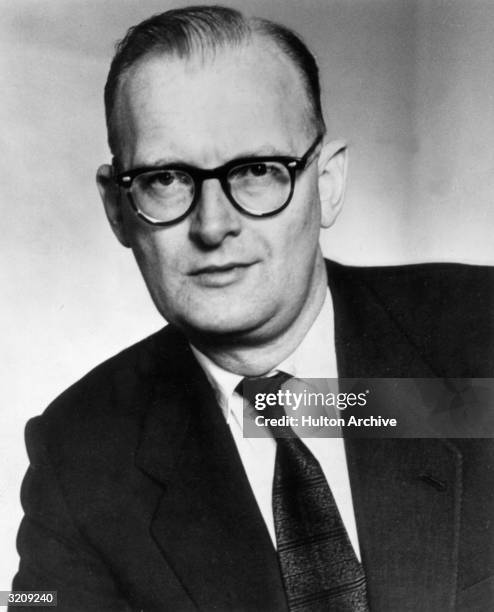
Arthur C. Clarke
 United Kingdom
science fiction writer•futurist•inventor•undersea explorer
Also known as: AC Clarke, Sir Arthur Clarke, The Prophet of the Space Age
Birthday
December 16, 1917
Birth Sign
Sagittarius
Birthplace
Minehead, Somerset, England
Age
Died at 90
Height
5 ft 10 in (178 cm)
About
Sir Arthur Charles Clarke was an English science fiction writer, futurist, inventor, undersea explorer, and television host who left an indelible mark on 20th-century culture. He is best known as the "Prophet of the Space Age" for co-writing the screenplay for 2001: A Space Odyssey and proposing the concept of geostationary communications satellites in 1945. His work bridged hard science and imaginative storytelling, earning him numerous Hugo and Nebula awards and a massive global readership.
Clarke spent the latter half of his life in Sri Lanka, where he pursued underwater archaeology and became a champion for space travel. He served as chairman of the British Interplanetary Society and received the UNESCO Kalinga Prize for popularizing science. His influence extended beyond literature into technology, with his predictions about satellite communication forming the basis of modern global connectivity.
Early Life & Background
Born on December 16, 1917, in Minehead, Somerset, Arthur Charles Clarke grew up surrounded by the sea and sky, a combination that fueled his early fascination with astronomy. As a teenager, he spent hours gazing at the stars from the cliffs near his home, dreaming of interplanetary travel. In 1934, at just 17 years old, he joined the British Interplanetary Society (BIS), an organization dedicated to advancing rocketry and spaceflight. He would later serve as its chairman twice, first from 1946 to 1947 and again from 1951 to 1953.
Clarke attended Huish's Grammar School before studying mathematics and physics at King's College London. During World War II, he served in the Royal Air Force as a radar officer and instructor. This technical role deepened his understanding of how electromagnetic waves could be used for long-distance communication, a skill that would later inform his most famous scientific proposal. After the war, he worked as a lecturer at Gresham's School, balancing teaching duties with prolific writing.
His professional career began in earnest in the late 1940s. While still working as a teacher, he wrote essays and short stories that established him as a leading voice in the genre. His first professionally sold story, "Rescue Party," appeared in Astounding Science Fiction in 1946. That same year, he published a pivotal article titled "Extra-Terrestrial Relays" in Wireless World, outlining the use of geostationary satellites for global communications. This idea, initially theoretical, would eventually become the foundation for modern satellite television and internet infrastructure.
Career Growth
Clarke's career spanned seven decades, defined by a unique blend of speculative fiction and rigorous scientific non-fiction. Following his early success, he published influential works like The Exploration of Space (1951) and Interplanetary Flight (1950). In 1956, he immigrated to Ceylon (now Sri Lanka) to pursue his passion for scuba diving, eventually settling there permanently. That same year, he discovered the submerged ruins of the ancient Koneswaram Temple in Trincomalee using his own diving equipment.
His literary output reached new heights in the 1950s and 60s. Childhood's End, published in 1957, became a landmark novel exploring human evolution and alien contact. In 1961, he received the UNESCO Kalinga Prize for his efforts in popularizing science. The defining moment of his career arrived in 1968 when he co-wrote the screenplay for Stanley Kubrick's 2001: A Space Odyssey. Based on Clarke's short story "The Sentinel," the film is widely regarded as one of the most influential movies ever made.
Throughout the 1970s and 80s, Clarke continued to write acclaimed novels such as Rendezvous with Rama (1973) and The Fountains of Paradise (1979), both of which won major awards. He also hosted television series like Arthur C. Clarke's Mysterious World (1980) and Arthur C. Clarke's World of Strange Powers (1985), bringing fringe science and mythology to mass audiences. He remained active in space advocacy until his death, receiving a knighthood in 2000 and Sri Lanka's highest national honor, Sri Lankabhimanya, in 2005.
Career Timeline
Public Image & Style
Clarke was known for his calm, articulate demeanor and his ability to bridge the gap between hard science and imaginative storytelling. He was often portrayed as a visionary futurist who took the future seriously, avoiding sensationalism in favor of rigorous scientific accuracy within speculative narratives. His signature style involved grounding fantastical concepts in real physics, which earned him respect from both scientists and writers.
He was a proponent of space travel and undersea exploration, often appearing in media wearing casual attire suitable for fieldwork or academic settings. His public persona was that of a gentle intellectual, a man who believed deeply in the potential of humanity to explore the cosmos. This image was reinforced by his long residence in Sri Lanka, where he embraced a simpler lifestyle away from the Hollywood spotlight.
Fame & Fandom (iFAMOUS Rankings)
iFANN has not yet collected fame data for this person. He is not on the September 2026 iFAMOUS Rankings flagship list. Clarke remains a towering figure in science fiction and futurism, revered by the "Sci-Fi Community" and "Space Enthusiasts." Fans often refer to themselves collectively as readers of the "Big Three," a group comprising Clarke, Isaac Asimov, and Robert Heinlein.
While there is no formal fandom name, his fanbase is highly organized around the preservation of his archives and the annual Arthur C. Clarke Award for science fiction. Notable fan rituals include reading 2001: A Space Odyssey and discussing his predictions about technology, particularly regarding AI and space colonization. The community continues to celebrate his legacy through online forums, book clubs, and academic conferences dedicated to his work.
Interesting Facts and Legends
Clarke proposed the concept of geostationary satellites in 1945, a breakthrough so fundamental that these orbits are now commonly referred to as "Clarke Orbits." He accurately predicted the existence of the internet, GPS, and the rise of artificial intelligence decades before they became mainstream realities. One of his most famous quotes, "Any sufficiently advanced technology is indistinguishable from magic," has become ubiquitous in tech culture and philosophy.
Beyond writing, Clarke was an avid undersea explorer who discovered ancient ruins in Sri Lanka using his own diving gear. He was part of the "Big Three" science fiction writers of the mid-20th century, alongside Isaac Asimov and Robert Heinlein. Despite his fame, he maintained a relatively quiet personal life, preferring to spend his time in Sri Lanka rather than attending high-profile events in the West.
Notable Quotes
“The only way of discovering the limits of the possible is to venture a little way past them into the impossible.”
“Any sufficiently advanced technology is indistinguishable from magic.”
“Two possibilities exist: either we are alone in the Universe or we are not. Both are equally terrifying.”
“The future is already here – it's just not evenly distributed yet.”
Family & Personal Life
Clarke was born to Charles and Mary Clarke in Minehead. He had a brother named Milton Clarke, who attended his funeral. In 1953, Clarke married Marilyn Mayfield. The couple separated in the early 1960s after Clarke moved to Sri Lanka, though they never legally divorced. There were no children from this marriage.
In his later years, Clarke lived with a long-term partner named Barbara, often referred to as Barbara Clarke or simply "Barbara" in obituaries. She was present at his side during his final days and attended his funeral. Sources do not indicate they were formally married, but she is widely recognized as his companion in his final decade. Clarke lived alone with his partner in Mount Lavinia, Sri Lanka, until his death.
Notable Connections
Relationships & Dating History
Arthur C. Clarke was married once. He wed Marilyn Mayfield in 1953. The couple separated in the early 1960s after Clarke moved to Sri Lanka to pursue scuba diving, though they never legally divorced. Their relationship effectively ended due to distance and differing lifestyles, with Marilyn remaining in England while Clarke settled in Asia. There were no children from this marriage.
In the later years of his life, Clarke lived with a partner named Barbara, sometimes referred to as Barbara Clarke. She was present at his side during his final days and attended his funeral. Sources do not indicate they were formally married, but she is widely recognized as his long-term companion and partner in his final decade. At the time of his death in 2008, he was living with Barbara in Mount Lavinia, Sri Lanka.
- DivorcedMarilyn Mayfield1953 - 1963Separated in the early 1960s after Clarke moved to Sri Lanka; never legally divorced.
- DatedBarbara Clarke1998 - 2008Long-term partner in his final decade; present at his death.
Death & Aftermath
Died
March 19, 2008 (aged 90)
Death Place
Mount Lavinia, Colombo, Sri Lanka
Cause of Death
Complications from pneumonia and old age
Sir Arthur Charles Clarke passed away in his sleep on March 19, 2008, at his home in Mount Lavinia, Colombo, following a period of declining health that included respiratory issues treated at Lady Ridgeway Hospital. The cause was officially ruled as natural causes, specifically complications related to old age and pneumonia, a determination confirmed by family members and hospital officials. His final public appearance occurred earlier that year via a video message for the Arthur C. Clarke Institute for Space Education, in which he discussed the future of space exploration and artificial intelligence.
Following the announcement, tributes poured in from the scientific and literary communities. The Royal Society and the American Astronautical Society issued statements honoring his contributions, while fan vigils convened at the British Interplanetary Society headquarters in London and the University of Warwick. Memorial murals appeared in his hometown of Minehead and in Colombo, and his backlist titles saw a significant resurgence in digital availability months after the announcement.
A private funeral service was held on March 25, 2008, at St. John's Church in Mount Lavinia. Close family, including his brother Milton and partner Barbara, attended alongside representatives from the Sri Lankan government and the British High Commissioner. Readings from 2001: A Space Odyssey accompanied speeches focusing on his legacy before Clarke was cremated and his ashes scattered in the Indian Ocean off the coast of Sri Lanka. Posthumous honors include the naming of asteroid 2008 CL1 in 2019 and the continued operation of the Arthur C. Clarke Award and Foundation, which now manages the estate to preserve archives and fund educational programs.
Net Worth (Estate Value)
$6 Million
iFANN Editorial Team estimate
As Sir Arthur C. Clarke passed away in 2008, his financial legacy is reflected in the value of his estate, managed by the Arthur C. Clarke Foundation. Research by the iFANN Editorial Team puts his estate's value at around $6 million, derived from ongoing royalties, licensing deals for 2001: A Space Odyssey, book sales, and the management of his intellectual property.
Estimates of his personal wealth at death varied, with some sources suggesting approximately $5 million USD, primarily from book royalties and film residuals. The estate continues to generate significant revenue, with annual earnings from the 2001 franchise estimated at over $10 million USD in recent years, though much of this goes to rights holders and production companies rather than the estate directly. Wealth sources included high-volume book sales, screenplay fees, television hosting contracts, and speaking engagements. Real estate holdings in Sri Lanka were significant but likely liquidated or managed by the foundation.
Awards Won (11)
Clarke received numerous prestigious awards throughout his life, including the UNESCO Kalinga Prize in 1961. He won multiple Hugo and Nebula Awards for novels like Rendezvous with Rama and The Fountains of Paradise. He was awarded the Grand Master Award by the Science Fiction and Fantasy Writers of America in 1986. In 2000, he was knighted by Queen Elizabeth II, and in 2005, he received Sri Lanka's highest national honour, Sri Lankabhimanya.
1961 · Science Popularization
General contributions
1979 · Best Novel
The Fountains of Paradise
1973 · Best Novel
Rendezvous with Rama
Known For
2001: A Space Odyssey
1968 · Co-writer (Screenplay)
Rendezvous with Rama
1973 · Author
Childhood's End
1957 · Author
The Fountains of Paradise
1979 · Author
Keywords
Sources
Quick Facts
- Profession
- inventor, screenwriter, novelist
- Born
- December 16, 1917
- Birthplace
- Minehead, Somerset, England
- Died
- March 19, 2008
- Death Place
- Mount Lavinia, Colombo, Sri Lanka
- Gender
- Male
- Birth Sign
- Sagittarius
Personal Details
- Full Name
- Sir Arthur Charles Clarke
- Height
- 5 ft 10 in (178 cm)
- Children
- Education
- Huish's Grammar School; King's College London
Filmography
12
Total
8
Film
4
TV
Frequently Asked Questions
What did Arthur C. Clarke predict?
Who was Arthur C. Clarke married to?
How did Arthur C. Clarke die?
What is Arthur C. Clarke famous for?
Where is Arthur C. Clarke buried?
Similar People
Join the community
fans discussing