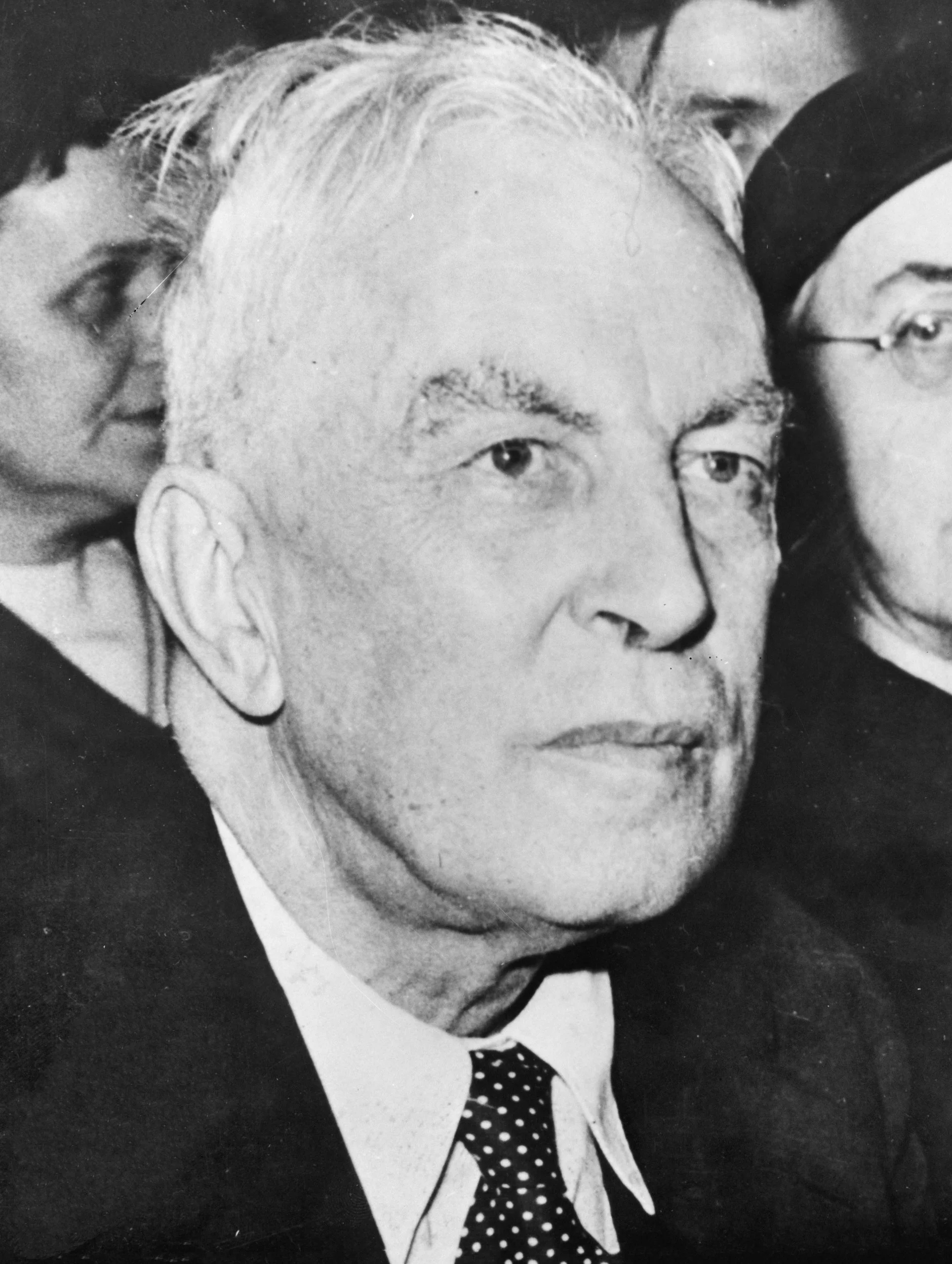
Arnold J. Toynbee
 United Kingdom
historian•philosopher of history•university teacher•diplomat
Birthday
April 14, 1889
Birth Sign
Aries
Birthplace
London, England
Age
Died at 86
About
Arnold Joseph Toynbee was a towering English historian and philosopher of history whose 12-volume A Study of History (1934–1961) made him a household name among intellectuals. He argued that civilizations rise by responding to challenges and fall when their leaders fail, a theory that resonated deeply in the mid-20th century. Beyond his magnum opus, Toynbee was a leading specialist in international affairs, serving as Director of Studies at Chatham House and producing the authoritative Survey of International Affairs. His work shaped how generations understood the grand sweep of human civilization.
Early Life & Background
Toynbee was born into a family steeped in intellectual life. His mother, Sarah Edith Marshall, was one of the first women to earn a degree in English history from Cambridge. His father, Harry Valpy Toynbee, worked as a social worker and secretary to the Charity Organisation Society. His uncle, also named Arnold Toynbee, was a noted economic historian, which sometimes causes confusion between the two.
Young Arnold attended Winchester College, where he excelled in classics, then moved to Balliol College, Oxford, graduating in 1911. He spent the next year at the British Archaeological School in Athens and Greece, an experience that deepened his interest in ancient civilizations. In 1912, he returned to Balliol as a fellow and tutor in history, marking the start of his academic career. During World War I, he left the classroom to work in the intelligence department of the British Foreign Office, a role that gave him firsthand exposure to international politics.
Career Growth
Toynbee's big break came after the war. He served as a delegate to the Paris Peace Conference in 1919, then became professor of Modern Greek and Byzantine History at King's College London (1919–1924). In 1921 he worked as a war correspondent in the Balkans for the Manchester Guardian. His most consequential move came in 1925 when he was appointed Research Professor of International History at the London School of Economics and Director of Studies at the Royal Institute of International Affairs (Chatham House). He held both roles until 1956.
At Chatham House, Toynbee oversaw the 34-volume Survey of International Affairs, an indispensable resource for diplomats and scholars. But it was his own project that defined his legacy. Starting in 1934, he published volume after volume of A Study of History, analyzing 26 civilizations through his challenge-response framework. The work brought him global fame, especially in the 1940s and 1950s, and was widely discussed in both academic and popular circles. He retired from teaching in 1956 but continued writing until his death.
Career Timeline
Public Image & Style
Toynbee was seen as a grand synthesizer, a historian who dared to ask the biggest questions. His writing style was accessible yet erudite, which helped A Study of History reach a broad audience. In the 1940s and 1950s, he was a celebrity intellectual, frequently featured in magazines and invited to lecture worldwide. Critics accused him of being too speculative and of forcing facts into his framework, but his fans admired his sweeping vision. He maintained a dignified, scholarly persona in public, rarely engaging in controversy.
Fame & Fandom (iFAMOUS Rankings)
Arnold J. Toynbee commanded a global stage of intellectual gravity rather than pop-culture frenzy, his name echoing through lecture halls and policy rooms for decades after his death. As of August 2026, the iFANN Global Fame Engine has evaluated this historical figure but does not currently hold him in any published ranking tier, including the Global Top 1,000 or any Top-100 scope list. He is not placed in the current standings. While he once stood as a celebrity intellectual in the mid-20th century, his modern presence exists as a scholarly reference point rather than a ranked entity in contemporary fame metrics. His audience consists of historians, political philosophers, and students who engage with his texts, yet no formal organization or collective title identifies these readers. There is no documented fandom name associated with Arnold J. Toynbee, nor are there fan clubs, rituals, or campaigns driven by a dedicated following. The admiration he receives is metaphorical, rooted in the enduring study of his theories on civilization cycles rather than the organized worship seen in entertainment industries.
Interesting Facts and Legends
Arnold Joseph Toynbee was frequently mistaken for his uncle, the economist Arnold Toynbee, who passed away in 1883, a confusion that required constant clarification throughout his life. A polyglot capable of reading Greek, Latin, French, German, and some Arabic, he wove linguistic depth into his sweeping historical narratives. His son Philip Toynbee followed in his footsteps to become a noted journalist and author. Toynbee remained a steadfast critic of nationalism and militarism, viewing them as fatal symptoms of civilizational decay, and eventually championed the concept of a world government in his later years. His lifelong fascination with religion grew more pronounced in the final volumes of his magnum opus. Legends surrounding his legacy include the sheer scale of his forty-year labor on A Study of History, a feat often cited as a monumental scholarly endurance test. Another enduring story involves his famous assertion that civilizations die from suicide rather than murder, a quote that has become a staple in discussions regarding the fall of empires. Some narratives also claim he predicted the collapse of the Soviet Union and the rise of China, though these remain interpretations of his later writings rather than verified prophecies. Professional historians still debate the rigor of his work, creating a persistent legend of academic controversy surrounding his philosophical approach versus empirical data.
Notable Quotes
“Civilizations are the real actors on the stage of history.”
“The supreme human activity is the search for God.”
“History is a vision of God's creation on the move.”
“No civilization can survive if it turns its back on the spiritual forces that gave it birth.”
Family & Personal Life
Toynbee married twice. His first wife was Veronica Boulter Toynbee; they had a son, Philip, who became a journalist. After their divorce, he married Rosalind Murray, daughter of the classicist Gilbert Murray. Rosalind was a writer and translator. Toynbee also had other children, though details are scarce. His sister, Jocelyn Toynbee, was a noted archaeologist and art historian at Oxford. The family's intellectual legacy was formidable.
Notable Connections
Toynbee was influenced by Oswald Spengler, though he rejected Spengler's determinism. He collaborated with many scholars at Chatham House and LSE. His son Philip Toynbee was a prominent journalist. His sister Jocelyn was a noted archaeologist. His father-in-law Gilbert Murray was a famous classicist.
Relationships & Dating History
Toynbee married Veronica Boulter in the 1910s. They had a son, Philip, before divorcing. He later married Rosalind Murray, daughter of the classicist Gilbert Murray. Rosalind was a writer and translator. They remained married until Toynbee's death in 1975. His relationships were not a major focus of his public life.
- MarriedVeronica Boulter Toynbee1913 - 1940First wife; mother of his son Philip.
- MarriedRosalind Murray1946 - 1975Second wife; daughter of classicist Gilbert Murray; they remained married until Toynbee's death.
Death & Aftermath
Died
October 22, 1975 (aged 86)
Death Place
Weybridge, Surrey, England
Cause of Death
Natural causes associated with old age
The British Academy and the Royal Society of Literature issued formal acknowledgments when Arnold Joseph Toynbee passed, marking the end of an era for British historiography. Tributes highlighted his role as a public intellectual who had once graced the cover of Time magazine in 1947, cementing his status as a thinker whose work remained a standard reference in university curricula long after his final volume appeared in 1961. Toynbee died on October 22, 1975, at his home in Weybridge, Surrey, England, from natural causes associated with old age. His final days were spent in relative seclusion at his residence, consistent with the habits of a scholar who had largely retired from public life by the mid-1970s. Historical records confirm he died peacefully without any disputed accounts regarding the circumstances of his passing.
A private funeral service took place shortly after his death at St. Mary Magdalene Church in Weybridge, where he was cremated. The ashes were subsequently interred at the Woking Crematorium in Surrey, attended by fellow historians, diplomats, and members of his immediate family. Foundations and scholarships have since been established in his name to support research in international relations and history, particularly through the Institute of Historical Research at the University of London. A notable dedication occurred in 2015 when Aeon published essays re-evaluating his role in the humanities, ensuring his theories continue to be referenced in contemporary political discourse regarding civilizational decline.
Net Worth (Estate Value)
$5 Million
iFANN Editorial Team estimate
As a historian and professor, Toynbee earned a comfortable middle-class income, falling short of great wealth during his lifetime. Per iFANN's editorial analysis, his net worth at death is estimated at $5 Million in 2026 terms. This figure derives primarily from book royalties generated by the strong sales of A Study of History in the mid-20th century, alongside steady earnings from his many other books, articles, salaries, and lecture fees. He did not accumulate major investments or real estate holdings beyond his family home. The financial stability he enjoyed reflected his status as a leading specialist in international affairs and Director of Studies at Chatham House, yet it remained grounded in professional compensation rather than speculative ventures.
Awards Won (2)
Toynbee was elected a Fellow of the British Academy in 1937 and an International Member of the American Philosophical Society in 1941. He received honorary degrees from several universities, though specific listings are sparse. He did not win major prizes like the Nobel or Pulitzer.
1937 · Academy Fellowship
1941 · Membership
Known For
A Study of History
1934 · Author
Survey of International Affairs
1925 · Editor and contributor
Keywords
Sources
Quick Facts
- Profession
- historian, university teacher, diplomat
- Born
- +1889-04-14
- Birthplace
- London
- Died
- +1975-10-22
- Death Place
- York
- Gender
- Male
- Spouse
- Veronica Boulter Toynbee, Rosalind Murray
- Birth Sign
- Aries
Personal Details
- Full Name
- Arnold Joseph Toynbee
- Spouse
- Veronica Boulter Toynbee, Rosalind Murray
- Children
- Philip Toynbee (son), others
- Education
- Winchester College; Balliol College, Oxford
Frequently Asked Questions
Who was Arnold J. Toynbee?
What is Arnold J. Toynbee's net worth in 2026?
What was Toynbee's main theory?
Is Arnold J. Toynbee still influential today?
Where did Arnold J. Toynbee teach?
Similar People
Join the community
fans discussing