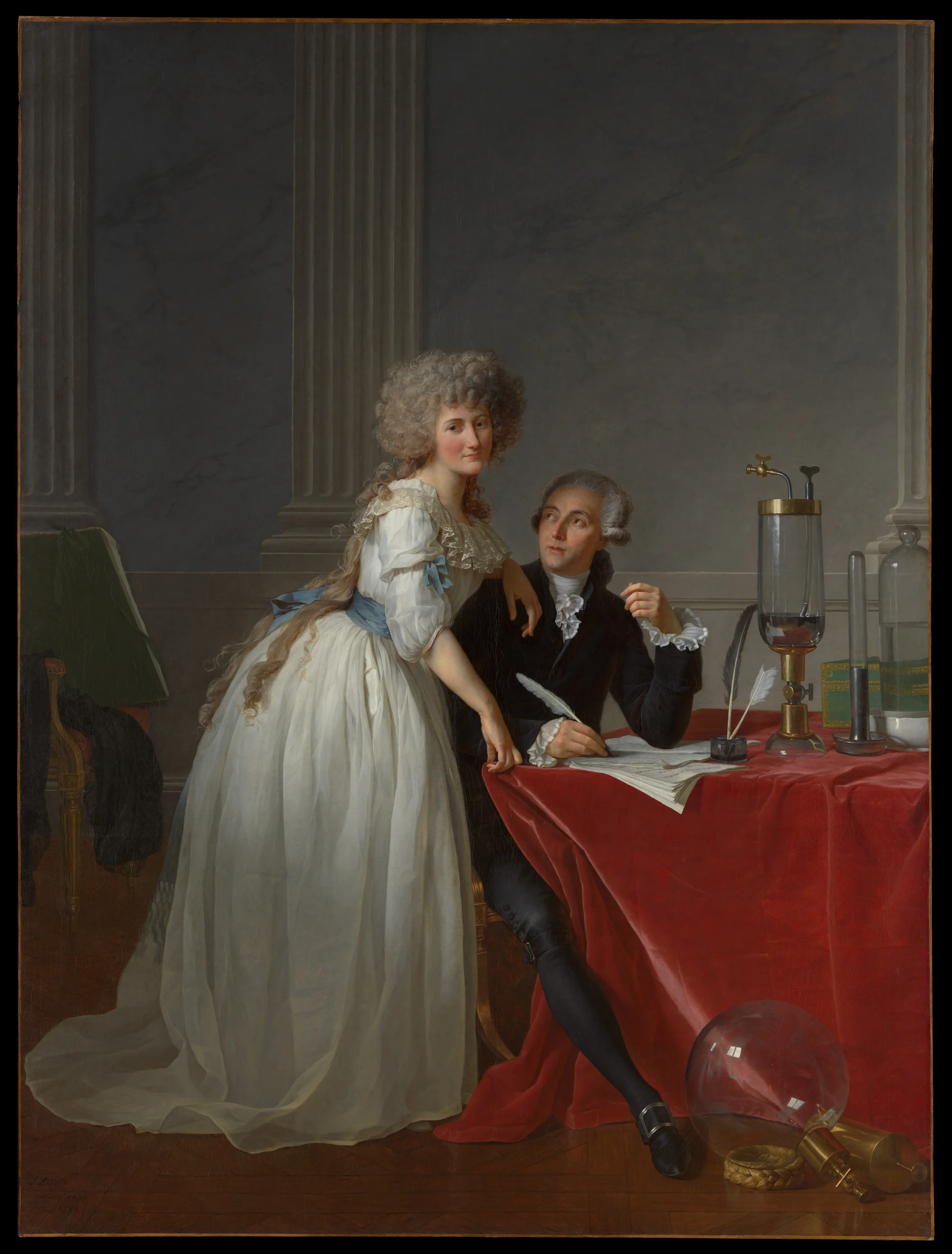
Antoine Lavoisier
 France
Also known as: Antoine-Laurent de Lavoisier, Father of Modern Chemistry
Birthday
August 26, 1743
Birth Sign
Sagittarius
Birthplace
Paris, France
Age
Died at 50
Height
5 ft 6 in (168 cm)
About
Antoine-Laurent de Lavoisier was a French nobleman and chemist who served as the central figure in the 18th-century chemical revolution. He transformed chemistry from a qualitative discipline based on vague observations into a precise science grounded in measurement and quantitative analysis. His work established the law of conservation of mass, proved that water is a compound of hydrogen and oxygen, and introduced the systematic nomenclature still used today. Lavoisier also played a key role in designing the metric system and improving public health through innovations in gas lighting and urban sanitation.
Born into a wealthy bourgeois family in Paris, Lavoisier inherited a substantial fortune after his mother died when he was thirteen. This wealth allowed him to fund an extensive laboratory and pursue scientific research alongside his duties as a farmer-general for the royal tax collection agency. Despite his aristocratic status and financial success, his career ended abruptly during the French Revolution. Chargered with tax fraud and selling adulterated tobacco, he was convicted by the Revolutionary Tribunal and executed by guillotine on May 8, 1794, at the age of 50.
Early Life & Background
Antoine-Laurent de Lavoisier entered the world on August 26, 1743, in Paris, born into the heart of the French bourgeoisie. His father, Antoine Lavoisier Sr., was a respected attorney and member of the Parliament of Paris, while his mother, Marie-Catherine Pamart, came from a prominent legal family. The household enjoyed significant privilege, yet tragedy struck early when his mother passed away in 1756. At just thirteen years old, young Antoine became an orphan and inherited a large estate that would define his future trajectory. He was raised by his aunt and grandmother, who ensured he received a rigorous classical education tailored to prepare him for a life of intellectual pursuit.
He attended the Collège des Quatre-Nations, now known as Lycée Louis-le-Grand, where he studied mathematics, astronomy, and natural philosophy under mentors like the Abbé Nollet. Even as a student, Lavoisier displayed a keen interest in the physical sciences, attending lectures by Guillaume-François Rouelle and developing a deep curiosity about chemistry and physics. Although he earned a law degree in 1763, he quickly abandoned the legal profession to follow his passion for science. In 1764, at the age of twenty-one, he purchased a position as a farmer-general (*fermier général*) within the *Ferme Générale*. This role provided him with immense personal wealth and the freedom to establish a private laboratory, setting the stage for his future scientific breakthroughs.
Career Growth
Lavoisier's professional life was defined by a radical shift from the qualitative alchemy of his predecessors to a rigorous, quantitative approach to chemistry. His breakthrough occurred in the late 1770s when he successfully disproved the phlogiston theory, which claimed that combustible materials contained a fire-like element called phlogiston. Through meticulous weighing experiments, he demonstrated that combustion requires a specific gas, which he named oxygen in 1778. He also identified hydrogen as an element in 1783, initially calling it inflammable air. These discoveries overturned centuries of scientific dogma and laid the groundwork for modern chemical understanding.
The crowning achievement of his career was the publication of Traité Élémentaire de Chimie (Elementary Treatise of Chemistry) in 1789. This work served as the first modern chemistry textbook, introducing the metric system, establishing the law of conservation of mass, and presenting the first extensive list of chemical elements. He collaborated with colleagues such as Joseph-Louis Lagrange and Pierre-Simon Laplace to refine calorimetry and thermodynamics. Beyond pure science, his commercial impact was profound; he helped design the French metric system, standardized chemical nomenclature still in use today, and improved public health through his work on gas lighting and urban sanitation. His contributions fundamentally reshaped how humanity understands matter and energy.
Career Timeline
Public Image & Style
Lavoisier is remembered as the archetype of the Enlightenment scientist: rational, precise, and transformative. Media depictions emphasize his tragic end and the injustice of his execution, often contrasting his scientific genius with the brutality of the Revolution. His signature aesthetic combined scientific rigor with aristocratic refinement, often seen in portraits wearing the uniform of the Ferme Générale or formal dress. He is universally recognized as the Father of Modern Chemistry, a title that reflects his ability to bring order and precision to a field previously dominated by speculation. His legacy is one of intellectual brilliance cut short by political fanaticism.
Fame & Fandom (iFAMOUS Rankings)
iFANN has not yet collected fame data for this person. He does not appear on the September 2026 iFAMOUS Rankings flagship list. The scientific community actively commemorates his birthday and death anniversary, engaging in educational outreach to highlight his contributions to the metric system and the periodic table. Notable campaigns include the restoration of his laboratory in Paris and the continued use of his name in scientific institutions. While there is no organized fan club with a specific name, historians, chemists, and science enthusiasts form a dedicated base that studies his work and preserves his memory.
Interesting Facts and Legends
Antoine Lavoisier coined the terms oxygen and hydrogen, deriving them from Greek roots meaning acid-producer and water-producer respectively. He invented precise instruments like the barometer and manometer to ensure accurate measurements in his experiments. Lavoisier was also a pioneer in using ether as an anesthetic for surgical procedures, anticipating modern medical practices by nearly a century. His collaboration with his wife was unique for the time, as she translated English scientific texts and illustrated his experiments, effectively serving as his co-author. The iconic 1788 portrait by Jacques-Louis David originally depicted the couple with opulent symbols of wealth, but these were later painted over to reflect their scientific identities and the changing political climate.
Notable Quotes
“In this world nothing can be said to be created, nothing can be said to be destroyed.”
“I have done my duty.”
“The Republic has no need of savants.”
Family & Personal Life
Following the death of his mother when he was thirteen, Lavoisier was raised by his aunt and grandmother, who instilled in him the values of a rigorous classical education. His most significant family partnership began in 1771 when he married Marie-Anne Pierrette Paulze, a thirteen-year-old girl from a wealthy family. She became his indispensable collaborator, translating scientific texts, illustrating experiments, and managing his laboratory. They had six children together, though only two daughters, Anne-Catherine and Marie-Zélie, survived infancy. The couple shared a deep intellectual bond that was both professional and romantic, making their partnership central to his scientific success. Upon his execution, his wife survived him and eventually recovered some of the family's confiscated property.
Notable Connections
Marie-Anne Paulze Lavoisier, Joseph-Louis Lagrange, Pierre-Simon Laplace, Jean-Baptiste Dumas, Jacques-Louis David
Relationships & Dating History
Antoine Lavoisier had one documented spouse: Marie-Anne Pierrette Paulze. They married on May 16, 1771, when she was thirteen years old. Their relationship was monogamous and deeply collaborative, spanning over two decades until his death. Marie-Anne played a crucial role in his scientific career, translating English texts, illustrating experiments, and managing his laboratory. They had six children together, though only two daughters survived infancy. There are no records of prior engagements, divorces, or other romantic partners. As of the historical record, Lavoisier was widowed upon his execution in 1794. His wife survived him and continued to promote his legacy through her own writings and translations.
- MarriedMarie-Anne Pierrette Paulze1771 - 1794His only spouse; they collaborated on scientific work until his execution.
Death & Aftermath
Died
May 8, 1794 (aged 50)
Death Place
Paris, France
Cause of Death
Execution by guillotine
Antoine Lavoisier spent his final months detained within the Conciergerie prison in Paris, having been held since August 1793 following accusations of embezzlement and tax fraud related to his service with the Ferme Générale. On May 8, 1794, he was brought before the Revolutionary Tribunal where the presiding judge Pierre Joseph Cambon reportedly dismissed pleas for leniency based on his scientific stature, declaring that the Republic had no need of savants. The court ruled him guilty of defrauding the state, and the sentence was carried out by guillotine later that same day. His death marked a swift legal conclusion devoid of the due process typical of the era, as the execution stood as an act of state policy sanctioned by the National Convention without further investigation or inquiry into foul play.
Public reaction to the event was complex and divided between revolutionary celebration and profound regret among the scientific community. While the government hailed the execution as a victory against corruption, prominent peers expressed deep sorrow over the loss of his intellect. The mathematician Joseph-Louis Lagrange famously lamented that it took only an instant to sever that head, suggesting a century might not suffice to produce another like him. Lavoisier's funeral remained a private affair conducted under the shadow of the Revolution, with his body likely interred in a common grave at the Cemetery of Sainte-Marguerite in Paris as was standard for those executed by the guillotine. His wife Marie-Anne Pierrette Paulze survived him and eventually secured the return of some confiscated assets while continuing to promote his scientific legacy through her own writings and translations, ensuring his theories survived the political purge despite the initial loss of much property to the state.
In the posthumous era, Lavoisier has been honored extensively across multiple disciplines and institutions. A joint laboratory named the Antoine Lavoisier laboratory was launched by Imperial College London and the CNRS to transform global metabolism research, while the DuPont company awards the annual Lavoisier Medal for Lifetime Technical Achievement. Numerous books, films, and academic papers have been produced about his life, including analyses of the Jacques-Louis David portrait which originally depicted the Lavoisiers as wealthy elites before being altered to reflect their scientific identities. His name remains synonymous with the law of conservation of mass and the foundation of modern chemistry.
Net Worth (Estate Value)
$0
iFANN Editorial Team estimate
Antoine Lavoisier's net worth is not applicable in the modern sense as he died in 1794. Historical records indicate he was one of the wealthiest individuals in France at the time due to his position in the Ferme Générale. Upon his execution, his assets were confiscated by the revolutionary government, and his estate was liquidated. His wife later recovered some of the family's property, but much was lost to state seizure. The value of his estate at death was estimated to be equivalent to several million livres, a sum that would place him among the top 1% of earners in 18th-century France. Since his passing, his estate has generated value through the enduring copyright-free status of his scientific works, which continue to be published and studied, and through the licensing of his name for educational and institutional purposes. The estate is managed by various historical societies and academic institutions rather than a single executor.
Awards Won (3)
Lavoisier received the Copley Medal from the Royal Society in 1784 for his work on the combustion of diamonds and the nature of heat. He was elected a Fellow of the Royal Society of London in 1768 and appointed to the French Academy of Sciences in 1771. Posthumously, he has been honored with the annual Lavoisier Medal awarded by DuPont and the establishment of the Antoine Lavoisier Laboratory by Imperial College London and CNRS.
1784 · Science
Work on combustion and heat
1768 · Honorary Membership
General Scientific Contribution
Known For
Traité Élémentaire de Chimie
1789 · Author
Discovery of Oxygen
1778 · Scientist
Law of Conservation of Mass
1789 · Discoverer
Keywords
Sources
Quick Facts
- Profession
- chemist, economist, biologist
- Born
- August 26, 1743
- Birthplace
- Paris, France
- Died
- May 8, 1794
- Death Place
- Paris, France
- Gender
- Male
- Spouse
- Marie-Anne Pierrette Paulze
- Birth Sign
- Sagittarius
Personal Details
- Full Name
- Antoine-Laurent de Lavoisier
- Height
- 5 ft 6 in (168 cm)
- Spouse
- Marie-Anne Pierrette Paulze
- Children
- Anne-Catherine and Marie-Zélie (surviving daughters)
- Education
- Collège des Quatre-Nations (Lycée Louis-le-Grand), Law Degree (1763)
Frequently Asked Questions
Who is Antoine Lavoisier?
How did Antoine Lavoisier die?
What was Antoine Lavoisier's biggest discovery?
Did Antoine Lavoisier have children?
Why is Antoine Lavoisier important?
Similar People
Join the community
fans discussing