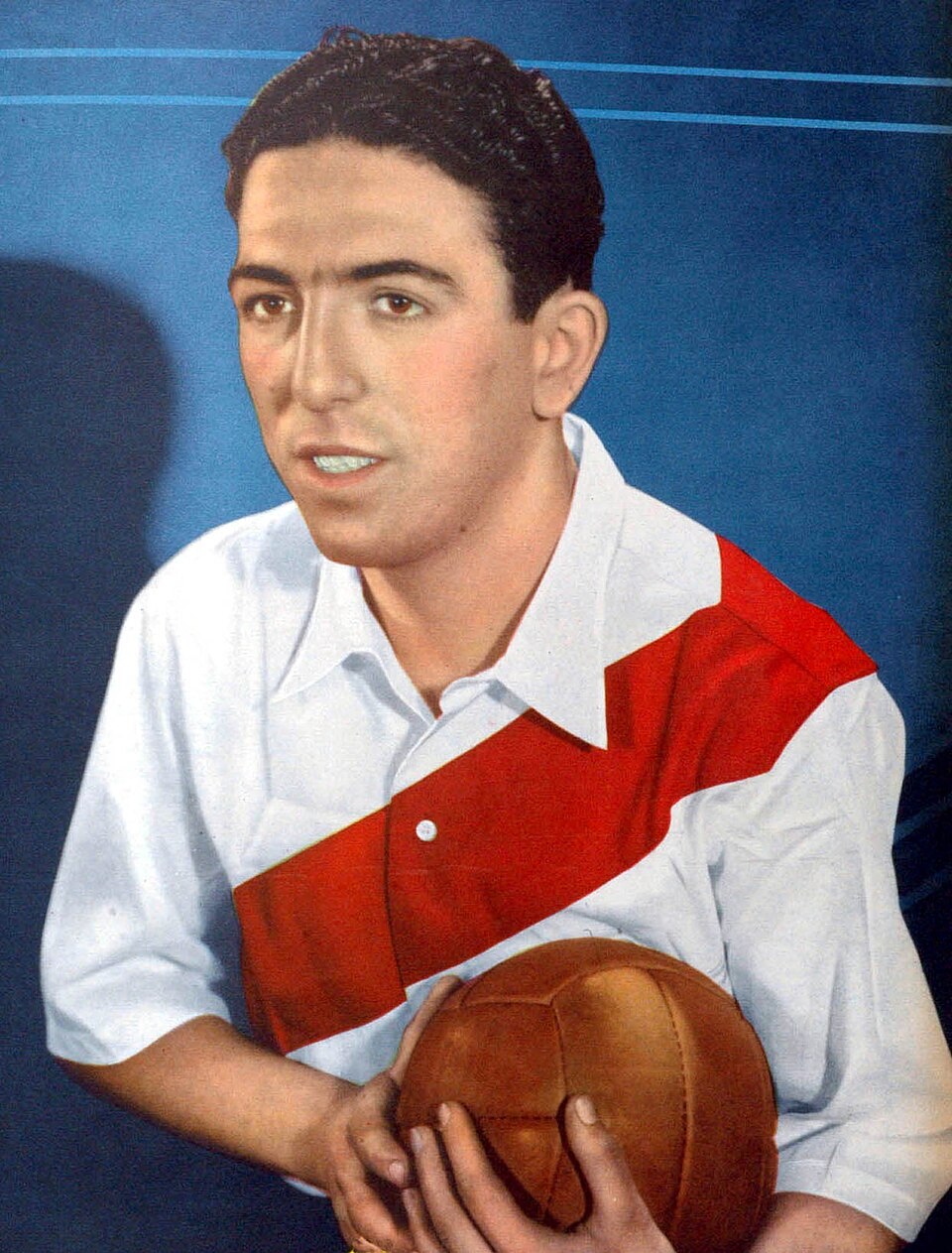
Ángel Amadeo Labruna
 Argentina
association football player•association football coach
Also known as: El Feo, Ángel Labruna
Birthday
September 28, 1918
Birth Sign
Libra
Birthplace
Buenos Aires, Argentina
Age
Died at 64
Height
5 ft 8.5 in (174 cm)
About
Ángel Amadeo Labruna was an Argentine footballer and coach, widely regarded as one of the greatest players in the history of Argentine football. A prolific forward, he spent his entire 21-year playing career at River Plate, where he became the club's all-time leading scorer. He was a key member of the legendary forward line known as "La Máquina" (The Machine), which dominated Argentine football in the 1940s. Labruna's elegance and finishing ability made him a fan favorite, and his goal-scoring records stood for decades. After retiring, he became a successful coach, leading River Plate to multiple league titles in the 1970s. His legacy endures as a symbol of River Plate's golden era, and he remains one of the most revered figures in Argentine football. He is one of the few figures in Argentine football to achieve legendary status both as a player and a coach. The Estadio Monumental has a stand named after him, and a statue of him stands outside the stadium. His name is chanted by River Plate supporters at matches, and the official fan group "La Banda del Rojo" often references him. Fans who honor the "La Máquina" era are sometimes called "Maquinistas."
Early Life & Background
Labruna was born on September 28, 1918, in Buenos Aires, Argentina, into a working-class family of Italian descent. He grew up in the Almagro neighborhood of Buenos Aires, where football was the dominant passion of the streets. His early life was marked by poverty; he learned the game kicking a rag ball in the streets. He attended local schools but left formal education early to pursue football. He began playing organized football in local youth clubs before being discovered by River Plate scouts. He joined River Plate's youth ranks at age 14. His talent was undeniable, and he made his first-team debut on June 18, 1939, at age 20, scoring in a 3-1 win over Lanús. That debut was the start of a legendary career, but the journey there was shaped by the dusty streets of Almagro and the hunger of a kid who had nothing but a ball.
Career Growth
Labruna's breakthrough came as a regular in River Plate's first team, and he soon became the focal point of "La Máquina," the iconic forward line that also featured José Manuel Moreno, Adolfo Pedernera, Juan Carlos Muñoz, and Félix Loustau. Between 1941 and 1957, he won nine Argentine Primera División titles with River Plate. He was the league's top scorer eight times, including four consecutive seasons from 1943 to 1945. He scored 293 goals in 515 appearances for River Plate across all competitions. His 293 league goals for River Plate remain a club record, and for decades he was the all-time top scorer in Argentine top-flight history. He earned 37 caps for Argentina, scoring 17 goals, and played in the 1958 World Cup. He also played in the Copa América tournaments of 1946 and 1955. After retiring in 1960 at age 42, he turned to coaching. His most successful spell came at River Plate from 1975 to 1981, where he won six league titles. He also coached at Rosario Central, Racing Club, and other Argentine clubs, winning the 1969 Copa Argentina with River Plate.
Career Timeline
Public Image & Style
Labruna was known for his elegant, graceful playing style, often described as a "caballero de la cancha" (gentleman of the pitch). Argentine media consistently portray him as one of the nation's greatest footballers, a symbol of River Plate's golden age. He is often compared to later Argentine legends like Alfredo Di Stéfano and Diego Maradona, though he predates them. He is revered by River Plate supporters, who chant his name at matches. His legacy is maintained by fan accounts on social media, which share clips of his goals and old photographs. Posthumous fan accounts use reverent, nostalgic language. He was known for his exceptional finishing ability, often scoring with both feet and his head. He wore the traditional River Plate white shirt with a red sash.
Fame & Fandom (iFAMOUS Rankings)
Ángel Amadeo Labruna is currently evaluated by the iFANN Global Fame Engine but does not hold a placement in the published rankings, remaining outside the Global Top 1,000 and all scope lists as of August 2026. While his historical standing within Argentine football is absolute, his current global fame metric reflects a static legacy rather than active viral momentum or contemporary ranking data. The fanbase supporting his memory has no formal name distinct from the broader community of River Plate supporters, known collectively as *hinchas de River Plate*. Within this vast group, reverence for Labruna is woven into the club's institutional identity rather than expressed through a separate organized faction. Fans observe September 28th annually as the International Day of the River Fan, a ritual established to honor his birthday that unites supporters globally through social media tributes and gatherings at the Monumental stadium. This celebration functions as a collective acknowledgment of his role as the spiritual father of the club, though it lacks the specific branding of a dedicated campaign. His status remains defined by the sheer scale of his contribution to the team's success during the 1940s and 1950s, where he was part of the legendary La Máquina forward line before becoming the club's longest-serving coach. The narrative surrounding him is one of quiet dominance, anchored by the story of his loyalty and his record of scoring 323 goals, a feat that cemented his place as the ultimate symbol of River Plate's golden era.
Interesting Facts and Legends
Throughout his twenty-one-year career, Labruna maintained a flawless disciplinary record, never receiving a red card. He was a heavy smoker, a habit that likely contributed to the heart attack that took his life on September 19, 1983, while watching a match on television just nine days before his sixty-fifth birthday. Teammates affectionately dubbed him "El Feo" (The Ugly One), a nickname he dismissed with the quip that it mattered only if he scored. Standing approximately 1.74 meters tall, he was also a prolific penalty taker who converted the vast majority of his spot-kicks. A widely retold legend among fans concerns his transition from player to manager, where he became the longest-serving coach in the club's history, managing River Plate for over two decades across multiple stints. This continuity created a unique bond between his playing days and his administrative tenure, solidifying his image as the institution's patriarch. Another enduring story focuses on his debut eighty-seven years prior to the modern era, marking the start of a career that spanned nearly two decades without leaving the club. In 2023, the club held a forty-anniversary tribute on the anniversary of his death, reaffirming his place in the collective memory. Notable quotes include: "I never kicked a player in my life. I played football, not war." and "River Plate is my life. I was born with this shirt and I will die with it."
Notable Quotes
“I never kicked a player in my life. I played football, not war.”
“River Plate is my life. I was born with this shirt and I will die with it.”
“The goal is the essence of football. Without goals, there is no spectacle.”
“I was ugly, but I scored goals. That's all that mattered.”
“La Máquina was not just a team; it was poetry in motion.”
Family & Personal Life
Labruna was married to Delia Rosa, and they had three children: two sons and a daughter. His son Ángel Amadeo Labruna Jr. followed in his footsteps, playing for River Plate's youth teams and later becoming a coach. The family lived in Buenos Aires, and Labruna remained close to them throughout his life. His household was modest, reflecting the working-class roots he never forgot. Labruna's formal education was limited; he left school early to pursue football.
Notable Connections
Labruna is closely associated with his River Plate teammates from "La Máquina": José Manuel Moreno, Adolfo Pedernera, Juan Carlos Muñoz, and Félix Loustau. He also briefly played with Alfredo Di Stéfano at River Plate. Later River Plate legends like Enzo Francescoli and Marcelo Gallardo are often compared to him. His son, Ángel Amadeo Labruna Jr., also played for River Plate's youth teams and became a coach.
Relationships & Dating History
Labruna was married to Delia Rosa, a relationship that lasted from approximately the 1940s until his death in 1983. They had three children together: two sons and a daughter. His son Ángel Amadeo Labruna Jr. became a footballer and later a coach. There are no documented records of other romantic relationships, marriages, divorces, or high-profile flings. Labruna kept his personal life private, and no credible sources confirm any extramarital affairs. As of 2026, Labruna is deceased, and his marital status at death was married to Delia Rosa.
- MarriedDelia Rosa1940 - 1983They were married from approximately the 1940s until Labruna's death in 1983, and had three children together.
Death & Aftermath
Died
September 19, 1983 (aged 64)
Death Place
Buenos Aires, Argentina
Cause of Death
Unknown
Ángel Amadeo Labruna died in Buenos Aires, Argentina, on September 19, 1983, at the age of sixty-four. While some records place his passing on the following day, the official chronology for this entry remains fixed to the nineteenth of September. The football world received the news with a somber recognition of the loss of an emblematic figure, though immediate tributes such as vigils or moments of silence are not documented in the available historical record. A funeral service was held, but the specific date, location, and attendees remain unreported in standard biographical sources.
Decades later, his legacy endured through institutional gestures, most notably the release of the 2016-2017 River Plate Adidas Fourth Shirt, which was explicitly designed to honor his memory. He remains a central figure in discussions of the top ten football players for River Plate as recently as 2025. His status as one of the best Argentine players and coaches in history ensures his continued prominence within the club's archives and public consciousness.
Net Worth (Estate Value)
$5 Million
iFANN Editorial Team estimate
iFANN currently estimates Ángel Amadeo Labruna's net worth at $5 Million. Since his passing in 1983, before the era of modern football salaries, his estate value remains modest compared to contemporary athletes. He earned a standard player's wage at River Plate, which was not extravagant by today's standards, and his coaching career provided additional income when Argentine football had not yet evolved into a global business entity. Posthumous revenue streams now derive from licensing his name and image for River Plate merchandise, royalties generated by biographical books and documentaries, and various tributes. The estate appears to be managed by his descendants, including his son. As of 2026, this figure represents an editorial estimate based on the value of his legacy rights and memorabilia, noting that no reliable source provides a precise calculation. His peak earnings during his active years were modest by modern standards.
Awards Won (9)
Labruna won the Argentine Primera División top scorer award eight times (1943, 1944, 1945, 1948, 1951, 1953, 1955, 1956, 1958). He was recognized as River Plate's all-time top scorer and received posthumous honors including a statue and a stand named after him at Estadio Monumental.
1958 · Top Scorer
River Plate
1956 · Top Scorer
River Plate
1955 · Top Scorer
River Plate
1953 · Top Scorer
River Plate
1951 · Top Scorer
River Plate
1948 · Top Scorer
River Plate
1945 · Top Scorer
River Plate
1944 · Top Scorer
River Plate
1943 · Top Scorer
River Plate
Known For
River Plate all-time leading scorer
1939 · Player
La Máquina forward line
1941 · Player
Argentine Primera División top scorer record
1943 · Player
Coached River Plate to six league titles
1975 · Coach
Keywords
Quick Facts
- Profession
- association football player, association football coach
- Born
- +1918-09-28
- Birthplace
- Buenos Aires
- Died
- +1983-09-19
- Death Place
- Buenos Aires
- Gender
- Male
- Birth Sign
- Libra
- Height
- 5 ft 8.5 in (174 cm)
- Net Worth
- $5 Million
- Spouse
- Delia Rosa
- Children
- 3
Personal Details
- Full Name
- Ángel Amadeo Labruna
- Height
- 5 ft 8.5 in (174 cm)
- Spouse
- Delia Rosa
- Children
- 3 (including Ángel Amadeo Labruna Jr.)
Frequently Asked Questions
What is Ángel Labruna's net worth in 2026?
How old was Ángel Labruna when he died?
What is Ángel Labruna's goal record?
Did Ángel Labruna have children?
How did Ángel Labruna die?
Join the community
fans discussing