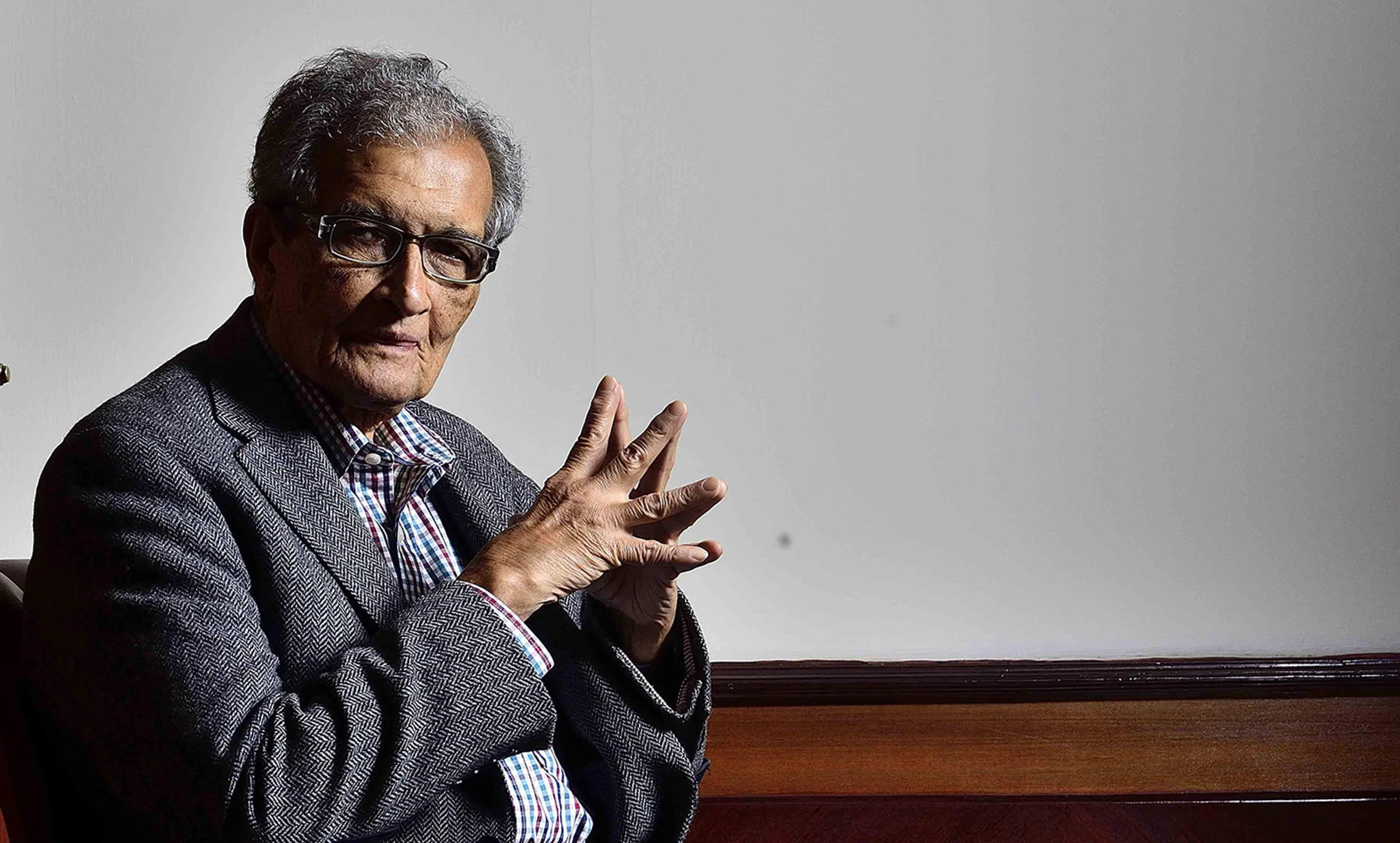
Amartya Sen
 India
Indiaeconomist•philosopher•university teacher
Also known as: Amartya Kumar Sen, Professor Amartya Kumar Sen
Birthday
November 3, 1933
Birth Sign
Scorpio
Birthplace
Santiniketan, West Bengal, India
Age
92 years old
Height
5 ft 9 in (175 cm)
About
Amartya Kumar Sen is an Indian economist and philosopher whose work has fundamentally reshaped welfare economics, social choice theory, and development studies. Born in Santiniketan, he currently serves as the Thomas W. Lamont University Professor at Harvard University while holding a concurrent position as a professor of economics and philosophy. His academic influence extends globally through his analysis of famine, poverty, and well-being, notably arguing that famines result from failures in entitlement rather than food shortages. In 1998, he received the Nobel Memorial Prize in Economic Sciences for these contributions, followed by India's highest civilian honor, the Bharat Ratna, in 1999.
Sen remains an active public intellectual who bridges rigorous academic theory with urgent policy debates on democracy, justice, and global inequality. He previously served as the Master of Trinity College at the University of Cambridge from 1998 to 2004. His scholarship continues to inform international frameworks for human development, emphasizing the expansion of real freedoms as the core of economic progress. Recent years have seen him engage in significant historical revisions regarding colonial responsibility and the role of reason in modern governance.
Early Life & Background
Amartya Sen was born into an intellectually vibrant family in Santiniketan, a town founded by Nobel laureate Rabindranath Tagore. His father, Amitabh Sen, was a professor of chemistry who moved from Dhaka University to teach at Visva-Bharati University, where Amartya spent his early childhood. The cultural atmosphere of Santiniketan deeply influenced his worldview, exposing him to a unique blend of Indian tradition and modernist thought from a young age. He attended the school associated with Visva-Bharati before moving to Calcutta for higher education.
His academic ascent began rapidly at Presidency College in Calcutta, where he completed his Bachelor of Arts degree in 1953. The institution provided a rigorous foundation in economics that would define his future career path. Seeking broader horizons, he traveled to the United Kingdom to pursue advanced studies at Cambridge University. There, he earned his Master of Arts degree in 1956 and subsequently completed his PhD at Trinity College in 1959. His doctoral thesis, titled The Theory of Rational Choice, laid the theoretical groundwork for his later groundbreaking work in social choice theory. Before gaining international prominence, he taught at the Delhi School of Economics and the University of Delhi, establishing a reputation for intellectual rigor within the Indian academic system.
Career Growth
Sen's transition to international academia marked a pivotal shift in his career trajectory. After teaching in India until 1971, he moved to England to hold positions at the London School of Economics and King's College, Cambridge. This period allowed him to refine his theories on collective choice and social welfare, culminating in the publication of his seminal work Collective Choice and Social Welfare in 1970. The book challenged existing economic models by demonstrating how individual preferences could be aggregated into social decisions without violating logical consistency.
In 1987, he joined the faculty of Harvard University, where he holds the prestigious title of Thomas W. Lamont University Professor. His most defining professional milestone arrived in 1998 when he was awarded the Nobel Memorial Prize in Economic Sciences. The committee recognized his foundational contributions to welfare economics, particularly his revolutionary analysis of famines which posited that they are caused by distributional failures rather than absolute food scarcity. This insight, derived from his study of the 1943 Bengal Famine, transformed how governments and organizations approach hunger relief worldwide. Following his Nobel win, he served as the Master of Trinity College, Cambridge, until 2004, balancing administrative leadership with continued scholarly output.
His career has been defined by a relentless focus on the intersection of ethics and economics. Recent publications include An Idea of Justice in 2019, which expanded his earlier work on capability approaches to address complex moral questions. In 2020, he received the Peace Prize of the German Book Trade for his scholarship on global justice. As of 2026, he continues to contribute to high-level debates on democracy and the power of reason, maintaining an active presence in both academic circles and public discourse.
Career Timeline
Public Image & Style
Sen presents himself as a modest public intellectual, often wearing traditional Indian attire such as the dhoti and kurta paired with a shawl. His public persona is defined by a commitment to rational debate and ethical clarity, avoiding the trappings of celebrity in favor of substantive engagement. Media portrayals emphasize his role as a bridge between Western economic theory and developing world realities. He is viewed as a critical voice on issues of democracy and human rights, willing to challenge established narratives even when controversial.
Fame & Fandom
In the August 2026 cycle of the iFANN Global Fame Rankings, Amartya Sen holds the position of the 62nd most famous person from India, a placement that reflects his sustained influence in international affairs rather than fleeting celebrity. This standing underscores his status as a transformative figure in economic thought, consistently cited alongside Adam Smith and John Maynard Keynes. While his work on welfare economics and social choice theory has generated deep reverence among scholars, his audience consists primarily of students, academics, and policymakers rather than a traditional fanbase. No formal name exists for this group, as his influence is measured by the adoption of his ideas in development frameworks and public debates rather than organized cultural rituals or fan campaigns.
Interesting Facts and Legends
Amartya Sen was born on a university campus in Santiniketan, where his father taught, making his birthplace intrinsically linked to the academic environment. He is fluent in Bengali, English, French, and German, allowing him to engage with diverse intellectual traditions across Europe and Asia. Known for his sharp wit, Sen once publicly predicted that Narendra Modi would not become Prime Minister of India, a statement that sparked considerable controversy given the eventual political outcome. He is a dedicated vegetarian and a strong advocate for animal rights, reflecting his ethical stance on consumption and treatment of living beings.
A persistent legend surrounding his life involves his deep connection to Dhaka, Bangladesh. During a journey to trace his ancestral roots in July 2026, he famously stated, "I knew I belonged to Dhaka," highlighting a personal history that transcends national borders. His analysis of the 1943 Bengal Famine remains a cornerstone of modern economic theory, though it has faced recent historical revisions challenging aspects of his original conclusions regarding colonial administration. These moments define his legacy as a thinker whose life intersects with history, politics, and the enduring power of reason.
Notable Quotes
“The freedom to determine the nature of one's life is one of the most important capabilities.”
“Development can be seen as a process of expanding the real freedoms that people enjoy.”
“The future of the world will be dark if we do not rediscover the power of reason.”
“I knew I belonged to Dhaka.”
Family & Personal Life
Amartya Sen comes from a prominent intellectual family. His father, Amitabh Sen, was a professor of chemistry who taught at Dhaka University and later at Visva-Bharati University. His mother, Surendranath Sen, managed the household in Santiniketan. Sen has one daughter, Arundhati Sen, from his first marriage. He resides primarily in the United States with his current wife, Emma Georgina Rothschild, while maintaining connections to India and the UK through his academic appointments and family history.
Notable Connections
Relationships & Dating History
Amartya Sen has been married three times throughout his life. His first marriage was to Nabaneeta Dev Sen, a renowned Bengali poet and writer, in 1959. They had one daughter, Arundhati Sen, before divorcing in the late 1970s or early 1980s. Sources vary slightly on the exact year of the split, but it occurred prior to his second marriage. His second marriage was to Eva Colorni, an Italian economist and philosopher, in 1981. This union was relatively short-lived; Eva Colorni died of cancer in 1985 after only four years of marriage. Sen's third and current marriage was to Emma Georgina Rothschild, a British economic historian, in 1987. The couple resides primarily in the United States, with Sen holding positions at Harvard. As of 2026, he remains married to Emma Georgina Rothschild.
- DivorcedNabaneeta Dev Sen1959 - 1979Married fellow poet and writer; one daughter together.
- WidowedEva Colorni1981 - 1985Italian economist and philosopher; died of cancer.
- MarriedEmma Georgina Rothschild1987 - presentCurrentBritish economic historian; current spouse.
Salary, Net Worth In 2026
$2 Million
iFANN Editorial Team estimate
iFANN Editorial Team research estimates Amartya Sen's net worth at approximately $2 million as of 2026. Unlike entertainment figures, Sen's wealth derives from academic salaries, book royalties, lecture fees, and honorary stipends rather than commercial ventures. His primary income streams include his tenure at Harvard University and his extensive bibliography, which includes widely read texts like Development as Freedom. Financial details remain private due to his academic status, but credible profiles suggest his assets consist mainly of real estate holdings in the US and India, pension benefits from Harvard and Trinity College, and ongoing royalty payments. His financial trajectory reflects steady accumulation over decades of distinguished service rather than rapid speculation.
Awards Won (6)
Amartya Sen has received numerous prestigious awards including the Nobel Memorial Prize in Economic Sciences (1998), the Bharat Ratna (1999), the Presidential Medal of Freedom (2013), and the Peace Prize of the German Book Trade (2020). He also holds the J.B. Clark Medal (1980) and the National Humanities Medal (2021).
1998 · Economic Sciences
Contributions to welfare economics
1999 · Civilian Honor
Lifetime achievement in economics
Known For
Development as Freedom
1999 · Author
Poverty and Famines: An Essay on Entitlement and Deprivation
1981 · Author
Collective Choice and Social Welfare
1970 · Author
Keywords
Sources
Quick Facts
- Profession
- economist, university teacher, philosopher
- Born
- November 3, 1933
- Birthplace
- Santiniketan, West Bengal, India
- Gender
- Male
- Spouse
- Emma Georgina Rothschild
- Birth Sign
- Scorpio
Personal Details
- Full Name
- Amartya Kumar Sen
- Height
- 5 ft 9 in (175 cm)
- Spouse
- Emma Georgina Rothschild
- Children
- Arundhati Sen
- Education
- Presidency College, University of Cambridge (MA), Trinity College, Cambridge (PhD)
Frequently Asked Questions
What is Amartya Sen famous for?
How many times has Amartya Sen been married?
Where did Amartya Sen go to school?
What is Amartya Sen's net worth?
Is Amartya Sen still alive?
Similar People
Join the community
fans discussing