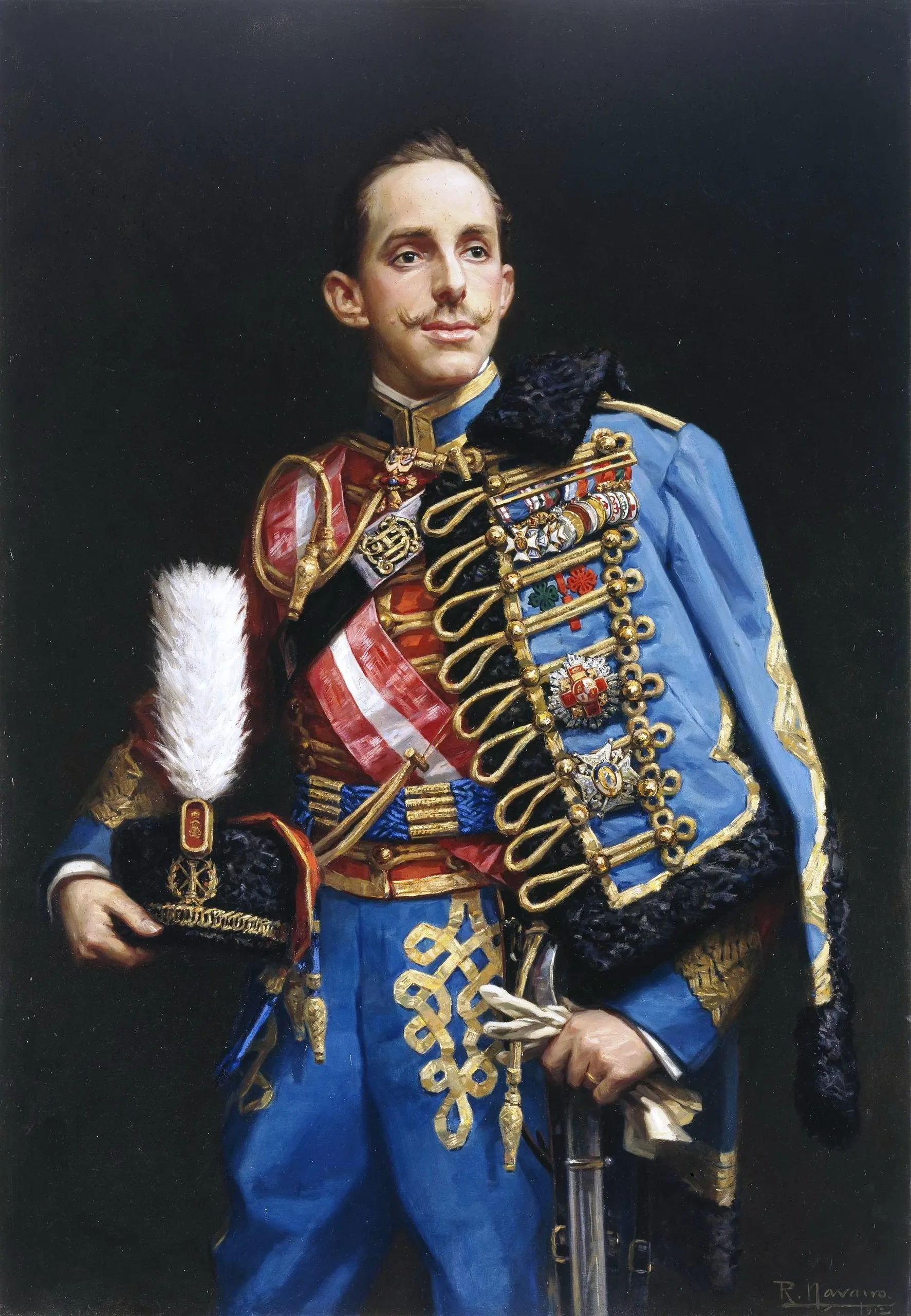
Alfonso XIII
 Spain
SpainAlso known as: Don Alfonso de Borbón y Habsburgo, The African, Alfonso XIII of Spain
Birthday
May 17, 1886
Birth Sign
Taurus
Birthplace
Madrid, Spain
Age
Died at 54
About
Alfonso XIII was King of Spain from the moment of his birth in 1886 until 1931, when the Second Spanish Republic was proclaimed. Born in Madrid, he came into the world as a posthumous son, his father Alfonso XII having died the previous year. His mother, Maria Christina of Austria, served as regent until he assumed full powers on his sixteenth birthday in 1902. Known as 'El Africano' for his Africanist views, Alfonso often styled himself as a soldier-king, and his public image was closely tied to the military. His reign began just four years after the Spanish-American War, and many Spaniards pinned their hopes of national regeneration on him. Like other European monarchs of his era, he played an active political role, which stirred controversy over his use of constitutional powers. His wedding to Princess Victoria Eugenie of Battenberg in 1906 was nearly cut short by an anarchist's bomb, but he escaped unharmed.
Early Life & Background
Entering the world as a posthumous child, Alfonso XIII's infancy was defined by the absence of a reigning father and the shadow of political instability. His birth on May 17, 1886, occurred just one year after the death of his father, King Alfonso XII, leaving the infant as the titular sovereign from his first breath. For the first sixteen years of his life, his mother, Maria Christina of Austria, acted as regent, navigating the delicate aftermath of the Spanish-American War of 1898. That conflict resulted in the loss of Spain's last major overseas colonies, including Cuba, Puerto Rico, and the Philippines, casting a long pall over the young kingdom's future.
His upbringing was rigorous and militaristic, designed to forge a leader capable of restoring Spain's prestige. Unlike many contemporaries who received broad liberal education, Alfonso focused heavily on military strategy, law, and history. He participated in military maneuvers from a young age, internalizing the identity of a soldier-king. This period also saw him develop a fascination with modern technology, particularly automobiles. He became known as the first car-guy king, frequently driving vehicles himself, a habit that distinguished him from more distant European royals. By the time he turned sixteen, he had absorbed the weight of a nation seeking renewal after imperial collapse.
Career Growth
Alfonso XIII assumed full sovereign powers on his sixteenth birthday in 1902, ending his mother's regency. His early reign was marked by an attempt to modernize the monarchy and engage directly with the public. In 1906, he married Princess Victoria Eugenie of Battenberg, a union that drew international attention but ended in tragedy when an anarchist bomb exploded in the procession, killing several bystanders while sparing the King. During World War I, he leveraged his extensive family connections across European royal houses to maintain Spain's neutrality, earning a Nobel Peace Prize nomination in 1917 for his mediation efforts.
Political interventionism characterized the later years of his reign. Facing labor unrest and separatist movements in 1917, he struggled to maintain stability. In 1923, he acquiesced to a coup d'état by General Miguel Primo de Rivera, establishing a dictatorship that severely damaged his constitutional legitimacy. As the dictatorship collapsed in 1930, Alfonso withdrew his support, but his political capital was irretrievably lost. Following municipal elections in April 1931 that served as a referendum on the monarchy, he voluntarily left Spain to avoid civil war. The Second Spanish Republic was proclaimed immediately after his departure, ending his reign of forty-five years.
Career Timeline
Public Image & Style
Alfonso XIII cultivated a distinct persona as a modern, approachable ruler, often referred to as a 'soldier-king.' He frequently drove automobiles, a hobby that set him apart from other European monarchs of his era and earned him the title of the first car-guy king. His style was characterized by military bearing and a desire to be seen as actively engaged in governance rather than a distant figurehead. Media perception of him shifted over time; initially viewed as a symbol of national regeneration, he later became associated with political interventionism and the controversial support of dictatorships. His image remains that of a complex historical figure who navigated the turbulent transition from empire to republic.
Fame & Fandom
The legacy of Alfonso XIII lacks a formal fandom designation, as no organized fan clubs, unofficial names, or modern campaign structures exist for the deposed monarch. His engagement with the public remains the domain of historians and royalists rather than an active community of enthusiasts driving chart pushes or digital rituals. While the Alfonso XIII Hotel in Seville endures as a cultural landmark hosting events like the Feria de Abril, this physical presence does not constitute a living fanbase. The King's historical footprint is substantial enough to secure him a position within the iFANN Global Fame Rankings. Current data places him as the 72nd most famous person in Spain, holding steady from the previous cycle. Furthermore, his status among his compatriots ranks him as the 79th most famous person from Spain, maintaining that specific placement. These metrics reflect a consistent level of recognition sustained by his long reign and the dramatic nature of his exile.
Interesting Facts and Legends
Alfonso XIII holds the unique distinction of being the only monarch in history nominated for a Nobel Peace Prize, recognized for his diplomatic efforts during World War I. He earned the nickname 'the car-guy king' for his pioneering enthusiasm for automobiles, specifically favoring the Hispano-Suiza brand, which he famously drove himself. A recurring story in historical trivia notes that he was the first monarch to regularly drive a car, breaking protocol to appear approachable. Despite the pressures of global conflict, he successfully maintained Spain's neutrality throughout World War I, a feat attributed to his extensive family ties with warring European leaders. After being forced into exile, he lived out his final years in Rome, where he died of heart attacks on February 28, 1941.
Notable Quotes
“The King must be above politics, yet he cannot ignore them.”
“I am the soldier-king.”
Family & Personal Life
Alfonso XIII was the posthumous son of King Alfonso XII and Maria Christina of Austria. He married Princess Victoria Eugenie of Battenberg in 1906, and they remained together until his death. Their marriage produced seven children: Infante Jaime, who was born with hemophilia; Infante Gonzalo; Infanta Beatriz; Infante Juan, who later became the Count of Barcelona; Infante Ferdinand; Infanta Pilar; and Infanta Maria Cristina. The couple faced significant challenges, including the assassination attempt on their wedding day. There are no publicly confirmed romantic relationships outside of this marriage. His descendants include Felipe VI, the current King of Spain, who links the pre-republican monarchy to the restored constitutional order.
Notable Connections
Maria Christina of Austria, Victoria Eugenie of Battenberg, Miguel Primo de Rivera, Felipe VI, Francisco Franco.
Relationships & Dating History
Alfonso XIII had only one spouse, whom he married for life: Princess Victoria Eugenie of Battenberg. They wed on May 31, 1906, in Madrid. She was the granddaughter of Queen Victoria of the United Kingdom. Their meeting was arranged through royal court introductions. The couple remained together until Alfonso's death in exile. There are no publicly confirmed romantic relationships outside of this marriage; while some historical speculation exists regarding the private lives of monarchs, no credible sources document extramarital affairs or other partners during his lifetime. The couple had seven children together, though two of their sons died young due to complications related to hemophilia inherited from the Battenberg line.
- MarriedVictoria Eugenie of Battenberg1906 - 1941Granddaughter of Queen Victoria; seven children together.
Death & Aftermath
Died
February 28, 1941 (aged 54)
Death Place
Rome, Italy
Cause of Death
Cardiac failure
Alfonso XIII passed away on February 28, 1941, at the age of 54 within the Hotel de Russie in Rome, Italy, where he had resided since his exile began in April 1931. The official cause of death was determined to be cardiac failure following immediate medical observation by physicians attending the monarch during his final illness. Public reaction consisted of formal tributes from European institutions recognizing his status as a major figure in early twentieth-century monarchy rather than spontaneous vigils or chart surges.
The Spanish government under Francisco Franco eventually granted a special dispensation allowing the body of the exiled monarch to return for burial, marking a tentative reconciliation between the Bourbon dynasty and the regime. This decision followed an initial refusal to permit Alfonso XIII's interment on Spanish soil, resulting in his final resting place within the Royal Crypt of the Monastery of El Escorial near Madrid. The funeral ceremony served as the first occasion in a decade that a member of the royal family was laid to rest in Spain, attended by his son Infante Juan, Count of Barcelona, and other dignitaries who acknowledged the late king's historical role as a mediator during World War I.
His great-grandson Felipe VI currently serves as King of Spain, linking the pre-republican monarchy to the restored constitutional order. Management of his assets and titles fell to his heir Don Juan, who became the claimant to the throne while the Spanish state assumed control of remaining royal properties within its borders.
Net Worth (Estate Value)
$0
iFANN Editorial Team estimate
As a deceased monarch from the early 20th century, Alfonso XIII does not have a contemporary net worth in the sense of liquid assets managed by a living individual. Historical records indicate that upon his exile in 1931, the Spanish Republic seized most of the Crown's property. The estate value is therefore theoretical and tied to the historical value of the Spanish Crown jewels and properties, which remain state property today. No specific dollar figure exists for his personal estate in 2026, as his assets were largely nationalized or dispersed. The primary financial legacy is the enduring commercial success of the Hotel Alfonso XIII in Seville, named in his honor, which continues to operate as a luxury landmark hosting events like the Feria de Abril.
Awards & Accolades
View 5 records, honours and achievementsKnown For
King of Spain
1886 · Sovereign
Keywords
Sources
Quick Facts
- Profession
- sovereign
- Born
- May 17, 1886
- Birthplace
- Madrid
- Died
- February 28, 1941
- Death Place
- Rome
- Gender
- Male
- Spouse
- Victoria Eugenie of Battenberg
- Birth Sign
- Taurus
Personal Details
- Full Name
- Alfonso León Fernando María Jaime Isidro Pascual Antonio de Borbón y Austria-Lorena
- Spouse
- Victoria Eugenie of Battenberg
- Children
- Infante Jaime, Infante Gonzalo, Infanta Beatriz, Infante Juan, Infante Ferdinand, Infanta Pilar, Infanta Maria Cristina
- Education
- Military and diplomatic training; law and history studies
Frequently Asked Questions
Who was Alfonso XIII?
How did Alfonso XIII die?
Was Alfonso XIII nominated for a Nobel Peace Prize?
Who was Alfonso XIII's wife?
Where is Alfonso XIII buried?
Similar People
Join the community
fans discussing