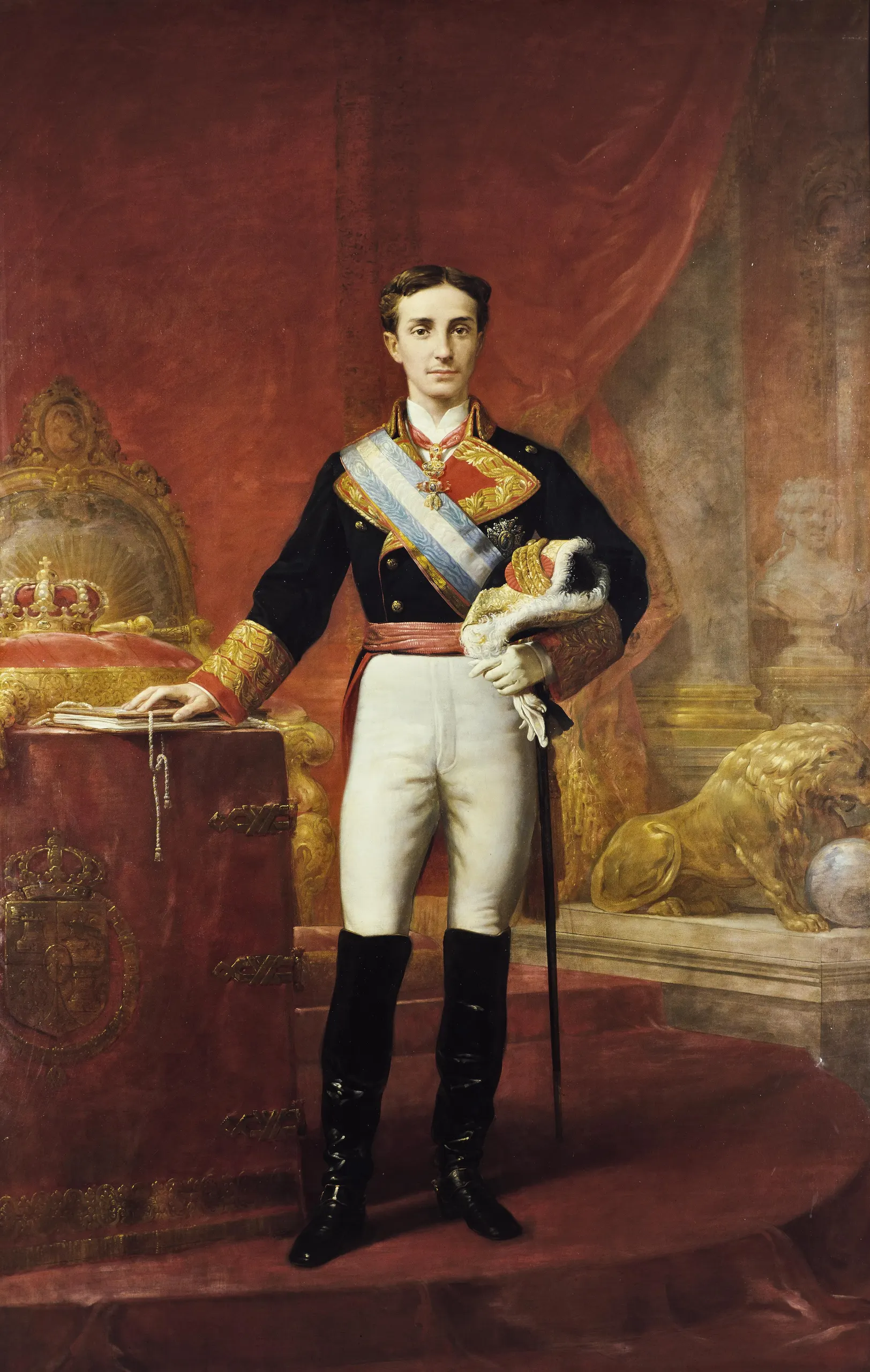
Alfonso XII
 Spain
SpainBirthday
+1857-11-28
Birth Sign
Sagittarius
Birthplace
Madrid
Age
Died at 27
About
Alfonso XII of Spain, born in Madrid on November 28, 1857, was a monarch known for restoring stability to a country fractured by revolution. His brief reign, from December 29, 1874, until his untimely death at 27 in 1885, earned him the nickname 'the Peacemaker.' The son of Queen Isabella II, Alfonso spent his early years in exile after the Glorious Revolution of 1868 toppled his mother. Educated in Austria and France, he returned to Spain in 1874 following a military coup that ended the First Spanish Republic. His reign brought an end to the Carlist Wars and established a constitutional monarchy, though his life was cut short by illness. He died just days before his 28th birthday, leaving his pregnant wife, Maria Christina of Austria, as regent. Their son, Alfonso XIII, was born the following year and became king at birth, with Maria Christina ruling as regent until 1902.
Fame & Fandom
Alfonso XII of Spain commands a legacy defined by historical necessity rather than modern adulation. Unlike contemporary icons who cultivate digital communities, the King of the Restoration era possesses no organized fanbase, nor is there a documented name for any collective of admirers. His interactions were strictly those of a monarch with his subjects during the late nineteenth century, devoid of the streaming campaigns, birthday billboards, or charity drives that characterize current celebrity culture. The search records contain no evidence of fan rituals, inside jokes, or projects funded by followers, as the figure died over a century ago and lacks the living presence required to generate such phenomena. While recent news occasionally references the broader Spanish monarchy or vehicles named after his successor, Alfonso XIII, these instances do not indicate a resurgence of a specific movement around Alfonso XII himself. iFANN has evaluated this profile within its Global Fame Engine, yet the subject does not currently hold a placement in the published rankings, including the Global Top 1,000 or any Top-100 scope list. This absence of a numeric rank reflects the reality that his fame exists entirely within the realm of history books and academic study rather than global consumption signals. He is not ranked among the most famous people in the world because his influence was confined to a specific political era and geography, lacking the transnational, pop-culture saturation required for inclusion in the engine's current metrics. The narrative surrounding him remains one of political restoration and tragic brevity, a story told by historians rather than celebrated by fans. There are no viral moments or crowds shutting down streets due to personal charisma in the manner of modern stars. His reputation rests on the verified fact that he ended the Carlist Wars and established a constitutional monarchy, a feat that secured his place in Spanish historiography without generating the widespread, ongoing public engagement needed for a ranking.
Interesting Facts and Legends
Born in Madrid on November 28, 1857, Alfonso XII was the son of Queen Isabella II and spent his early years in exile following the Glorious Revolution of 1868. Educated in Austria and France, he returned to Spain in 1874 to reclaim the throne after a military coup ended the First Spanish Republic. He is universally known by the epithet 'El Pacificador' (The Peacemaker), a title earned by successfully restoring the Bourbon monarchy and bringing stability to a country fractured by decades of civil war. His reign brought an end to the Carlist Wars and established the 'Restoration' era, characterized by relative peace and political rotation between liberal and conservative parties. The King suffered from tuberculosis and died at the Royal Palace of Zarzuela on November 25, 1885, just days before his twenty-eighth birthday. His untimely death created a massive national mourning event and triggered a succession crisis that led to the regency of his wife, Maria Christina of Austria, for their unborn son, the future Alfonso XIII. Historical accounts confirm his death occurred in 1885, correcting earlier erroneous reports suggesting a date in January 1875. The narrative of his short but crucial reign serves as a central theme in Spanish historiography, marking the bridge between mid-nineteenth-century chaos and the eventual establishment of a long-lasting constitutional monarchy.
Death & Aftermath
Died
+1885-11-25 (aged 27)
Death Place
La Moraleja, Madrid, Spain
Cause of Death
Typhoid fever
Alfonso XII died at the Royal Palace of El Pardo in La Moraleja on November 25, 1885. The attending physicians attributed the fatal illness to typhoid fever, a diagnosis reached through clinical observation over several days of declining health rather than a formal autopsy or coroner's ruling. While some later analyses have suggested tuberculosis as a contributing factor, the official record remains fixed on the acute infection contracted from contaminated food or water during his final weeks. The monarch's death triggered immediate and profound mourning across Spain, with spontaneous gatherings and moments of silence observed in churches throughout Madrid and other major cities. Political leaders, military officials, and the general populace offered tributes to the Peacemaker, whose reign had restored stability after the turmoil of the First Republic.
A private yet state-attended funeral ceremony took place shortly thereafter, featuring high-ranking clergy and government officials who escorted the body to the Royal Pantheon at the Royal Site of San Lorenzo de El Escorial. Queen Maria Christina of Austria and various European royalty attended the solemn religious rites and military honors that marked the burial. Posthumously, the continuity of the Bourbon dynasty was secured when the throne passed to his posthumous son, Alfonso XIII, born seven months after the king's death. The estate was managed according to royal succession laws, ensuring the smooth transition of power without dispute.
Awards & Accolades
Keywords
Quick Facts
- Profession
- sovereign
- Born
- +1857-11-28
- Birthplace
- Madrid
- Died
- +1885-11-25
- Death Place
- Royal Palace of El Pardo
- Gender
- Male
- Spouse
- Mercedes of Orléans, Maria Christina of Austria
- Birth Sign
- Sagittarius
Personal Details
- Spouse
- Mercedes of Orléans, Maria Christina of Austria
Join the community
fans discussing