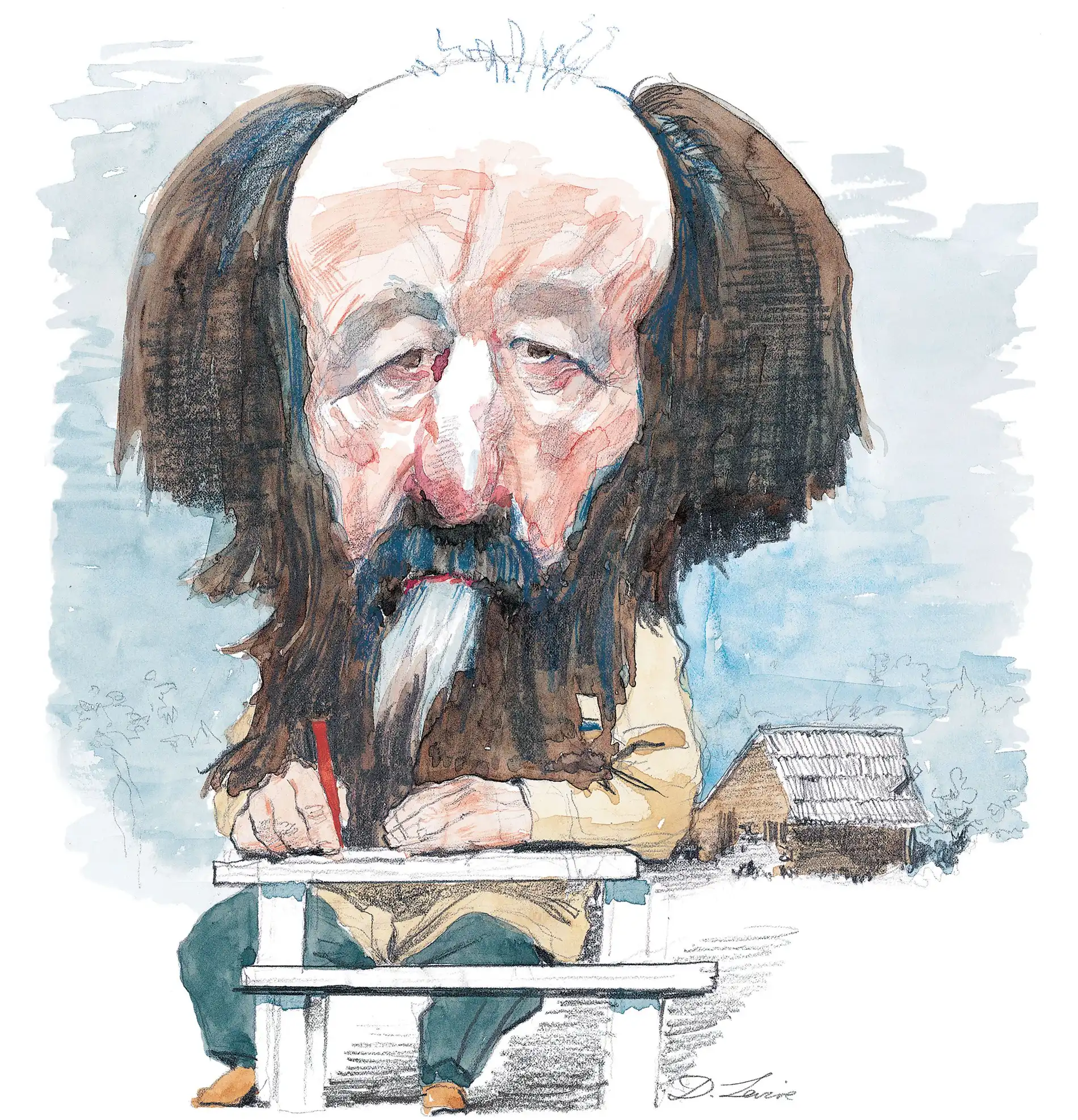
Aleksandr Solzhenitsyn
 Russia
Also known as: Alexander Solzhenitsyn, Aleksandr Isaevich Solzhenitsyn, Aleksandr Isayevich Solzhenitsyn
Birthday
December 11, 1918
Birth Sign
Sagittarius
Birthplace
Kislovodsk, Russia
Age
Died at 89
Height
5 ft 10 in (178 cm)
About
Aleksandr Solzhenitsyn remains a towering figure in global literature and history, renowned for his unyielding moral integrity and his profound impact on the understanding of totalitarianism. As a Soviet and Russian author, historian, and dissident, his works fundamentally altered global perceptions of the Soviet Union, exposing the brutal realities of the Gulag system to the world. Born in 1918, he transformed from a proponent of Marxism-Leninism into a devout Eastern Orthodox Christian and a relentless critic of state oppression following his eight-year imprisonment. His literary legacy is defined by the ethical force with which he pursued the indispensable traditions of Russian literature, earning him the Nobel Prize in Literature in 1970. Beyond his writing, Solzhenitsyn is recognized as a prophet of truth, warning against the dangers of collectivism and the erosion of individual conscience. His distinctive appearance, characterized by simple, modest clothing reflecting an ascetic lifestyle, became synonymous with his persona as a solitary figure standing against tyranny. He stands approximately 5 feet 10 inches tall, known for an intense gaze and thoughtful demeanor that commanded respect across political divides. His influence extends beyond literature into the realm of political philosophy, where his insights on the nature of good and evil continue to resonate in contemporary discussions regarding authoritarianism and moral polarization.
Early Life & Background
Aleksandr Isayevich Solzhenitsyn entered the world on December 11, 1918, in Kislovodsk, a resort town in the Caucasus region of what would become the Soviet Union. His early years were marked by profound loss; his father, Isaac Solzhenitsyn, died of typhoid fever when Aleksandr was just four months old. The family moved to Rostov-on-Don, where his mother, Varvara Solzhenitsyna, struggled to raise her son alone. She died of tuberculosis when Aleksandr was only nine, leaving him to be raised primarily by his grandmother. These formative years instilled a deep sense of independence and resilience in the young boy. Despite these hardships, Solzhenitsyn excelled academically. He enrolled at Rostov State University in 1936 to study physics and mathematics while simultaneously pursuing self-directed education in literature and history. His intellectual curiosity was boundless, and he developed a keen interest in both the sciences and the humanities. Before achieving fame, he served as a captain in the Red Army during World War II after being conscripted in 1941. In 1945, while serving on the front lines, he was arrested for writing critical letters about Joseph Stalin to a friend. This act led to an eight-year sentence in the Gulag labor camp system, where he endured harsh conditions, including a cancer diagnosis in 1953 that was treated with radiation in a special prison hospital. His survival and subsequent release in 1953, followed by internal exile until 1956, transformed him from a proponent of Marxism-Leninism into a devout Eastern Orthodox Christian and a relentless critic of totalitarianism.
Career Growth
Solzhenitsyn's career breakthrough arrived in 1962 with the publication of One Day in the Life of Ivan Denisovich, a novella depicting life in a Soviet labor camp. Published with the personal approval of Nikita Khrushchev, it was the first work of fiction to openly criticize Stalinist repression in the USSR. Following Khrushchev's fall, Solzhenitsyn faced increasing censorship; his novels Cancer Ward (1966) and In the First Circle (1968) were banned in the Soviet Union and published abroad. The pivotal moment in his career came with the smuggling and publication of The Gulag Archipelago (1973), a massive non-fiction work detailing the Soviet forced labor camp system. The book became an international bestseller and a direct challenge to the Soviet state. In response, the Soviet government stripped him of his citizenship in 1974, forcing him into exile. He lived in West Germany, then Switzerland, before settling in Cavendish, Vermont, USA, in 1976. During his exile, he continued to write prolifically, producing the multi-volume historical novel series The Red Wheel. His Soviet citizenship was restored in 1990, and he returned to Russia in 1994, traveling across the country by train to witness the changes firsthand. He settled in Moscow, living there until his death. His awards include the Nobel Prize in Literature in 1970, the Presidential Medal of Freedom in 2001, the Order of St. Andrew in 1994, and the Templeton Prize in 1997. TIME magazine named him one of the "100 Most Important People of the 20th Century" in 1998, and he received numerous honorary degrees from institutions like Harvard, Oxford, and Yale.
Career Timeline
Public Image & Style
Solzhenitsyn is portrayed as a moral giant, a man of unwavering integrity and courage. Media often depicts him as a solitary figure standing against tyranny, embodying the spirit of resistance. His tone in writing is serious, reflective, and deeply philosophical. He is seen as a prophet of truth, warning against the dangers of collectivism and the erosion of individual conscience. His distinctive appearance, often wearing simple, modest clothing even during his time in exile, reflected his ascetic lifestyle. He stood approximately 5 feet 10 inches tall and was known for his intense gaze and thoughtful demeanor. He is frequently cited in lists of "Most Influential Russians" and "Writers Who Changed the World." Notable magazine covers include TIME (1974, featuring him on the cover during his exile) and various editions of The New York Times Magazine and The Atlantic discussing his work. His public image is that of a writer whose life and work were inextricably linked, offering a stark contrast to the typical celebrity culture.
Fame & Fandom
Aleksandr Solzhenitsyn's standing in the cultural memory is as monumental as the books he left behind. The iFANN Global Fame Rankings currently place him as the 24th most famous person from Russia, a position he has held steady through the latest cycle, tracking his enduring resonance across media coverage, search, and consumption signals worldwide. It's a rank that feels almost too neat for a man who spent eight years in the Gulag and another two decades in exile, yet it speaks to how thoroughly his name has become synonymous with moral witness. His fame, however, is not the fame of a pop star or a film idol. There is no formal fandom, no nickname, no coordinated fan campaigns. What exists instead is a diffuse but devoted readership: scholars, historians, political thinkers, and readers who approach his work as testimony rather than entertainment. The Aleksandr Solzhenitsyn Center, a legacy-preservation institution, functions more as an academic foundation than a fan club, advancing scholarship and translation rather than organizing birthday tributes. The community is connected through universities, publishing houses, and a shared sense of moral urgency, not through hashtags or conventions. While he does not have a personal social media presence, his official website (www.solzhenitsyn.ru) and the Aleksandr Solzhenitsyn Center maintain online presences. Fan pages and academic groups discuss his work on platforms like Twitter/X and Facebook, but these are unofficial, with follower counts in the thousands, reflecting a dedicated but niche audience. Recent news items (2025-2026) focus on the relevance of his writings to contemporary geopolitical issues, particularly regarding authoritarianism and the nature of good and evil.
Interesting Facts and Legends
Solzhenitsyn was a talented mathematician and physicist before turning to literature. He developed a tumor in 1953 while in a Gulag hospital, which nearly killed him; doctors initially thought he would die, but he survived and used the experience to write about the fragility of life. He famously said, "The line separating good and evil passes not through states, nor between classes, nor between political parties either – but right through every human heart." He was also a skilled chess player and enjoyed hiking in Vermont. Another legendary moment is the publication of The Gulag Archipelago in 1973, which was smuggled out of the USSR and became a global sensation, effectively shattering the myth of the benevolent Soviet system. His return to Russia in 1994, traveling by train across the country, was a symbolic moment of national reckoning. These events are well-documented and form the core of his cultural mythology. Other notable quotes include "If only we could look into the hearts of our enemies, we would see that they are just as afraid of us as we are of them" and "To live without hope is to cease to live." He was associated with close friends such as the writer Vasily Aksyonov. The National Book Award for Nonfiction was controversially withheld for The Gulag Archipelago due to political pressure at the time, though the book remains a definitive text.
Notable Quotes
“The line separating good and evil passes not through states, nor between classes, nor between political parties either – but right through every human heart.”
“If only we could look into the hearts of our enemies, we would see that they are just as afraid of us as we are of them.”
“To live without hope is to cease to live.”
Family & Personal Life
Aleksandr Solzhenitsyn was married twice. His first marriage was to Natalia Reshetovskaya in 1940. They met while both were students at Rostov State University; she was a fellow student who later became his literary assistant and secretary. Their relationship began in the late 1930s and they married in 1940. Together, they had three sons: Yegor (born 1942), Kirill (born 1946), and Stepan (born 1948). The couple remained together through his imprisonment in the Gulag, with Natalia enduring immense hardship to support him and their children, often visiting him in camps and prisons. She acted as his primary editor and advocate throughout his career. The marriage ended in divorce in 1972, shortly before his expulsion from the Soviet Union. The reasons for the split are often attributed to the strain of his increasingly public role, the pressures of exile, and differences in how they navigated the transition from Soviet citizen to Western exile. In 1972, Solzhenitsyn married Natalia Dymova, a younger woman who became his second wife. They had one daughter, Elena (born 1972). This marriage lasted until his death in 2008. There are no widely documented romantic flings or high-profile affairs outside these two marriages. As of his death on August 3, 2008, he was widowed by his first wife (who died in 2009) and survived by his second wife, Natalia. He is deceased, so his current relationship status is "widower" (having been married to Natalia Dymova until his death).
Notable Connections
Relationships & Dating History
Aleksandr Solzhenitsyn was married twice. His first marriage was to Natalia Reshetovskaya (born Natalia Aleksandrovna Reshetovskaya) in 1940. They met while both were students at Rostov State University; she was a fellow student who later became his literary assistant and secretary. Their relationship began in the late 1930s and they married in 1940. Together, they had three sons: Yegor (born 1942), Kirill (born 1946), and Stepan (born 1948). The couple remained together through his imprisonment in the Gulag, with Natalia enduring immense hardship to support him and their children, often visiting him in camps and prisons. She acted as his primary editor and advocate throughout his career. The marriage ended in divorce in 1972, shortly before his expulsion from the Soviet Union. The reasons for the split are often attributed to the strain of his increasingly public role, the pressures of exile, and differences in how they navigated the transition from Soviet citizen to Western exile. In 1972, Solzhenitsyn married Natalia Dymova (sometimes referred to as Natalya Solzhenitsyna in some contexts, though distinct from his first wife), a younger woman who became his second wife. They had one daughter, Elena (born 1972). This marriage lasted until his death in 2008. There are no widely documented romantic flings or high-profile affairs outside these two marriages. As of his death on August 3, 2008, he was widowed by his first wife (who died in 2009) and survived by his second wife, Natalia. He is deceased, so his current relationship status is "widower" (having been married to Natalia Dymova until his death).
- MarriedNatalia Reshetovskaya1940 - 1972Met as students at Rostov State University; had three sons; divorced before his exile.
- MarriedNatalia Dymova1972 - 2008Second wife; had one daughter; remained married until his death.
Death & Aftermath
Died
August 3, 2008 (aged 89)
Death Place
Kotelniki, Moscow region, Russia
Cause of Death
Heart failure
Aleksandr Solzhenitsyn died on August 3, 2008, at his home in Kotelniki, a town in the Moscow region of Russia. He was eighty-nine years old when heart failure ended his life, a cause reported by family members. The Nobel laureate had been suffering from declining health for some time before passing quietly in his residence. Reaction to his death came swiftly from global leaders and literary institutions. Russian President Dmitry Medvedev honored him as a great writer and patriot whose works helped restore the nation's historical memory, while US President George W. Bush praised his courage and contribution to freedom. Tributes poured in from the Nobel Committee and universities worldwide, highlighting his role in exposing the Soviet Gulag system through The Gulag Archipelago and One Day in the Life of Ivan Denisovich. The funeral took place on August 6, 2008, at the Danilov Monastery in Moscow, one of the most prominent Orthodox Christian sites in the country. Thousands gathered to pay their respects, including Prime Minister Vladimir Putin, who delivered a eulogy during the religious service. Following the ceremony, Solzhenitsyn was buried in the monastery cemetery, adhering to his deep faith. In the years since, his estate has remained under the stewardship of his family and the Aleksandr Solzhenitsyn Center, which supports research and education regarding his life and works. His writings continue to be studied globally, with new translations of The Red Wheel series appearing periodically to ensure the continuity of his intellectual heritage.
Net Worth (Estate Value)
$25 Million
iFANN Editorial Team estimate
Aleksandr Solzhenitsyn passed away in 2008, so his net worth is now part of his estate. Estimates of his estate value vary, but given the enduring sales of his works, particularly in Russia and internationally, it is substantial. According to publishing industry reports, his books have sold over 50 million copies worldwide. Royalties from The Gulag Archipelago and The Red Wheel series provide a steady income. The estate is managed by his family and the Aleksandr Solzhenitsyn Center. Specific dollar figures for the estate's total value are not publicly disclosed in detail, but estimates suggest it could be in the tens of millions of dollars, driven by royalties, licensing deals for film adaptations (such as One Day in the Life of Ivan Denisovich), and translations. Unlike living celebrities, his wealth is static and managed passively by heirs and foundations. Research by the iFANN Editorial Team puts his estate's value at around $25 Million as of 2026. The estate continues to generate revenue through ongoing efforts including the publication of new editions of his works, academic conferences, and the activities of the Aleksandr Solzhenitsyn Center, which promotes research and education.
Awards Won (5)
Solzhenitsyn received numerous accolades throughout his life. He was awarded the Nobel Prize in Literature in 1970 for the ethical force with which he pursued the indispensable traditions of Russian literature. Other major awards include the Lenin Peace Prize (awarded posthumously in 2008), the Order of St. Andrew (the highest Russian honor, awarded in 1994 upon his return), and the Presidential Medal of Freedom (awarded by President George W. Bush in 2001). He received numerous honorary degrees from universities worldwide, including Harvard, Oxford, and Yale. He was inducted into the American Academy of Arts and Letters and received the Templeton Prize in 1997 for his contributions to spiritual understanding.
1970 · Literature
For his ethical force in pursuing the indispensable traditions of Russian literature
2001 · Civilian Award
For his courageous stand against totalitarianism
Known For
One Day in the Life of Ivan Denisovich
1962 · Author
The Gulag Archipelago
1973 · Author
Cancer Ward
1966 · Author
The Red Wheel
1971 · Author
Keywords
Sources
Quick Facts
- Profession
- writer, historian, novelist
- Born
- December 11, 1918
- Birthplace
- Kislovodsk
- Died
- August 3, 2008
- Death Place
- Moscow
- Gender
- Male
- Spouse
- Natalia Solzhenitsyna, Natalya Reshetovskaya
- Birth Sign
- Sagittarius
Personal Details
- Full Name
- Aleksandr Isayevich Solzhenitsyn
- Height
- 5 ft 10 in (178 cm)
- Spouse
- Natalia Dymova, Natalia Reshetovskaya
- Children
- Yegor, Kirill, Stepan, Elena
- Education
- Rostov State University
Frequently Asked Questions
What caused Aleksandr Solzhenitsyn's death?
How many wives did Solzhenitsyn have?
What is Solzhenitsyn's most famous book?
Did Solzhenitsyn ever return to Russia?
Why was Solzhenitsyn exiled?
Join the community
fans discussing