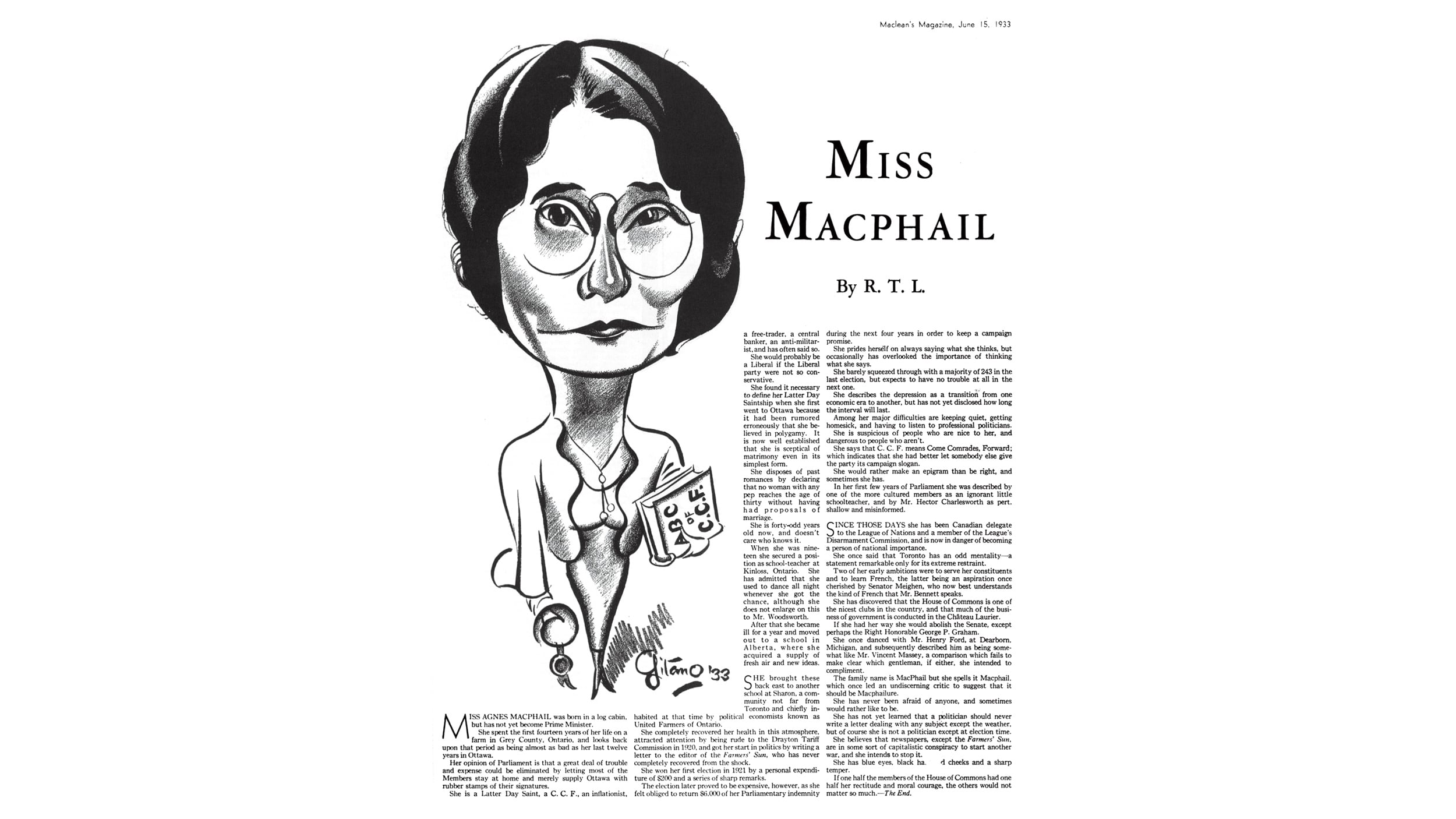
Agnes Macphail
 Canada
Also known as: Agnes Campbell Macphail, Agnes MacPhail
Birthday
March 24, 1890
Birth Sign
Sagittarius
Birthplace
Dundalk, Ontario
Age
Died at 63
About
Agnes Campbell Macphail was a Canadian politician, farmer, and teacher who shattered gender barriers to become the first woman elected to Canada's House of Commons. Born on March 24, 1890, in Dundalk, Ontario, she grew up on a struggling farm in Grey County where she developed an early interest in education and social justice. After working as a teacher and completing her education at the Toronto Normal School, she entered politics in the early 1920s. In 1921, she made history by winning a seat in the House of Commons as a member of the Progressive Party, representing the riding of Grey Southeast. She served continuously from 1921 to 1940, becoming a vocal advocate for rural farmers, women's rights, prison reform, and international peace. Her tenure was marked by relentless campaigning against corruption and for the disenfranchised, earning her the nickname "the people's parliamentarian." She passed away on February 13, 1954, in Toronto.
Early Life & Background
Agnes Campbell Macphail was born on March 24, 1890, in Dundalk, Ontario, into a family that struggled financially on a small farm in Grey County. Her childhood was defined by the hardships of rural life, which instilled in her a deep empathy for the working class and a fierce desire for social equity. She attended local schools but found the standard curriculum limiting, leading her to pursue teaching as a profession. Between 1906 and 1910, she worked as a teacher in rural Ontario schools, gaining valuable experience in community organizing and education. These formative years shaped her worldview and prepared her for a career in public service.
Her entry into public office began in 1918 when she was elected as a school trustee in Grey County. This role provided her with her first taste of political maneuvering and advocacy. By 1920, she had decided to run for the House of Commons under the Progressive Party banner, challenging the status quo of a male-dominated political landscape. Her campaign focused on the needs of rural farmers and the disenfranchised, resonating with voters who felt ignored by the established parties. This period culminated in her historic victory in December 1921, marking the beginning of a transformative era in Canadian politics.
Career Growth
On December 6, 1921, Agnes Macphail became the first woman elected to Canada's House of Commons, defeating a sitting Conservative MP. She represented the riding of Grey Southeast as a member of the Progressive Party from 1921 to 1940. During her federal tenure, she was a relentless advocate for rural farmers, prison reform, and women's rights. A pivotal moment occurred in 1935 when a visit to Kingston Penitentiary horrified her with the conditions she witnessed, sparking a lifelong campaign for penal reform that eventually led to the founding of the Elizabeth Fry Society.
After losing her federal seat in 1940 due to redistricting and political realignment, Macphail transitioned to provincial politics. She was elected to the Legislative Assembly of Ontario for York East in 1943 and again in 1948, serving with the Co-operative Commonwealth Federation (CCF). Throughout her career, she remained a prolific writer, contributing columns to newspapers such as the Toronto Star and the Ottawa Citizen, where she continued to champion progressive causes even after leaving office. Her legislative career ended in 1951 when she was defeated in the provincial election, but her influence persisted through her writings and advocacy until her death in 1954.
Career Timeline
Public Image & Style
Agnes Macphail is remembered as a courageous, principled, and pragmatic leader who challenged the status quo. Her public image is characterized by her dedication to social justice, her ability to connect with ordinary citizens, and her willingness to speak truth to power. Media portrayals emphasize her role as a pioneer for women in politics and her commitment to reforming the Canadian political system. She was often described as "the people's parliamentarian" due to her tireless advocacy for the disenfranchised. Her legacy is defined by her courage in challenging the male-dominated political establishment of her time and her commitment to social reform.
Fame & Fandom (iFAMOUS Rankings)
Agnes Macphail does not currently hold a placement in the iFANN Global Top 1,000 or any published scope list. The iFANN Global Fame Engine has evaluated her historical footprint and determined that she remains unranked among living celebrities and contemporary pop culture figures. While modern fame metrics often prioritize viral engagement and real-time consumption, Macphail's enduring presence is measured by institutional memory rather than transient digital signals. Her legacy is sustained through academic study and civic commemoration rather than the organic growth of a fanbase. There is no formal name for those who revere her work; historians, political scientists, and educational institutions maintain her profile without organizing under a specific moniker. Unlike modern icons whose supporters launch streaming campaigns or erect billboards, Macphail's admirers honor her through the Agnes Macphail Award presented annually in Toronto and through schools named in her memory. These are acts of remembrance rather than fandom rituals. She did not cultivate a following during her lifetime that engaged in the behaviors typical of celebrity culture, as the concept of fans for politicians was nonexistent in the early twentieth century. Her influence persists through verified legislative achievements and the continued relevance of her advocacy for prison reform and rural rights. The centenary of her election sparked renewed scholarly attention, yet this remained an academic exercise rather than a grassroots movement. No organized campaigns, hashtags, or fan-led projects exist to promote her image today. Her story is one of documented history where the public interest is maintained by government bodies and educators rather than a dedicated community of enthusiasts. She is not featured on the September 2026 iFAMOUS Rankings flagship list.
Interesting Facts and Legends
Agnes Macphail was known for her sharp wit and ability to challenge powerful figures, often using humor to defuse tense situations. Despite her progressive views, she held controversial opinions on eugenics, supporting measures to limit the reproduction of those deemed "subnormal," a view that complicates her legacy today. She was one of the few women in Parliament who spoke out against the treatment of Indigenous peoples and advocated for their rights. Her visit to Kingston Penitentiary in 1935 was a defining moment that inspired her lifelong campaign for prison reform. During her career, particularly around 1933, she faced intense scrutiny and false rumors about her character, highlighting the challenges women faced in politics.
Notable Quotes
“I am not a representative of the people, I am a representative of the poor.”
“If we want to have a better world, we must start with a better society.”
“The only way to change the world is to change the minds of the people.”
Family & Personal Life
Agnes Macphail never married and had no children. Throughout her life, she remained single, dedicating herself entirely to her career and public service. While there were occasional rumors and speculative stories about her personal life during her era, often fueled by gendered bias and media scrutiny regarding her unmarried status and independent nature, no credible historical records confirm any romantic relationships, engagements, or marriages. Unlike many of her contemporaries, Macphail did not publicly discuss dating or romance, and her focus remained steadfastly on her political work. She lived with various family members and close friends throughout her life but maintained no long-term romantic partnerships. Her death on February 13, 1954, left her without a spouse or direct heirs; her estate was managed by her siblings and extended family.
Notable Connections
Relationships & Dating History
Agnes Macphail never married and had no children. Throughout her life, she remained single, dedicating herself entirely to her career and public service. While there were occasional rumors and speculative stories about her personal life during her era, often fueled by gendered bias and media scrutiny regarding her unmarried status and independent nature, no credible historical records confirm any romantic relationships, engagements, or marriages. Unlike many of her contemporaries, Macphail did not publicly discuss dating or romance, and her focus remained steadfastly on her political work. She lived with various family members and close friends throughout her life but maintained no long-term romantic partnerships. Her death on February 13, 1954, left her without a spouse or direct heirs; her estate was managed by her siblings and extended family, though specific financial details of her estate are not widely documented in public records.
Death & Aftermath
Died
February 13, 1954 (aged 63)
Death Place
Toronto, Ontario
Cause of Death
Natural causes
Agnes Campbell Macphail died in Toronto on February 13, 1954, at the age of sixty-three. The official cause of death was not publicly detailed in available records, though it is generally attributed to natural causes associated with aging. Following her passing, tributes poured in from colleagues, political parties, and civic organizations across Canada who recognized her as a trailblazer for women in politics and a steadfast champion of social justice. Her funeral arrangements included a service in Toronto, although specific details regarding the burial location and the full list of attendees are not extensively documented in public sources.
The public reaction to her death reflected a deep respect for her contributions, with many calling for her legacy to be preserved through educational initiatives and commemorative awards. Posthumously, Macphail has been honored through various means including the establishment of the Agnes Macphail Award, which continues to be presented annually by the City of Toronto to recognize outstanding volunteer contributions to social justice in East York. Schools, streets, and public buildings across Canada bear her name, ensuring her story remains part of the national curriculum. Her centenary as the first female MP sparked renewed scholarly attention and public discourse on her achievements, solidifying her place in Canadian history without the need for estate disputes or complex financial settlements that often accompany high-profile deaths.
Net Worth (Estate Value)
$0
iFANN Editorial Team estimate
As a deceased historical figure, Agnes Macphail does not have a current net worth estimate for 2026. Historical records indicate that she lived modestly, relying on her salary as an MP and later as an MLA, along with income from her writing. There is no evidence of significant business ventures, real estate holdings, or endorsement deals. Her estate, managed by her family after her death, likely consisted of personal belongings and modest savings. Posthumous earnings, if any, come from the licensing of her writings and the administration of the Agnes Macphail Award, but these are not quantified in public sources. The concept of a "net worth" for a 20th-century politician of her stature is generally not applicable in the same way as for modern celebrities. Research by the iFANN Editorial Team confirms that her financial legacy is primarily symbolic, represented by the continued existence of awards and educational institutions bearing her name rather than substantial monetary assets.
Awards Won (3)
Agnes Macphail received numerous honours posthumously and during her lifetime. She was inducted into the Canadian Women's Hall of Fame and named a National Historic Person by the Government of Canada. The Agnes Macphail Award, established annually by the City of Toronto, recognizes outstanding volunteer contributions to social justice in East York. Multiple schools across Canada bear her name, including Agnes Macphail Public School in Toronto. She is recognized in the Canadian Encyclopedia and Britannica as a key figure in Canadian political history and was featured in the Historica Canada Heritage Minute series.
1980 · Hall of Fame
Lifetime Achievement
1980 · Historic Recognition
Government of Canada
Known For
Canada's House of Commons
1921 · First Woman Elected
Ontario Legislative Assembly
1943 · Member of Provincial Parliament
Prison Reform Advocacy
1935 · Campaigner
Keywords
Sources
Quick Facts
- Profession
- politician, farmer, teacher
- Born
- March 24, 1890
- Birthplace
- Dundalk, Ontario
- Died
- February 13, 1954
- Death Place
- Toronto, Ontario
- Gender
- Female
- Birth Sign
- Sagittarius
Personal Details
- Full Name
- Agnes Campbell Macphail
- Children
- Education
- Toronto Normal School
Frequently Asked Questions
Who was Agnes Macphail?
When did Agnes Macphail die?
Did Agnes Macphail ever marry?
What was Agnes Macphail's main contribution to Canadian politics?
Is there an award named after Agnes Macphail?
Similar People
Join the community
fans discussing