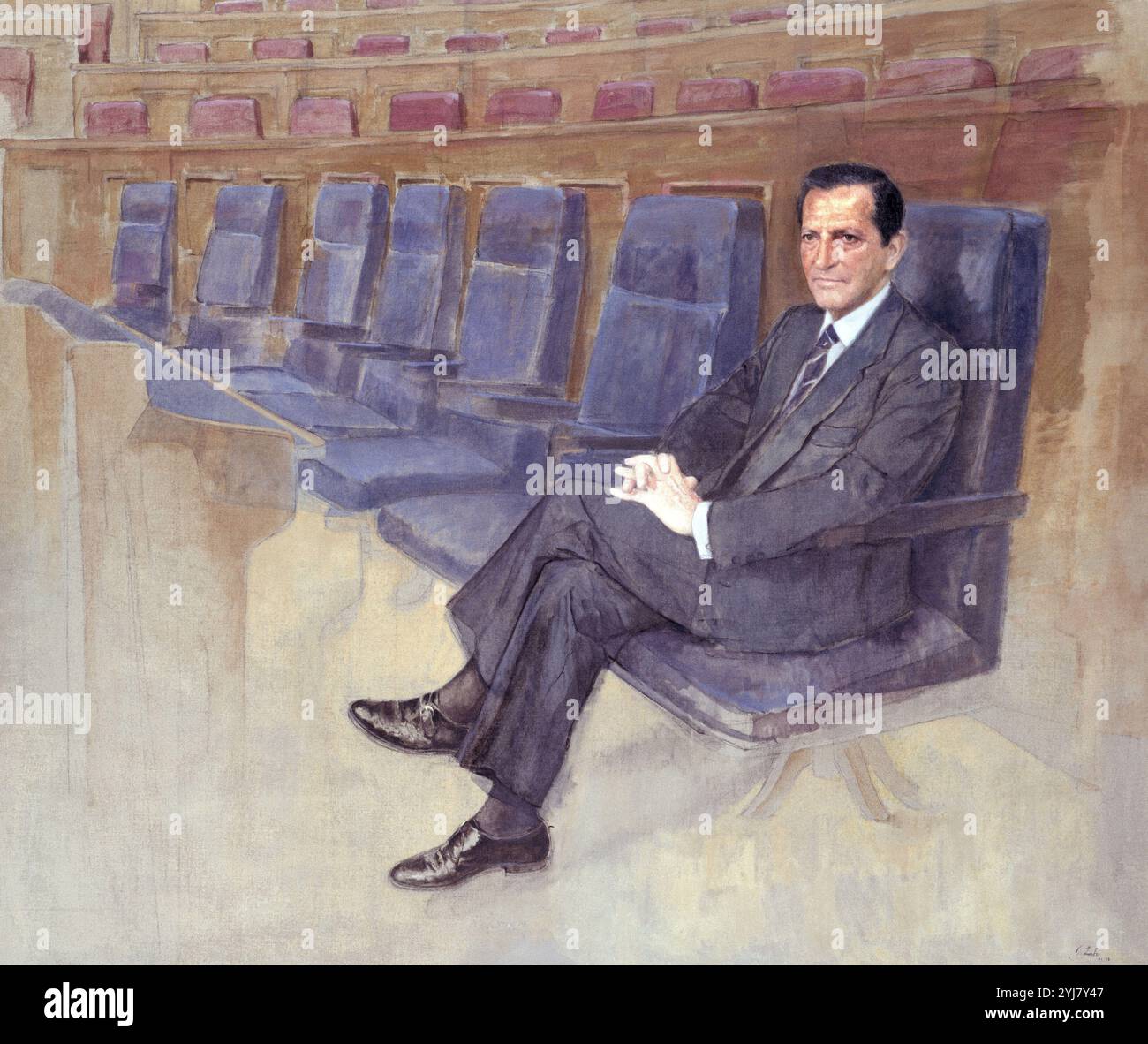
Adolfo Suárez
 Spain
SpainAlso known as: Adolfo Suárez González, 1st Duke of Suárez
Birthday
September 25, 1932
Birth Sign
Libra
Birthplace
Cebreros, Ávila, Spain
Age
Died at 81
About
Adolfo Suárez González was a Spanish lawyer and politician who served as Prime Minister of Spain from 1976 to 1981. He was the country's first democratically elected prime minister since the Second Spanish Republic and the pivotal figure in Spain's transition to democracy after the dictatorship of Francisco Franco.
Suárez is remembered for his courage and pragmatism during a delicate political period. Appointed by King Juan Carlos I, he dismantled the Francoist institutions, legalized political parties, and led the Union of the Democratic Centre (UCD) to victory in the 1977 general election. He also shepherded the 1978 Constitution that established a parliamentary monarchy. After resigning in 1981, he founded the Democratic and Social Centre (CDS) and remained active in politics until 1991. He retired from public life in 2003 due to Alzheimer's disease and died in Madrid on March 23, 2014, at age 81.
Early Life & Background
Adolfo Suárez was born on September 25, 1932, in Cebreros, a small town in the Province of Ávila, Spain. He was the eldest son of Hipólito Suárez Guerra, a lawyer and minor civil servant, and Herminia González Prados, who came from a politically influential family. Both parents supported the Republican side during the Spanish Civil War, a fact that shaped his early understanding of the country's divisions.
At 16, he entered the University of Salamanca, and at 21 he earned a law degree. He later completed a doctorate cum laude at the Central University of Madrid. As a young man, he was president of the Ávila chapter of Catholic Action, and he briefly worked as a porter at Madrid's Atocha railway station. He became a member of Opus Dei, a conservative Catholic organization.
His professional life began in 1955 when he took a job at the municipal government of Ávila. His diligence caught the attention of Fernando Herrero Tejedor, the civil governor, who appointed him as his private secretary. Suárez then rose through the administrative ranks of Franco's regime, winning a seat in the Cortes for Ávila in 1966, serving as civil governor of Segovia from 1968 to 1969, and directing national radio and television from 1969 to 1973. He also chaired the National Tourism Company from 1973 to 1975 and became secretary-general of the National Movement in December 1975. That same year, he founded the Union of the Spanish People (UDPE), a reformist political association.
Career Growth
Suárez's breakthrough came in July 1976 when King Juan Carlos I appointed him prime minister, a surprise choice that initially drew skepticism from many political forces. He moved quickly to dismantle the old regime, overseeing the dissolution of the Francoist Cortes and legalizing all political parties, including the Communist Party of Spain, a decision that required considerable courage.
He led the Union of the Democratic Centre (UCD) to victory in the 1977 general election with over a third of the votes, and he pushed the new constitution through parliament in 1978. Reelected in 1979, he faced a motion of censure in 1980 but narrowly won a vote of confidence. Weakened by internal party divisions, he resigned on January 29, 1981, and was succeeded by Leopoldo Calvo-Sotelo. The king granted him the title Duke of Suárez in February 1981.
After leaving office, Suárez founded the Democratic and Social Centre (CDS) in 1982 and was elected to Congress in 1982, 1986, and 1989. He retired from active politics in 1991 and from public life in 2003 due to Alzheimer's disease.
Career Timeline
Public Image & Style
Adolfo Suárez is remembered as a pragmatist rather than an ideologue, a man who understood that Spain's transition to democracy required dismantling the Francoist regime from within. His deep knowledge of the old system gave him credibility among conservatives while his reformist actions won over the opposition. He was seen as a bridge between the old and the new, a leader who could negotiate with both sides. His courage in legalizing the Communist Party and pushing for democratic elections earned him respect across the political spectrum. In later years, his struggle with Alzheimer's disease humanized him further, and his death in 2014 brought an outpouring of national mourning, with tributes highlighting his role as the architect of modern Spanish democracy.
Fame & Fandom
Adolfo Suárez commanded the global stage during a singular historical juncture, yet his enduring legacy is primarily anchored in Spain rather than as a figure of contemporary international celebrity culture. While his name remains synonymous with the transition to democracy, iFANN's Global Fame Engine has evaluated this person, but they do not currently hold a placement in the published rankings (Global Top 1,000 or a Top-100 scope list). The evaluation confirms that while he is a monumental figure in political history, he does not appear in the current global fame metrics for living or recently deceased public figures outside of specific regional historical contexts. Consequently, there is no documented fandom name associated with him; his admirers are best understood as historians, political scientists, and citizens who revere his foundational role in modern Spanish democracy rather than an organized fanbase with rituals or campaigns. Unlike pop icons or athletes, there are no fan-funded projects, birthday billboards, or viral incidents where crowds disrupted events due to his presence in a celebratory context. The interaction between Suárez and the public was that of a statesman and his constituents during a critical period of national transformation. His story is one of legislative courage and constitutional negotiation, remembered through the annual celebration of the 1978 Constitution and the naming of major infrastructure like the Madrid-Barajas Airport, which serve as permanent memorials to his contribution to the state.
Interesting Facts and Legends
Suárez was appointed prime minister while still a relatively unknown figure, which initially made many political forces skeptical. He legalized the Communist Party of Spain, a move requiring considerable political courage. In 1996, the Prince of Asturias honored him with the Concord Prize in recognition of his political leadership during the Spanish transition. His resting place is the Cathedral of Ávila. He is listed as a member in memoriam of the Club de Madrid. A widely retold story from his tenure involves his resignation just days before the attempted coup d'état known as '23-F'. In his departure speech, he famously declared, 'I am leaving without having been asked to,' a moment frequently referenced in analyses of the period. Another iconic moment was the drafting of the new constitution, which is celebrated annually in Spain as a reflection of the fragile pacts he managed. These legislative victories define his cultural mythology more than any personal folklore, cementing his status as a pragmatist who navigated the country through its most delicate political era.
Family & Personal Life
Adolfo Suárez's family background was rooted in the province of Ávila. His father, Hipólito Suárez Guerra, was a lawyer and minor civil servant, while his mother, Herminia González Prados, came from a politically influential family in Cebreros. He had siblings, but their names are not widely documented. In 1961, he married Amparo Illana Elórtegui, and they had five children together, including Adolfo Suárez Illana, who later entered politics. The couple remained married until Amparo's death in 2001. Suárez was widowed and did not remarry. He lived in Madrid for much of his later life, and his family remained close, with his son becoming a prominent figure in the People's Party.
Notable Connections
Adolfo Suárez worked closely with King Juan Carlos I, who appointed him prime minister and later granted him the title Duke of Suárez. He succeeded Carlos Arias Navarro as prime minister and was succeeded by Leopoldo Calvo-Sotelo. His early mentor was Fernando Herrero Tejedor, who gave him his first political appointment. Suárez's political legacy is intertwined with the transition from Franco's dictatorship to democracy, and he is often compared to other leaders of democratic transitions, such as Nelson Mandela.
Relationships & Dating History
Adolfo Suárez's personal life was marked by a single, long-lasting marriage. He married Amparo Illana Elórtegui in 1961, and they remained together until her death in 2001. The couple had five children, and their marriage was seen as stable and supportive, with Amparo often appearing alongside her husband at official events. After Amparo's death, Suárez remained a widower and did not remarry. No other public romantic relationships were reported during his lifetime. As of 2026, Suárez is deceased, having passed away in 2014.
- MarriedAmparo Illana Elórtegui1961 - 2001Married from 1961 until her death in 2001; they had five children together.
Death & Aftermath
Died
March 23, 2014 (aged 81)
Death Place
Madrid, Community of Madrid, Spain
Cause of Death
Natural causes due to Alzheimer's complications
Adolfo Suárez González passed away on March 23, 2014, at his home in the Moncloa district of Madrid. The former Prime Minister died peacefully in his sleep at the age of 81 following a long decline in health marked by complications from Alzheimer's disease. His family and the Spanish government confirmed the natural causes, noting that the end came after years of frailty that had already removed him from active public life. The nation responded with profound mourning, as President Mariano Rajoy declared three days of national mourning to honor the architect of Spain's transition to democracy. King Juan Carlos I, who had appointed Suárez in 1976, paid tribute to him as the great architect of their democracy, while tributes poured in from across the political spectrum and international dignitaries alike.
The funeral service took place two days later on March 25, 2014, at the historic Church of San Jerónimo el Real in Madrid. The solemn ceremony was attended by King Felipe VI, former King Juan Carlos I, and Prime Minister Mariano Rajoy, reflecting the high status Suárez held as a national hero. Following the religious rites, Suárez was laid to rest in the family plot in Cebreros, Ávila, his birthplace. His legacy endured through immediate honors such as the continued naming of Adolfo Suárez Madrid-Barajas Airport. Decades later, his former residence in Ávila saw a commercial transformation into a five-star luxury hotel in February 2026, though his family maintained a low profile regarding the estate to focus on preserving his historical memory.
Net Worth (Estate Value)
$5 Million
iFANN Editorial Team estimate
Per iFANN's editorial analysis, Adolfo Suárez's net worth is estimated at around $5 Million as of 2026, derived from his long political career, including his time as prime minister and his later roles as party leader and member of parliament. While specific salary figures are not publicly documented, his positions came with government remuneration, and he also received a pension after his retirement. After his death in 2014, his estate has been managed by his family, primarily his son Adolfo Suárez Illana. The estate's value is modest compared to modern politicians, reflecting his relatively modest lifestyle. No significant posthumous earnings from book deals or licensing have been reported, though his legacy continues to be honored through memorials and institutional tributes.
Awards Won (1)
Adolfo Suárez received the Prince of Asturias Award for Concord in 1996, recognizing his leadership during Spain's transition to democracy. He was also granted the title Duke of Suárez by King Juan Carlos I in 1981, a hereditary honor that reflects his lasting impact on the nation.
1996 · Concord
Leadership during Spanish transition to democracy
Known For
Prime Minister of Spain
1976-1981 · Prime Minister
Spanish transition to democracy
1976-1981 · Leader of the transition
Keywords
Sources
Quick Facts
- Profession
- politician, lawyer
- Born
- September 25, 1932
- Birthplace
- Cebreros, Ávila, Spain
- Died
- March 23, 2014
- Death Place
- Madrid, Spain
- Gender
- Male
- Spouse
- Amparo Illana Elórtegui
- Children
- 5
- Education
- University of Salamanca; Central University of Madrid
- Title
- Duke of Suárez
Personal Details
- Full Name
- Adolfo Suárez González
- Spouse
- Amparo Illana Elórtegui
- Children
- 5 (including Adolfo Suárez Illana)
- Education
- University of Salamanca, Central University of Madrid
Frequently Asked Questions
What is Adolfo Suárez known for?
When did Adolfo Suárez die?
Who was Adolfo Suárez's wife?
How many children did Adolfo Suárez have?
What party did Adolfo Suárez lead?
Similar People
Join the community
fans discussing