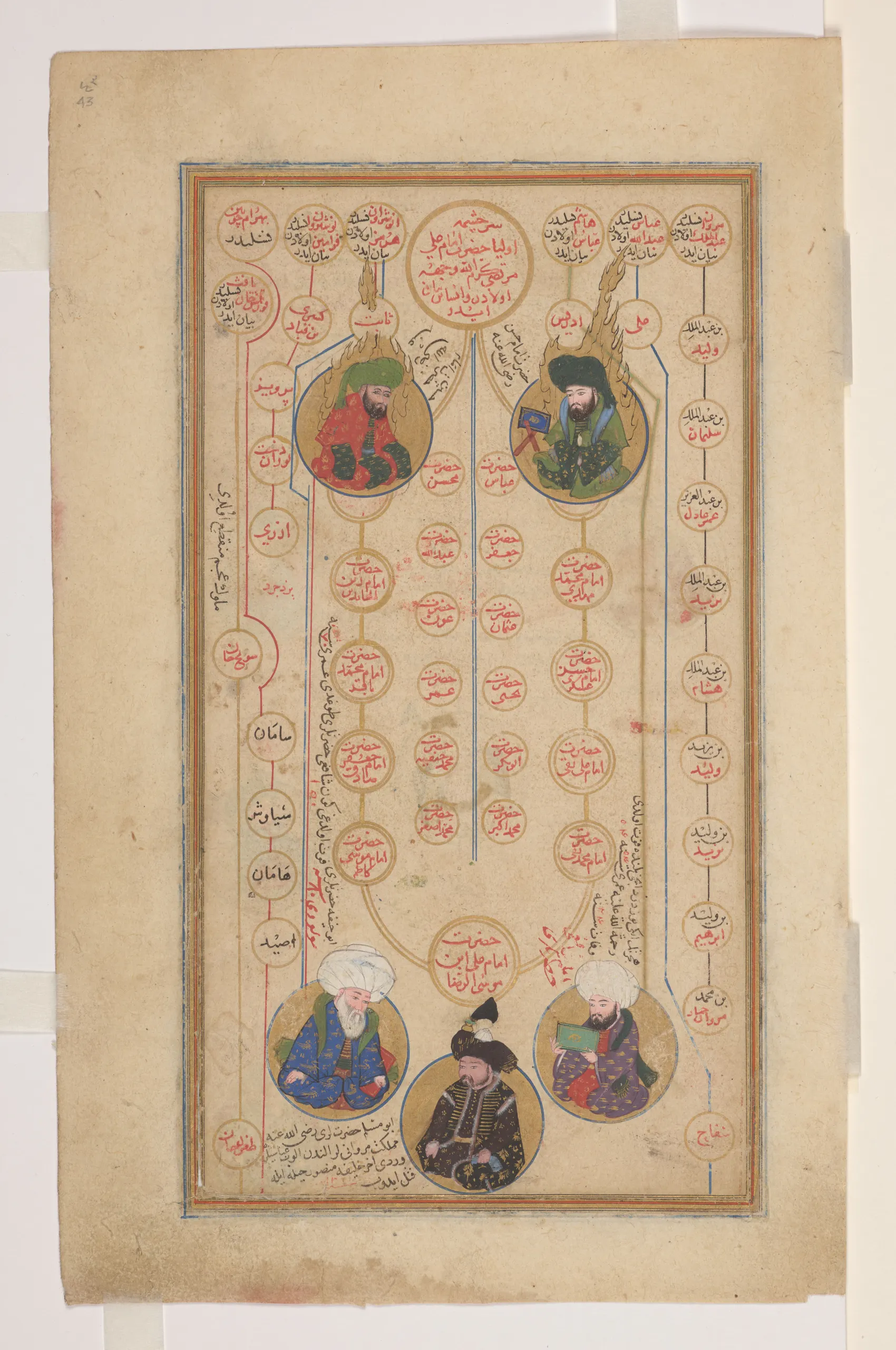
Abū Ḥanīfa
Islamic jurist•theologian•merchant
Also known as: Imam Abu Hanifa, Nūʿmān ibn Thābit, Imam al-A'zam
Birthday
September 5, 699
Birth Sign
Virgo
Birthplace
Kufa
Age
Died at 67
About
Abū Ḥanīfa was a preeminent Muslim scholar, jurist, and theologian born in Kufa during the early eighth century. His full name was Nūʿmān ibn Thābit, though history remembers him as Imam al-A'zam, meaning The Greatest Leader. He founded the Hanafi school of Sunni jurisprudence, which stands today as the largest legal tradition within Sunni Islam, guiding hundreds of millions of Muslims across Central Asia, South Asia, Turkey, and beyond.
Unlike many contemporaries who sought political power, Abū Ḥanīfa prioritized intellectual independence and the use of human reason alongside religious texts. His methodology emphasized analogical deduction and flexible interpretation, allowing his legal framework to adapt to diverse cultures and times. This approach earned him deep respect among students and scholars alike, even as it brought him into conflict with ruling authorities who demanded absolute obedience.
Early Life & Background
Nūʿmān ibn Thābit entered the world on September 5, 699, in the bustling city of Kufa, Iraq. Born into a family of Persian descent, he initially followed a path far removed from the scholarly life that would eventually define him. His father, Thābit, passed away when Nūʿmān was young, leaving the boy to manage the family's silk trading business. Historical accounts describe him as a successful khazzāz, or silk merchant, who owned a large workshop employing numerous workers. This commercial success provided him with financial independence that later proved crucial for his scholarly pursuits.
Before dedicating himself entirely to religious studies, Abū Ḥanīfa traveled extensively for trade purposes. These journeys took him to the Hejaz region, including the holy cities of Mecca and Medina around 714 CE. It was during these travels that he encountered prominent scholars and began formal religious education. Upon returning to Kufa, he settled under the tutelage of Hammad ibn Abi Sulayman, a renowned teacher whose influence sparked a profound transformation in Nūʿmān's life. Impressed by Hammad's teachings, he reportedly abandoned his primary commercial focus to devote his days to the pursuit of knowledge, though he occasionally engaged in trade to support his students and maintain his financial autonomy.
Career Growth
Abū Ḥanīfa's career as a scholar unfolded through his teaching circle in Kufa, where he attracted thousands of students over several decades. His breakthrough as a leading authority came not through official appointments but through the sheer volume and quality of his followers. Two students, Abu Yusuf and Muhammad al-Shaybani, became particularly influential. They later served as judges under the Abbasid Caliphate and systematically wrote down his oral rulings, transforming his teachings into a structured legal system known as the Hanafi school.
His most significant achievement was formulating principles that balanced strict adherence to the Quran and Sunnah with the use of human intellect (*ra'y*) and analogical reasoning (*qiyas*). This flexibility allowed Islamic law to remain relevant across vast empires and diverse populations. However, his commitment to principle often clashed with political power. In 736 CE, he refused an offer to serve as Chief Judge under Caliph Al-Mansur, a stance that led to his imprisonment in 763 CE. He remained incarcerated until his death in Baghdad in 767 CE, refusing to compromise his integrity even at the cost of his freedom.
Career Timeline
Public Image & Style
Abū Ḥanīfa is portrayed as a model of humility, integrity, and intellectual rigor. Religious texts and media emphasize his refusal to compromise his principles for political gain, presenting him as the wise old scholar who stood firm against tyranny. His image is one of the independent thinker who valued truth over power. Followers view him as a symbol of justice and moderation, appreciating his theology of restraint and his ability to blend strict legal reasoning with deep personal piety.
Fame & Fandom (iFAMOUS Rankings)
iFANN has not yet collected fame data for this person. As a historical figure from the eighth century, Abū Ḥanīfa does not appear in modern global fame rankings based on current digital signals. Instead, his influence is measured by the enduring reach of his legal school. Millions of Muslims worldwide follow the Hanafi school of jurisprudence, making him one of the most impactful figures in Islamic history.
There is no formal fandom name documented for his followers, though those adhering to his school are often referred to as Hanafis. Fan campaigns do not exist in the modern sense, but widespread charitable drives and educational initiatives bear his name. Mosques built in his honor and scholarships established by his name continue to spread his teachings. Recent events like the Fourth National and International Exhibition of Imam Abu Hanifa in Kabul in November 2025 highlight his ongoing global reverence.
Interesting Facts and Legends
Before becoming one of history's most revered scholars, Abū Ḥanīfa was a wealthy silk merchant who owned a large workshop. This rare background for a major jurist gave him unique insights into commerce and daily life, which influenced his legal rulings. A famous legend tells of a time when scholars challenged him with complex questions; he answered them all with ease, demonstrating his mastery of both text and reason.
The incident where he refused to accept the position of Chief Judge is considered his most iconic moment. When Caliph Al-Mansur pressured him to take the post, Abū Ḥanīfa declared he would not be a tool of the state. This defiance led to his imprisonment, where he reportedly died either from poisoning or harsh conditions in 767 CE. Stories also recount that he spent entire nights in prayer, weeping for his sins, with tears soaking his prayer mat. While some tales of miracles are folklore, they remain cherished in popular culture.
Notable Quotes
“Knowledge is better than wealth, for wealth is lost while knowledge is preserved.”
“I am only a human being; if I speak the truth, it is from Allah, and if I err, it is from myself.”
“The best of people are those who benefit others.”
Family & Personal Life
Abū Ḥanīfa's family background included a father named Thābit, who died when he was young, leaving him to manage the family business. While historical sources mention he had children, specific details about their names or mothers are not consistently recorded in primary texts. His legacy was carried forward primarily through his students rather than his direct descendants. He lived simply despite his wealth, often wearing humble woolen garments and engaging in nightly prayers, reflecting his ascetic lifestyle and dedication to God.
Notable Connections
Hammad ibn Abi Sulayman, Abu Yusuf, Muhammad al-Shaybani, Caliph Al-Mansur
Relationships & Dating History
Historical records do not document any romantic relationships, dating history, or marriages for Abū Ḥanīfa in the modern sense. Biographies focus entirely on his spiritual life, asceticism, and dedication to God. While some sources mention he had children, specific details about their names or mothers are not consistently recorded, and they played no public role in his legacy. His life was defined by his relationship with his students and the broader Muslim community, particularly those who followed his legal school.
Death & Aftermath
Died
June 18, 767 (aged 67)
Death Place
Baghdad
Cause of Death
Reported injuries from imprisonment beatings
The scholarly community in Baghdad fell silent when news spread of the death of Abū Ḥanīfa, marking the immediate loss of one of the four great Imams of Sunni jurisprudence. Tributes from peers were profound, eulogizing him as Imam al-A'zam (the Greatest Imam). His passing triggered an immediate shift in the center of gravity for Islamic legal thought, solidifying the Hanafi school as the dominant tradition across vast regions. On 18 Ramadan 150 AH (June 18, 767 CE), the jurist died in a prison cell in Baghdad at approximately sixty-eight years of age. Historical narratives established through later biographical accounts state that he was incarcerated by Caliph al-Manṣūr following his steadfast refusal to accept the position of Chief Judge, a stance rooted in his belief that such an appointment compromised judicial independence.
During his confinement, sources report he endured physical abuse and flogging, with the most widely cited account asserting that he died from the severe injuries sustained during this beating. While some traditions suggest poisoning, the consensus among major historians leans toward death by injury or the cumulative effects of mistreatment and starvation in custody. His funeral followed shortly after his death in Baghdad, where he was buried in the Bab al-Saghir cemetery near the grave of his teacher, Hammad ibn Abi Sulayman. The burial adhered to standard Islamic rites, attended by his students and prominent scholars of the time. In the centuries since, his legacy has been honored globally through institutions, mosques, and universities named in his memory, alongside foundations and scholarships dedicated to supporting Islamic legal education.
Net Worth (Estate Value)
$0
iFANN Editorial Team estimate
As a deceased historical figure from the eighth century, Abū Ḥanīfa did not accumulate personal wealth in the modern sense, nor does he have a net worth or estate managed for profit. During his lifetime, he was an independently wealthy silk merchant who used his earnings to support his students and maintain financial independence from state patronage. After his death, his legacy was maintained not through commercial ventures but through the Hanafi school of law, which continues to guide legal practice for hundreds of millions of people.
The value of his legacy is measured by the number of adherents to his school and the enduring influence of his legal texts. There are no posthumous releases, licensing deals, or merchandise royalties managed by an estate in the contemporary commercial sense. The iFANN Editorial Team estimates his historical impact as immeasurable in monetary terms, focusing instead on his spiritual and intellectual contributions to Islamic civilization.
Awards & Accolades
View 7 records, honours and achievementsKnown For
Hanafi School of Jurisprudence
750 · Founder
Imam al-A'zam
767 · Title bestowed upon him
Keywords
Sources
Quick Facts
- Profession
- ulema, merchant, Islamic jurist
- Born
- September 5, 699
- Birthplace
- Kufa
- Died
- June 18, 767
- Death Place
- Baghdad
- Gender
- Male
- Birth Sign
- Virgo
Personal Details
- Full Name
- Nūʿmān ibn Thābit
- Education
- Self-taught in commerce; studied under Hammad ibn Abi Sulayman in Kufa and learned from various scholars in Mecca and Medina
Frequently Asked Questions
What is Abū Ḥanīfa's full name?
Where was Abū Ḥanīfa born?
When did Abū Ḥanīfa die?
Why is Abū Ḥanīfa famous?
Did Abū Ḥanīfa have any children?


Join the community
fans discussing