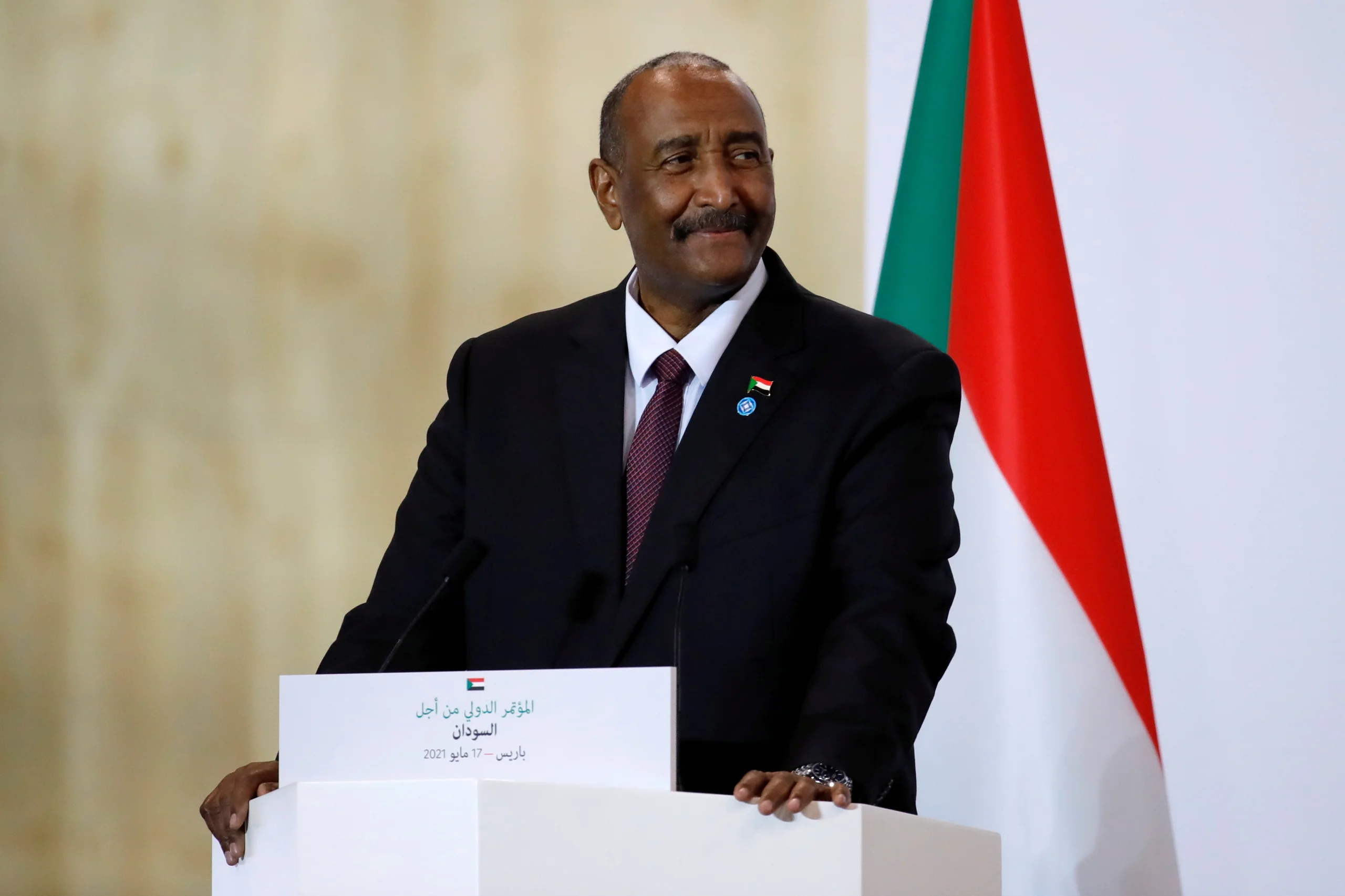
Abdel Fattah al-Burhan
 Sudan
Military officer and head of state
Also known as: al-Burhan, Abdel Fattah Burhan
Birthday
July 11, 1960
Birth Sign
Cancer
Birthplace
Qandato, Northern Sudan
Age
66 years old
About
Abdel Fattah al-Burhan is a Sudanese military officer and the de facto leader of Sudan, serving as chairman of the Transitional Sovereignty Council and commander-in-chief of the Sudanese Armed Forces. He has held the country's top position since April 2019, when he took over the Transitional Military Council in the chaotic days after Omar al-Bashir's fall.
Since April 2023 he has commanded the armed forces in a civil war against the Rapid Support Forces, a conflict that has reshaped Sudan's borders, alliances and standing abroad. He survived an assassination attempt in July 2024. In late 2026 he remains dug in, publicly refusing negotiations with the RSF while managing a diplomatic squeeze with Washington, Cairo and the Gulf. His public profile is that of a uniformed commander rather than a politician, and he governs largely through military and security channels.
Early Life & Background
He was born on 11 July 1960 in Qandato, a village in northern Sudan. Published accounts of his childhood are thin; the documented record picks up with his military education. He trained at the Sudanese Military Academy and spent the next four decades inside the Sudanese Armed Forces, building a career as a staff officer rather than a field celebrity.
His service spanned the Second Sudanese Civil War, and one profile also places him in the First Congo War. Those years produced the thing that later mattered most: a network inside the officer corps and a reputation for institutional loyalty. Before any political role came his way, he reached the post of General Inspector of the armed forces, a senior position that put him close to the top of the chain of command without making him a public figure.
That anonymity ended in April 2019. Protests had pushed out Omar al-Bashir, and the military formed a Transitional Military Council. Its first head, Ahmed Awad Ibn Auf, resigned within about a day under pressure from the street, which rejected him as too close to the old regime. On 12 April 2019 the council turned to al-Burhan. He was, in effect, the compromise candidate the officer corps could agree on.
Career Growth
The chairmanship he took on 12 April 2019 became the foundation of everything since. On 21 August 2019 a power-sharing deal with civilian groups created the Transitional Sovereignty Council, and al-Burhan became its first chairman, with Abdalla Hamdok installed as prime minister. The 2020 Juba Agreement then extended his leadership of the council by 20 months past the original February 2021 handover date.
October 2021 brought the rupture. He dissolved the council in a coup and reconstituted it a month later with new members, keeping the chair himself. From April 2023 the arrangement collapsed into open war between the Sudanese Armed Forces and the Rapid Support Forces, and he has commanded the army throughout. He survived an assassination attempt in July 2024.
The 2026 record shows a leader fighting on two fronts. In early October he rejected negotiations with the RSF outright and vowed to retake all territory from the paramilitary force, repeating the position in a Wadi Halfa address where he also denounced foreign interference. He has clashed with Washington over a withheld visa, postponing a UN trip in response, while reportedly writing to Donald Trump to reaffirm commitment to US peace efforts. In mid-October 2026 he ordered an investigation into an airstrike that killed 72 people, and he has said he expects new sanctions.
Career Timeline
Public Image & Style
Media coverage paints him as a uniformed, uncompromising army chief. The image is deliberately institutional: he appears in military dress, speaks in the language of sovereignty and territorial integrity, and frames his opponents as forces acting on foreign instructions. Reports from late 2026 describe him as defiant toward external pressure and closed to talks with the RSF, leaning on what he calls friendly capitals for diplomatic cover.
There is little personal branding to speak of. No signature style, no social media persona, no attempt to cultivate a civilian political identity. Where other leaders build a public character, al-Burhan's public presence is the office itself: commander-in-chief, chairman of the Sovereignty Council, the man in the uniform.
Fame & Fandom (iFAMOUS Rankings)
iFANN has not yet collected fame data for Abdel Fattah al-Burhan, so no ranking is published for him at this time. He is not on the September 2026 iFAMOUS Rankings flagship list. His prominence runs through news coverage of the Sudanese civil war rather than through the attention metrics the rankings track.
There is no fandom in the sense this platform usually means. No fan name, no organized campaigns, no birthday billboards. His following is political and military: Sudanese citizens who support the armed forces, diaspora communities that track the war closely, and the foreign diplomats and analysts who follow his statements for signals about the conflict. Online, discussion of him clusters around news threads and analysis rather than fan communities, and the tone is argument and worry rather than celebration.
What does exist is a kind of watchers' culture. Sudan observers trade details of his speeches, note which city he appeared in and when, and read his silences as carefully as his statements. That is the closest thing to a devoted audience he has.
Interesting Facts and Legends
His full name runs to five parts: Abdel Fattah al-Burhan Abdelrahman al-Burhan. The repetition of al-Burhan is not a typo but the Sudanese naming convention, where the family name is carried through the chain.
He is a Cancer by birth sign, born on 11 July 1960, which makes him one of the small group of serving heads of state born in the same July week.
A story that circulates among Sudan watchers concerns the sheer speed of his 2019 ascent. The man before him, Ahmed Awad Ibn Auf, held the Transitional Military Council for roughly a day before protesters forced him out, and al-Burhan went from senior staff officer to national leader almost overnight.
He is among the few sitting heads of state to have had a US visa withheld while actively corresponding with an American president. He wrote to Donald Trump in 2026 even as the visa dispute kept him from travelling to New York.
Notable Quotes
“We will retake all territory from the RSF.”
“The danger of war in Sudan is now a threat beyond its borders.”
“There will be no dialogue with the RSF.”
Family & Personal Life
Family details are not part of the public record in any reliable form. Sudanese officers of his generation tend to keep their households out of the press, and no confirmed names of a wife or children appear in the reporting around him. What is documented is his origin: Qandato, a village in northern Sudan, where he was born on 11 July 1960 into a family whose background has not been made public.
That silence is itself characteristic. Coverage of al-Burhan runs through state channels, Sudan Tribune, Al Jazeera and the BBC, and it concerns war conduct, sanctions and foreign policy rather than his home life. Anyone claiming a detailed account of his household should be treated with caution.
Notable Connections
Omar al-Bashir, the president whose 2019 ouster brought him to power. Ahmed Awad Ibn Auf, his one-day predecessor at the Transitional Military Council. Abdalla Hamdok, the civilian prime minister installed under the 2019 power-sharing deal. Mohamed Hamdan Dagalo, known as Hemedti, his rival and the commander of the Rapid Support Forces. Abiy Ahmed, the Ethiopian prime minister. And Donald Trump, to whom he wrote in 2026 amid a visa dispute with Washington.
Relationships & Dating History
Salary, Net Worth In 2026
$1 Million
iFANN Editorial Team estimate
There is no reliable public accounting of Abdel Fattah al-Burhan's personal finances. Sudan publishes no leader asset declarations, and international sanctions and wartime conditions make independent verification close to impossible. The iFANN Editorial Team's analysis of his known salary, property and holdings points to roughly $1 million, a figure that should be read as a conservative estimate rather than a measured total.
His income has come from state service: a career officer's pay across four decades in the Sudanese Armed Forces, followed by the salary attached to the chairmanship of the Transitional Sovereignty Council. Sudan's military has extensive commercial interests, from gold mining to agriculture and construction, and the armed forces under his command control a large share of the wartime economy. Whether any of that flows to him personally is undocumented. Sanctions designations against Sudan have targeted institutions and commanders, not his personal bank accounts.
His net worth in 2026 is best described as modest by head-of-state standards, at least on paper. The real financial story sits with the institutions he commands, not the man. Any figure far above a low seven-figure sum should be treated as speculation.
Awards & Accolades
Known For
Chairman of the Transitional Sovereignty Council of Sudan
2019 · Chairman
Commander-in-Chief of the Sudanese Armed Forces
2019 · Commander-in-Chief
Sudanese civil war against the Rapid Support Forces
2023 · Commander
2021 Sudanese coup
2021 · Leader
Keywords
Sources
Quick Facts
- Profession
- military officer, head of state
- Born
- July 11, 1960
- Birthplace
- Qandato, Northern Sudan
- Gender
- Male
- Birth Sign
- Cancer
- Education
- Sudanese Military Academy
- Role
- Chairman, Transitional Sovereignty Council
Personal Details
- Full Name
- Abdel Fattah al-Burhan Abdelrahman al-Burhan
- Education
- Sudanese Military Academy
Frequently Asked Questions
Where is Abdel Fattah al-Burhan now?
How did Abdel Fattah al-Burhan come to power?
Who is fighting in Sudan in 2026?
Is Abdel Fattah al-Burhan open to peace talks?
What happened with al-Burhan's US visa?
Similar People
Join the community
fans discussing